


Editorial Integrity
Making informed real estate decisions starts with having the right knowledge. At HomeAbroad, we offer US mortgage products for foreign nationals & investors and have a network of 500+ expert HomeAbroad real estate agents to provide the expertise you need. Our content is written by licensed mortgage experts and seasoned real estate agents who share insights from their experience, helping thousands like you. Our strict editorial process ensures you receive reliable and accurate information.
Quick Answer: Gross Rent Multiplier (GRM)
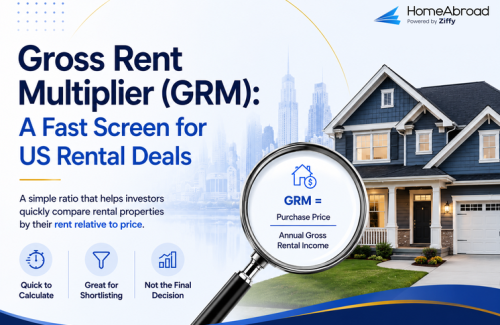
Gross Rent Multiplier (GRM) is a real estate metric that compares a property’s purchase price with its annual gross rental income. It helps investors quickly identify rental properties worth further analysis, but it does not account for operating expenses, financing costs, or profitability.
While a lower GRM often indicates stronger rental income relative to the purchase price, there is no universal “good” GRM because market conditions vary. Investors should use GRM as an initial screening tool alongside metrics like cap rate, cash flow, and DSCR when evaluating US investment properties.
Compare GRM only with similar rental properties in the same market rather than using a national benchmark.
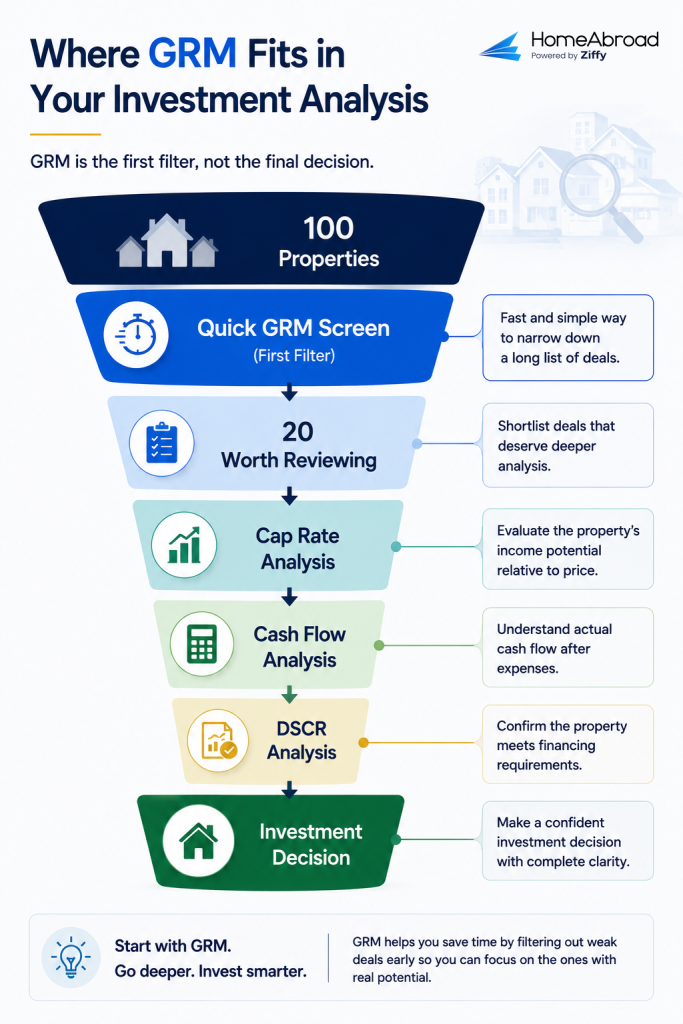
Use GRM to quickly narrow your shortlist before analyzing cap rate, cash flow, and DSCR
A property’s operating expenses, financing terms, and local market conditions can significantly affect investment performance, even when two properties have similar GRMs
Foreign national investors using DSCR financing should evaluate both the property’s investment potential and its ability to meet lender underwriting requirements.
Table of Contents
Gross rent multiplier, or GRM, is one of the fastest ways to size up a rental listing before spending real time on it. It compares a property’s price to the rent it generates, without touching taxes, insurance, maintenance, or how the deal will be financed.
GRM quickly identifies whether a property deserves a closer look. It is not designed to determine whether the investment is ultimately profitable.
For an investor reviewing dozens of US listings from another country, that speed matters. Reviewing dozens of listings from another country makes it impractical to analyze every property in detail. GRM gives you a first cut.
This article covers the GRM formula, what a reasonable GRM looks like in different markets, how GRM compares to cap rate and to the debt service coverage ratio that HomeAbroad uses to qualify DSCR loans, and where the metric fits once you are ready to move from screening to financing.
What Is a Gross Rent Multiplier (GRM)?
GRM is the ratio of a property’s price to the annual rent it brings in before any expenses are subtracted. It answers one narrow question: relative to what it costs, how much rent does this property produce?
GRM = Purchase Price ÷ Annual Gross Rental Income
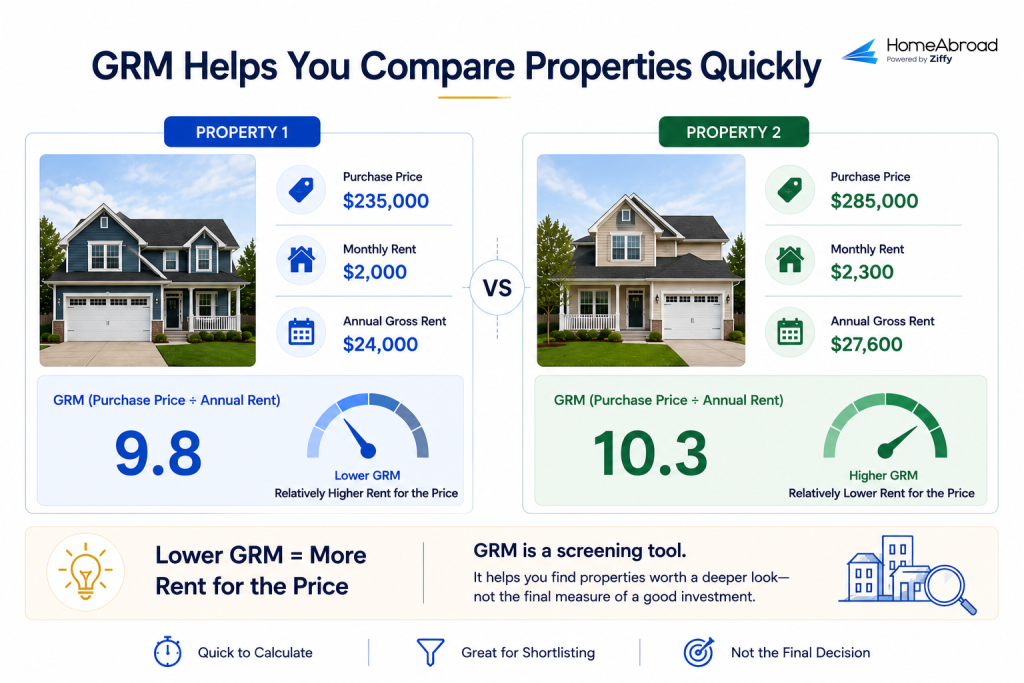
One of the foreign national investors we recently worked with was comparing two single-family rental properties before deciding which one deserved a closer look. The first property was listed at $235,000 with an expected monthly rent of $2,000, while the second was listed at $285,000 with projected rent of $2,300.
Before reviewing operating expenses, financing options, or projected cash flow, we calculated the Gross Rent Multiplier (GRM) for each property.
Property | Purchase Price | Monthly Rent | Annual Gross Rent | GRM |
|---|---|---|---|---|
Property A | $235,000 | $2,000 | $24,000 | 9.8 |
Property B | $285,000 | $2,300 | $27,600 | 10.3 |
Although the second property generated more rental income each month, it also required a significantly higher purchase price. Based on GRM alone, the first property offered slightly stronger rental income relative to its purchase price.
However, a lower Gross Rent Multiplier alone wasn’t enough to identify the better investment. GRM is only a screening tool. It helps investors quickly narrow down a long list of properties before moving on to a deeper analysis using metrics like cap rate, cash flow, and DSCR.
The Gross Rent Multiplier Formula, Step by Step
Calculating GRM takes only three steps:
- Find the property’s purchase price or current market value.
- Determine its annual gross rental income. If you only have the monthly rent, multiply it by 12.
- Divide the purchase price by the annual gross rental income.
Using the first property as an example, the purchase price was $235,000 and the expected monthly rent was $2,000. That equals $24,000 in annual gross rental income.
$235,000 ÷ $24,000 = 9.8 GRM
A GRM of 9.8 doesn’t tell you whether the property is profitable or whether it will qualify for financing. It simply provides a quick way to compare one rental property with another before spending time on a more detailed investment analysis.
Monthly vs Annual GRM
Some listings and calculators use monthly gross rent instead of annual gross rent when calculating GRM. That produces much larger numbers, often around 100 to 150 instead of 8 to 12.
Neither approach is inherently wrong, but you should never compare a monthly GRM with an annual GRM. Always confirm which method is being used so you’re making an accurate, apples-to-apples comparison across properties.
What Counts as a Good GRM?
There is no single GRM that qualifies as “good” everywhere because local market conditions vary significantly. As a general rule of thumb, many investors use a GRM between roughly 6 and 10 as an initial screening reference, although the ideal range depends on the local market, property type, and investment strategy.
Lower-cost, cash-flow-focused markets often support lower GRMs, while high-cost, appreciation-driven markets may have higher GRMs.
Rather than relying on a universal benchmark, compare similar rental properties within the same neighborhood, property type, and market conditions. Local rental demand, property values, operating expenses, and investment goals determine what investors consider an attractive GRM in a given market.
The most meaningful comparison is always against comparable rental properties in the same submarket, using current local market data instead of a single national benchmark.
GRM vs Cap Rate: What Is the Difference?
GRM and cap rate both compare a property’s income to its price, but they measure different things.
GRM | Cap Rate | |
|---|---|---|
Formula | Price ÷ Annual Gross Rent | Net Operating Income ÷ Property Value |
Accounts for Operating Expenses? | No | Yes |
Accounts for Financing? | No | No |
Best Used For | A fast first-pass screen | Comparing income-adjusted returns across markets |
Direction of a Stronger Number | Lower is generally better | Higher is generally better |
Cap rate factors in operating expenses, so it comes closer to reflecting what the property actually earns. GRM skips that step entirely, which is exactly why it is faster to calculate but less precise. Use GRM to shorten a long list of listings, then run cap rate on the properties that survive the first cut.
For a full breakdown of cap rate, cash flow, and the sequence HomeAbroad recommends for evaluating a deal, see Cap Rate vs Cash Flow vs DSCR. You can estimate the cap rate side of that comparison using HomeAbroad’s Cap Rate Calculator.
GRM vs DSCR: Screening a Deal vs Qualifying for a Loan
GRM and the debt service coverage ratio (DSCR) answer two completely different questions. GRM asks whether a listing is worth a closer look. DSCR asks whether a lender will actually approve financing on it.
DSCR compares a property’s rental income to its full monthly housing payment, principal, interest, taxes, insurance, and HOA dues where applicable, commonly written as PITIA. This is the ratio HomeAbroad underwrites against for DSCR loans, which qualify a borrower based on the property’s income rather than personal income, employment history, or US credit.
GRM plays no role in that underwriting decision. A property can have an appealing GRM and still fail to produce enough rent to satisfy the DSCR a specific loan program requires, particularly once real property taxes and insurance are factored in.

Steven Glick
Director of Mortgage Sales
HomeAbroad
NMLS #1231769A low GRM can help you identify properties worth analyzing, but it doesn’t tell us whether a property qualifies for DSCR financing. During underwriting, we evaluate the property’s ability to cover its debt obligations using the full housing payment, including principal, interest, taxes, insurance, and any applicable HOA dues. That’s why a property with an attractive GRM may still need a closer review before it meets program requirements.
How to Use GRM to Screen US Rental Deals Remotely
For an investor working from outside the US, GRM works best as the first step in a short, repeatable process rather than a one-time calculation.
- Confirm current rent, not an old or optimistic figure: Use the current asking rent or, for an occupied property, the current lease amount rather than a projection.
- Calculate GRM the same way every time: Price divided by annual gross rent, consistently, so comparisons across listings are apples to apples.
- Compare against similar properties in the same submarket: A GRM of 9 might be strong in one neighborhood and unremarkable two miles away.
- Move properties that clear the screen into cap rate and cash flow analysis: GRM’s job ends once it has narrowed the list.
- Before financing, request underwriting-grade rent support rather than relying on the listing: We base DSCR on the appraiser’s market rent schedule, not the number in the listing description, and that figure can come in lower than expected.

Dorian Adams-Walker
Mortgage Loan Originator, HomeAbroad
Many of the international investors I work with use GRM as a quick way to narrow down a list of potential properties before reaching out to us. Once they’ve identified a property worth pursuing, the conversation shifts to confirming market rent, reviewing the purchase details, and determining whether the property’s projected income aligns with our DSCR program requirements. Starting that discussion early helps identify any underwriting considerations before an offer moves too far along.
To simplify your investment analysis, HomeAbroad’s AI-native investment property search platform provides key metrics, including gross rental yield, cap rate, cash flow, ROI, and DSCR, so you can evaluate and compare US investment properties with greater confidence.
Investment Properties on Sale in US


Limitations of GRM: What It Does Not Tell You
GRM leaves out most of what actually determines whether a rental performs. It does not include property taxes, insurance, HOA dues, maintenance, management fees, or vacancy. Two properties with an identical GRM can produce very different cash flow once those costs are added in, especially in states where property insurance runs high.
GRM also ignores financing entirely. It assumes, in effect, that the deal is bought with cash, which is not how most HomeAbroad clients structure a purchase. Once a loan is added, the actual return on the money invested depends on the loan terms, not just the property’s price and rent.
For foreign investors, there is one more gap worth flagging early. GRM says nothing about what happens at sale. Under the Foreign Investment in Real Property Tax Act (FIRPTA), a foreign seller can be subject to withholding at closing, and the applicable rate is tiered based on the sale price and the buyer’s intended use of the property rather than a single flat percentage.
That withholding does not change your GRM calculation, but it affects how much cash you actually walk away with at exit. For the full mechanics, see HomeAbroad’s FIRPTA guide.
Where HomeAbroad Fits Into Your Investment Journey
Once you’ve used GRM to narrow your shortlist, the next step is evaluating each property’s DSCR, cash flow, and cap rate before moving into financing.
HomeAbroad specializes in foreign national mortgages for US investment properties. Our team helps you understand your financing options, determine the right mortgage for your investment strategy, and guides you through the underwriting process from pre-qualification to closing.
Beyond financing, HomeAbroad offers an AI-native investment property search platform, along with concierge services that help international investors buy, finance, and manage US investment properties with greater confidence.
Our team can help you evaluate financing options and determine whether the property meets the requirements for the loan program that’s right for your investment strategy.
Get pre-qualified with HomeAbroad and move forward with confidence on your US real estate investment.
FAQs
What is a good GRM for a rental property?
There is no universal number. A GRM in roughly the 6 to 10 range is common for many single-family rentals, but the right benchmark depends on the market. Compare a property’s GRM against similar rentals nearby rather than against a fixed national figure.
Is a lower or higher GRM better?
Generally, a lower GRM is more attractive, since it means the property produces more rent relative to its price. A very low GRM can also signal a distressed property or a weaker location, so treat it as a starting point for further review, not a conclusion on its own.
How is GRM different from cap rate?
GRM divides price by gross rent and ignores expenses entirely. Cap rate divides net operating income by property value, which means it accounts for operating costs. Cap rate is more precise; GRM is faster.
Can I use GRM to qualify for a mortgage?
No. At HomeAbroad, we do not underwrite loans based on GRM. HomeAbroad’s DSCR loans are qualified using the debt service coverage ratio, which compares rental income to the property’s full monthly housing payment.
Does GRM account for operating expenses?
No. GRM is based on gross rent only. Property taxes, insurance, maintenance, HOA dues, and vacancy are not part of the calculation, which is why GRM should be paired with cap rate or cash flow analysis before you make a final decision.
What is the difference between GRM and gross income multiplier (GIM)?
The two terms are often used interchangeably. Where a distinction is drawn, GIM can include other property income beyond rent, such as parking or laundry fees, while GRM is based on rental income alone.