



Editorial Integrity
Making informed real estate decisions starts with having the right knowledge. At HomeAbroad, we offer US mortgage products for foreign nationals & investors and have a network of 500+ expert HomeAbroad real estate agents to provide the expertise you need. Our content is written by licensed mortgage experts and seasoned real estate agents who share insights from their experience, helping thousands like you. Our strict editorial process ensures you receive reliable and accurate information.
Landlord-friendly states can reduce operational risk. States with faster eviction processes, no statewide rent control, and flexible landlord laws may make it easier for foreign investors to manage rental properties from abroad.
State laws affect investment performance, even if they don’t affect loan qualification. Property taxes, rent regulations, and eviction timelines can influence cash flow and long-term returns, so they should be evaluated alongside market fundamentals.
Your investment strategy should drive your state selection. A state that works well for long-term rentals may not be the best fit for short-term rentals, appreciation-focused investing, or investors with a lower risk tolerance.
At HomeAbroad, we offer DSCR Loans that qualify foreign national investors based on a property’s rental income, without requiring an established US credit history
Table of Contents
If you’re comparing landlord-friendly states for your next US rental property, the state you choose matters almost as much as the property itself. State law determines how quickly you can remove a nonpaying tenant, whether rent increases are restricted, how much of a security deposit you can collect, and how much you’ll pay in property taxes each year.
For investors managing rental properties from abroad, these rules can have a significant impact on cash flow and long-term returns. If you can’t be on the ground to handle a tenant dispute, they become even more important. This guide explains what makes a state landlord-friendly, highlights some of the best landlord-friendly states for foreign investors, and shows how each state’s legal environment can influence your financing options with HomeAbroad.
What Makes A State Landlord Friendly For Foreign Investors
“Landlord friendly” is not an official designation. It is shorthand the real estate industry uses to describe states where the law leans toward giving property owners control over their rental business, rather than restricting it. That does not mean tenants are unprotected in these states. It means landlords generally have fewer procedural hurdles and less exposure to open-ended costs.
For a foreign investor evaluating a state for the first time, five factors matter most.
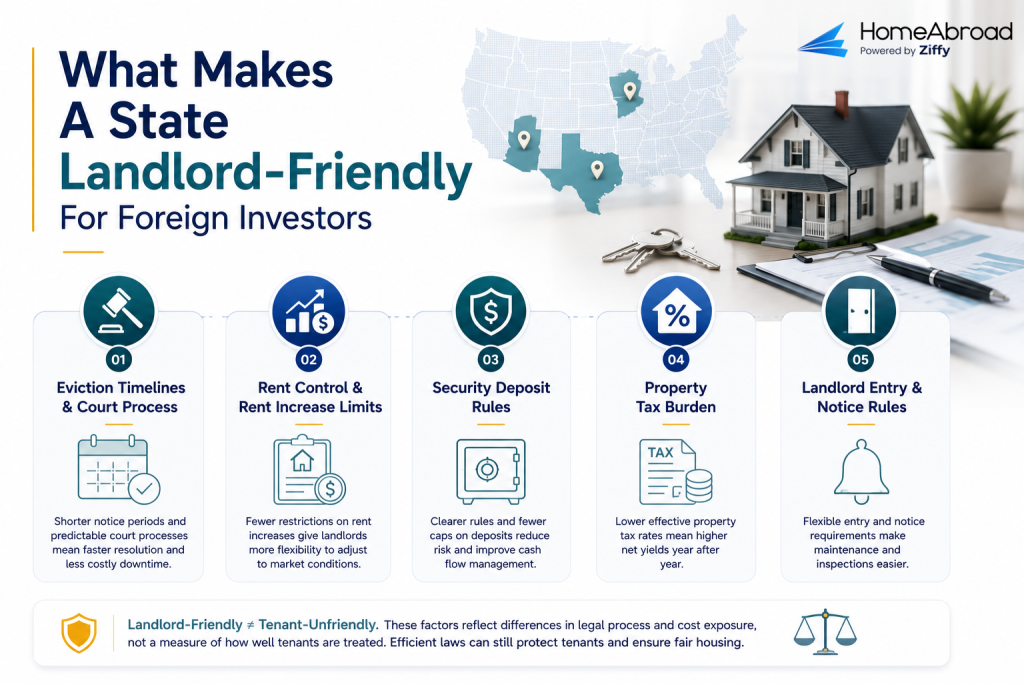
Eviction Timelines And Court Process
How long it takes to remove a tenant who has stopped paying or violated the lease varies significantly by state. States with shorter notice periods and more predictable court procedures let a landlord (or property manager) resolve a nonpayment situation in weeks rather than months. For an owner managing the process remotely, a slow, unpredictable eviction timeline is one of the more expensive risks in the entire investment.
Rent Control And Rent Increase Limits
A handful of states, including California and Oregon, cap how much a landlord can raise rent in a given year. Most states have no statewide rent control at all, though some allow individual cities to pass their own rent stabilization ordinances even where the state itself does not require it. This distinction matters: a landlord-friendly state on paper can still have a restrictive city inside it.
Security Deposit Rules
States differ on whether they cap the deposit amount, how quickly it must be returned after move-out, and what penalties apply if a landlord misses the deadline. Some states leave this almost entirely up to the lease agreement. Others set a maximum deposit tied to monthly rent.
Property Tax Burden
Property tax is not technically a landlord-tenant law, but it directly affects net yield every single year the property is held. According to Tax Foundation data, effective property tax rates across the country range from roughly 0.27% in Hawaii to more than 2% in states like New Jersey, so the difference between a low-tax and high-tax state can meaningfully change a deal’s cash flow.
Landlord Entry And Notice Requirements
Rules on how much notice a landlord must give before entering a unit, and how much flexibility exists around lease terms, affect how easily an owner or property manager can handle routine maintenance and inspections without friction.
Landlord-Friendly Does Not Mean Tenant-Unfriendly. These are differences in legal process and cost exposure, not a measure of how well tenants are treated in a given state. A state can have efficient eviction procedures and still require habitable housing, proper notice, and fair treatment of tenants. Treat this list as a guide to operational friction, not a moral ranking of states.
Why The Legal Environment Matters More When You Are Investing From Abroad
A landlord who lives twenty minutes from their rental property can absorb a slow eviction or a confusing notice requirement by handling it in person. A foreign investor usually cannot. Time zone differences, the cost of international communication, and the practical impossibility of appearing in a US courtroom on short notice all raise the stakes of picking a state with a difficult or unpredictable legal process.
This is also why property management matters as much as the state you choose. A qualified local property manager can absorb most of the day-to-day friction that state law creates, but the underlying rules still shape how fast problems get resolved and how much they cost. For a closer look at setting up property management before closing, see HomeAbroad’s guide on property management for foreign investors.
Three Questions To Ask Before Buying In Any State
- How long does an uncontested eviction typically take here, and does that match your risk tolerance?
- Does the state, or the specific city you’re buying in, restrict rent increases?
- Is a local property manager available and familiar with this state’s landlord-tenant law?
The Most Landlord Friendly States For Foreign Real Estate Investors
Choosing the right state involves more than comparing rental demand or home prices. The legal environment can affect everything from tenant disputes and rent increases to operating costs and long-term cash flow. The table below compares some of the most landlord-friendly states across the US based on the factors that matter most to rental property investors.
State | Statewide Rent Control | Eviction Process | Property Tax Load | Security Deposit Rules |
|---|---|---|---|---|
Texas | None | Fast, well-defined process | Above national average (no state income tax offsets this) | No state cap on amount; deposit generally due back within 30 days |
Florida | None (state preempts local rent control in most cases) | Fast | Below national average | No state cap on amount |
Georgia | None | Fast (dispossessory process) | Below national average | No state cap on amount or notice period commonly cited |
Indiana | None | Efficient, straightforward | Below national average | No state cap on amount |
Arizona | None | Fast | Below national average | Commonly cited cap near one and a half months’ rent |
Alabama | None | Fast; short notice periods commonly cited | Among the lowest in the country | Deposit return window commonly cited around 60 days |
Tennessee | None | Favorable to landlords | Below national average | No statewide cap commonly cited |
North Carolina | None | Efficient | Near the national average | Tiered caps tied to lease length commonly cited |
Ohio | None | Generally efficient | Higher than the national average | No state cap on amount |
Texas
Texas consistently ranks among the country’s most landlord-friendly states, thanks to its lack of statewide rent control, well-defined eviction process, and flexible lease laws. The trade-off is property tax: Texas has no state income tax, which local governments partly offset with property tax rates that run above the national average.
For a foreign investor, that means underwriting the property tax line carefully rather than assuming Texas is universally cheap to hold. HomeAbroad Loans offers DSCR financing across the state, with more detail on eligibility and market-specific factors on the Texas DSCR loan page.
Florida
Florida preempts most local rent control ordinances, which means individual cities generally cannot impose their own rent caps even if they wanted to. Combined with a fast eviction process and no state income tax, Florida has long attracted both domestic and international investors.
Property values and insurance costs have both climbed in recent years, so the legal environment being favorable does not automatically mean the numbers work in every market. HomeAbroad’s guide on buying a rental property in Florida covers city-by-city considerations in more depth.
Georgia
Georgia’s eviction process, known as a dispossessory action, is generally regarded as one of the more efficient in the country when a case is uncontested. There is no statewide rent control, and Atlanta’s rental demand has continued to grow with the metro’s population. Learn how HomeAbroad’s DSCR Loan in Georgia can help finance rental properties across the state.
Indiana
Indiana is a consistent presence on landlord-friendly rankings, driven by affordable entry prices, no statewide rent control, and property tax rates that run below the national average. Indianapolis in particular has a well-established turnkey rental market, which can be a practical advantage for an investor who is not local and wants a property that is already tenant-occupied and professionally managed at closing. See the Indiana DSCR loan page for current program terms and top markets.
Arizona
Arizona pairs a fast eviction timeline with no statewide rent control and property taxes that sit below the national average. The state’s security deposit rules are more specific than many others on this list, with a commonly cited cap near one and a half months’ rent, so this is a state where checking the current statute before setting lease terms matters more than usual.
Alabama
Alabama consistently ranks among the states with the lowest property tax burden in the country, which is one of the more overlooked advantages for a buy-and-hold investor. Eviction timelines are commonly cited as short when a case is uncontested, and there is no statewide rent control.
Tennessee
Tennessee has no state income tax and no statewide rent control, and its eviction process is generally described as favorable to landlords when the lease and notice requirements are followed correctly. The state’s tourism-driven markets, particularly around the Smoky Mountains, have also made short-term rental strategies unusually strong here compared to some of the other states on this list.
See HomeAbroad’s guide on DSCR Loan in Tennessee for market-level detail.
North Carolina
North Carolina’s landlord-tenant law is generally efficient, with security deposit rules that are more structured than in some neighboring states (deposit caps are commonly tied to how long the lease runs, rather than a single flat limit). Charlotte and Raleigh have both seen sustained population growth, which continues to support rental demand. The North Carolina DSCR loan page covers current program terms and top markets.
Ohio
Ohio does not have statewide rent control, and its eviction process is generally regarded as efficient, but it is worth being direct about one thing: Ohio generally has higher-than-average effective property taxes compared with many US states, although costs vary by county and municipality. Investors are drawn here more for affordability and rental yield than for a uniquely light tax burden. Explore HomeAbroad’s DSCR Loan Ohio guide to learn about eligibility, loan requirements, and financing options for rental properties.
Landlord Friendly Vs Tenant Friendly States: What Is The Difference
The terms describe where a state sits on a spectrum, not a binary category. A landlord-friendly state generally gives owners more control over rent increases, faster legal remedies when a tenant violates the lease, and fewer procedural requirements.
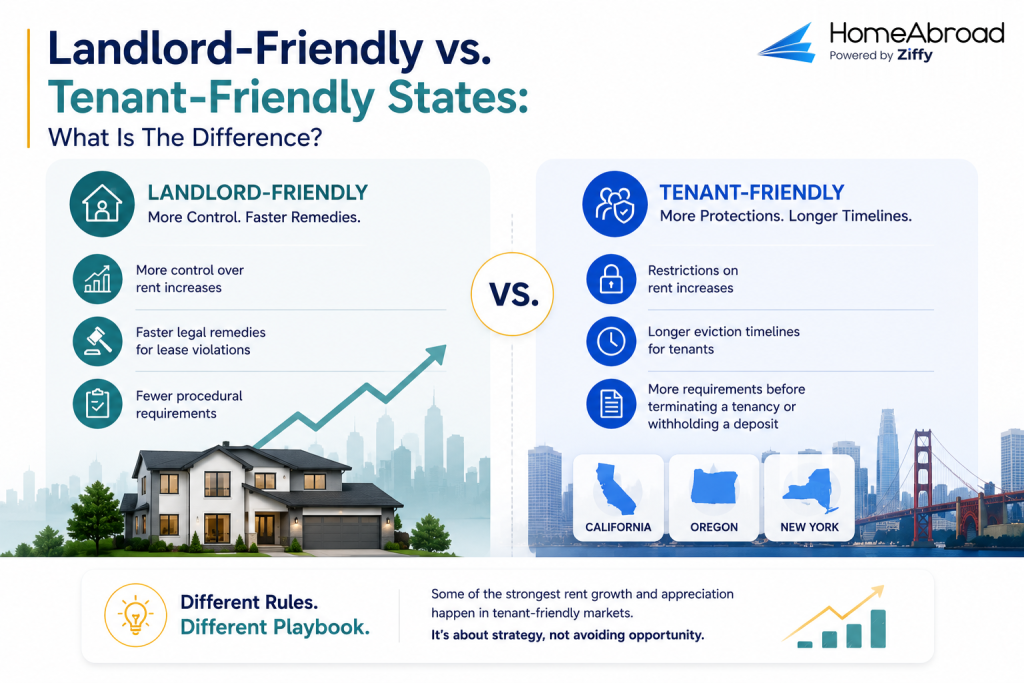
A tenant-friendly state generally does the opposite: it restricts rent increases, extends eviction timelines to give tenants more time to respond, and requires more from landlords before they can terminate a tenancy or withhold a deposit.
California, Oregon, and New York are the states most often cited as tenant-friendly, largely because each has some form of statewide or major-city rent regulation and longer eviction timelines than the states profiled above.
That does not make them poor investment states. Some of the strongest rent growth and appreciation in the country has happened in exactly these markets. It means the operating model looks different: an owner in a tenant-friendly state typically needs to plan for slower dispute resolution and tighter rent-increase limits from the start, rather than treating those as edge cases.
Eviction Laws By State: What Foreign Investors Need To Know
Eviction law is the single factor that varies the most from state to state, and it is also the one with the most direct financial consequence if things go wrong. A nonpaying tenant does not just mean lost rent. It means lost rent for however long the legal process takes, plus court costs, plus the risk of property damage before the unit is recovered.
Most states require a formal written notice before a landlord can even file for eviction, and the required notice period ranges from a matter of days to several weeks depending on the reason for the eviction and the state. From there, the case has to go through the local court system, which adds its own variability based on how backed up that particular court is at the time.
This is part of why HomeAbroad builds reserve requirements into DSCR underwriting. A few months of reserves give an investor a cushion if a tenant situation takes longer to resolve than expected, regardless of which state the property is in.

Steven Glick
Director of Mortgage Sales · HomeAbroad
When we’re working with foreign national investors, we encourage them to look beyond the property’s projected rental income. If they’re buying in a market where resolving a tenant issue could take longer, we discuss building a larger cash reserve so they’re prepared for unexpected carrying costs. Strong planning at the beginning of the transaction can make the investment more resilient over the long term.
How State Landlord Laws Affect Financing And Cash Flow
State law does not change whether a foreign investor qualifies for HomeAbroad’s DSCR loan. Qualification is based on the property’s rental income relative to its housing payment, not on which state the property sits in.
What state law does affect is how much financial cushion an investor may want to build into a deal, since properties in states with slower eviction processes or rent caps can carry greater cash flow risk if tenant issues arise.
This is a useful lens for deciding how much cushion to build into a deal. A property in a fast-eviction, no-rent-control state can often support a leaner reserve position than a similar property in a state where a dispute could take considerably longer to resolve. For a detailed breakdown of HomeAbroad’s DSCR Loan requirements, including down payment, reserve requirements, and the qualification process, read the HomeAbroad DSCR Loan Guide.

The state where you invest doesn’t determine whether you qualify for a DSCR Loan, but it can influence how we think about the overall investment strategy. When a property is in a market where resolving tenant issues may take longer, many investors choose to maintain additional financial flexibility so they’re better prepared for unexpected holding costs.
At HomeAbroad, we qualify foreign nationals based on a property’s rental income rather than personal income, US tax returns, or US credit history. Connect with a loan officer to confirm current terms for your target state.
How To Choose The Right State For Your Investment Strategy
There is no single “best” state, because the right answer depends on what the investor is optimizing for. An investor prioritizing predictable, low-friction long-term rentals will weigh eviction speed and rent control status heavily.
An investor targeting short-term rentals cares more about local STR ordinances, which can vary by city even within a landlord-friendly state. An investor focused purely on appreciation may accept a more tenant-friendly legal environment in exchange for a stronger long-term growth market.
A few practical questions help narrow the decision:
- Does the strategy rely on long-term or short-term rental income, and does the target city allow the strategy being planned?
- How much reserve cushion is comfortable if a tenant dispute takes longer than expected to resolve?
- Is a property manager already lined up, and how familiar are they with that state’s specific landlord-tenant law?
- Does the property tax burden in the target state still leave room for the DSCR calculation to work at current rates?
None of these questions has a universally correct answer. They are the starting point for a conversation with a real estate agent and a loan officer who understand both the target market and the financing side of the deal.
Frequently Asked Questions
What is the most landlord-friendly state in the US?
Several states, including Texas, Florida, Georgia, Indiana, and Alabama, consistently rank near the top because they combine no statewide rent control with efficient eviction processes. There is no single official ranking, so different sources weigh these factors somewhat differently.
What states are considered tenant-friendly?
California, Oregon, and New York are the states most commonly cited as tenant-friendly, largely due to statewide or major-city rent regulation and longer eviction timelines. This does not necessarily make them weaker investment markets; it changes what an owner needs to plan for.
Can foreign nationals buy rental property in landlord-friendly states?
Yes. Foreign nationals can generally purchase rental property in any US state, subject to applicable federal, state, and property-specific rules. HomeAbroad Loans offers DSCR financing to foreign national investors in states across the country, including the ones covered in this guide.
Does a state’s landlord-tenant law affect DSCR loan qualification?
Not directly. DSCR qualification is based on the property’s rental income relative to its housing payment, not on the state’s landlord-tenant law. State law is a factor worth weighing separately when deciding how much financial cushion to build into the deal.
Does a landlord-friendly state guarantee a fast, simple eviction?
No. State law sets the general framework, but the actual timeline for any individual eviction depends on the specific court, whether the case is contested, and how correctly the landlord follows notice requirements. A landlord-friendly state reduces friction; it does not eliminate it.