




Editorial Integrity
Making informed real estate decisions starts with having the right knowledge. At HomeAbroad, we offer US mortgage products for foreign nationals & investors and have a network of 500+ expert HomeAbroad real estate agents to provide the expertise you need. Our content is written by licensed mortgage experts and seasoned real estate agents who share insights from their experience, helping thousands like you. Our strict editorial process ensures you receive reliable and accurate information.
Build to rent means new homes constructed specifically to be leased rather than sold to owner-occupants. Individual investors buy a single home inside these communities. They do not buy the community itself.
Foreign nationals can finance a build-to-rent home through HomeAbroad without an established US credit history, using the property’s rental income as the basis for qualification.
A brand-new home has no lease and no operating history, so qualifying rent comes from the appraiser’s market rent schedule rather than from an existing tenant.
Year-one property tax on new construction is often assessed on land value alone. When the county reassesses on the finished home, the payment can rise enough to move a deal out of qualifying range.
Build-to-rent construction is slowing. NAHB counted roughly 15,000 single-family built-for-rent starts in the second quarter of 2026, down from 18,000 a year earlier.
Table of Contents
Build to rent, often shortened to BTR, refers to new residential construction built specifically to be leased rather than sold to owner-occupants. In the US the term usually describes purpose-built single-family communities: detached homes or townhomes on their own lots, grouped into a subdivision, professionally managed, and marketed to renters who want a house without buying one.
For an international investor the practical question is narrower than the definition suggests. Most build-to-rent coverage online is written for institutional capital, and it describes transactions that individual buyers cannot access.
This guide covers what a foreign national can actually purchase in a build-to-rent market, how HomeAbroad finances it, and the specific numbers that behave differently on a brand-new rental home.
What Build to Rent Means in US Real Estate
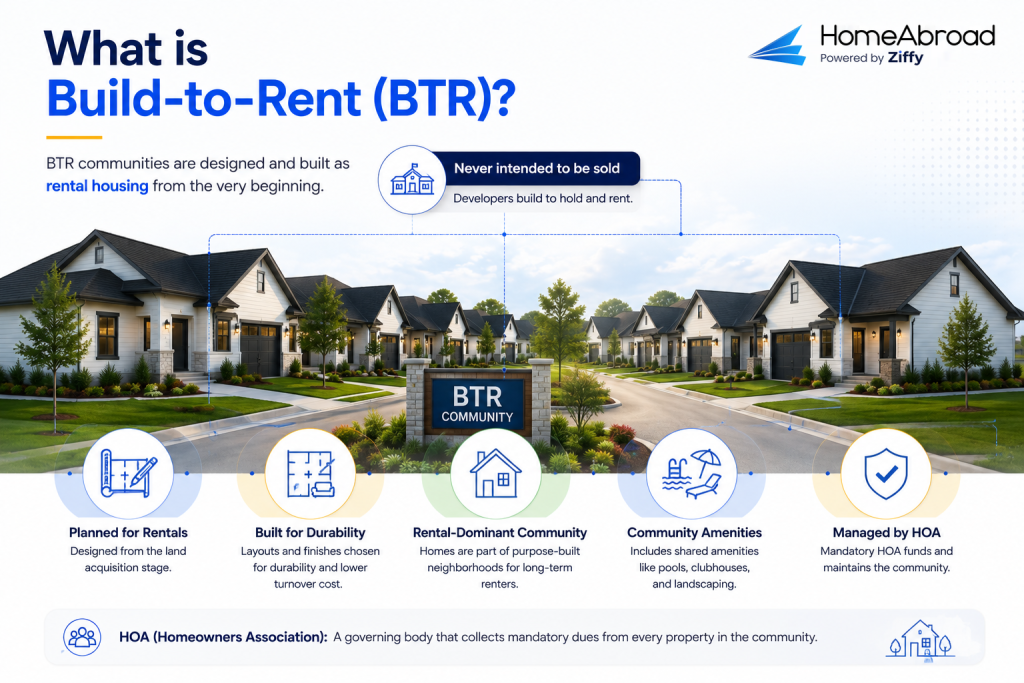
A build-to-rent community is planned as rental housing from the land acquisition stage. The developer never intends to sell the homes to individual owner-occupants. Floor plans, finishes, and lot layouts are chosen for durability and turnover cost rather than for resale appeal, and the community typically carries a mandatory homeowners association (HOA) that funds shared amenities such as a pool, a clubhouse, or maintained landscaping.
The Census Bureau tracks these homes separately in its Quarterly Starts and Completions by Purpose and Design series, which the National Association of Home Builders analyzes each quarter. That data is the cleanest available read on how much build-to-rent supply is actually being created.
Build to Rent vs Traditional Single Family Rentals
A traditional single-family rental is a house that was built to be sold, bought by an investor, and then leased. Build-to-rent homes skip the owner-occupant step entirely. The practical differences show up in three places: the homes are new, they deliver in cohorts rather than one at a time, and they sit inside a rental-dominant neighborhood rather than among owner-occupied houses.
Build to Rent vs Turnkey and BRRRR
These three strategies get grouped together because all of them promise a rent-ready property, but they behave differently under financing.
Build to Rent | Turnkey | BRRRR | |
|---|---|---|---|
Property condition | New construction | Existing, renovated | Distressed, needs work |
Rental history at closing | None | Often a tenant in place | None |
Source of qualifying rent | Appraiser’s market rent schedule | Executed lease or market rent | Projected post-rehab rent |
Rehab required | No | No | Yes |
Typical financing | DSCR loan | DSCR loan | Short-term loan, then refinance |
Main risk | Lease-up competition and tax reassessment | Provider quality and inflated rent claims | Renovation cost and refinance appraisal |
If you are weighing a renovated existing property against a new build, the turnkey rental property guide covers the provider vetting questions that do not apply to a builder purchase.
What Foreign Nationals Can Actually Buy in a Build to Rent Market
This is where most build-to-rent research goes wrong for individual investors. The pages that rank for this topic are largely written by and for institutional capital, and the transactions they describe start in the millions of dollars.
Buying a Single Home Inside a Build for Rent Community
This is the realistic path. Many builders sell individual homes to retail buyers alongside bulk sales to rental operators. You buy one house, take title in your own name or through an entity, and lease it yourself or through a manager.
The trade-off is that community-level terms are set before you arrive. HOA dues, amenity fees, exterior maintenance arrangements, and in some communities the approved property manager are fixed by the developer. Read those documents before you sign, because they flow directly into your monthly cost.
Buying a New Construction Spec Home From a Builder
A spec home is completed or nearly completed inventory that the builder priced and built without a specific buyer. These transactions close faster, the Certificate of Occupancy already exists or is imminent, and the appraisal is straightforward because there is a finished house to inspect. A Certificate of Occupancy is the local government’s confirmation that a building is legally habitable.
For a first US purchase made remotely, a completed spec home removes more variables than a to-be-built contract does.
What Individual Investors Generally Cannot Access
Bulk portfolio acquisitions, forward purchase agreements with developers, and private BTR funds are structured for institutional or accredited investors. Non-US persons face additional constraints on participation in some US private placements. That is a securities question for a qualified professional and sits outside what any mortgage lender can advise on.
Why Build to Rent Appeals to Foreign National Investors
New Construction and Remote Ownership
Maintenance risk is the part of US rental ownership that international investors control least well, because they cannot walk the property. A new home shifts that risk. Roof, HVAC, water heater, and appliances are new and typically under builder warranty, which compresses the range of possible year-one capital costs. Warranty terms differ by builder and by component, so read the actual warranty document rather than the sales brochure.
Professional Management and Lease-Up
Many build-to-rent communities are delivered with an established management operator already in place. That can shorten the time to a signed lease and remove the need to source a manager from overseas. Confirm what the management agreement includes, what it charges, and whether using the community operator is optional or required.
Where Build to Rent Supply Is Concentrated
Build-to-rent development clusters in the Sun Belt, with Dallas-Fort Worth, Houston, San Antonio, Phoenix, and Atlanta among the most active markets. Those metros overlap heavily with where international buyers already purchase. Texas ranks among the leading destination states for foreign buyers, and the foreign buyer purchase data shows how concentrated that demand is.
Supply is not expanding the way it was three years ago. NAHB’s analysis of Census data counted roughly 15,000 single-family built-for-rent starts in the second quarter of 2026, down from about 18,000 in the same quarter of 2025. Full-year 2025 starts came in near 68,000, a decline of about 19% from 84,000 in 2024. Higher construction financing costs and a period of policy uncertainty around institutional capital both contributed.
That deceleration cuts two ways for an individual buyer. Less new supply arriving means less lease-up competition in 2027 and 2028 in markets that were previously oversupplied. It also means fewer communities to choose from and less builder motivation to discount.
How HomeAbroad Finances a Build to Rent Purchase
You do not need US income, an established US credit history, or a Social Security Number to finance a build-to-rent home. A Social Security Number is the US taxpayer identification number issued to citizens and certain visa holders. HomeAbroad structures financing for foreign nationals around the property and the borrower’s documented assets rather than around a US credit file.
How DSCR Works When the Property Has No Rental History
A DSCR (Debt Service Coverage Ratio) loan qualifies the property rather than the person by comparing expected rental income against the full monthly payment, known as PITIA: principal, interest, taxes, insurance, and any association dues.
On an existing rental there is usually a lease to point to. On a new build there is not. Qualifying rent instead comes from the appraiser’s market rent schedule, Form 1007, which the appraiser completes using comparable rentals in the area. Online rent estimates and the builder’s own projections do not substitute for it.
In a new community the closest comparable rentals may be homes the same builder delivered six months earlier, sometimes leased with concessions that do not appear in the headline rent. The appraiser’s number is the number the file runs on.

Steven Glick
Director of Mortgage Sales · HomeAbroad
On a new-construction file, we want the appraisal and market rent schedule completed early in the process. That helps us establish the property’s qualifying rent and DSCR before closing, rather than relying on an estimate that could change as the home nears completion.
When Full Documentation Fits Better
If the property’s own numbers do not carry the deal, or the strategy involves a property that will not be leased immediately, a Full Documentation Loan reviews foreign income, assets, debts, and credit profile instead. It is a non-QM foreign-national option, which means it does not follow Fannie Mae or Freddie Mac guidelines. Compare both paths before choosing: see the Full Documentation Loan program details.
What Changes on a To Be Built Home
Contracting for a home that does not exist yet introduces timing risk that a spec purchase does not have.
- The appraisal is completed subject to completion, based on plans and specifications, with a final inspection required once the home is finished.
- Rate lock windows are finite. A delivery date that slips past your lock can force an extension at a cost, or a reprice.
- Builder deposits are typically non-refundable after specified milestones and are handled differently from the earnest money in a resale transaction. Earnest money is the good-faith deposit a buyer places when a contract is signed.
- The Certificate of Occupancy must be issued before the loan can fund.
Bring the delivery timeline into the financing conversation early. Adjusting a lock strategy is straightforward when it is planned and expensive when it is not.
Ready to see what a build-to-rent purchase looks like on paper? Get pre-qualified for a DSCR loan and we will structure the financing around the property before you go under contract.
Running the Numbers on a New Construction Rental
Three cost lines behave differently on a new build than on an existing rental. Each of them sits inside PITIA, which means each of them moves the DSCR directly.
The Year One Property Tax Trap
Property tax reassessment can materially change the economics of a new-construction rental. We have seen this matter in client financing because the tax bill at the time of purchase may reflect the land value, while the completed property can be reassessed at a much higher value.
The figures below are assumed inputs used to demonstrate the mechanics. They are not a quote, a program term, or a prediction for any specific property.
Assumed inputs: purchase price $340,000; 25% down payment of $85,000; loan amount $255,000; 30-year fixed at 7.25%; combined property tax rate 2.2%; land-only assessed value $70,000; completed assessed value $340,000; insurance $185 per month; HOA dues $145 per month; appraiser’s market rent $2,300 per month.
Line item | Assessed on land only | Assessed on completed home |
|---|---|---|
Principal and interest | $1,740 | $1,740 |
Property taxes | $128 | $623 |
Insurance | $185 | $185 |
HOA dues | $145 | $145 |
Total PITIA | $2,198 | $2,693 |
Market rent | $2,300 | $2,300 |
DSCR | 1.05 | 0.85 |
The same house, the same rent, and the same loan produce a DSCR of 1.05 in one column and 0.85 in the other. The monthly difference is $495, or $5,940 a year.
Two things follow. First, when you build your own investment model, use the projected assessed value of the completed home and the current combined tax rate for that jurisdiction, not the bill sitting on the county website today. Second, ask directly which tax figure the lender is using to underwrite. Assessment practice, reassessment timing, and exemption rules vary by state and by county.
When an investor brings us a builder’s pro forma showing a strong DSCR, the first step is to verify the figures we can actually use for underwriting. We look at the qualifying rent, total PITIA, and the appraisal-supported numbers before relying on the projected cash flow.

HOA and Amenity Fees Inside PITIA
Build-to-rent communities are amenity-heavy by design, and those amenities are funded by mandatory dues. Some communities layer a separate amenity or lifestyle fee on top of standard HOA dues. All of it lands in the “A” of PITIA.
A $340,000 home with $145 in monthly dues carries a higher qualifying payment than a $355,000 home with none, on the same loan terms. Compare properties on total PITIA, not on price.
How Builder Incentives Affect the Deal
Builders compete on incentives: rate buydowns, closing cost credits, included upgrades, and paid HOA dues for a first year. These are real value, and they also complicate underwriting.
A temporary buydown lowers the payment for a defined period, after which the note rate applies. Seller-paid concessions are subject to limits that vary by program and loan-to-value ratio. Loan-to-value ratio is the loan amount divided by the property value. Ask which incentives the file can recognize and which are simply a discount to your out-of-pocket cost before you use them in a return calculation.
For a broader view of how new-construction deals get reviewed against builder pricing, see the analysis of new-construction DSCR financing.
State and Ownership Rules to Check Before You Sign
Foreign nationals can generally buy US real estate. There is no federal prohibition on foreign ownership of residential property. State rules are a different matter, and they have been changing.
State Foreign Ownership Restrictions
Texas is directly relevant here because build-to-rent supply concentrates in Dallas-Fort Worth, Houston, and San Antonio. Senate Bill 17, codified at Texas Property Code Chapter 5, Subchapter H, sections 5.251 through 5.259, took effect on September 1, 2025. It prohibits certain individuals and entities connected to designated countries from acquiring an interest in Texas real property. The initially designated countries are China, Russia, Iran, and North Korea, and the statute provides mechanisms for that list to expand.
The law applies to acquisitions on or after the effective date and is not retroactive. It contains a limited exception allowing certain individuals lawfully present in the US to purchase a primary residence, which does not extend to investment property. A constitutional challenge was dismissed for lack of standing and that dismissal was upheld on appeal, so the statute is in effect.
Other states have enacted their own restrictions with different scopes and different designated-country lists. Confirm the rules in your target state with a qualified attorney before signing a contract. This is a legal question rather than a financing question, and it should be resolved early because it can eliminate a market entirely.
The Texas investment property guide covers SB 17 and the state’s rental markets in more detail.
Buying Through an LLC
Many international investors take title through a US limited liability company for liability separation and estate planning reasons. Entity structure affects financing, taxation, and reporting, and unwinding a structure after closing is far more expensive than choosing correctly before contract. Settle this with your tax advisor and attorney during planning, not during underwriting.
Tax Considerations for Foreign Owners of New Build Rentals
This section covers the points specific to new construction. Each topic has a dedicated guide.
Rental income: Rental income earned by a nonresident alien is subject to a 30% withholding tax on gross rents by default. A Section 871(d) election allows the income to be treated as effectively connected with a US trade or business and taxed on a net basis after deductions. Section 871(d) is an election made with the IRS. It is not a treaty benefit, and it is not automatic.
Depreciation: New construction is a strong candidate for cost segregation because component values are documented in the build itself, which makes the study cleaner than on an older property. Under IRS Notice 2026-11, 100% bonus depreciation is permanent for qualifying property acquired and placed in service after January 19, 2025.
FIRPTA at sale: The Foreign Investment in Real Property Tax Act requires withholding from the gross sale price when a foreign person sells US real property. The rate is tiered at 0%, 10%, or 15% depending on the sale price and the buyer’s intended use. It is not a flat rate, and US income tax treaties do not reduce FIRPTA withholding for individual nonresident alien sellers.
The Real Disadvantages of Build to Rent
Concentration and Simultaneous Lease-Up
When a hundred near-identical homes deliver in one subdivision within a few months, they compete against each other for the same tenant pool. Landlords respond with concessions: a month free, reduced deposits, or paid utilities. Those concessions rarely appear in advertised rents, which means the market rent your appraisal relies on may sit above what the neighborhood is effectively achieving during lease-up.
Ask the builder how many homes have delivered, how many remain, and what the current occupancy and concession picture looks like across the community.
Resale Comparables Work Against You
A rental-dominant subdivision has a thinner owner-occupant buyer pool at exit. When you sell, your comparable sales may be other investor transactions priced on yield rather than on the emotional premium an owner-occupant pays. Build-to-rent is a cash-flow strategy. Treat appreciation as a secondary outcome.
Delivery Delays and Rate Lock Risk
Completion dates on to-be-built homes slip. Labor availability, permitting, and utility connections all move timelines. If the slip pushes past your lock expiration, the options are an extension fee, a reprice at current market, or in some cases a new application. Discuss the lock strategy against the contract’s delivery language before you sign.

If a builder’s delivery date slips past the rate lock, we first review the new timeline and determine whether an extension is possible or if the loan needs to be repriced. For investors buying new construction, we recommend discussing the expected completion date and rate-lock strategy early so there is a plan if the builder’s timeline changes.
Is Build to Rent Right for Your Portfolio?
Build to rent tends to fit | Build to rent tends not to fit |
|---|---|
Remote investors who want low maintenance variance | Investors who need income from day one |
Buyers making a first US purchase who want fewer unknowns | Buyers targeting near-term appreciation or forced equity |
Portfolios where predictable operating cost matters more than yield | Investors seeking maximum yield per dollar deployed |
Buyers comfortable with HOA-governed communities | Buyers who want control over property-level decisions |
Before you sign a contract:
- Confirm the state and property type are open to you as a purchaser.
- Model taxes on the completed assessed value, not the current bill.
- Total the HOA and any amenity fees, and add them to PITIA.
- Ask how many homes in the community have delivered and what concessions are being offered.
- Establish your ownership structure with your tax advisor.
- Get financing terms confirmed before the builder’s contract deadline.
If you are still deciding between rental strategies, the rental property investing guide compares the main approaches, and the first US investment property guide walks through the full purchase sequence.
Talk to HomeAbroad about your target market and price range, and we will tell you what the financing supports before you tour a single community. Start your DSCR pre-qualification.
Frequently Asked Questions
What is build to rent housing?
Build to rent housing is new residential construction developed specifically for leasing rather than for sale to owner-occupants. In the US it usually takes the form of purpose-built single-family or townhome communities with professional management and shared amenities.
Can a foreign national buy a home in a build-to-rent community?
Generally yes, subject to state law. Many builders sell individual homes to retail buyers alongside bulk sales to rental operators. Some states, including Texas, restrict acquisitions by individuals and entities connected to designated countries, so confirm eligibility in your target state before contracting.
What are the disadvantages of build to rent?
The main ones are lease-up competition when many similar homes deliver at once, a thinner owner-occupant buyer pool at resale, mandatory HOA and amenity costs that reduce cash flow, and property tax reassessment after the home is completed. Delivery delays on to-be-built homes also create rate lock risk.
Do you need US credit history to finance a build-to-rent home?
No. HomeAbroad offers foreign-national mortgage programs that do not require an established US credit history. Qualification can be based on the property’s rental income under a DSCR loan.
How is rent determined on a home with no rental history?
The appraiser completes a market rent schedule, Form 1007, using comparable rentals in the area. That figure, not the builder’s projection or an online estimate, is what the loan file uses.
Are build-to-rent homes a good investment for overseas buyers?
They suit investors who prioritize predictable operating costs and low maintenance exposure over maximum yield. They suit appreciation-focused buyers less well, because rental-dominant subdivisions have a narrower resale market. The answer depends on the specific community, its tax and HOA profile, and your holding period.
Which US markets have the most build-to-rent supply?
Development concentrates in the Sun Belt, with Dallas-Fort Worth, Houston, San Antonio, Phoenix, and Atlanta among the most active. National starts have been declining, with roughly 15,000 single-family built-for-rent starts in the second quarter of 2026 compared with about 18,000 a year earlier.