





Editorial Integrity
Making informed real estate decisions starts with having the right knowledge. At HomeAbroad, we offer US mortgage products for foreign nationals & investors and have a network of 500+ expert HomeAbroad real estate agents to provide the expertise you need. Our content is written by licensed mortgage experts and seasoned real estate agents who share insights from their experience, helping thousands like you. Our strict editorial process ensures you receive reliable and accurate information.
Georgia’s typical home value is $334,465, down 1.0% over the past year, with several lower-priced cities showing positive value growth.
Columbus, Augusta and Macon combine relatively low entry prices with positive rent and home-value growth.
Rent growth sits in the mid-size cities: Columbus 4.6%, Macon 3.3%, Augusta 3.1%, against 2.0% in metro Atlanta and a 0.7% decline in Savannah.
HomeAbroad offers DSCR financing for eligible foreign-national investors buying Georgia investment properties, without requiring an established US credit history.
Table of Contents
Georgia’s typical home value is $334,465, down 1.0% from a year earlier and below the US typical value of $369,678. That statewide figure hides the more useful story. Columbus, Macon and Augusta posted value growth of 2.4% to 2.9% and rent growth of 3.1% to 4.6%, while metro Atlanta and Savannah lost value.
This article is for foreign nationals considering a long-term rental purchase in Georgia. It examines current home values, rents, price trends, inventory and buyer leverage across the state and selected Georgia markets, then explains how HomeAbroad can finance Georgia rental properties for buyers without an established US credit history.
Georgia Housing Market Snapshot 2026
Metric | Georgia |
|---|---|
Typical home value | $334,465 |
Home value change, past year | -1.0% |
Median sale price | $337,833 |
Sale-to-list ratio | 0.988 |
Median days to pending (under contract) | 33 |
Share of sales over list price | 18.1% |
Homes for sale | 55,489 |
New listings in the month | 14,972 |
Georgia is priced below the national typical value. The US typical home value was $369,678, compared with $334,465 in Georgia. For an investor funding a purchase from abroad, a lower purchase price can also mean less capital is required for the down payment and closing costs.
Values have stopped rising, and the decline is mild. Georgia’s typical home value fell 1.0% over the past year while the national figure increased 1.3%. For an investor considering a 2026 purchase, current rental income and property-level cash flow deserve close attention alongside the potential for future appreciation.
Sellers are conceding. Homes go pending in a median 33 days. Only 18.1% of sales close above the list price and 58.4% close below it. With a sale-to-list ratio of 0.988, a negotiated discount is the normal outcome, and a foreign buyer should expect to ask for one.
Are Georgia Home Prices Coming Down?
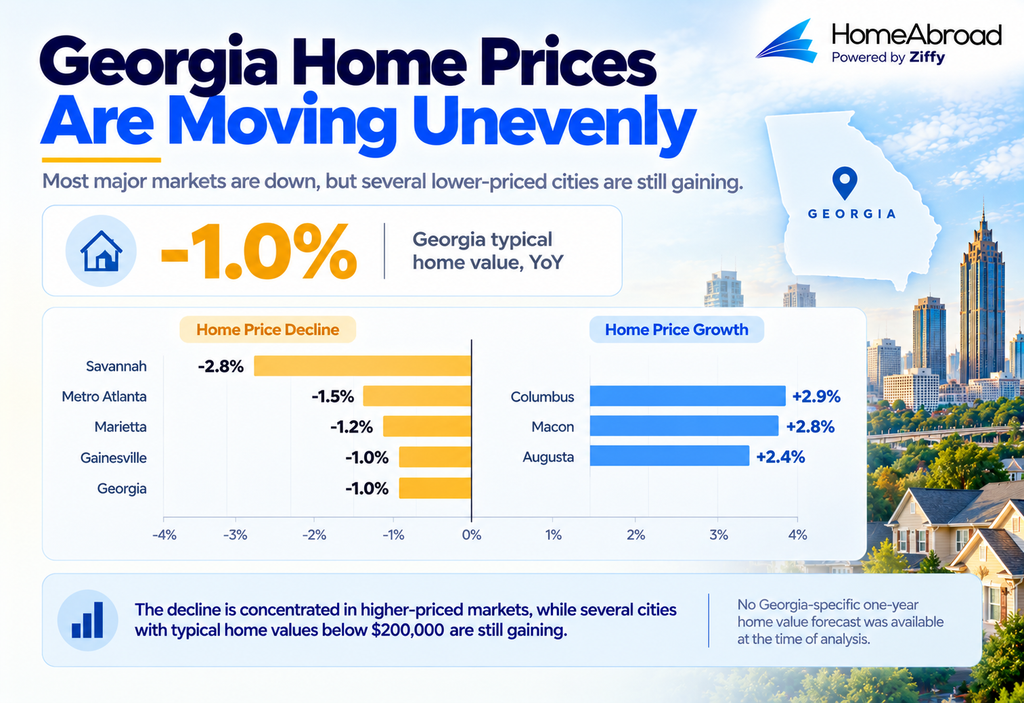
Slightly, and unevenly. Georgia’s typical home value is down 1.0% over the past year. Metro Atlanta is down 1.5%, including a 0.4% decline in August 2026 alone. Savannah is down 2.8%, while Marietta and Gainesville are down 1.2% and 1.0%, respectively.
Three cities moved the other way. Columbus is up 2.9%, Macon up 2.8% and Augusta up 2.4%. The decline is concentrated in higher-priced markets, while the strongest gains are in cities where a typical home costs less than $200,000.
No one-year home value forecast was available for Georgia or the individual cities reviewed at the time of analysis. The available national forecast was +0.3% for the following year. This article does not use that national figure to project Georgia’s future home values.
Is Georgia a Buyer’s or Seller’s Market?
On price, buyers have measurable negotiating room. Across Georgia, 58.4% of sales close under list, 18.1% close over it, and the sale-to-list ratio is 0.988. There were 55,489 homes for sale at the end of May 2026, with 14,972 new listings added during the month.
The state average does not describe every city. Columbus homes go pending in a median 17 days and only 53.6% sell under list, so sellers there give up less. Marietta sees 23.7% of sales close above list, the highest share in this article. How much leverage a buyer has depends on the city.

Steven Glick
Director of Mortgage Sales · HomeAbroad
For a foreign investor, a statewide price decline does not tell the whole investment story. We look at the property’s rental income, purchase price and projected debt service together, because those factors determine whether the property can support the financing.
Georgia Rental Market: Rents, Rent Growth and Renter Demand
Two sets of rental figures help describe Georgia’s market, and they measure different things.
Statewide asking rents. As of August 15, 2026, the average asking rent across bedroom counts and property types was $1,929, which was $17 lower than the previous month and $54 lower than a year earlier. There were 27,354 rentals listed statewide, renter demand was rated Cool, and Georgia’s asking rent was 4% below the national average of $2,000. A typical three-bedroom property was listed at $1,979.
Statewide asking rents are soft. A Georgia rental purchased on the assumption that rent will rise needs to be evaluated at the city and property level, where rental trends can differ materially from the state average.
Typical rent by market (Through August 31, 2026):
- Columbus: $1,308, up 4.6%
- Macon: $1,246, up 3.3%
- Augusta: $1,369, up 3.1%
- Gainesville: $1,652, up 2.1%
- Metro Atlanta: $1,853, up 2.0%
- Marietta: $1,689, up 1.6%
- Savannah: $1,757, down 0.7%
- United States: $1,948, up 2.5%
Rent growth and value growth line up in the same three cities. Metro Atlanta is the exception worth noting: rents rose 2.0% while values fell 1.5%, creating a more favorable entry environment for buyers focused on rental income. Atlanta’s city-level asking rent was $2,100 on September 17, 2026, with renter demand rated Warm.
A verified statewide rental-yield figure was not available for this analysis, so no yield is presented as a market-wide fact. Investors can compare typical rent with typical home value as an initial screening measure, while recognizing that gross yield does not account for taxes, insurance, vacancy, maintenance, management or financing costs.
What the Market Data Means for a Foreign Investor
Georgia offers relatively lower entry prices in several markets alongside measurable rental growth. With statewide values down 1.0%, the investment case depends heavily on the relationship between purchase price and rental income. The strongest combination of value and rent growth is concentrated in cities where typical home values are below $200,000, reducing the initial capital required at a given down-payment percentage.
The negotiating room is real. With 58.4% of sales closing under list, the price a buyer agrees to is likely to be below what the seller asked, and on a financed purchase that price also sets the loan amount and the monthly payment the rent has to cover.
Choose the city, not the state. Savannah and Columbus are moving in opposite directions on both values and rents, a wider spread than the difference between Georgia and the US. Investors buying their first US investment property often start by picking a state. In Georgia, the decision is made at city level.
Best Georgia Cities for Rental Property Investment
The table compares the markets using a consistent set of indicators: value growth, rent growth, market pace and seller pricing power. Price and rent alone did not determine the comparison.
Market | Typical home value | Typical rent | Rental yield |
|---|---|---|---|
Columbus | $175,951 | $1,308 | 8.9% |
Augusta | $188,114 | $1,369 | 8.7% |
Macon | $174,105 | $1,246 | 8.5% |
Metro Atlanta | $377,813 | $1,853 | 5.8% |
Savannah | $322,239 | $1,757 | 6.5% |
Source: Zillow Home Value Index and Zillow Observed Rent Index, city pages with data through August 31, 2026.
Columbus: Fastest Rent Growth and the Quickest Market in This Ranking
Investment Properties Listed Today on Sale in Columbus
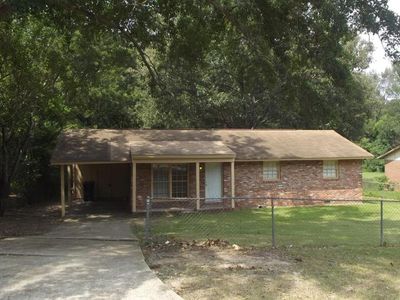


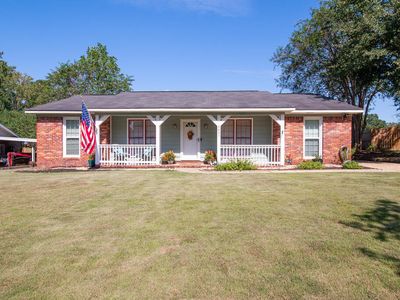
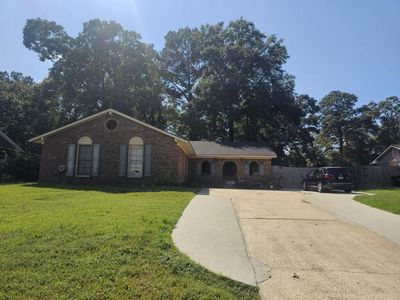
Columbus shows the strongest combination of the indicators reviewed. The typical home value is $175,951, up 2.9%. Typical rent is $1,308, up 4.6%, the fastest rent growth of any market in this article. Homes go pending in a median 17 days, the quickest among the cities reviewed, and 53.6% of sales close under list, the lowest share among the cities priced below $200,000. The sale-to-list ratio is 0.993, with 727 homes for sale at the end of August 2026 and 201 new listings during the month.
Columbus offers a low entry price with rent already moving up, in a market where sellers do not have to discount much to find a buyer. Expect less negotiating room here than in Augusta, Macon or Savannah.
Augusta: Balanced Growth With Room to Negotiate
Investment Properties Listed Today on Sale in Augusta
Augusta’s typical home value is $188,114, up 2.4%, and its typical rent is $1,369, up 3.1%, the highest rent of the three growth cities. Homes take a median 39 days to go pending, 57.0% of sales close under list and the sale-to-list ratio is 0.990. There were 758 homes for sale in August 2026, with 176 new listings.
Both growth signals are positive here, and the market moves at a pace that leaves a buyer time to negotiate. Augusta suits an investor who wants growth on both sides without competing for homes the way they would in Columbus.
Macon: Lowest Entry Price, Softer Pricing Power
Investment Properties Listed Today on Sale in Macon
Macon has the lowest typical home value in this article at $174,105, up 2.8%. Typical rent is $1,246, up 3.3%. Homes go pending in a median of 34 days. The caution is in the pricing figures: 62.7% of sales close under list, the highest share of the three growth cities, and the sale-to-list ratio of 0.980 is the lowest in this article. There were 910 homes for sale with 200 new listings.
The growth is there and the entry price is the lowest, but sellers are accepting below-list offers more often than in Columbus or Augusta, which is what places Macon third. A buyer should negotiate, and should recognize that a market where most homes sell below asking may require the same concession at resale.
Metro Atlanta: Scale, Liquidity and Buyer Leverage
Investment Properties Listed Today on Sale in Metro Atlanta
Metro Atlanta is the largest market in this article and the only one of the three Rental Manager pages reviewed where renter demand was rated Warm. The metro’s typical home value is $377,813, down 1.5% over the year and down 0.4% in August alone. Typical rent is $1,853, up 2.0%. Inventory grew 0.6% year over year, while August sales were 0.8% below a year earlier. Atlanta’s city-level asking rent was $2,100 on September 17, 2026, flat over both the month and the year, with 4,028 rentals listed.
Marietta, inside the metro, carries a higher entry price and slower rent growth: a typical home value of $471,117, down 1.2%, typical rent of $1,689, up 1.6%, and 23.7% of sales closing above list. Gainesville, northeast of Atlanta, is close to the metro on both counts, with a typical value of $371,176, down 1.0%, rent of $1,652, up 2.1%, and a median 52 days to pending.
Atlanta ranks fourth because scale has value. A large tenant pool and a liquid resale market reduce two risks an investor cannot manage from abroad: extended vacancy and a slow exit. Values drifting down while rents rise is the right direction for a buyer. The trade-off is a much higher entry price, and because Zillow’s metro figures cover the whole Atlanta-Sandy Springs-Roswell area, neighborhood selection matters more here than in the smaller cities reviewed.
Savannah: A Market to Watch Before Buying
Investment Properties Listed Today on Sale in Savannah
Savannah has the steepest value decline in this article at 2.8%, with a typical home value of $322,239, and it is the only market where typical rent also fell, down 0.7% to $1,757. On September 18, 2026, the average asking rent was $1,932, down $168 over the year, with renter demand rated Cool. Homes take a median of 41 days to go pending; 64.6% of sales close under list price, the highest share in this article; and 1,384 homes were for sale.
On paper, sellers here concede more often than anywhere else in this comparison. Without rent growth, though, there is no clear indication that a discounted purchase will be followed by improving rental income. Savannah is worth revisiting if rental growth turns positive.
The same market measures are used across states in the ranking of the best places to buy rental property in the US.
Financing a Georgia Rental as a Foreign National: DSCR Loans
A common financing route for foreign investors buying in Georgia is a DSCR loan. DSCR stands for Debt Service Coverage Ratio. The loan qualifies on the property’s rental income measured against its monthly mortgage payment, so the borrower’s personal income and tax returns are not the basis of the decision. That makes it a practical option for a nonresident buyer with no established US credit history and income earned outside the US.
The market figures above provide useful context for DSCR financing, but they do not determine loan qualification on their own. Rising typical rents in Columbus, Augusta and Macon can support the rental-income side of the analysis. A lower negotiated purchase price can also reduce the loan amount and monthly debt service that the property’s rent needs to cover.
For underwriting, the lender evaluates the subject property’s documented rental income and the applicable appraisal or rent analysis. A city-level typical rent is useful for market research, but it does not replace the property-specific rent figure used for loan qualification.
At HomeAbroad, we offer DSCR loans in Georgia for foreign-national investors. The program requires a 25% down payment, offers up to 75% LTV for purchases and rate-and-term refinances, and requires six months of cash reserves. For eligible properties with a DSCR below 1.0, the No-Ratio DSCR option can support financing with a higher down payment.

When reviewing a DSCR loan for a foreign national, we focus on the property’s ability to support the proposed debt service. The market rent can provide useful context, but the property-specific rent analysis and the final loan structure are what matter during underwriting.
Finance Your Georgia Investment Property With HomeAbroad
At HomeAbroad, we finance eligible Georgia rental purchases for foreign nationals through DSCR financing, with qualification based primarily on the property’s rental income. An established US credit history is not required for eligible foreign-national borrowers. Pre-approval can help an investor understand the potential financing amount before making an offer and provide a clearer budget when evaluating properties in Columbus, Augusta, Atlanta or other Georgia markets.
Get pre-approved with HomeAbroad and review your Georgia financing options.
Frequently Asked Questions
Can a Foreign National Buy Investment Property in Georgia?
Yes. Foreign nationals can generally purchase US real estate, including rental property in Georgia, subject to federal, state and property-specific rules. Owning property does not grant a visa, residency or any immigration status. The steps for international buyers, including title, escrow and closing from abroad, are explained in how foreigners can buy property in the US.
How Much Have Georgia Home Values Fallen?
By 1.0% statewide over the past year. Metro Atlanta is down 1.5% and Savannah is down 2.8%. Augusta, Macon and Columbus are up 2.4%, 2.8% and 2.9%. No one-year Georgia forecast was available in the market data reviewed for this article.
Where Do Buyers Have the Most Leverage in Georgia?
Statewide, 58.4% of sales close under list, the sale-to-list ratio is 0.988 and homes go pending in a median 33 days. Savannah and Macon show the highest shares of under-list sales in this article, at 64.6% and 62.7%. Columbus and Marietta are tighter on price than the state average.
Which Georgia City Is Best for Rental Cash Flow?
Columbus stands out on the market figures reviewed, with rent up 4.6%, values up 2.9% and a 17-day median time to pending. Augusta and Macon also show positive value and rent growth. Compare typical rent against typical home value for each city as an initial screening measure, since no verified market-wide yield figure is presented here.
Do I Need an Established US Credit History or a Social Security Number for a Georgia DSCR Loan?
Not necessarily. At HomeAbroad, we offer foreign national mortgage options, including DSCR loans, for borrowers without an established US credit history or a Social Security Number. The lender still reviews creditworthiness through other documentation, and terms depend on the program and the property.