


Editorial Integrity
Making informed real estate decisions starts with having the right knowledge. At HomeAbroad, we offer US mortgage products for foreign nationals & investors and have a network of 500+ expert HomeAbroad real estate agents to provide the expertise you need. Our content is written by licensed mortgage experts and seasoned real estate agents who share insights from their experience, helping thousands like you. Our strict editorial process ensures you receive reliable and accurate information.
New Bern ranks first among the six leading North Carolina rental markets, combining a 7.16% gross rental yield with 37.1% five-year home value growth.
Hickory offers the highest gross rental yield among the 14 ranked metros at 7.21%, while Greenville has the lowest typical home value in the top six at $244,755.
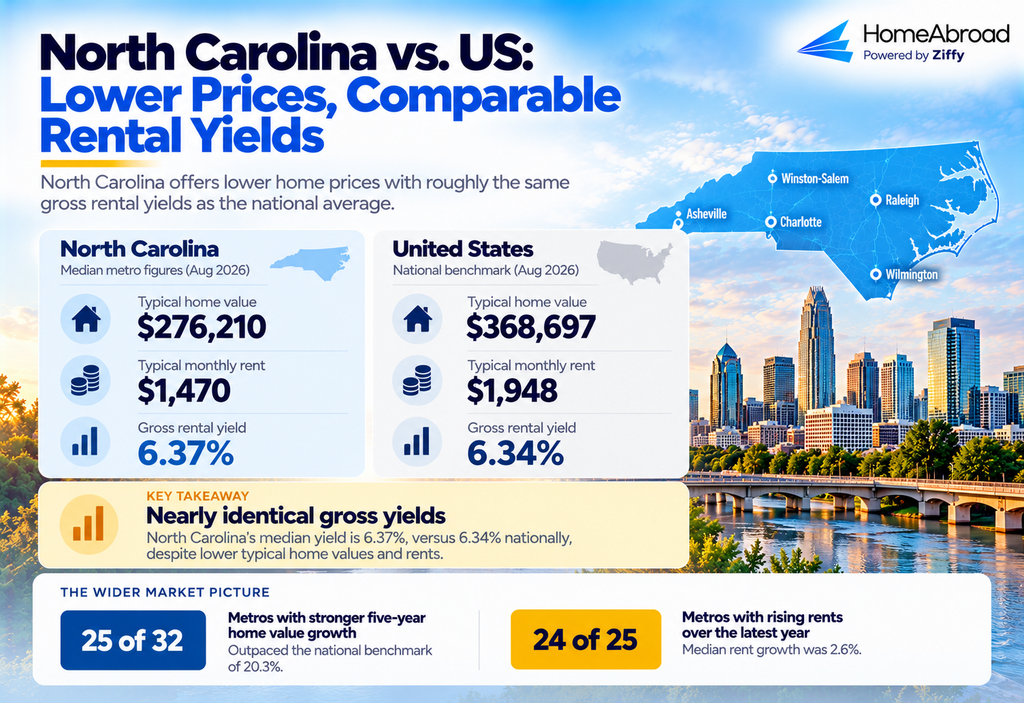
North Carolina offers competitive rental yields at lower entry prices. The state’s median gross rental yield is 6.37%, compared with 6.34% nationally, while typical home values remain below the US median.
Foreign investors should evaluate financing, operating costs, and ownership rules. Gross yields exclude expenses, and North Carolina’s new Farmland and Military Protection Act is scheduled to take effect on April 1, 2027.
Table of Contents
New Bern, Jacksonville, Greenville, Hickory, Fayetteville and Winston-Salem are the strongest North Carolina markets for buying rental property in 2026. Each combines a gross rental yield between 6.46% and 7.21% with home value growth of 27% to 39% since August 2021, and in all six the typical home costs less than the typical US home.
The wider state picture is similar. Across North Carolina’s 32 metro areas, the typical home value is $276,210, about 25% below the US figure of $368,697, yet the median gross yield of 6.37% matches the national 6.34%. The state’s best-known metros, Raleigh, Charlotte, Durham and Asheville, finish at the bottom of the ranking.
This guide is for international investors buying a long-term rental in North Carolina, with cash or with a mortgage. If you are new to buying from abroad, start with whether foreigners can buy property in the US.
North Carolina’s Real Estate Market in 2026: Lower Prices, National-Level Yields
North Carolina lets a foreign investor buy into the US rental market at a lower price point while earning roughly the national gross yield. The figures below cover all 32 metro areas with both home value and rent data as of August 2026, with each metro counted once.
Homes Cost Less, and Rents Keep Pace
The typical home value across North Carolina’s metros is $276,210, and the typical monthly rent is $1,470. Nationally, those figures are $368,697 and $1,948.
Rent falls in proportion to price, so returns hold up. Gross rental yield is a property’s annual rent divided by its price, before any costs. The median across North Carolina’s metros is 6.37%, against 6.34% for the US, and 17 of the 32 metros beat the national figure. The spread is wide, from 4.22% in Cullowhee to 10.17% in Lumberton.
A second way to read the same numbers is the price-to-rent ratio: how many years of gross rent it would take to equal the home’s value. North Carolina’s median is 15.7 years, close to the US at 15.8. Lower is better for an income investor, and the six markets ranked below all sit between 13.9 and 15.5.
Five Years of Rent and Price Growth, Moving Together
Home values in 25 of North Carolina’s 32 metros grew faster than the US over the five years to August 2026. The median metro gained 29.2%, compared with 20.3% nationally.
Rents rose at a similar pace. In the 14 metros with complete five-year records, gross yields shifted by less than half a percentage point between August 2021 and August 2026, ranging from a 0.43-point drop in Pinehurst to a 0.36-point gain in Greensboro. Price growth in North Carolina has not come at the expense of rental income, which matters to a buyer paying today’s prices.
The Last 12 Months: Slower, and Uneven
The most recent year looks different from the five-year trend. The median metro’s home value rose 1.0%, and 10 of the 32 metros recorded a decline, among them Charlotte, Raleigh, Durham and Asheville. Rents held up better: they rose in 24 of the 25 metros with a full year of rent data, with a median increase of 2.6%.

Steven Glick
Director of Mortgage Sales · HomeAbroad
In smaller markets, limited rental comparables can make it harder for appraisers to establish market rent. If the appraised rent comes in below your expectations, it can lower the property’s DSCR and affect your loan terms. Investors should review local rental comparables before making an offer and account for the possibility of a more conservative rent estimate.
The 6 Best Places to Buy Rental Property in North Carolina
The six metros below scored highest on a combined measure of gross rental yield, five-year growth in home values and rents, and the latest 12 months of both. Yield carries the most weight, but a high yield in a market where prices or rents are slipping did not earn a top spot. The full method is explained under How We Ranked the Markets, further down this page.
Metro | Typical home value | Typical monthly rent | Gross yield | 5-yr value growth | 5-yr rent growth |
|---|---|---|---|---|---|
New Bern | $262,920 | $1,568 | 7.1% | +37.1% | +36.3% |
Jacksonville | $292,020 | $1,573 | 6.4% | +39.4% | +35.2% |
Greenville | $244,755 | $1,448 | 7.1% | +33.3% | +32.1% |
Hickory | $269,037 | $1,618 | 7.2% | +29.3% | +29.5% |
Fayetteville | $255,537 | $1,458 | 6.8% | +33.7% | +29.6% |
Winston-Salem | $280,379 | $1,541 | 6.5% | +26.7% | +30.4% |
All six beat the US on gross yield and on five-year home value growth, and every one of them costs less than the typical US home. The differences between them come down to what you want the property to do: produce income now, grow in value, or both.

Our loan files show that foreign investors are financing properties across different North Carolina markets, with each market offering a different mix of property types and rental potential. The right fit depends on the property’s numbers, the investor’s objectives, and whether the rental income supports the financing structure.
1. New Bern: The Most Balanced Numbers in the State
Investment Properties Listed Today on Sale in New Bern, NC
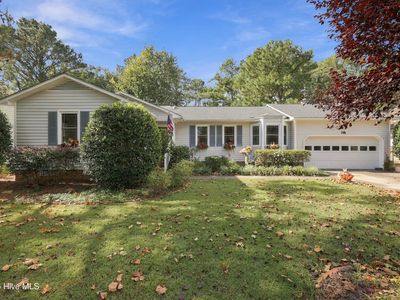


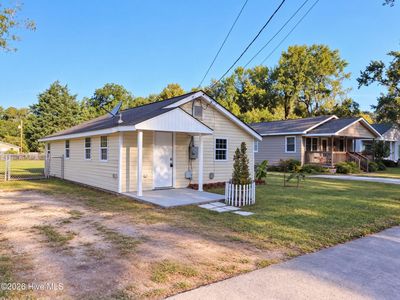
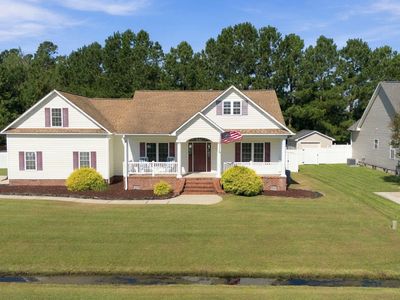
New Bern scored highest of the 14 metros we ranked, and no single figure carries it. A typical home is valued at $262,920 and rents for $1,568 a month, or $18,817 a year, for a gross yield of 7.16%.
The five-year record is just as strong. The typical value rose 37.1% ($71,152), and rent rose 36.3%, or $418 a month. Both kept climbing through the past year, with values up 2.8% and rents up 3.7%.
Because rents grew almost exactly as fast as prices, New Bern’s gross yield has barely moved: 7.20% in August 2021 and 7.16% today. The trade-off is scale. New Bern is the smallest metro in the top six, so expect fewer listings to choose from and a smaller tenant pool than in a larger city.
2. Jacksonville: The Fastest Growth in Prices and Rents
Investment Properties Listed Today on Sale in Jacksonville, NC
Jacksonville suits investors who weight appreciation heavily. Its typical home value rose 39.4% over five years, or $82,550, the largest percentage gain of any ranked metro. Rent rose 35.2% ($409 a month).
The momentum continued into 2026. Over the last 12 months, values rose 3.3%, the biggest one-year gain among the 14 metros, and rents rose 4.2%, second only to Wilmington.
That growth has a cost. With a typical value of $292,020 and rent of $1,573, Jacksonville’s gross yield is 6.46%, the lowest in the top six, and down from 6.67% in 2021 because prices outran rents. You pay more for each dollar of rent here than in New Bern or Greenville.
3. Greenville: The Lowest Entry Price in the Top Six
Investment Properties Listed Today on Sale in Greenville, NC
Greenville has the lowest typical home value of any ranked metro at $244,755. Typical rent is $1,448, or $17,377 a year, for a gross yield of 7.10% and a price-to-rent ratio of 14.1.
A lower price means less cash is needed at any given down-payment percentage. That helps if you are financing from abroad and moving the down payment and reserves into dollars.
Greenville’s five-year growth was strong (values up 33.3%, rents up 32.1%), but the past year was slower, with values up 1.4% and rents up 2.6%. If you buy here, plan around the rental income rather than a repeat of the last five years of appreciation.
4. Hickory: The Highest Gross Yield in the Ranking
Investment Properties Listed Today on Sale in Hickory, NC
Hickory has the highest gross yield of the 14 ranked metros, 7.21%, and the lowest price-to-rent ratio, 13.9. Its typical rent of $1,618 is the highest in the top six, set against a mid-range typical value of $269,037.
Prices and rents have moved in step here. Values rose 29.3% and rents 29.5% over five years, and the gross yield was 7.20% in 2021, almost exactly where it is now. The last year added 2.0% to values and 3.4% to rents.
Hickory’s five-year appreciation trails New Bern, Jacksonville, Greenville and Fayetteville, which is why it ranks fourth overall despite leading on yield.
5. Fayetteville: Strong Five-Year Gains, a Flat Last Year
Investment Properties Listed Today on Sale in Fayetteville, NC
Fayetteville’s typical home value of $255,537 and rent of $1,458 produce a gross yield of 6.85%. Over five years, values climbed 33.7% ($64,472) and rents 29.6% ($333 a month).
The past 12 months were quieter. Home values rose only 0.4%, while rents still grew 2.4%. Because rents grew more slowly than prices across the full five years, the gross yield eased from 7.06% in 2021.
Fayetteville fits an investor focused on rental income at a low entry price who does not need near-term appreciation to make the numbers work.
6. Winston-Salem: Rents Growing Faster Than Prices
Investment Properties Listed Today on Sale in Winston Salem, NC
Winston-Salem is the largest metro in the top six, which usually means more properties and tenants to work with. A typical home is valued at $280,379 and rents for $1,541 a month, for a 6.59% gross yield.
It is also the clearest case in the top six of rents outpacing home prices. Over five years, rent rose 30.4% ($359 a month) while values rose 26.7% ($59,117), lifting the gross yield from 6.41% to 6.59%. The last year followed the same pattern, with rents up 3.6% and values up 2.1%.
The weak spot is appreciation. Winston-Salem’s five-year value growth is the lowest of the six, though still above the US figure.
Ready to look at actual homes? Browse North Carolina rental listings on the HomeAbroad property search, which shows estimated cash flow for each property.
Where Charlotte, Raleigh, Durham and Asheville Fit
North Carolina’s best-known metros ranked 11th to 14th of the 14 we scored. They are established markets with a different profile: higher prices, lower gross yields, and returns that depend more on future appreciation than on rent.
Metro | Typical home value | Gross yield | 5-yr value growth |
|---|---|---|---|
Charlotte | $384,458 | 5.4% | +22.3% |
Durham | $405,282 | 4.8% | +21.0% |
Asheville | $419,186 | 4.8% | +18.0% |
Raleigh | $431,269 | 4.6% | +18.8% |
All four carry typical home values above the US figure of $368,697, and all four recorded a decline in home values over the past year. Rents grew 1.3% or less, about half the state median.
The price-to-rent ratios tell the story for an income investor. In Raleigh, a typical home costs 21.5 years of gross rent; in Hickory, 13.9 years. On a financed purchase, less rent per dollar of loan generally makes debt coverage tighter at the same loan size.
That does not rule these metros out. Five-year value growth in all four still matched or came close to the national 20.3%, and some investors will prefer a larger metro with a deeper resale market. Wilmington (rank 10) sits in a similar position: a 4.67% gross yield on a $445,278 typical value, offset by the fastest one-year rent growth of any ranked metro, 4.5%. If you buy in any of these markets, underwrite the property on its rent today and treat appreciation as upside.
How We Ranked the Markets
Every figure in this article comes from two Zillow datasets for August 2026, and every calculation can be repeated from them. This section is the full method.
Data Sources
- Home values: the Zillow Home Value Index (ZHVI) for the middle third of the market (homes between the 33rd and 67th percentile of value), covering single-family homes and condos, smoothed and seasonally adjusted, by metro area.
- Rents: the Zillow Observed Rent Index (ZORI), smoothed, which measures typical asking rent across single-family homes, condos and apartments, by metro area.
- Dates: August 2026 for current figures, August 2025 for one-year change, and August 2021 for five-year change.
How Each Metric Is Calculated
- Annual rent = typical monthly rent × 12
- Gross rental yield = annual rent ÷ typical home value × 100
- Price-to-rent ratio = typical home value ÷ annual rent
- Five-year and one-year change = (August 2026 figure ÷ earlier figure − 1) × 100
To see what a specific property would earn after these costs, run it through the rental property ROI calculator or the cash flow calculator.
Taxes on Rent and on Sale
Rental income from US property is taxable in the US. Nonresident owners can often choose the Section 871(d) net election, an IRS election that lets you be taxed on rental income after deducting expenses. Without it, tax is withheld from the gross rent.
When you sell, the buyer generally must withhold part of the price under FIRPTA (the Foreign Investment in Real Property Tax Act). The general rate is 15% of the amount realized, with reduced rates of 10% or 0% when the buyer will live in the home and the price falls under set thresholds. The withholding is a prepayment against your final tax, not the tax itself. Read the FIRPTA withholding rules before you list a property, and work with a qualified US tax professional on both stages.
A complete DSCR loan file should include a property rent schedule, an insurance quote, and proof of required cash reserves. For foreign borrowers, preparing these documents early can help avoid delays during underwriting. Having the key figures ready also helps the team assess the property’s cash flow and financing options more efficiently.

Financing Your North Carolina Investment Property With HomeAbroad
HomeAbroad helps foreign nationals and international investors finance US rental properties based primarily on the property’s rental income or, where applicable, the borrower’s foreign income and assets. Certain financing programs also accommodate investors without an established US credit history.
Our AI-native investment property search platform helps you discover rental properties across the US and evaluate their potential cash flow. By combining property search tools with financing support, HomeAbroad helps international investors assess opportunities, understand their financing options, and move forward with greater clarity.
Whether you are exploring North Carolina for its rental income potential or comparing markets across the US, our team can help you understand the available financing options and documentation requirements.
Ready to invest in North Carolina real estate? Get pre-qualified with HomeAbroad and take the next step toward financing your investment property.
Frequently Asked Questions
Can Foreign Nationals Buy Investment Property in North Carolina?
Yes, foreign nationals can generally buy residential investment property in North Carolina. From April 1, 2027, the state’s Farmland and Military Protection Act bars foreign governments on a federal restricted-country list, and entities they own or control, from acquiring farmland or property within 50 miles of listed military bases. Owning property does not give you a US visa, residency or citizenship.
What Is the Best Place to Buy Rental Property in North Carolina?
New Bern ranks first on our combined score of yield and growth, with a 7.16% gross yield and 37.1% five-year price growth. Hickory has the highest gross yield of the ranked metros (7.21%), and Jacksonville has the fastest five-year price growth (39.4%). The right pick depends on your goal: income now or appreciation over time.
What Is a Good Rental Yield in North Carolina?
The median gross yield across North Carolina’s metro areas is 6.37%, level with the US figure. Among the 14 ranked metros, gross yields run from 4.66% in Raleigh to 7.21% in Hickory. A property yielding above about 6.4% gross beats both the state median and the US figure, but compare net yield, after taxes, insurance and management, before you decide.
Are Home Prices Falling in North Carolina?
Not statewide. The median metro’s typical home value rose 1.0% in the year to August 2026. Ten of the 32 metros did record declines, including Asheville (-3.3%), Durham (-2.2%), Raleigh (-1.8%) and Charlotte (-0.5%).
Can I Get a Mortgage on a North Carolina Rental Without US Credit History?
Certain DSCR loan programs accept borrowers without an established US credit history, qualifying them mainly on the property’s rent. You will still provide identification, proof of funds and reserves, and the lender will review your application. Terms depend on the property, your documents and the current program.
Do I Pay Tax When I Sell North Carolina Property as a Foreign National?
Usually, yes. Under FIRPTA, the buyer generally withholds 15% of the sale price and sends it to the IRS as a prepayment toward your US tax. Lower rates apply in some cases where the buyer will live in the home. Your actual tax is settled when you file a US return, so speak with a qualified tax professional before you sell.