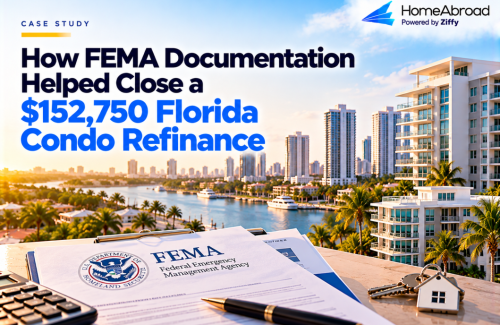
A rental property can have steady tenants, documented income, and enough equity to support a refinance. Yet a detail buried in an insurance requirement can still prevent the loan from reaching closing.
That was the challenge surrounding a Florida condominium financed through HomeAbroad. The property was already leased as a long-term rental, and the investor was pursuing a cash-out refinance to access equity without selling the property.
The financial side of the transaction was straightforward. The condo appraised at $235,000, and its qualifying monthly rental income of $2,200 supported the proposed housing expense. HomeAbroad structured a $152,750 DSCR cash-out refinance at 65% LTV.
But before the loan could close, one outstanding issue needed to be resolved: the condominium’s flood-zone classification and its related insurance requirements.
The turning point came when FEMA documentation confirmed that the property had been removed from its previous special flood hazard designation. With that documentation and the updated insurance policy in place, the refinance could proceed.
Investment Highlights
The Funded Refinance at a Glance
Investment Properties on Sale in Florida Today



The Starting Point
A Leased Florida Condo With Equity to Access
Owning a rental condominium creates a particular kind of financing challenge. The investor controls the individual unit, but important expenses and insurance arrangements may depend on decisions and documentation provided by the condominium association.
For this Florida property, the investor had an existing long-term lease generating $2,200 in qualifying monthly rent. The property also had an appraised value of $235,000, making a cash-out refinance possible within the proposed loan structure.
Rather than selling the property to realize its value, the transaction was designed to access a portion of the equity while preserving ownership of the rental.
The refinance used a HomeAbroad DSCR loan, which meant the property’s qualifying rental income, rather than the investor’s personal tax returns or employment income, formed the basis of the debt-service qualification.
A lender may need to review both the borrower’s individual insurance coverage and the condominium association’s master policy. Even when rental income and property valuation support the loan, missing insurance or flood documentation can prevent final loan clearance.
In this case, that insurance review became the decisive part of the transaction.
Loan Structure
How the $152,750 Refinance Was Structured
HomeAbroad structured the refinance at a conservative 65% loan-to-value ratio. This kept the new loan below the full appraised value of the property while allowing the investor to use a cash-out refinance structure.
The difference between the appraised property value and the new loan principal was $82,250. This represents the equity remaining against the new loan balance at closing, based on the stated appraisal and principal amount.
It is not the investor’s cash-out proceeds. The amount actually received from a cash-out refinance depends on the existing mortgage payoff, closing costs, and other settlement adjustments. Those figures were not provided in the transaction summary.
The Final Loan Terms
The fixed-rate structure provided a defined principal-and-interest payment schedule over the loan term. The three-year prepayment provision is also relevant to future decisions, because refinancing or paying off the loan during that period may have contractual cost implications.
Rental Income Test
The Rental Income Supported a 1.11 DSCR
Before the insurance issue could become the focus, the loan first needed to make sense from a rental-income standpoint.
For a DSCR loan, the central question is whether qualifying rental income is sufficient to cover the monthly property payment used in underwriting.
PITIA generally includes principal, interest, property taxes, insurance, and applicable association dues. For a condominium, those association costs deserve particular attention because they can materially affect the property’s monthly carrying expenses.
The difference between qualifying rent and PITIA was $212.46 per month.
This is the monthly difference between qualifying rental income and underwritten PITIA. It is not net operating income or actual investor cash flow after maintenance, vacancies, management fees, and other expenses.
A DSCR above 1.00 means the qualifying rent exceeds the underwritten monthly housing expense. Here, the reported 1.11 DSCR established that the property met that basic coverage test.
It also highlights why the insurance question mattered. If a required insurance premium changes, the expense side of the DSCR calculation may change with it. For a property with a relatively modest rental coverage margin, the insurance review cannot be treated as an administrative afterthought.
The Main Obstacle
The Flood Insurance Requirement Holding Up Closing
On paper, the refinance had several things working in its favor: an existing lease, documented rental income, an appraisal supporting the proposed loan amount, and a 65% LTV.
Yet none of those figures could replace the insurance documentation required for final loan approval.
The lender needed confirmation about flood coverage under the condominium association’s master insurance policy. The file also required documentation establishing the property’s flood-zone status.
This distinction is particularly relevant in Florida, where older coastal condominium buildings may have flood-zone designations inherited from earlier mapping. An existing classification can create insurance requirements that need to be verified before underwriting is finalized.
Those questions were connected but not interchangeable. The insurance policy established the coverage arrangements, while the flood-zone documentation established the applicable mapping status.
Until the lender could verify both, the otherwise supportable refinance remained subject to an outstanding closing requirement.
The Turning Point
How the FEMA Documentation Cleared the File
The important breakthrough was not a higher appraisal or a change to the loan amount. It was documentation establishing that the property no longer carried the earlier special flood hazard designation.
A letter from the Federal Emergency Management Agency (FEMA) confirmed that the property had been removed from the special flood hazard area.
That confirmation resolved the outstanding flood-zone requirement. An updated homeowner’s insurance policy was then bound at a premium consistent with the original underwriting assumptions.
How the File Moved Toward Closing
The association’s master policy and the property’s flood-zone designation required further verification.
Documentation established removal from the previous special flood hazard designation.
The homeowner’s policy was finalized at a premium consistent with the original underwriting.
With the documentation confirmed, the refinance closed under the stated loan structure.
The broader lesson is that an older flood-zone designation should not automatically be assumed to reflect the property’s current status. FEMA provides processes through which qualifying property owners can request formal map amendments or revisions when the applicable flood mapping does not accurately describe a structure or parcel.
Investors can review the process through FEMA’s guidance on Letters of Map Amendment and Letters of Map Revision Based on Fill.
Removal from a special flood hazard area does not mean the property has no flood risk. It may change federally mandated insurance requirements, but individual lenders, associations, or insurance arrangements can still require coverage.
In this transaction, the official documentation satisfied the lender’s requirement, and the updated insurance premium remained consistent with the cost assumptions supporting the refinance.
Funded Result
HomeAbroad Closed the $152,750 Florida Condo Refinance
With the flood-zone documentation and insurance confirmation completed, the refinance closed.
HomeAbroad funded a $152,750 DSCR cash-out refinance against the Florida condominium’s $235,000 appraised value. The transaction closed at 65% LTV with a 6.875% interest rate and a 30-year fixed term.
The qualifying monthly rent of $2,200 against PITIA of $1,987.54 produced a reported DSCR of 1.11. The loan also carried a three-year prepayment term.
The investor retained the rental property while completing a refinance designed to access existing equity. Most importantly, the insurance documentation was resolved without requiring a change to the original underwriting premium assumptions.
Final Funded Structure
The result demonstrates how a property can satisfy the financial requirements of a DSCR refinance while still needing careful attention to insurance and condominium-specific documentation before it is ready to close.
Investor Takeaways
What Other Florida Condo Investors Can Learn
Not every delayed refinance is caused by insufficient income, an unfavorable appraisal, or an excessive loan amount. Sometimes the figures support the transaction, but the property’s documentation needs additional attention.
Confirm the Current Designation Early
Older maps or previously recorded flood-zone information may not tell the whole story. Reviewing the current designation before underwriting can identify documentation requirements sooner.
Request Association Documents Promptly
Confirm what the master insurance policy covers and what separate coverage the unit owner must maintain. Missing association documents can become a closing obstacle.
Watch the Expense Side of the Ratio
Rent is only half of a DSCR calculation. Taxes, insurance, and applicable association dues can influence whether the property satisfies the required coverage ratio.
Separate Equity From Usable Proceeds
A property’s appraised equity does not equal the cash a borrower receives. Existing debt, fees, and other settlement expenses must be considered.
For international real estate investors, these details can be especially valuable to identify before committing to a financing strategy. When managing an investment remotely, early document collection and a clear understanding of property-level expenses can reduce uncertainty during the loan process.
The Bigger Picture
What This Florida Refinance Reveals About DSCR Financing
This case illustrates an often-overlooked part of real estate financing: a property’s financial performance is only one part of the underwriting picture.
The Florida condominium had an existing lease, documented rental income, an appraisal supporting the requested financing, and a DSCR above 1.00. The proposed loan was structured at 65% LTV, leaving a meaningful equity position in the property.
Yet the refinance still depended on resolving a property-specific insurance requirement. Without confirmation of the flood-zone classification and appropriate coverage, the transaction could not receive its final clearance.
For international investors, these are the kinds of complications that can be difficult to anticipate from abroad. A rental property’s projected income and value may support financing, while condominium association requirements, flood determinations, or insurance documents introduce additional steps.
At HomeAbroad, we work with international real estate buyers and investors seeking US mortgage solutions, including DSCR loans that evaluate qualifying rental income instead of relying on traditional personal-income documentation.
This funded transaction demonstrates the importance of evaluating the entire file, from the property’s rental income and proposed loan structure to the documents needed to satisfy underwriting and closing requirements.
The Bottom Line
The $152,750 Florida condo refinance was supported by a 65% LTV and a reported 1.11 DSCR. But the deciding factor was the FEMA documentation confirming that the property had been removed from its previous special flood hazard designation. Once the insurance requirements were satisfied, HomeAbroad completed the refinance on a 30-year fixed structure, allowing the investor to retain the rental property while accessing its equity.