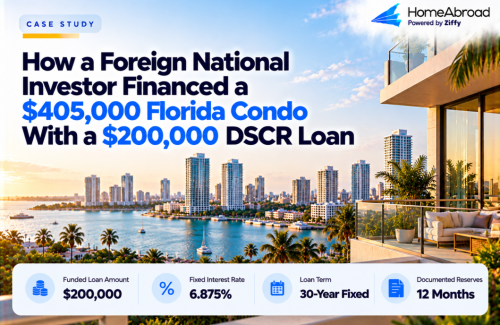
Buying a rental property in another country involves more than choosing the right home. For an international investor, even a financially conservative purchase can come with questions about how overseas funds will be verified, whether a US lender will accept international banking records, and how much financing makes sense for the investment.
This Florida condominium purchase offers a useful example. The buyer was a foreign national investor seeking financing for a condo that ultimately appraised at $405,000. Rather than borrowing close to the property’s full value, the transaction was completed with a $200,000 DSCR purchase loan through HomeAbroad.
The file included another important element: the investor’s financial documentation involved an international digital banking relationship, along with 12 months of documented reserves.
HomeAbroad funded the purchase with a 6.875% interest rate and a 30-year fixed term. The result illustrates how conservative leverage and properly documented cross-border assets can come together in a foreign national real estate transaction.
Investment Highlights
The Funded Florida Condo Purchase
Funded Loan Amount
$200,000
Appraised Property Value
$405,000
Reported Loan-to-Value
50.26%
Fixed Interest Rate
6.875%
Loan Term
30-Year Fixed
Documented Reserves
12 Months
LTV is reproduced as reported in the transaction summary, pending reconciliation with the underlying valuation and loan figures.
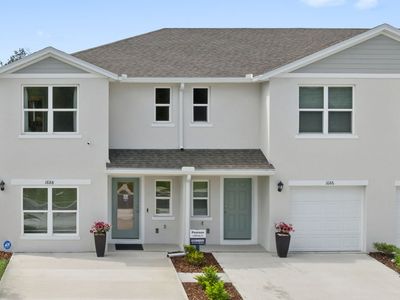
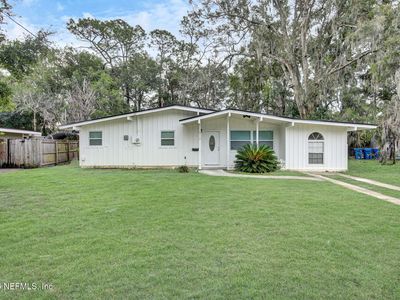
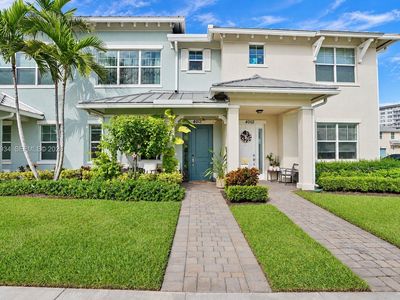
Investment Properties on Sale in Florida Today


The Starting Point
A Florida Condo Purchase With a Cross-Border Financing Question
A US real estate purchase can look straightforward on paper. There is a property to acquire, a price to evaluate, and a financing amount to arrange.
For a foreign national investor, however, the financing process extends beyond the property itself. Funds may be held outside the US. Financial records may originate from institutions that operate differently from traditional American banks. The lender must evaluate the property and the buyer’s financial position within the requirements of the loan program.
The Florida investor in this case was acquiring a condominium using HomeAbroad’s DSCR purchase program. The completed transaction involved a $200,000 loan secured by a property with a final appraised value of $405,000.
What makes this purchase interesting is not the size of the loan alone. It is the combination of relatively low leverage, international asset documentation, substantial documented reserves, and long-term fixed-rate financing.
The central question: Could the investor complete a US condo purchase using DSCR financing while relying on properly documented funds held through an international banking relationship?
The funded transaction demonstrates that this combination can work when the property, financing structure, and supporting documentation satisfy underwriting requirements.
The Financing Challenge
The Financing Challenge Wasn’t Just the Property
Foreign national financing has two sides. One concerns the real estate itself: its value, property type, and eligibility for the selected program. The other concerns the investor’s ability to provide acceptable financial documentation.
The second part can be particularly relevant for investors whose assets are maintained internationally.
A conventional US banking relationship often produces familiar statements and transaction records. An international digital banking relationship may present the same financial information through different formats, account structures, or documentation practices.
That difference does not automatically make the funds unacceptable. It does mean the documentation must be sufficient for the lender to evaluate the assets under the applicable underwriting requirements.
01 / PROPERTY
Could the condo support the financing?
The property needed an acceptable valuation and had to meet the program’s condo eligibility requirements.
02 / ASSETS
Could international funds be documented?
The financial file included funds maintained through an international digital banking relationship.
03 / LIQUIDITY
Was additional financial capacity established?
The completed file documented 12 months of reserves, an important component of the financial review.
These elements help explain why international financing is not simply a matter of choosing a loan amount and comparing interest rates. A transaction also depends on whether the lender can establish a complete, supportable picture of the property and the investor’s finances.
Property Valuation
What the $405,000 Appraisal Established
Before the financing could be finalized, the property’s value needed to be established through the appraisal process.
The Florida condominium received a final appraisal of $405,000, higher than the preliminary estimate recorded in the transaction file.
This provided an important point of reference for the financing. It confirmed the property’s appraised value while allowing the lender to assess the requested loan amount against the collateral.
Final Property Valuation
$405,000
The completed appraisal came in above the preliminary estimate, supporting a purchase financed with a loan substantially smaller than the appraised property value.
An appraisal above an initial estimate can be encouraging in a purchase transaction, but it should not be confused with immediate realized profit or a guaranteed investment return.
The appraisal is a valuation at a particular point in time. Future property values, rental demand, operating expenses, and resale outcomes remain subject to market conditions.
In this case, the more relevant point was the financing relationship: HomeAbroad completed a $200,000 loan against a condo appraised at $405,000.
Loan Structure
Why Conservative Leverage Shaped the Deal
Real estate investors frequently focus on how much financing a property can support. But borrowing capacity and borrowing strategy are not necessarily the same thing.
Higher leverage can reduce the initial equity requirement, but it also increases the debt obligation relative to the property’s value. Lower leverage means less debt exposure, although it generally requires the investor to commit more capital.
This Florida transaction used the latter structure. HomeAbroad funded $200,000 in financing against the property’s $405,000 appraised value.
The transaction summary separately lists the final LTV as 50.26%. Because that reported percentage differs from the ratio of the funded loan to the final appraised value, the illustration above uses the mathematical relationship between the two stated dollar amounts.
Regardless of that reporting distinction, the financing was conservative relative to the property’s value.
A lower loan balance relative to collateral value can provide a greater valuation cushion, although it does not eliminate risks associated with rental income, property expenses, market declines, or ownership costs.
Cross-Border Documentation
Documenting 12 Months of Reserves Across Borders
The property value established one side of the transaction. The investor’s documented financial resources established another.
The file included assets maintained through an international digital banking relationship. It also documented 12 months of reserves.
For a foreign national investor, this part of the mortgage process can be particularly relevant. Money held outside the US may need to be supported by records that establish ownership, availability, and acceptability under the lender’s requirements.
Documented Financial Reserves
The completed mortgage file included documentation supporting 12 months of reserves.
Why do mortgage reserves matter?
Reserves are financial assets available beyond the funds needed for the immediate transaction. Depending on the program, they may be measured against a specified number of months of the property’s qualifying housing expense.
For an investment property, reserves can be especially meaningful because ownership costs continue even during periods of vacancy, unexpected maintenance, or rental-income disruption.
Documenting 12 months of reserves supported the financial review in this case. The public transaction summary does not disclose the investor’s account balances or the exact dollar amount of those reserves.
What made the international banking relationship relevant?
Cross-border funds are not necessarily difficult because of where they are held. The more consequential issue is whether the records provided satisfy the lender’s verification requirements.
HomeAbroad’s completed transaction illustrates that funds maintained through an international digital banking relationship can form part of an acceptable mortgage file when the necessary documentation is available.
It does not mean every digital bank, account type, transfer, or source of funds will automatically qualify. Acceptance remains dependent on the applicable lender and underwriting requirements.
Mortgage Program
How DSCR Financing Fit the Florida Condo Purchase
HomeAbroad funded the condominium purchase through its Debt Service Coverage Ratio (DSCR) loan program.
A DSCR mortgage for foreign national investors generally evaluates a rental property’s qualifying income relative to the housing expense used for underwriting, rather than relying primarily on the borrower’s personal debt-to-income ratio.
Understanding DSCR
DSCR = Qualifying Monthly Rent ÷ Monthly PITIA
PITIA = Principal, Interest, Taxes, Insurance, and Association Dues, where applicable.
Condominiums require particular attention to association dues because those expenses can affect the monthly housing payment and therefore the property’s debt-service coverage.
In this Florida purchase, the available public summary confirms that HomeAbroad funded the transaction under a DSCR program. However, it does not provide the qualifying monthly rent, monthly PITIA, or final numerical DSCR.
Consequently, the transaction should not be presented as having a particular DSCR or as generating a specific amount of positive cash flow.
The confirmed outcome is that the purchase was completed with DSCR financing under the documented terms.
Why the 30-year fixed structure mattered
The loan was funded at a 6.875% fixed interest rate over a 30-year term.
A fixed-rate mortgage provides a predictable principal-and-interest payment schedule, which can help investors plan their long-term debt obligations.
This does not mean the property’s total monthly expense remains unchanged for 30 years. Property taxes, insurance premiums, condo association dues, assessments, and maintenance costs can change over time.
For a foreign national investor evaluating a long-term US property investment, separating predictable mortgage principal and interest from variable ownership costs is an important part of financial planning.
Funded Result
HomeAbroad Funded a $200,000 Florida Condo Purchase Loan
The completed transaction brought the different pieces of the financing together.
The condo’s final appraisal established a value of $405,000. The investor’s financial file documented 12 months of reserves and included funds held through an international digital banking relationship. The final loan was funded under HomeAbroad’s DSCR purchase program.
This was not a transaction defined by maximum borrowing or a speculative projection of future returns.
Its distinguishing feature was the completed financing structure: a foreign national investor secured a long-term, fixed-rate mortgage for a US condo while the file supported the lender’s review of international assets and reserves.
Investor Takeaway
What International Investors Can Learn From This Purchase
The most useful lesson from this Florida transaction is that successful cross-border financing involves more than simply finding a lender willing to issue a mortgage to someone living outside the US.
The structure of the debt, the appraised value of the property, the accessibility of financial records, and the investor’s documented liquidity all contribute to whether a transaction can be completed.
LESSON 01
More borrowing isn’t always the objective
Conservative leverage can reduce debt relative to property value, although it requires a greater equity commitment.
LESSON 02
International funds require a documentation strategy
Investors should establish early what account statements and supporting records their lender will accept.
LESSON 03
Reserves support more than qualification
Maintaining accessible funds can also help investors manage ongoing ownership expenses and unexpected costs.
LESSON 04
The property must work as an investment
DSCR financing evaluates qualifying rental income and expenses, making property-level financial analysis important.
There is also a broader point for international buyers. An investor does not necessarily need to maximize leverage to make US real estate financing worthwhile.
In this case, the investor acquired financing for a Florida condominium through HomeAbroad with a $200,000 loan, a 30-year fixed term, and documented financial resources maintained across borders.
The case demonstrates one way a foreign national purchase can be financed when the structure is appropriate and the documentation supports it. It does not establish that every international investor, digital banking relationship, or condo purchase will qualify on comparable terms.
Closing Perspective
A Cross-Border Purchase Built Around Financial Documentation and Conservative Debt
The defining feature of this case was the combination of modest financing relative to appraised value and documented international financial resources.
HomeAbroad funded the foreign national investor’s Florida condo purchase with a $200,000 DSCR mortgage at 6.875% on a 30-year fixed term. With 12 months of documented reserves and an appraisal of $405,000, the completed transaction offers a practical example of how international investors can structure US real estate financing around their actual financial circumstances.
Case Study Disclosure: This case study describes one completed transaction. Individual financing outcomes vary. Loan programs, interest rates, fees, qualification requirements, and terms are subject to change. Approval is subject to underwriting, appraisal, property eligibility, asset documentation, and lender requirements. Past financing outcomes do not guarantee future loan approval or property performance. Equal Housing Opportunity.