


Editorial Integrity
Making informed real estate decisions starts with having the right knowledge. At HomeAbroad, we offer US mortgage products for foreign nationals & investors and have a network of 500+ expert HomeAbroad real estate agents to provide the expertise you need. Our content is written by licensed mortgage experts and seasoned real estate agents who share insights from their experience, helping thousands like you. Our strict editorial process ensures you receive reliable and accurate information.
Vacant home insurance protects US properties during extended vacancies, when standard homeowners or landlord policies may limit coverage.
Vacancy clauses often restrict coverage after 30 to 60 consecutive days, depending on the insurer and policy form.
Foreign national investors should arrange appropriate coverage before closing on a vacant property and review policy terms during tenant turnovers.
Insurance premiums affect PITIA and can lower a property’s DSCR, making vacancy coverage an important part of rental investment planning.
Table of Contents
Homeowners and landlord policies are priced for a house with someone living in it. When the house sits empty longer than the policy allows, often 30 to 60 consecutive days, coverage for losses such as vandalism, broken glass, and frozen pipes can shrink or stop. Vacant home insurance is the policy or endorsement that covers that period.
The gap matters more when you own US property from another country. A new rental can sit empty for weeks between closing and the first lease. A tenant moves out in January and the next one signs in March. You take a job abroad and leave your former home behind while you decide whether to sell or rent it. In each case nobody is there to notice a leak, and you may be the last person to hear about it.
This guide explains how vacancy clauses work, what vacant home insurance covers and excludes, what drives the cost, and how vacancy coverage interacts with a US mortgage. Terms depend on your policy form, your insurer, and the state where the property is located, so use it to prepare questions for your insurer or broker. HomeAbroad finances US property for foreign nationals and other international buyers. It does not sell insurance.
What Is Vacant Home Insurance?
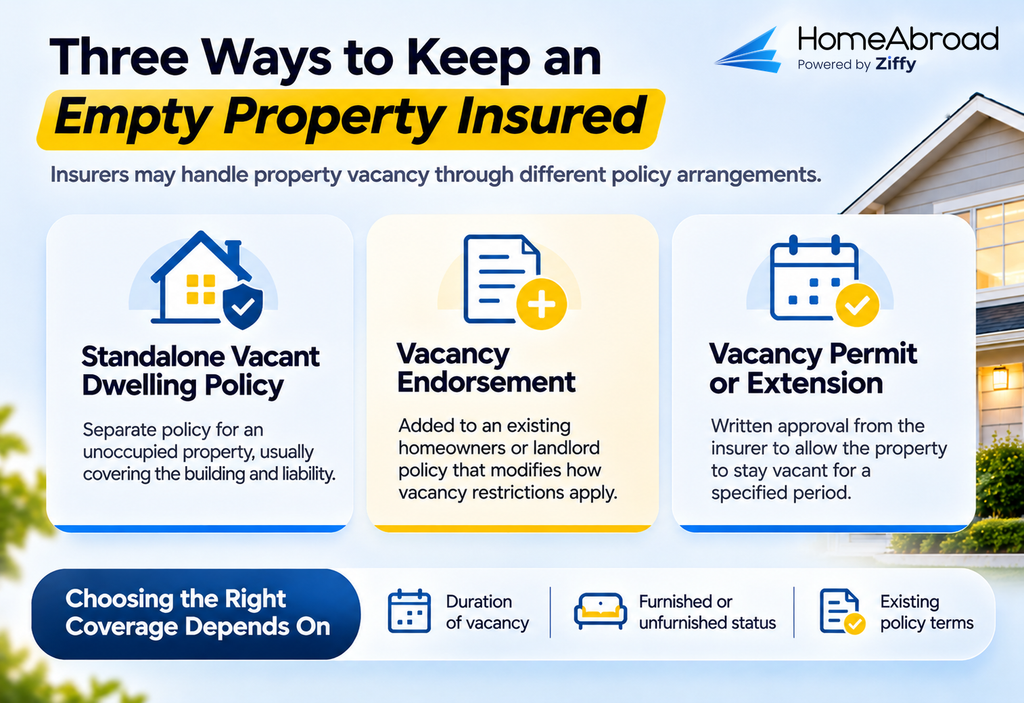
Vacant home insurance protects a residential property while no one lives in it. Insurers sell it under several names, including vacant property insurance, vacant dwelling insurance, and vacant house insurance, and usually in one of three forms:
- A standalone vacant dwelling policy. Written for the empty property itself, typically for a shorter term than a standard annual policy, and usually covering the building and liability.
- A vacancy endorsement. An add-on to an existing homeowners or landlord policy that changes how the policy’s vacancy limits apply.
- A vacancy permit or extension. Some insurers will agree in writing that the property can stay empty for a stated period without losing coverage.
Which one fits depends on how long the property will be empty, whether it is furnished, and whether your current insurer will cover a vacant property at all.
Vacant vs. Unoccupied: Which One Describes Your Property
Insurers treat these two words differently, and the difference can decide a claim.
Status | Vacant | Unoccupied |
|---|---|---|
People living there | No | No |
Furniture and belongings | Removed, or nearly all removed | Still in place |
Typical example | New rental before the first tenant; home emptied for sale | Furnished seasonal home between visits; furnished home of an owner working abroad |
How policies usually treat it | Strictest limits | Often more lenient, depending on the policy |
Coverage written for furnished homes is often sold as unoccupied home insurance. Many homeowners policies do not define either term, and when a dispute reaches court, judges generally give the words their ordinary meaning. That leaves room for argument, so ask your insurer how your policy defines vacant and unoccupied and keep the answer in writing.
Why Standard Policies Limit Coverage on an Empty Home
An empty house is a different risk from an occupied one. A slow leak can run for weeks. A broken window may go unreported until a neighbor happens to notice it. Insurers manage that risk through vacancy clauses, which are written into most homeowners and landlord policies.
How the Vacancy Clause in a Homeowners Policy Works
Many US homeowners policies are based on standard forms published by Insurance Services Office (ISO). The most widely used, the Homeowners 3 Special Form (HO-3), removes coverage for vandalism and malicious mischief, and for glass breakage, once the dwelling has been vacant for more than 60 consecutive days immediately before the loss. Under the current edition, a home being constructed, remodeled, renovated, or repaired is not considered vacant.
Two details trip owners up. The 60 days must be consecutive and must run up to the date of the loss, so a house that has been empty for 70 days is treated differently from one whose tenant left last month. Some insurers use a shorter vacancy period, such as 30 days, depending on their policy forms. Check your own policy for the applicable limit.
A homeowners policy also assumes you live in the home. If you move abroad and rent the house out, the homeowners policy may no longer be the right product even before any vacancy begins, and you will likely need a landlord policy instead.
The Freezing Condition
The HO-3 also excludes damage from plumbing, heating, air-conditioning, and sprinkler systems or appliances that freeze, unless you used reasonable care to maintain heat in the building or shut off the water supply and drained the systems. For an owner abroad, this is how a winter vacancy goes wrong: the utility account is closed after a tenant leaves, the furnace stops, and a pipe splits.
Insurance professionals often treat a thermostat set at about 55°F as reasonable care. That number does not appear in the standard form, and the insurer decides what was reasonable after the loss, so ask your insurer what it expects and record what you did.
Landlord Policies Have Vacancy Limits Too
Rental properties are usually insured on a dwelling policy (DP-1, DP-2, or DP-3), commonly called a landlord policy. The ISO dwelling forms carry their own vacancy limits. The basic DP-1 form excludes vandalism once the dwelling has been vacant for more than 60 consecutive days.
The broader DP-2 form applies a similar limit to damage caused by burglars. The DP-3 form, commonly used for rental properties, also excludes vandalism after more than 60 consecutive days of vacancy.
So a rental between tenants is not automatically protected because it carries a landlord policy. Read the dwelling policy’s vacancy section the same way you would a homeowners policy.
Tell Your Insurer Before the Property Goes Empty
Some insurers will cancel or decline to renew a policy once they learn a home is vacant, and some policies list extended vacancy as grounds for cancelation. State law sets notice periods and limits on cancelling a policy mid-term, and those rules vary.
Telling your insurer before the vacancy starts lets you arrange an endorsement or a replacement policy on your own timetable, instead of the insurer finding out when you file a claim.
When Overseas and Absentee Owners Face a Vacancy Gap
For an owner who lives abroad, vacancy is rarely a one-off. It shows up at predictable points in the life of a US property, and each one calls for a slightly different conversation with the insurer.
Situation | Usual status | |
|---|---|---|
Closing on a new rental, before the first tenant moves in | Vacant | Vacant dwelling policy, or a landlord policy with a vacancy endorsement |
Turnover between tenants | Vacant or unoccupied | The landlord policy’s vacancy terms; an endorsement if re-leasing runs long |
Seasonal second home used a few weeks a year | Unoccupied | Seasonal or secondary-home policy and its unoccupancy terms |
Former US residence left behind after a move abroad | Vacant or unoccupied | Switching from a homeowners policy to a landlord or vacant policy |
Renovation between tenants | Under renovation | Builder’s risk or a renovation endorsement, alongside vacancy terms |
Property listed for sale and empty | Vacant | Short-term vacant policy matched to the expected listing period |
Why Distance Raises the Stakes
Three things change when the owner is in another country.
Damage is found later. Without a tenant, or a neighbor who knows to call you, a leak or a break-in can go unnoticed until the next inspection. Policies generally require prompt notice of a loss and steps to prevent further damage, and weeks of continuing damage can lead to a dispute over how much of it is covered.
Claims run on US time. Claims are usually reported by phone or online, and adjusters schedule inspections locally and expect someone to give them access. If you are 10 hours ahead of the property, a missed call can push an inspection back by days.
Policy conditions are easy to breach without knowing it. Vacancy policies and endorsements can require inspections at set intervals, utilities left on, or specific security measures. If your property manager has never seen those conditions, there is a good chance nobody is meeting them.
The property manager’s agreement and inspection routine do most of the work here, and the guide on how to manage a US rental property remotely covers both in detail.
One point for readers whose circumstances have changed: moving abroad, a change in visa status, or a change in tax residency does not by itself change how an insurer classifies the house. What matters to the policy is whether people are living in it.
What Vacant Home Insurance Typically Covers
A vacant home insurance policy usually covers the building and your liability, with theft, vandalism, and water damage either included or available as add-ons. Coverage varies by insurer, so treat the list below as a checklist for comparing quotes.
- Dwelling and other structures: The house itself, and often detached structures such as a garage or fence. Many vacant policies cover named perils only, meaning the policy pays for the causes of loss it lists, such as fire, lightning, windstorm, and hail, and nothing else.
- Liability: Pays for injuries to other people on the property, such as a contractor or a prospective tenant who falls on a damaged step. With agents, inspectors, and repair crews coming through an empty house, this is coverage to keep.
- Vandalism, theft, and water damage: Sometimes included and sometimes sold as endorsements at extra cost. These are the perils most likely to be limited under a standard policy after a long vacancy, so check how each quote handles them.
Many vacant home insurance policies provide limited or no coverage for personal property and loss of use or rental income. Coverage varies by insurer and policy form. If you leave appliances or furniture in a furnished rental, confirm whether those items are covered and whether the policy includes any protection for lost rental income.
Two more terms to compare:
-
 Policy length: Vacant home insurance policies may be available for shorter periods or annual terms, depending on the insurer. Confirm the available policy duration and renewal options before choosing coverage for an extended vacancy.
- How losses are settled: Replacement cost coverage generally pays the cost of repairing or rebuilding covered damage without deducting depreciation, subject to policy limits and conditions. Actual cash value coverage accounts for depreciation when calculating a covered loss. Before binding a vacant home policy, confirm that its settlement terms meet your mortgage lender’s insurance requirements.
Common Exclusions and Conditions
Vacant home insurance covers sudden events. It does not pay for damage the policy treats as foreseeable or preventable, and it often comes with conditions you have to keep meeting while the property is empty.
- Flood and earthquake: Standard homeowners policies and vacant policies generally exclude both. Flood coverage comes from the National Flood Insurance Program or a private flood insurer, and an NFIP policy generally takes effect 30 days after purchase. FEMA waives that wait when the policy is bought in connection with making, increasing, extending, or renewing a mortgage. Earthquake coverage is a separate policy or endorsement.
- Wear, neglect, and mold: Deterioration, poor maintenance, and gradual leaks are not covered. A policy insures the sudden pipe burst, not the slow drip that went unnoticed for months.
- Renovation beyond what you declared: Major work on an empty house can require builder’s risk coverage. Tell the insurer before contractors start.
- Policy conditions: Depending on the insurer, vacant home policies may require periodic property inspections, functioning security measures, or specific arrangements for utilities. Review these conditions with your insurer and make sure your property manager can meet them throughout the vacancy.
Before you buy, ask the insurer or broker to show you three things in the policy wording: how it defines vacancy, what it excludes, and every condition you or your property manager has to meet.
How Much Does Vacant Home Insurance Cost?
Vacant home insurance usually costs more than a standard policy on the same house, because the insurer expects more frequent and larger claims when no one is there. There is no reliable national average for vacant home insurance cost, and figures quoted online vary widely, so the only useful number is a quote for your property.
What Drives the Premium
- Location: Exposure to hurricanes, wildfire, hail, and crime, plus local construction costs.
- The house itself: Replacement cost, age, roof condition, and the plumbing and electrical systems.
- Length of the vacancy: A three-month policy for a listing period prices differently from an open-ended one.
- Security and monitoring: Deadbolts, alarms, and remote water-leak or temperature sensors can affect both price and eligibility.
- Deductible and coverage form: A higher deductible lowers the premium; named-peril coverage usually costs less than broader forms.
- Endorsements: Adding vandalism, theft, or water damage where it is not included raises the price.
Get quotes from more than one insurer or through an independent broker, and compare the coverage line by line before you compare prices.
How the Premium Affects Your DSCR
For an investor financing a rental, insurance is part of PITIA: the monthly principal, interest, property taxes, insurance, and association dues. A DSCR (Debt Service Coverage Ratio) loan, which HomeAbroad offers to foreign nationals who may not have an established US credit history, generally measures the property’s rent against that payment. A higher insurance figure lowers the ratio.
Here is a hypothetical example for illustration.
Monthly figure | Lower premium | Higher premium |
|---|---|---|
Market rent | $2,400 | $2,400 |
Principal and interest | $1,500 | $1,500 |
Property taxes | $300 | $300 |
Insurance | $125 ($1,500 a year) | $200 ($2,400 a year) |
HOA dues | $0 | $0 |
PITIA | $1,925 | $2,000 |
DSCR (rent ÷ PITIA) | 1.25 | 1.20 |
A $75 monthly difference in insurance premiums changes the DSCR by about 0.05 in this example. Ask your loan officer which insurance premium underwriting will use when the property closes vacant and later transitions to an occupied-rental policy. To test your own numbers, enter your quoted premium in the DSCR loan calculator.
Vacant Home Insurance and Your US Mortgage
A mortgaged property has to stay insured for the life of the loan, with the lender named on the policy, and that requirement does not pause while the house is empty. For HomeAbroad borrowers financing a rental with a DSCR or foreign national loan, the vacancy question usually comes up twice: at closing, before the first lease, and at each tenant turnover.
What Your Lender Needs to See at Closing
If the property will be empty on closing day, the policy you bind has to fit a vacant house and still meet the lender’s insurance requirements: the right coverage amount and settlement basis, the lender’s details in the mortgagee clause, the named insured matching the deed, and proof that the premium is paid. The landlord insurance checklist for foreign investors walks through each of those closing items.

Steven Glick
Director of Mortgage Sales · HomeAbroad
For an investment property closing vacant, have the insurance policy arranged and approved before closing so there is no gap in coverage when ownership transfers. Once the first tenant signs the lease and takes occupancy, coordinate the transition to an occupied-rental policy and provide the updated declarations page to your mortgage servicer. Keep your loan officer informed of both changes so the insurance documentation in your loan file stays current.
What Happens If Coverage Lapses
If the policy lapses, or the servicer has no proof of coverage, the servicer can buy insurance on the property and charge you for it. This is called force-placed or lender-placed insurance. It typically costs more than a policy you choose yourself and is designed to protect the lender’s interest in the building, not your liability or your lost rent.
For investment-property loans, the requirements for maintaining insurance and the terms governing lender-placed coverage are generally established in the loan documents. If acceptable coverage lapses or the servicer cannot verify an active policy, the servicer may obtain lender-placed insurance and charge the borrower as permitted under the loan agreement. Review your mortgage documents to understand the notice requirements, coverage conditions, and charges that may apply.
For an owner abroad, the risk is timing. The notices go to the mailing address on file, and a letter that sits unopened in a US mailbox for six weeks can mean a force-placed charge on your next statement.
Keep Your Servicer Informed
- Keep your mailing address, email, and phone number current with your mortgage servicer.
- Notify your loan officer if the property’s intended use changes, since occupancy and property use can affect the terms of your financing.

When insurance coverage lapses during a vacancy, the borrower’s loan file may be flagged for missing coverage, potentially leading to lender-placed insurance. Foreign national borrowers should monitor policy renewals, maintain communication with their property manager, and promptly send updated insurance documents to their mortgage servicer.
How to Protect a Vacant US Property From Abroad
Each of these steps is easier to take before the house goes empty than to prove after a claim. Work through the list each time a vacancy starts.
- Get the vacancy definition in writing. Ask your insurer how the policy defines vacant and unoccupied, how many days are allowed, and when the count starts.
- Notify the insurer before the vacancy begins. Confirm which coverage applies and add an endorsement or a vacant policy if the gap will exceed the limit.
- Set an inspection schedule that matches the policy. If the policy requires inspections every week or two, your property manager needs to know that and send dated photos after each visit. Choosing a manager who works with nonresident owners is covered in the guide to property management for foreign investors.
- Decide on heat or winterization, and record it. Keep the utilities on and the heat set, or have a plumber shut off and drain the water system. Keep the invoice or the utility statement as evidence.
- Secure the property. Working locks, exterior lighting on timers, and someone to collect mail and keep the yard tidy so the house does not look abandoned.
- Name a US contact for the insurer. A property manager or local representative who can meet an adjuster within a day or two.
- Record the condition at the start. A dated video walkthrough and photos of every room give you a baseline if you have to prove what changed.
- Switch coverage the day a tenant moves in. Move to an occupied-rental policy, then send the new declarations page to your mortgage servicer.
Plan the Vacancy Before the Property Sits Empty
Most vacancy gaps can be seen coming: closing day, a lease end date, a move abroad. Price vacant coverage at the same time you price the deal, and build the vacancy-period premium into your DSCR estimate before you sign a purchase contract.
HomeAbroad finances US rental property for foreign nationals and other international investors, including DSCR loans that qualify primarily on the property’s rental income. Get pre-qualified to see how insurance, taxes, and the rest of the payment fit your numbers before you commit.
FAQs
How Long Can a House Be Vacant Before Insurance Stops Covering It?
How Long Can a House Be Vacant Before Insurance Stops Covering It?
It depends on your policy. The ISO HO-3 form limits vandalism and glass breakage coverage after 60 consecutive days of vacancy, and many insurers that use their own forms set the limit at 30 days. Your declarations page and the policy’s vacancy section give the number that applies to you.
Is It More Expensive to Insure a Vacant Home?
Usually, yes. An empty house carries a higher risk of theft, vandalism, and damage that goes unnoticed, and premiums reflect that. How much more depends on the location, the property, and the coverage you choose.
What Insurance Company Will Insure a Vacant Home?
Start with your current insurer, which may offer a vacancy endorsement. If it does not, specialty insurers write standalone vacant dwelling policies, and an independent broker can compare several at once.
Does Landlord Insurance Cover a Rental Between Tenants?
For a limited time, in most cases. Dwelling policies have their own vacancy limits, so a long gap between tenants can reduce coverage even though the policy is still in force. Check the vacancy section and add an endorsement if re-leasing will take longer than the limit allows.
Can I Buy US Vacant Home Insurance If I Live Outside the US?
Often, yes, but insurers set their own rules for owners who live abroad, such as requiring a US mailing address or a local contact. An independent broker familiar with nonresident owners is the most direct route.
Does Leaving Furniture in the House Make It Unoccupied Instead of Vacant?
Often it does, and unoccupied homes are usually treated more leniently than vacant ones. The policy wording and the insurer make the final call, so ask before you rely on furniture to keep full coverage.