


Editorial Integrity
Making informed real estate decisions starts with having the right knowledge. At HomeAbroad, we offer US mortgage products for foreign nationals & investors and have a network of 500+ expert HomeAbroad real estate agents to provide the expertise you need. Our content is written by licensed mortgage experts and seasoned real estate agents who share insights from their experience, helping thousands like you. Our strict editorial process ensures you receive reliable and accurate information.
Minnesota’s regional markets offer gross rental yields ranging from 4.6% to 6.9%, with Austin and Duluth leading the eight metros analyzed.
Duluth, Winona, and St. Cloud recorded stronger five-year home price growth than the Twin Cities, making regional markets worth evaluating.
Foreign nationals can purchase residential property throughout Minnesota, but agricultural land ownership is subject to state restrictions.
Rental property owners must account for non-homestead property taxes, local landlord regulations, winter maintenance, and insurance costs when evaluating investment returns.
Table of Contents
Foreign nationals can buy residential investment property anywhere in Minnesota, and the state’s regional markets offer several opportunities for rental investors. As of 2026, gross rental yields across the state’s eight metros with reliable rent data ranged from 4.6% to 6.9%. Interestingly, the Twin Cities, where many international investors begin their property search, ranks last among these markets for both gross rental yield and five-year home price growth. Duluth, Rochester, and smaller regional cities show stronger performance across several investment metrics.
However, choosing where to invest in Minnesota requires more than comparing property prices and rental income. Foreign buyers should understand the state’s restrictions on agricultural land ownership, the property tax classification that applies to rental properties, and local landlord regulations, including St. Paul’s rent stabilization ordinance. Winter maintenance, insurance costs, and property management also affect the economics of owning rental property from abroad.
This guide examines Minnesota’s real estate market in 2026, compares the state’s leading investment markets, and explains the legal, tax, and operating considerations foreign nationals should evaluate before purchasing. It also covers how HomeAbroad DSCR loans can help international investors finance Minnesota rental properties without requiring an established US credit history.
Minnesota Home Values and Rents in 2026
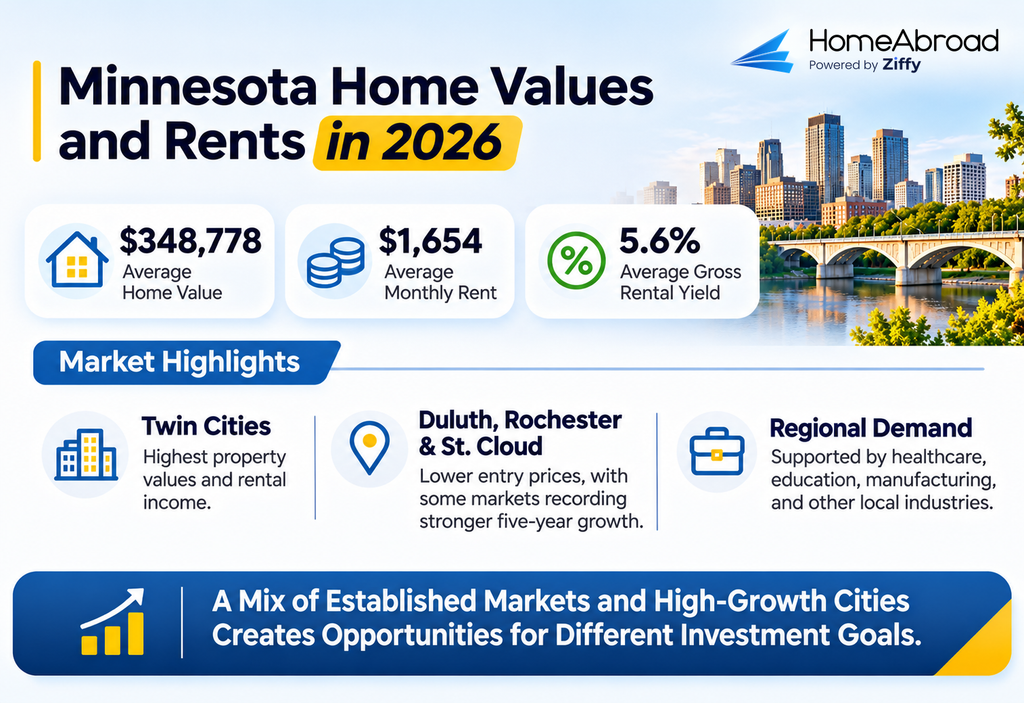
Minnesota offers a relatively affordable entry point for foreign nationals looking to invest in US residential real estate. The average home value across the state’s markets is approximately $348,778, while the average monthly rent is around $1,654. This translates to an average gross rental yield of approximately 5.6%, giving investors a useful starting point when evaluating Minnesota against other US real estate markets.
The state’s regional markets show different investment characteristics. The Twin Cities has the highest property values and rental income, supported by a larger housing market and broader tenant base. Regional cities such as Duluth, Rochester, and St. Cloud offer lower entry prices, with some recording stronger five-year home value and rental growth. This creates opportunities for investors with different priorities, from established rental demand to long-term appreciation.
Rental demand across Minnesota is supported by a mix of healthcare, education, manufacturing, and other regional industries. Rochester benefits from its healthcare sector, while Duluth and Mankato have established educational and employment centers. These local economic drivers contribute to rental demand and make market selection an important part of investment planning.
However, statewide averages do not tell the full story. Property values, rental income, growth rates, and operating costs vary considerably between cities. The following markets stand out based on their rental yields, recent price movements, and rent growth.
Can Foreign Nationals Buy Property in Minnesota?
Yes, for houses, condominiums, townhomes, and apartment buildings. Minnesota places no citizenship or residency condition on buying residential real estate. A nonresident buyer signs the same purchase agreement, goes through the same title and closing process, and holds the same deed as a US buyer. The federal picture is the same: foreign nationals can buy property in the US with no national ownership restriction.
The Agricultural Land Restriction Every Foreign Buyer Should Know
Minnesota is one of the states that restricts foreign ownership of farmland, and the rule is broader than many buyers expect. Under Minnesota Statutes section 500.221, a person who is not a US citizen or a lawful permanent resident may not acquire an interest in agricultural land.
The statute defines “interest” to include leases and other beneficial interests, not only ownership of title, and it applies to business entities unless at least 80% of the beneficial ownership is held by US citizens or permanent residents. The Minnesota Department of Agriculture describes it as the state’s Alien Farm Law.
The definition of agricultural land turns on whether the land is capable of agricultural use, not on whether the buyer intends to farm it. Land zoned by a local government for a non-agricultural use is excluded. The practical consequence for an investor: a lakeshore parcel with acreage, a hobby farm, or rural land outside a platted residential subdivision can fall inside the restriction even when the plan is a long-term rental or a vacation property.
Exceptions exist for inheritance, land acquired through debt collection (which must be sold within three years), citizens of countries whose land rights are secured by treaty, and certain research, transportation, and timber uses. Whether any exception applies to a specific parcel is a question for a Minnesota real-estate attorney, and the confirmation should happen before an offer is made, not at closing.
For the typical international investor buying a house, duplex, or condo in a city or suburb, this rule does not apply. It becomes relevant the moment the property search moves to land.
Ownership Does Not Change Immigration Status
Buying property in Minnesota does not grant a visa, residency, immigration status, or citizenship. Mortgage lenders may ask for passport, visa, or residency documents to verify identity and to classify the borrower, but that is a lending requirement, not an immigration process. Anyone with questions about status should consult an immigration attorney rather than a real-estate professional.
The Six Strongest Minnesota Investment Markets by the Numbers
Eight Minnesota metros have rent data complete enough to rank. Scored on gross yield, one-year rent growth, one-year value growth, and five-year value growth, the top six are Austin, Duluth, Winona, Mankato, Rochester, and Faribault. St. Cloud and the Twin Cities finish seventh and eighth. The full method is in the next section; the table below shows every figure the ranking used.
Metro | Home value | Typical monthly rent | Gross yield | 5-yr value growth |
|---|---|---|---|---|
Austin | $201,983 | $1,161 | 6.9% | +27.4% |
Duluth | $263,835 | $1,329 | 6.0% | +28.2% |
Winona | $282,829 | $1,093 | 4.6% | +31.4% |
Mankato | $305,707 | $1,236 | 4.8% | +24.8% |
Rochester | $338,327 | $1,590 | 5.6% | +20.1% |
Faribault | $350,912 | $1,579 | 5.4% | +20.4% |
St. Cloud | $310,763 | $1,224 | 4.7% | +24.1% |
Minneapolis-St. Paul | $387,807 | $1,736 | 5.3% | +10.8% |
All values are for September 2026. “Price as months of rent” is the home value divided by monthly rent; a lower number means rent recovers the purchase price faster. Only Austin and Duluth beat the national average on this measure.
Two cautions apply to the whole table. Rent indexes in metros below about 200,000 residents rest on fewer listings, so a single month’s figure can move more than it would in a large city. And none of these numbers capture the two things that matter most to an investor managing from abroad: how quickly a property can be bought or sold, and whether a competent local property manager is available. Both favor the larger metros.
1. Austin: Highest Yield and Fastest Rent Growth
Investment Properties Listed Today on Sale in Austin
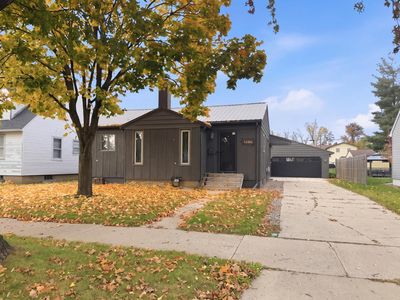


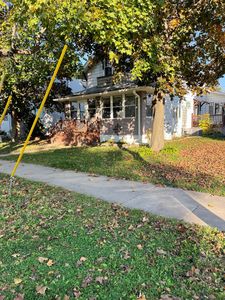
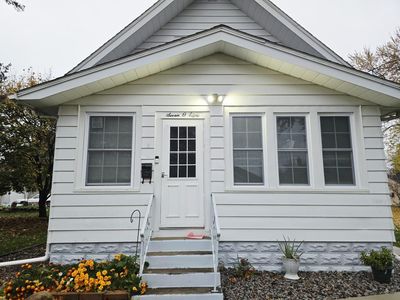
Austin tops the table on both the metrics an income investor cares about most. A mid-tier home valued at $201,983 rents for $1,161 a month, which produces $13,928 a year and a gross yield of 6.90%, the only Minnesota figure above the US average of 6.33%. Rent rose 9.0% in the year to September 2026, more than triple the national rate, and the home value gained 27.4% over five years.
The entry price is the lowest of the eight ranked metros, which matters for a buyer funding a down payment from savings held in another currency. The trade-off is scale: Austin is a small regional city in southern Minnesota, home to Hormel Foods’ headquarters, and its rent index had one missing month in the last three years. An investor here should expect a thin pool of comparable sales and should confirm property management availability before committing.
2. Duluth: Strongest Combined Growth
Investment Properties Listed Today on Sale in Duluth
Duluth is the best-balanced market in the data. Its gross yield of 6.04% is second only to Austin, its home value rose 5.2% in the past year (the fastest one-year gain of the eight) and 28.2% over five years, and its rent has grown 28.1% since September 2021. The rent index is complete for every month of the past three years, and Duluth is the second-largest Minnesota metro in the dataset, which gives it a depth of listings the smaller cities lack.
A mid-tier home at $263,835 renting for $1,329 returns $15,948 a year. The purchase price equals 199 months of rent, inside the national figure of 190 but well ahead of the Twin Cities at 223. Duluth sits on Lake Superior and hosts a University of Minnesota campus, which supports steady rental demand. For an international investor who wants both yield and liquidity in Minnesota, Duluth is the market the data points to first.
3. Winona: Fastest Five-Year Appreciation
Investment Properties Listed Today on Sale in Duluth
Winona ranks third on growth rather than yield. The mid-tier home value rose 31.4% over five years, the highest of any ranked Minnesota metro, and rent grew 7.1% in the latest year, second only to Austin. Its gross yield of 4.64% is the lowest of the eight, because rent of $1,093 has not kept pace with a home value of $282,829.
That combination describes an appreciation market with improving but still modest income. At 259 months of rent per dollar of price, it is the most expensive of the eight relative to rent. Winona is a small river city with a state university, and the same small-sample caution as Austin applies. It fits an investor who is comfortable with a lower starting yield in exchange for the growth record.
4. Mankato: Steady on Every Measure
Investment Properties Listed Today on Sale in Mankato
Mankato is in the top six on every one of the four ranking metrics without leading any of them. Gross yield is 4.85%, rent rose 4.6% in a year, home value rose 2.5% in a year and 24.8% over five years. The rent index is complete for all 36 months, and Mankato is the fifth-largest Minnesota metro in the dataset.
A mid-tier home at $305,707 rents for $1,236, or $14,831 a year. Minnesota State University, Mankato anchors the local rental market. This is a middle-of-the-road profile: no standout number, no weak number, and better data coverage than the two markets ranked above it.
5. Rochester: Highest Rent Outside the Twin Cities
Investment Properties Listed Today on Sale in Rochester
Rochester has the third-highest gross yield at 5.64% and the highest typical rent outside the Twin Cities at $1,590, which produces $19,075 a year on a $338,327 home. Its weakness is momentum. Rent grew just 1.9% in the latest year, the slowest of the eight, and five-year value growth of 20.1% is second-lowest, ahead of only the Twin Cities.
Rochester is the third-largest metro in the dataset and home to the Mayo Clinic, which makes it the regional market with the most stable employment base and the most professional property-management supply. The data describes a market that already carries a relatively high rent level and is now growing slowly. An investor here is buying current income and tenant quality, not growth.
6. Faribault: Twin Cities Commuter Belt at a Higher Yield
Investment Properties Listed Today on Sale in Faribault
Faribault sits south of the Twin Cities and shows what the metro-edge trade looks like. Its gross yield of 5.40% is nearly identical to the Twin Cities at 5.37%, but rent grew 4.7% in the past year versus 3.5% in the Twin Cities, and the home value rose 20.4% over five years versus 10.8%. A mid-tier home at $350,912 rents for $1,579, or $18,945 a year.
Faribault tied with Rochester and St. Cloud on average rank; the tie was broken by gross yield, which places Rochester fifth, Faribault sixth, and St. Cloud seventh. Faribault’s rent index is also missing three of the last 36 months, so its figures carry slightly less weight than the two metros it tied with. It is a reasonable option for an investor who wants Twin Cities proximity without the Twin Cities growth record.
Where the Twin Cities and St. Cloud Fit
The Twin Cities ranks last among the eight metros, and the reason is worth understanding rather than dismissing. Its gross yield of 5.37% is middling, but it ranks last on one-year value growth (+1.8%), last on five-year value growth (+10.8%), and seventh on one-year rent growth (+3.5%). The metro carries the highest home value in the state and the lowest growth, which is the combination an investor least wants to pay for.
What the ranking cannot measure is why most international investors still start here: the largest rental pool in the state, the deepest inventory of multifamily and single-family rentals, the most property managers, and the easiest resale. For many buyers those advantages outweigh a point of yield. One structural note: the Minneapolis-St. Paul metro includes the city of St. Paul, where a rent cap applies to older buildings, and the city of Minneapolis, where it does not. The landlord rules section covers the difference.
St. Cloud, ranked seventh, is the stronger of the two on every growth measure: rent up 5.4% in a year and 27.4% over five years, home value up 24.1% over five years. Its gross yield of 4.73% is what holds it back. For an investor choosing between the two largest central-Minnesota options, St. Cloud offers growth and the Twin Cities offers liquidity.
How We Calculated and Ranked These Markets
Every figure in this article comes from two public Zillow Research datasets, both at the metropolitan statistical area level.
Home values are the Zillow Home Value Index (ZHVI) for the mid-tier of the market (homes in the 33rd to 67th percentile of value), smoothed and seasonally adjusted. This is the value of a typical home in the middle of each metro’s price range, which is a closer match to a rental investor’s target than the all-homes average.
Rents are the Zillow Observed Rent Index (ZORI), smoothed, covering single-family homes, condominiums, and multifamily units. ZORI is a repeat-rent index of asking rents, so it reflects what a landlord could list a typical unit for, not the rent paid by existing tenants.
Landlord Rules That Affect Returns
Minnesota’s two largest cities regulate rentals differently, and the difference is large enough to change which side of the Mississippi River an investor buys on. Statewide landlord-tenant law has also changed recently. Each rule below is a current-year compliance item, and each has a direct effect on the yield figures above.
St. Paul Rent Stabilization: What Is Capped and What Is Exempt
St. Paul voters approved a rent stabilization ordinance in November 2021 that caps annual rent increases at 3%. It took effect in May 2022 and has been amended twice, in September 2022 and May 2025, each time to widen the exemptions. The most consequential exemption for an investor: buildings constructed in 2005 or later are permanently exempt from the cap.
Older buildings remain covered. The city’s Department of Safety and Inspections publishes the ordinance, its rules, and a process for landlords to self-certify or request increases above 3% in defined circumstances.
Two further St. Paul measures arrived in 2026. A Tenant Protections Ordinance effective May 14, 2026 sets screening guidelines and limits on security deposits and prepaid rent. The city also passed an ordinance in March 2026 temporarily extending the pre-eviction notice period.
The underwriting consequence is simple. A St. Paul building constructed before 2005 should be priced on its current rent roll, with rent growth modeled at no more than 3% a year regardless of what the market would bear. A buyer who assumes market-rate increases on a covered building is overpaying.
Minneapolis: No Rent Cap, but Licensing and Inspections
Minneapolis voters gave the City Council authority to regulate rent in 2021, but the council has not enacted a rent stabilization ordinance. What Minneapolis does require is a rental license for every rental dwelling before it is occupied, administered by the city’s Regulatory Services department, with inspections on a cycle tied to the property’s license tier. The license does not transfer automatically on sale; a new owner applies.
Statewide Landlord-Tenant Law
Minnesota’s landlord-tenant statute, Chapter 504B, was amended by the 2024 legislative session with new tenant protections that took effect in 2025.
Short-Term Rentals
Short-term rental rules are set city by city. Minneapolis requires a license for short-term rentals, and Duluth has limited the number of permits it issues. One statewide consequence is certain: a non-homestead home rented as a short-term rental for more than 14 days in the prior year moves to property tax class 4b, as noted in the tax section.

Steven Glick
Director of Mortgage Sales · HomeAbroad
For rent-capped properties in St. Paul, the rent figure used in DSCR underwriting can affect qualification. If in-place rent is below market rent, our underwriting guidelines determine which figure applies, potentially changing the property’s DSCR. Investors should review this with their HomeAbroad loan officer before purchasing.
Winter, Insurance, and Operating Costs Specific to Minnesota
A buyer from a warm or temperate country tends to price a Minnesota rental as if it were in Texas or Florida with lower rent. The costs that separate it are seasonal, and most of them fall on the owner rather than the tenant.
Heating: Minnesota winters routinely drop well below freezing for weeks at a time. Minneapolis and St. Paul both require landlords to maintain minimum indoor temperatures in rental units during the heating season. Where the lease makes the owner responsible for heat, the winter utility bill is an operating expense that can run for six months of the year.
Snow and ice: Cities including Minneapolis require sidewalks adjacent to a property to be cleared within a set number of hours after snowfall, with fines for non-compliance. For an owner abroad this is a recurring contracted service, not an occasional chore, and the cost belongs in the operating budget from the first winter.
Vacancy risk in winter: A unit that sits empty in January carries a frozen-pipe risk that a vacant unit in a southern state does not. Insurers and property managers typically require heat to be maintained in vacant units, which means paying to heat a property that produces no rent. Shorter vacancy windows between tenants are worth paying a manager to achieve.
Insurance: Landlord insurance in Minnesota prices in hail and wind exposure as well as winter damage. Premiums vary by county and by building age, and an older roof can move a quote materially. Obtain a written quote before making an offer rather than estimating from a national average.
Radon: Minnesota has high naturally occurring radon levels across much of the state, and the Minnesota Department of Health recommends testing. A radon test at inspection costs little, and a mitigation system, if needed, is a one-time capital cost that is easier to negotiate before closing than to discover afterward.
None of these items appears in the gross yield table, and together they are the main reason a Minnesota rental’s net yield sits well below its gross figure.
Foreign investors often underestimate the cost of insurance, winter maintenance, and cash reserves when buying rental property in Minnesota. Insurance also directly affects DSCR calculations because the premium is included in the property’s monthly housing expenses. A higher premium increases the payment and can lower the DSCR, so obtaining an insurance quote early is essential.

Financing a Minnesota Investment Property as a Foreign National
Foreign nationals can finance Minnesota rental properties through HomeAbroad, even without an established US credit history. HomeAbroad offers Foreign National DSCR loans, which qualify primarily on the property’s rental income relative to its monthly housing expenses, rather than the borrower’s personal income or US tax returns. This makes DSCR financing a practical option for international investors purchasing US rental properties.
HomeAbroad provides DSCR financing across Minnesota, including the Twin Cities, Rochester, Duluth, and St. Cloud. Investors can explore the Minnesota DSCR loan program to review available financing options and program requirements. Pre-approval can also help establish a realistic purchase budget before making an offer.
Beyond mortgage financing, HomeAbroad helps international investors throughout the US property investment process. our AI-native investment property search platform, helps investors discover and evaluate properties based on their investment preferences.
Whether you are considering a rental property in Duluth, Rochester, or the Twin Cities, HomeAbroad can help you explore investment opportunities and financing options. Connect with HomeAbroad to discuss your Minnesota investment plans and take the next step toward owning US investment property.
Frequently Asked Questions
Can a non-US citizen own land in Minnesota?
Residential property, yes, with no restriction. Agricultural land, generally no: Minnesota Statutes section 500.221 bars non-citizens who are not permanent residents from acquiring an interest in land capable of agricultural use, including through leases, with limited exceptions.
Does Minneapolis have rent control?
As of today, no rent stabilization ordinance has been enacted in Minneapolis, although voters gave the City Council the authority to pass one in 2021. St. Paul, across the river, caps annual increases at 3% on buildings built before 2005.
Does Minnesota tax a non resident’s rental income?
Yes. Rental income from Minnesota property is Minnesota-source income, and a nonresident owner may need to file a Minnesota nonresident return alongside the federal return. A Minnesota CPA familiar with nonresident filings should confirm the obligation.
Is now a good time to invest in Minnesota real estate?
The data shows slow price growth in the Twin Cities and faster growth in the regional metros, with rents in the regional metros rising faster than the national average over five years. Whether that makes a given purchase worthwhile depends on the property’s net yield after Minnesota’s property tax, insurance, and winter operating costs, which this article cannot calculate for a specific address.