


Editorial Integrity
Making informed real estate decisions starts with having the right knowledge. At HomeAbroad, we offer US mortgage products for foreign nationals & investors and have a network of 500+ expert HomeAbroad real estate agents to provide the expertise you need. Our content is written by licensed mortgage experts and seasoned real estate agents who share insights from their experience, helping thousands like you. Our strict editorial process ensures you receive reliable and accurate information.
Tucson ranks first for long-term rentals. The typical home costs $335,747, gross yield is 5.3%, and rents grew 14.9% over five years while values grew 9.6%.
Yuma has the highest gross yield in the ranking at 6.2% and the strongest five-year value growth at 26.3%, on the lowest typical price of $276,761.
Lake Havasu City and Flagstaff lead the short-term rental markets, with five-year rent growth of 18.4% and 20.5%. Flagstaff’s 4.1% gross yield is the lowest in the ranking because its typical home costs $618,862.
Phoenix is the deepest market but shows the weakest five-year growth, 5.7% for values and 5.3% for rents, because the September 2021 starting point sat close to the metro’s 2022 peak.
Foreign nationals can finance an Arizona rental through HomeAbroad with a DSCR loan qualified on the property’s rent, without an established US credit history.
Table of Contents
Arizona’s real estate market offers foreign investors a mix of established rental markets, emerging investment destinations, and tourism-driven opportunities. With an average gross rental yield of around 5.6%, the state presents opportunities for investors seeking rental income and long-term property appreciation.
Markets such as Phoenix and Tucson benefit from larger tenant pools and established housing demand, while smaller markets like Yuma, Lake Havasu City, and Flagstaff offer different advantages, including higher rental yields, stronger home value growth, and tourism-driven rental demand. However, property prices and investment potential vary considerably across these markets.
This guide compares six Arizona markets based on typical home values, monthly rents, gross rental yields, and five-year growth. It also examines which locations are better suited to long-term rentals and which offer potential for short-term rental investments, helping foreign investors identify markets that align with their investment goals.
Arizona’s Investment Property Market in 2026
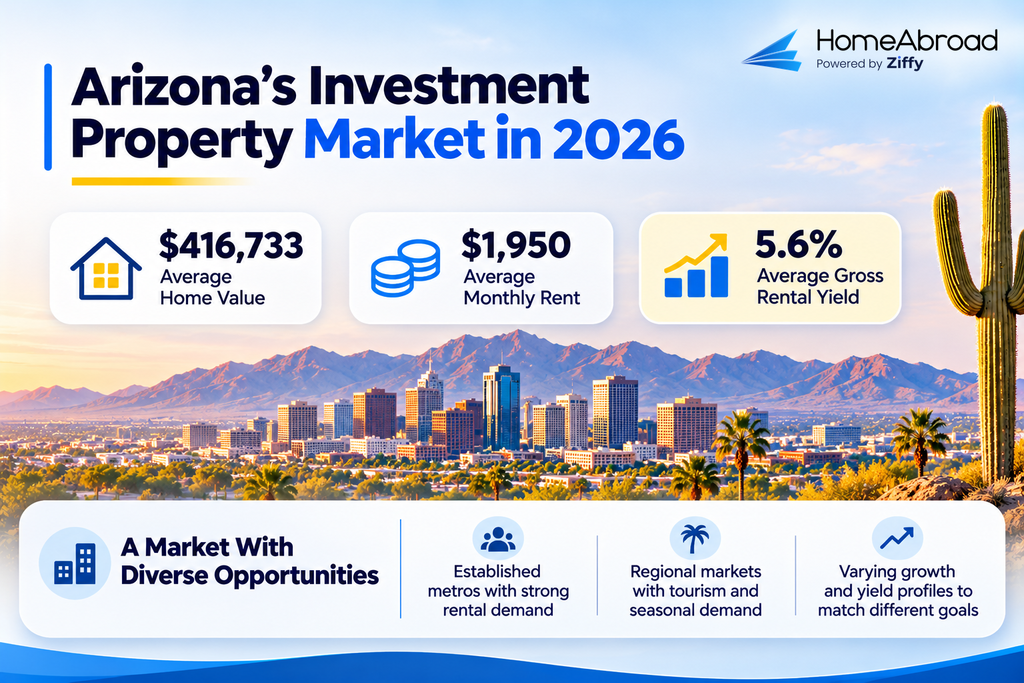
Arizona offers a relatively accessible entry point for real estate investors compared with several higher-priced US housing markets. The state’s average home value is approximately $416,733, with average monthly rent of $1,950 and an average gross rental yield of 5.6%. These figures provide a useful starting point for investors evaluating the state’s rental income potential and property acquisition costs.
The market also offers a mix of established metropolitan areas and smaller regional markets, each with different investment characteristics. Larger markets benefit from broader employment bases, established rental demand, and deeper housing markets. Smaller destinations can offer different opportunities through tourism, seasonal visitors, and comparatively affordable property prices.
Home value appreciation and rental income potential also vary across Arizona. Some markets have recorded stronger five-year property value growth, while others offer more attractive rental yields. This creates opportunities for investors with different priorities, from generating recurring rental income to building long-term property equity.

Steven Glick
Director of Mortgage Sales · HomeAbroad
When evaluating an investment property market, I encourage investors to look beyond the average rental yield. A market with strong rental demand may support consistent cash flow, while another may offer better potential for long-term appreciation. The right choice depends on the investor’s financial goals, property-level numbers, and how long they plan to hold the investment.
Long-Term vs Short-Term Rentals in Arizona: Which Strategy Fits Which Market
The ranking later in this guide labels each metro as either a long-term rental (LTR) market or a short-term rental (STR) market. The label describes the demand that the data and the local economy support best. It does not mean the other strategy is impossible there.
Strategy | Arizona metros that fit | What the data supports | What the data does not show |
|---|---|---|---|
Long-term rental (leases of 30 days or more) | Tucson, Yuma, Phoenix | Rent levels, five-year rent growth, gross yield on a 12-month lease | Vacancy, tenant turnover, management cost |
Short-term rental (stays under 30 days) | Lake Havasu City, Flagstaff, Show Low | Price, value growth, and the long-term rent a property would earn as a fallback | Nightly rates, occupancy, seasonality, platform fees, licensing cost |
Long-Term Rental Opportunities in Arizona
Tucson, Yuma, and Phoenix offer different advantages for investors pursuing long-term rental income. Tucson stands out for its rental performance, with five-year rent growth outpacing home value growth.
Yuma combines the lowest typical home value among the six ranked markets with the highest gross rental yield at 6.2%, making it attractive to investors focused on rental income and lower entry costs.
Phoenix offers a different advantage: its larger housing market, broader tenant base, and deeper resale market provide greater flexibility for investors building a rental portfolio from abroad.
Arizona’s rental regulations also influence the cost of owning and operating a long-term investment property. Investors should understand the following three rules before purchasing.
1. No Transaction Privilege Tax on Long-Term Residential Rentals
Arizona no longer applies its transaction privilege tax (TPT), the state’s sales-tax system, to residential rental properties leased for 30 days or longer. This change took effect on January 1, 2025. Before the change, many cities imposed TPT on residential rental income, adding to landlords’ operating costs. Removing this tax reduces the tax burden associated with long-term residential rentals and eliminates a cost that may still appear in older Arizona investment guides.
2. Property Tax Classification and Registration
Arizona classifies residential properties according to their use. Owner-occupied primary residences generally fall under Class 3, while other residential properties, including many rentals and second homes, fall under Class 4. Both classifications currently use a 10% assessment ratio, so the classification alone does not mean a rental property automatically carries a higher property tax rate.
Actual taxes depend on the property’s assessed value and applicable local tax rates. Rental property owners must also comply with county assessor registration requirements under A.R.S. § 33-1902.
3. Residential Landlord and Tenant Regulations
Long-term residential leases in Arizona are governed by the Arizona Residential Landlord and Tenant Act under A.R.S. Title 33, Chapter 10. The law establishes requirements covering security deposits, lease terms, landlord access, maintenance responsibilities, notices, and eviction procedures.
Arizona also prohibits local rent control under A.R.S. § 33-1329, preventing cities and towns from adopting rent control measures. Foreign investors should understand these requirements and account for local property management support when operating rentals remotely.
Short-Term Rental Opportunities in Arizona
Lake Havasu City, Flagstaff, and Show Low attract visitors for different reasons. Lake Havasu City draws tourists for its lake, boating, and Colorado River activities. Flagstaff benefits from its proximity to the Grand Canyon, Arizona Snowbowl, and Northern Arizona University, while Show Low attracts visitors looking for cabin stays and outdoor recreation in the White Mountains. These tourism-driven demand sources make the three markets worth considering for short-term rental investments.
The rental figures in this guide reflect long-term residential leases, so they provide a useful benchmark for evaluating alternative rental strategies. For example, Flagstaff’s typical monthly rent of $2,128 offers a reference point for estimating what a property might generate under a long-term lease if short-term bookings are inconsistent. Investors considering vacation rentals should separately evaluate nightly rates, occupancy, seasonal demand, cleaning expenses, platform fees, and property management costs. An Airbnb or short-term rental calculator can help estimate potential revenue for a specific property.
Arizona allows short-term rentals under state law, but owners must still comply with local licensing, safety, and operating requirements. Under A.R.S. § 9-500.39 and § 11-269.17, cities and counties generally cannot prohibit vacation rentals outright. However, cities can require local permits or licenses, liability insurance, emergency contact information, and notification of neighboring properties. Certain restrictions also apply to properties containing accessory dwelling units (ADUs) approved on or after September 14, 2024.
Short-term rental income remains subject to Arizona’s transaction privilege tax (TPT). Owners must obtain a TPT license even when bookings come exclusively through an online lodging marketplace such as Airbnb or Vrbo. These platforms generally collect and remit applicable taxes on bookings they facilitate, but owners still have reporting responsibilities and remain responsible for applicable taxes on direct bookings.
Local requirements can differ considerably. Flagstaff requires an annual short-term rental license, neighbor notifications, and, under its 2026 updates, at least $500,000 in liability insurance unless equivalent marketplace coverage applies. Scottsdale requires an annual city license and TPT registration, while Sedona has its own permit process.
Before purchasing, review the current city requirements, confirm the property can obtain the necessary license, and check HOA or condominium restrictions. State permission to operate a short-term rental does not override private community restrictions that may prohibit vacation rentals.
The 6 Best Places to Buy Investment Property in Arizona
The six metros below were ranked on gross yield and five-year growth in both values and rents, with a penalty for incomplete rent history, and then labeled by the strategy the figures support. The full method is explained in the methodology section.
Metro | Strategy | Typical home value | Typical monthly rent | Gross yield | 5-year value growth |
|---|---|---|---|---|---|
Tucson | LTR | $335,747 | $1,488 | 5.3% | 9.6% |
Yuma | LTR | $276,761 | $1,424 | 6.2% | 26.3% |
Lake Havasu City | STR | $349,800 | $1,540 | 5.3% | 8.2% |
Flagstaff | STR | $618,862 | $2,128 | 4.1% | 22.5% |
Show Low | STR | $393,924 | $1,745 | 5.3% | 14.4% |
Phoenix | LTR | $441,097 | $1,720 | 4.7% | 5.7% |
1. Tucson (Long-Term Rental)
Investment Properties Listed Today on Sale in Tucson
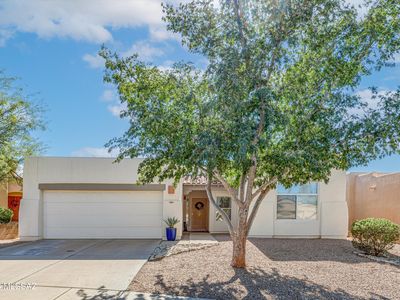


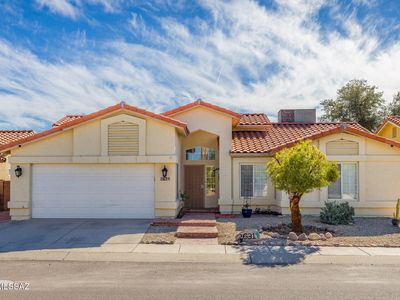
Tucson is first because its numbers hold together in a metro large enough to matter. Over five years, rents rose 14.9% while values rose 9.6%. When rent outpaces price, yield improves, and Tucson’s 5.3% gross yield is the result. The typical home costs $335,747, about $105,000 less than Phoenix, and the typical rent of $1,488 is only $232 lower, which is the whole case in two numbers.
Tucson fits an investor who wants a buy-and-hold rental in a metro with a university, a major air force base, and a diversified employer base, without paying Phoenix prices. [VERIFY: employer references if retained] It does not fit an investor whose main goal is appreciation. Five-year value growth here is half the US figure, and the metro’s typical value is below its 2024 level.
2. Yuma (Long-Term Rental)
Investment Properties Listed Today on Sale in Yuma
Yuma has the highest gross yield in the ranking, 6.2%, and the strongest five-year value growth, 26.3%, on the lowest typical price, $276,761. Typical rent is $1,424, only $64 below Tucson’s on a home that costs $59,000 less. The reason Yuma sits second rather than first is data, not performance. The rent index for Yuma begins in December 2021, so a true five-year rent figure does not exist, and the ranking method penalizes that gap.
Yuma also carries the trade-offs of a smaller metro: a thinner buyer pool when you sell, fewer property managers to choose from, and an economy tied to agriculture, the Marine Corps air station, and winter visitors. It fits a cash-flow investor who can hold through a slow resale. It does not fit an investor who needs to exit quickly.
3. Lake Havasu City (Short-Term Rental)
Investment Properties Listed Today on Sale in Lake Havasu City
Lake Havasu City is the strongest short-term rental candidate on the data. Long-term rents rose 18.4% over five years, the typical home costs $349,800, and the gross yield on a long-term lease is 5.3%. That last number is the fallback: a property bought for short-term use here can still produce a Tucson-level yield on a 12-month lease if the vacation strategy disappoints.
The demand base is the lake itself and the Colorado River, which draw boaters and winter residents from across the Southwest. Short-term returns depend on how well a property is run, and running one from another country means hiring a local manager and paying for it, which the gross yield does not reflect. Budget for a manager before you count on the short-term numbers; an investor who wants passive income will do better with a 12-month lease here or in Tucson.
4. Flagstaff (Short-Term Rental)
Investment Properties Listed Today on Sale in Flagstaff
Flagstaff is the only Arizona metro in this ranking where both five-year value growth (22.5%) and rent growth (20.5%) exceed the US figures. It also has the highest typical rent in the state, $2,128. The price of that performance is the entry cost, $618,862 for a typical home, which produces the lowest gross yield in the ranking at 4.1%.
The demand comes from the Grand Canyon, Arizona Snowbowl, and Northern Arizona University, and it runs year-round rather than in one season. Flagstaff requires a city short-term rental license. [VERIFY: Flagstaff STR licensing ordinance, fee, and renewal terms] The buyer this suits is combining appreciation with short-term income, can make a larger down payment, and accepts that the yield will stay thin for years.
5. Show Low (Short-Term Rental)
Investment Properties Listed Today on Sale in Show Low
Show Low is a cabin market in the White Mountains, about three hours from Phoenix, and it draws Phoenix residents escaping summer heat. The typical home costs $393,924, typical rent is $1,745, and the gross yield on a long-term lease is 5.3%, matching Tucson. Values rose 14.4% over five years.
Rent data for Show Low only begins in March 2025, which is why it ranks fifth despite a yield equal to Tucson’s. Nineteen months of rent history is not enough to show a trend. The typical Show Low buyer wants a second home that earns short-term income in the months they are not using it, and is underwriting the purchase on that plan rather than on a rent history the market cannot yet provide.
6. Phoenix (Long-Term Rental)
Investment Properties Listed Today on Sale in Phoenix
Phoenix ranks sixth on the data and first on almost everything the data cannot measure. Gross yield is 4.7%, and five-year growth is the weakest in the table, 5.7% for values and 5.3% for rents, for the base-date reason explained in the market overview. What Phoenix offers instead is the largest tenant pool in the state, the most property managers, the most lenders familiar with foreign-national borrowers, and a resale market where a correctly priced home sells without the owner flying in.
Scottsdale, the metro’s main short-term rental district, sits inside the Phoenix metro and has no separate figures in this dataset, so it is not ranked. Investors considering Scottsdale should treat it as a distinct market with its own licensing rules. Choose Phoenix if you value liquidity and a long holding period over current yield, and look to Tucson or Yuma if the yield matters more.
In smaller markets like Yuma and Show Low, finding comparable sales and rental properties can be more challenging. This may affect appraisal timelines and how qualifying rental income is established. Having relevant property and rental data available can help keep the underwriting process on track.

Other Arizona Markets Worth Considering
Beyond the six ranked markets, several other Arizona locations offer investment potential but lack sufficient data for a consistent comparison. Here are three worth noting:
Prescott Valley: The market has a typical monthly rent of $1,883, with five-year rent growth of 14.8%. However, a corresponding home-value index is unavailable in the dataset, making it difficult to calculate gross rental yield and five-year value appreciation.
Sierra Vista: With a typical home value of $260,537, monthly rent of $1,278, and gross rental yield of 5.9%, Sierra Vista offers another option for investors seeking relatively affordable rental properties. Home values increased by 14.0% over five years. Its rent data begins in December 2021, limiting the available comparison period.
Payson, Nogales, and Safford: These markets have limited rental history, ranging from two to eighteen months. As a result, their rental yields may not reflect consistent market conditions. Nogales, for example, shows a gross yield above 8%, but that figure is based on only two months of rental data and should be interpreted cautiously.
How We Evaluated Arizona’s Investment Markets
Every figure in this guide can be reproduced from two public datasets, and this section explains how.
Data Sources
Home values come from the Zillow Home Value Index (ZHVI) for the middle tier of the market, smoothed and seasonally adjusted, at the metropolitan area level. “Typical” in this guide means the ZHVI value, which represents homes between the 35th and 65th percentile of the market, not a simple average or a median of sales.
Rents come from the Zillow Observed Rent Index (ZORI) for single-family homes, condos, and multifamily units, smoothed, at the metropolitan area level. ZORI measures asking rents on long-term leases, which is why the figures for short-term rental markets are presented as a fallback rather than as expected income.
Both series were taken for September 2026, with September 2021 as the five-year base. All eleven Arizona metropolitan areas in the files were reviewed. Metro boundaries follow US Census definitions, so “Phoenix” includes Mesa, Scottsdale, Chandler, Gilbert, Tempe, Glendale, and the rest of Maricopa and Pinal counties.
How Each Metric Is Calculated
- Annual rent is typical monthly rent multiplied by 12.
- Gross rental yield is annual rent divided by typical home value, expressed as a percentage. It is calculated before property tax, insurance, HOA dues, vacancy, repairs, management, and loan payments.
- Five-year growth is the September 2026 figure divided by the September 2021 figure, minus one, for values and for rents separately.
How the Ranking Was Built
Metros were ordered on gross yield and five-year value and rent growth together, with a penalty for a missing or short rent series. Each was then labeled as a long-term or short-term rental market based on the demand base that supports its figures. The ranking is an editorial comparison on one consistent dataset. It is not a prediction of future returns, and a different dataset or base date would produce a different order.
Taxes on Rent and on Sale
Two Arizona rules affect rental income and were introduced in the strategy section: the end of TPT on long-term residential rentals from 1 January 2025, and the continuing TPT on short-term stays. Both should be confirmed with the Arizona Department of Revenue before you budget.
Two federal tax rules are particularly relevant to foreign nationals investing in US rental property. Rental income earned by nonresident aliens is generally subject to 30% tax on gross income, unless a lower treaty rate applies or the investor makes a Section 871(d) election to deduct eligible expenses and pay tax on net rental income at applicable rates.
When a foreign owner sells US real estate, FIRPTA generally requires the buyer to withhold a portion of the sale proceeds for federal tax purposes. The withholding rate depends on the transaction value and the buyer’s intended use of the property. The withheld amount is credited toward the seller’s final tax liability.
Foreign investors can explore these rules in our guides to Section 871(d) Net Election and FIRPTA Withholding. A cross-border tax professional can help determine how these rules apply to their ownership structure.
Financing and Investor Support for Arizona Rentals
Foreign nationals can finance investment properties in Arizona through HomeAbroad, even without an established US credit history. HomeAbroad offers DSCR loans that allow international investors to qualify based on the property’s rental income.
A DSCR (Debt Service Coverage Ratio) loan evaluates whether a property’s rental income can cover its monthly mortgage payment, including principal, interest, property taxes, insurance, and applicable HOA dues. This allows foreign investors to finance Arizona rental properties using the income the property generates, without relying on their personal income or US tax returns.
HomeAbroad also helps investors find suitable investment opportunities through its AI-native investment property search platform. Investors can explore available properties across Arizona and identify opportunities that align with their investment goals.
With financing and property discovery support under one platform, HomeAbroad helps foreign investors move from identifying an investment property to financing their purchase.
If you’re considering an Arizona rental property, pre-qualify with HomeAbroad to explore your financing options and understand the mortgage payment your investment property may carry.
Frequently Asked Questions
Can Foreign Nationals Buy Investment Property in Arizona?
Yes. Arizona places no general restriction on foreign nationals owning residential property, and the purchase process is the same as for a US buyer. Owning property does not grant a visa, residency, or citizenship. The differences for a foreign buyer show up in financing, where an established US credit history is usually absent, and in taxes, where FIRPTA withholding applies at sale.
What Is the Best Place to Buy Rental Property in Arizona?
On the September 2026 data, Tucson is the best long-term rental market, combining a 5.3% gross yield with five-year rent growth that outpaced value growth. Lake Havasu City is the best short-term rental candidate, with 18.4% five-year rent growth and a 5.3% long-term yield as a fallback. Yuma has the highest gross yield in the state at 6.2% but a shorter rent history.
Is Arizona a Good Place to Invest in Real Estate?
It depends on which Arizona you mean. Gross yields across the ranked metros run from 4.1% to 6.2%, and five-year value growth runs from 5.7% in Phoenix to 26.3% in Yuma. An investor who wants liquidity will find it in Phoenix at a lower yield; an investor who wants cash flow will find it in Tucson or Yuma at the cost of a thinner resale market. The state’s rental rules, including the removal of TPT on long-term rentals and the limits on city short-term rental bans, are generally favorable to landlords.
Is It a Buyer’s or Seller’s Market in Arizona?
The five-year figures show two different markets. Phoenix and Tucson values are below their 2022 and 2024 peaks, which gives a buyer more room than in the smaller metros, where values have risen between 14% and 26% over five years without a comparable correction.
What Are Arizona’s Short-Term Rental Laws?
State law prevents Arizona cities and counties from banning short-term rentals or capping their number, but it allows them to require a license, insurance, an emergency contact, and neighbor notification, and to suspend a license after repeated violations. Short-term stays remain subject to transaction privilege tax. Flagstaff, Scottsdale, and Sedona have their own licensing programs, and an HOA can prohibit short-term rentals regardless of city rules.
Can I Get a Mortgage on an Arizona Rental Without US Credit History?
Yes. HomeAbroad’s DSCR loan qualifies on the property’s rent rather than on a US credit score, so a foreign national without an established US credit history can apply. You will still need to document identity, source of funds, and reserves, and the property’s rent must cover the mortgage payment at the ratio the program requires.
Do I Pay Tax When I Sell Arizona Property as a Foreign National?
Usually, yes. Under FIRPTA, the buyer withholds 0%, 10%, or 15% of the sale price depending on the price and whether the buyer will live in the home, and sends it to the IRS as a prepayment of your capital gains tax. You then file a US return to settle the actual tax due and claim any refund. Arizona also taxes capital gains as income for nonresidents.