




![H1B Wage Levels [2026]: A Definitive Guide](https://homeabroadinc.com/wp-content/uploads/2022/06/H1B-Wage-Level-500x325.jpg)

Editorial Integrity
Moving to the US can feel overwhelming, filled with unknowns and uncertainties. HomeAbroad editorial team includes certified immigration experts/USCIS nerds who translate complex legalese into clear, actionable moving and visa guides. Rest assured, every article undergoes a reader-centric editorial process to ensure accuracy and reflect current regulations.
Quick Answer:
H1B wage levels are part of the prevailing wage framework used for jobs in a specific occupation and area of intended employment. There are four wage levels, but there is no single national H1B salary floor that applies to every case. The employer must generally pay the higher of the prevailing wage or the actual wage, and the official wage data is available through the DOL’s FLAG wage search tools.
Understanding H1B wage levels can make the visa process much easier to follow. They help explain how an employer’s offered wage is benchmarked for a specific job in a specific location, and they also shape what appears on the Labor Condition Application, or LCA. For the current wage cycle, the Department of Labor’s active wage year runs from July 2025 through June 2026, and DOL has also applied updated metropolitan area definitions based on the 2020 Census.
In our experience, the biggest point of confusion is this: an H1B wage level is not the same thing as a nationwide minimum H1B salary. The core wage rule is simpler than many guides make it sound. An H1B employer must generally pay at least the required wage, which is the higher of the prevailing wage or the employer’s actual wage for similarly employed workers.
Table of Contents
What are H1B Wage Levels?
H1B wage levels are tied to the prevailing wage system used in the foreign labor process. DOL explains that the prevailing wage rate is the average wage paid to similarly employed workers in a specific occupation in the area of intended employment. DOL also notes that this wage data is available through FLAG and is based on BLS Occupational Employment and Wage Statistics data.
What most guides do not explain clearly is that wage levels should not be treated as a simple years-of-experience chart. They are tied to the job opportunity itself, including the nature of the work, the level of responsibility, and the labor market for that occupation and location. That is why two jobs with similar titles can still fall at different wage levels.
How the Four H1B Wage Levels Usually Work
In practical DOL guidance, Level I is associated with beginning-level work, Level II with qualified employees, Level III with experienced employees, and Level IV with fully competent employees who can handle more independent judgment and responsibility.
DOL’s wage guidance describes Level I roles as beginning-level positions under closer supervision, Level II roles as moderately complex positions requiring limited judgment, Level III roles as positions requiring stronger occupational understanding and judgment, and Level IV roles as positions requiring independent evaluation and application of standard procedures and techniques.
That said, these labels are best understood as broad skill and responsibility markers, not rigid national experience bands. A job’s duties, educational requirements, occupational context, and work location all affect how the wage level is assessed.
The following table will help you compare various wage levels and corresponding information.
Wage Level | Wage | Job Type | Experience | Examples |
|---|---|---|---|---|
Level 1 | Lower | Entry-level | 0-2 years | Junior Software Developer, Research Assistant |
Level 2 | Moderate | Qualified | 2-5 years | Experienced Financial Analyst, Mid-level Project Coordinator |
Level 3 | Higher | Experienced | 5-10 years | Senior Software Engineer, Marketing Manager with several years of experience |
Level 4 | Highest | Advance | 10+ years | Senior Research Scientist, High-level Management Role, Specialized Consultant |
(Source: h1bgrader)
Understanding your wage level also helps you plan for major financial decisions like homeownership. H1B visa holders can qualify for mortgages with HomeAbroad even without US credit history.
What Wage Must an H-1B Employer Actually Pay?
DOL says the H1B employer must pay at least the required wage, which is the higher of the prevailing wage or the employer’s actual wage for similarly employed workers. The actual wage is the wage rate paid by the employer to individuals with similar experience and qualifications for the specific employment in question at the place of employment.
The reason this matters is that the H1B wage rule has two protections built into it. First, the employer cannot underpay compared with the local prevailing market for that role. Second, the employer cannot pay the H1B worker less than similarly situated workers internally if the employer’s actual wage is higher.
Is There an H-1B Minimum Salary in 2026?
There is no single nationwide H1B minimum salary that applies to every petition. The commonly cited $60,000 figure is not the universal H1B minimum. DOL uses that number in a specific context for certain “exempt” H1B nonimmigrants, not as the general wage floor for all H1B workers.
The required wage depends on the occupation, the area of intended employment, the prevailing wage source used, and the employer’s actual wage structure. If you are trying to understand whether an offer is compliant, the right comparison is not a national flat salary number. It is the required wage rule for that specific role and location.
How Prevailing H1B Wage is Determined
DOL explains that employers can obtain the prevailing wage by submitting a request to the National Prevailing Wage Center, or by using other legitimate sources of information such as the OFLC Wage Search for certain programs. For H1B, H1B1, and E-3 cases, DOL says employers may submit a prevailing wage request to the NPWC or independently determine the prevailing wage when filing the LCA.
Technically speaking, the most important inputs are the occupation, the area of intended employment, and the role’s level in the market. That is why location matters so much. A software-related role in one metro area may carry a different prevailing wage than a similar role in another metro area.
2026 H1B Updates
As of March 17, 2026, the current OFLC wage year in FLAG is July 2025 through June 2026. DOL published this wage-year update on July 1, 2025, and noted that the May 2024 OEWS wage estimates now reflect updated metropolitan delineations based on the 2020 Census. DOL also noted that New England area definitions changed because the older NECTA framework was discontinued for this wage year.
There is also a current USCIS cap-season update worth knowing. USCIS says the FY 2027 H1B initial registration period opened at noon Eastern on March 4 and runs through noon Eastern on March 19, 2026. USCIS registration materials also state that registrants must provide the highest OEWS wage level that the beneficiary’s proffered wage equals or exceeds for the relevant SOC code.
Wage level still matters for wage compliance, but in current cap-subject registration it is also more visible in the USCIS registration process than it was in older H1B cycles.
What Does the LCA Actually Do?
The LCA is an important step in the H1B process, but it should be described precisely. DOL says LCAs are reviewed within seven working days for completeness and obvious errors or inaccuracies. Once the LCA is certified, the employer may proceed with the process of obtaining an H1B, H1B1, or E-3 visa through USCIS and the Department of State.
To be clear, the LCA is primarily about labor-condition attestations, wage information, and worksite-related compliance. It is not the step where DOL broadly decides whether a worker’s skills are unavailable in the US.
How to Check Your H1B Wage Level Using Official DOL Tools
The most reliable starting point is the DOL’s FLAG wage search. DOL says its wage data for the foreign labor certification process is available on FLAG, and the prevailing wage pages point users directly to the OFLC Wage Search tool.
A practical way to check it is to start with your occupation or SOC code, then choose the state and area of intended employment, and review the wage data shown for the current wage year. If your employer obtained a prevailing wage from the NPWC, that can also be part of the record supporting the wage listed in the case.
Here’s a step-by-step guide to using the flag.dol.gov site to calculate the minimum wage (prevailing wage) for an H1-B job position:
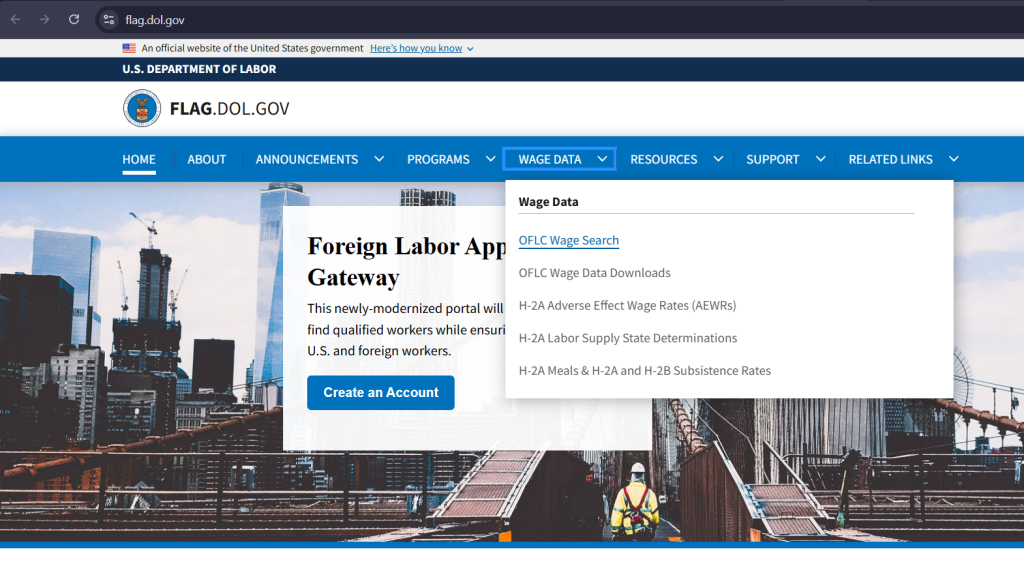
Step 1: “Select Wizard”
Go to the Foreign Labor Application Gateway website, go to the wage data and click on OFLC wage search from the menu at the top.
Step 2: “Fill in the Required Details”
You’ll need to fill out the form step by step. First, select a Data Series, which means choosing the year for which you want the wage data. Next, select a Collection, consider all industries first. Then, enter the Occupation (O*NET) Code and Title; if you don’t know the exact code, there’s a search option to help you find it.
After that, choose the State or Territory where the job will be located. Once the state is set, you’ll need to select an Area Type (such as County or BLS-defined area), and finally, pick the specific Area (like the county or township) where you’ll be working.
Step 3: “Hit search”
Once you fill out all the sections hit search, you’ll see a list of wage information. It will show all the wage levels and the minimum wage for each one.
It is essential for your H1B paperwork and approval with DOL and USCIS. Also, inquire about the Standard Occupation Classification (SOC) code they plan to use for the job. You’ll be able to view that as well. Finally, one of the most important questions you should ask your employer or learn is the wage rate being offered for your job.
How to Confirm the Wage Details in Your Own Case
If your employer has already filed the LCA, your certified LCA and related public access materials are key documents to review. DOL says H1B employers must make certain materials available to the public within one working day of filing the LCA, including the LCA itself, the rate of pay, a description or summary of the actual wage system, and the prevailing wage rate and its source.
A pattern we often notice is that workers focus only on the salary figure and do not compare the full set of details. The smarter review is to look at the job title, worksite, wage source, and the listed rate together. If one of those pieces is off, the wage analysis may be off too.
What Factors Affect H1B Wages?
The biggest factors are the occupation, the geographic area of intended employment, the prevailing wage source, and the employer’s internal actual wage for similarly employed workers. DOL’s guidance also makes clear that wage analysis is tied to the role being offered in that specific labor market, not to a broad national average applied to every case.
What actually matters most is not whether a salary sounds high or low in the abstract. What matters is whether it satisfies the required wage rule for that job, in that area, under that employer’s wage structure.
Conclusion
H1B wage levels are best understood as part of the prevailing wage framework, not as a simple experience chart and not as a single national salary rule. The most important rule is still the same in 2026: the employer must generally pay the higher of the prevailing wage or the actual wage. If you want the most accurate answer for your own case, use the official DOL tools and review the wage details attached to your LCA.
FAQs
Does every H1B worker have to earn at least $60,000?
No. That figure applies to a specific “exempt” H1B context for certain employers. It is not the universal minimum salary for all H1B workers.
Is there one national H1B wage chart?
No. Wage levels depend on the occupation, the area of intended employment, and the wage data or wage source used in the case. FLAG provides official wage search tools for this purpose.
Can I check my H1B wage level myself?
Yes. The best place to start is the DOL’s FLAG wage search. You can also compare it with your LCA and related wage records.
What happens if my employer does not pay according to the H1B LCA prevailing wage?
Review your wage documents first, then check the DOL WH-4 complaint process if you believe there is an H1B violation.
How is the prevailing wage calculated?
The prevailing wage for the occupations covered by the program is established through surveys of wages paid. Salaries are paid in those jobs in surrounding areas to ensure that the pay rates reflect local economic conditions. A state with a higher salary for a given position will have a higher wage than most people are paid for that same position.
How to find an H1B prevailing wage job?
There are a few ways that you can look for H1B prevailing wage jobs:
1. Check the Department of Labor website.
2. Check job boards and classifieds.
3. Attend job fairs.
4. Register with employment agencies
At HomeAbroad, we ensure the reliability of our content by relying on primary sources such as government data, industry reports, firsthand accounts from our network of experts, and interviews with specialists. We also incorporate original research from respected publishers when relevant. Discover more about our commitment to delivering precise and impartial information in our editorial policy.
H1B Grader: H1B Salaries Distribution, Find Prevailing Wage Levels
Foreign Labor Application Gateway: https://flag.dol.gov/




![How to Buy a House on an H1B Visa [2026]](https://homeabroadinc.com/wp-content/uploads/2021/08/BuyingonH1BVisa-scaled.jpg)
![Can Foreigners Buy Property in the USA? [2026]](https://homeabroadinc.com/wp-content/uploads/2021/07/CanForeignersBuyinUS.jpg)