



Editorial Integrity
Making informed real estate decisions starts with having the right knowledge. At HomeAbroad, we offer US mortgage products for foreign nationals & investors and have a network of 500+ expert HomeAbroad real estate agents to provide the expertise you need. Our content is written by licensed mortgage experts and seasoned real estate agents who share insights from their experience, helping thousands like you. Our strict editorial process ensures you receive reliable and accurate information.
A 1031 exchange allows investors to defer capital gains taxes and depreciation recapture by reinvesting into qualifying like-kind real estate.
Investors must identify replacement properties within 45 days and generally complete the exchange within 180 days of selling the relinquished property.
Foreign investors can use 1031 exchanges, but FIRPTA withholding may affect the amount of cash available for the replacement property.
A properly structured exchange, combined with early FIRPTA planning and the right financing strategy, can help foreign investors keep more capital invested in US real estate.
A 1031 exchange allows real estate investors to defer capital gains taxes by reinvesting the proceeds from the sale of an investment property into another qualifying property. Rather than paying tax immediately after a sale, investors can continue growing their portfolio while postponing the tax liability to a future transaction.
For foreign investors, however, a 1031 exchange involves more than just meeting the standard 45-day and 180-day deadlines. Rules such as FIRPTA withholding, taxpayer identification requirements, and cross-border tax considerations can affect how much cash is available for the replacement property and how smoothly the exchange process unfolds.
HomeAbroad works with foreign national investors purchasing and refinancing US real estate through foreign national mortgage programs. One of the most common questions investors ask when planning a sale is whether a 1031 exchange can help reduce taxes while keeping more capital invested in US real estate. The answer is often yes, but only when the exchange is structured correctly and the required deadlines and compliance rules are followed.
This guide explains how a 1031 exchange works, the key rules and timelines investors must understand, the different types of exchanges available, and the common mistakes that can trigger unexpected taxes. You’ll also learn how FIRPTA affects foreign sellers and what steps can help keep a like-kind exchange on track from sale to replacement purchase.
Table of Contents
What is a 1031 Exchange and How Does it Work?
A 1031 exchange is a tax-deferral strategy that allows real estate investors to sell an investment property and reinvest the proceeds into another qualifying property without immediately paying capital gains tax. The exchange is authorized under Section 1031 of the Internal Revenue Code and is commonly referred to as a like-kind exchange.
The term “like-kind” often causes confusion. In real estate, it does not mean the replacement property must be identical to the property being sold. Instead, both properties must generally be held for investment or business purposes and must qualify as real property under IRS rules. For example, an investor may exchange a single-family rental property for a multifamily building, commercial property, vacant land, or another investment property.
Since the Tax Cuts and Jobs Act (TCJA) took effect in 2018, Section 1031 exchanges have been limited to real property. Personal property exchanges, such as vehicles, equipment, artwork, and other non-real-estate assets, no longer qualify for tax deferral under Section 1031.
The primary benefit of a 1031 exchange is that it allows investors to defer capital gains taxes and depreciation recapture that would otherwise be triggered by the sale of an investment property. Rather than paying tax immediately after a sale, investors can keep more capital invested in real estate and continue growing their portfolio through future acquisitions.
How a 1031 Exchange Works and Why You Need a Qualified Intermediary
While a 1031 exchange can defer capital gains taxes, the IRS imposes strict rules on how the transaction must be structured. One of the most important requirements is that the investor cannot take direct possession of the sale proceeds.
To comply with Section 1031, investors typically work with a qualified intermediary (QI), an independent third party that holds the exchange funds between the sale of the relinquished property and the purchase of the replacement property.
If the investor receives or controls the proceeds from the sale, even temporarily, the transaction may no longer qualify for tax-deferred treatment. This concept is known as actual or constructive receipt and is one of the most common reasons exchanges fail.
The qualified intermediary acts as the bridge between the sale of the relinquished property and the purchase of the replacement property. The QI prepares the exchange documentation, safeguards the proceeds, and transfers the funds to complete the acquisition of the replacement property.

Lucas Hernandez
Mortgage Loan Originator, HomeAbroad
One of the most common mistakes investors make is waiting until after the sale to think about the replacement property. Having financing options and potential replacement properties lined up early can make it much easier to stay on track once the exchange deadlines begin.
A typical 1031 exchange follows these steps:
- Sell the relinquished investment property.
- Transfer the sale proceeds to a qualified intermediary.
- Identify one or more replacement properties within the required IRS timeframe.
- Purchase a qualifying replacement property using the exchange funds held by the QI.
- Defer recognition of the capital gain by meeting all Section 1031 requirements.
Because the exchange rules are highly procedural, many investors begin evaluating replacement properties and financing options before listing the relinquished property for sale. This can help reduce time pressure once the exchange deadlines begin.
If you’re evaluating the potential tax benefits of an exchange, our 1031 Exchange Calculator can help estimate how much capital may remain invested by deferring capital gains taxes.
The 45-Day and 180-Day Deadlines Every Investor Must Know
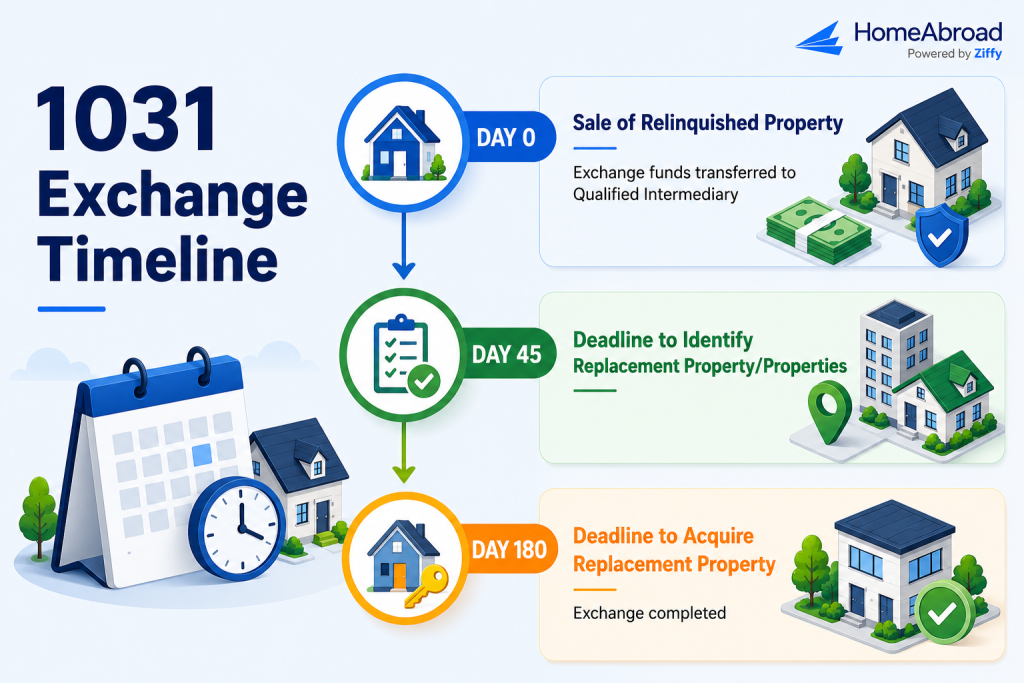
A 1031 exchange is governed by two strict IRS deadlines. Missing either deadline can cause the exchange to fail, resulting in immediate recognition of the deferred gain and a potential capital gains tax bill.
Both deadlines begin on the day the relinquished property closes, not when the investor starts searching for a replacement property.
The 45-Day Identification Period
Within 45 calendar days of selling the relinquished property, the investor must identify one or more potential replacement properties in writing. The identification must be delivered to the qualified intermediary or another party involved in the exchange and must comply with IRS identification requirements.
The 45-day period is often the most challenging part of the exchange process because investors must evaluate markets, conduct due diligence, review financing options, and narrow their choices within a relatively short timeframe.
The 180-Day Exchange Period
After the sale of the relinquished property, the investor generally has 180 calendar days to complete the purchase of the replacement property. However, the deadline may be shortened if the investor’s tax return due date arrives before the 180-day period ends, unless an extension is filed. For that reason, investors should consult their tax advisor when planning an exchange that closes later in the tax year.
The 180-day clock includes the initial 45-day identification period. In other words, investors do not receive 45 days plus an additional 180 days. Both deadlines run concurrently, with the 180-day period beginning on the same day as the 45-day identification period.

One of the biggest risks we see is investors underestimating how quickly the timeline moves. Financing, inspections, and closing requirements can take longer than expected, so it’s often beneficial to start evaluating replacement properties and financing options before the original property is sold.
Because these deadlines cannot generally be extended simply because a property falls out of contract, financing is delayed, or a buyer changes plans, investors should have a clear strategy for identifying and acquiring replacement property before entering the exchange process.
Identification Rules: The 3-Property, 200%, and 95% Rules
Identifying replacement properties is one of the most important steps in a 1031 exchange. The IRS allows investors to identify properties using one of three methods. Most exchanges use the 3-Property Rule, but the other options can be useful in larger or more complex transactions.
1. The 3-Property Rule
The most common identification method allows an investor to identify up to three replacement properties, regardless of their value. The investor can ultimately acquire one, two, or all three of the identified properties.
Example: An investor sells a rental property and identifies three potential replacements: a multifamily property, a retail building, and a vacation rental held for investment.
2. The 200% Rule
An investor may identify more than three properties as long as the combined fair market value of all identified properties does not exceed 200% of the value of the relinquished property.
Example: If the relinquished property sells for $1 million, the investor can identify five replacement properties with a combined value of up to $2 million.
3. The 95% Rule
Investors can identify any number of properties with no value limit, but they must ultimately acquire at least 95% of the total value of all identified properties.
Example: An investor identifies ten properties worth a combined $5 million. To satisfy the rule, the investor must acquire properties totaling at least $4.75 million.
Most investors rely on the 3-Property Rule because it offers the greatest flexibility with the least complexity. However, investors pursuing larger portfolios or multiple acquisitions may benefit from the 200% or 95% identification methods.
Rule | What It Allows | Example |
|---|---|---|
3-Property Rule | Identify up to 3 properties regardless of value | 3 properties worth any amount |
200% Rule | Identify multiple properties up to 200% of sale value | $1M sale: identify up to $2M total |
95% Rule | No limit on properties or value | Must acquire at least 95% of identified value |
Types of 1031 Exchanges: Delayed, Reverse, Improvement, and Simultaneous
Not all 1031 exchanges follow the same structure. While delayed exchanges are the most common, investors may choose a reverse, improvement, or simultaneous exchange depending on their investment goals, market conditions, and timing requirements.
Exchange Type | Best For | Main Advantage | Key Consideration |
|---|---|---|---|
Delayed | Most investors | Simplest structure | Must meet 45-day and 180-day deadlines |
Reverse | Competitive markets | Buy before selling | Higher complexity and cost |
Improvement | Renovation projects | Exchange funds can improve property | Improvements must be completed on time |
Simultaneous | Coordinated transactions | Immediate replacement | Difficult to align both closings |
Delayed Exchange
A delayed exchange is the most common type of 1031 exchange. The investor sells the relinquished property first and then acquires the replacement property within the required IRS deadlines.
This structure is often preferred because it provides time to identify suitable replacement properties after the original property is sold. However, investors must still comply with the 45-day identification period and the 180-day exchange deadline.
Reverse Exchange
A reverse exchange allows an investor to acquire the replacement property before selling the relinquished property.
This approach can be valuable in competitive markets where a desirable replacement property becomes available before the investor is ready to sell. Because specialized holding arrangements are typically required, reverse exchanges are generally more complex and expensive than traditional delayed exchanges.
Improvement (Build-to-Suit) Exchange
An improvement exchange allows exchange proceeds to be used for qualifying improvements on the replacement property before the exchange is completed.
Investors often use this structure when a replacement property requires renovations, expansion, or other improvements to better match their investment objectives. Any improvements intended to count toward the exchange generally must be completed within the exchange period.
Simultaneous Exchange
A simultaneous exchange occurs when the relinquished property and replacement property are transferred on the same day.
While this structure can simplify certain aspects of the exchange process, coordinating two transactions to close simultaneously can be difficult. As a result, simultaneous exchanges are less common than delayed exchanges.
Most investors use a delayed exchange because it offers the greatest flexibility. Reverse exchanges can be valuable when the right replacement property becomes available first, but they typically require more planning, coordination, and financing considerations.

The right exchange structure depends on the investor’s timeline, available capital, replacement-property strategy, and financing needs. For most investors, a delayed exchange provides the simplest path, while reverse and improvement exchanges offer additional flexibility when circumstances require a different approach.
Boot, Partial Exchanges, and the Equal-or-Up Rule
A 1031 exchange only provides full tax deferral when all IRS requirements are met. If an investor receives cash, reduces debt without replacing it, or fails to reinvest all exchange proceeds, part of the transaction may become taxable. This taxable portion is commonly known as boot.
Cash Boot
Cash boot occurs when an investor receives cash from the exchange rather than reinvesting all proceeds into the replacement property.
Example: An investor sells a property and receives $100,000 from the exchange proceeds instead of applying those funds toward the replacement property. That $100,000 may be taxable even if the rest of the transaction qualifies for Section 1031 treatment.
Mortgage or Debt Boot
Debt boot occurs when the mortgage on the replacement property is smaller than the debt paid off on the relinquished property and the difference is not offset with additional cash.
Example: An investor pays off a $700,000 mortgage when selling a property but takes on only a $500,000 mortgage when purchasing the replacement property. The $200,000 reduction in debt may create taxable boot unless additional capital is contributed to the transaction.
Understanding the Equal-or-Up Rule
Many investors use a simple guideline known as the “equal-or-up rule.” To maximize tax deferral, the replacement property should generally be equal to or greater in value than the relinquished property, and all net exchange proceeds should be reinvested.
Consider an investor who sells a property for $1.5 million. To achieve full tax deferral, the investor purchases a replacement property worth $2 million, reinvests all exchange proceeds, and replaces any debt that was paid off at closing. Because no cash is taken out of the transaction and the replacement property is of greater value, the exchange is more likely to qualify for full tax deferral.
The presence of boot does not automatically disqualify a 1031 exchange. Instead, it usually means that a portion of the gain may become taxable while the remaining gain continues to receive deferred treatment. Understanding these rules before listing a property can help investors avoid unexpected tax consequences at closing.
Depreciation Recapture and the 25% Tax Rate
Many real estate investors claim depreciation deductions during ownership to reduce taxable rental income. While these deductions can provide meaningful tax benefits, they may create an additional tax consideration when the property is eventually sold.
When a depreciated property is sold, the IRS generally requires a portion of the gain attributable to prior depreciation deductions to be recaptured. This amount is commonly referred to as unrecaptured Section 1250 gain and can be taxed at rates of up to 25%.
For example, if an investor claimed $100,000 in depreciation deductions over several years, that depreciation may reduce the property’s tax basis and increase the taxable gain recognized at sale. A portion of that gain could be subject to the 25% recapture rate.
One advantage of a properly structured 1031 exchange is that both capital gains tax and depreciation recapture are generally deferred rather than immediately recognized. Instead of paying tax when the relinquished property is sold, the investor carries the deferred gain and depreciation adjustments into the replacement property.
However, the tax is deferred, not eliminated. If the investor later sells the replacement property without completing another qualifying exchange, both the deferred capital gain and any applicable depreciation recapture may become taxable.
For investors with long holding periods and substantial depreciation deductions, understanding how recapture works can be just as important as understanding the capital gains tax itself.
1031 Exchanges for Foreign Investors and FIRPTA
Foreign investors can use a 1031 exchange on the same terms as US investors. The property must be held for investment or business purposes, the replacement property must qualify as like-kind real estate, and the 45-day and 180-day deadlines still apply.
The difference is that foreign sellers must also consider the Foreign Investment in Real Property Tax Act (FIRPTA), which can affect the amount of cash available to complete the exchange.
FIRPTA (Foreign Investment in Real Property Tax Act) generally requires buyers to withhold a portion of the sale proceeds when purchasing US real estate from a foreign seller. Many investors are familiar with the commonly cited 15% withholding rate, but the actual withholding rules depend on factors such as the sales price and how the buyer intends to use the property.
Current FIRPTA withholding rules generally fall into three categories:
- 0% withholding if the buyer intends to use the property as a residence and the amount realized is $300,000 or less.
- 10% withholding if the buyer intends to use the property as a residence and the amount realized is more than $300,000 but not more than $1 million.
- 15% withholding in most other transactions.
One important detail is that FIRPTA withholding is based on the amount realized, which is generally the gross sales price, rather than the seller’s actual gain.
For example, if a foreign investor sells an investment property for $1.5 million, the default 15% withholding could result in $225,000 being withheld at closing. This withholding applies regardless of the investor’s actual profit or the amount of tax ultimately owed.
That can create challenges in a 1031 exchange because those proceeds are often intended to be reinvested into the replacement property. Having a significant portion of the sale proceeds withheld may reduce the funds available for the next purchase.
One solution is IRS Form 8288-B, which allows eligible sellers to apply for a withholding certificate. When approved, the certificate may reduce withholding to the amount of tax actually expected to be due rather than the default FIRPTA withholding amount. For example, on a $1.5 million sale where the default withholding would be $225,000, an approved withholding certificate could significantly reduce the amount withheld if the seller’s projected tax liability is substantially lower.
Lucas Hernandez
Mortgage Loan Originator, HomeAbroad
The biggest challenge we see is when investors wait until closing to address FIRPTA. If withholding isn’t planned for early in the process, it can affect the funds available for the replacement property and create unnecessary pressure on the exchange timeline.
Foreign investors should also understand that income tax treaties generally do not eliminate FIRPTA withholding on the sale of US real estate. The more common planning tools are properly structured 1031 exchanges and withholding certificate applications rather than treaty-based exemptions.
In addition, foreign investors typically need a US taxpayer identification number to report the transaction and reconcile any withholding with the IRS. Addressing ITIN or EIN requirements early can help avoid delays later in the exchange process.
For a deeper discussion of withholding rules, see our guide to FIRPTA withholding.
Worked Example: How a Foreign Investor Uses a 1031 Exchange
One of HomeAbroad’s Canadian clients purchased a US investment property using a DSCR loan and later explored a 1031 exchange as part of a long-term portfolio growth strategy. Rather than selling the property and triggering an immediate tax event, the investor wanted to reinvest the proceeds into a larger income-producing property while preserving as much capital as possible.
Step 1: Sell the Relinquished Property
After several years of ownership, the investor decided to sell the original investment property. To maintain eligibility for Section 1031 treatment, the sale proceeds were transferred to a qualified intermediary rather than being received directly by the investor.
Step 2: Identify Replacement Properties
Within the required 45-day identification period, the investor identified replacement properties that met the IRS like-kind requirements and aligned with the investor’s income and growth objectives.
Step 3: Evaluate FIRPTA Withholding
Because the seller was a foreign national, FIRPTA withholding became an important consideration. Depending on the sales price, FIRPTA withholding can significantly reduce the amount of cash available for a replacement property.
The investor worked with qualified tax and exchange professionals to evaluate available withholding-relief options, including a potential Form 8288-B withholding certificate, before the transaction moved toward closing.
Step 4: Acquire the Replacement Property
The investor completed the purchase of a qualifying replacement property within the 180-day exchange period and reinvested the exchange proceeds into the new asset.
Result
By following the exchange rules, coordinating with the qualified intermediary, and addressing FIRPTA considerations early in the process, the investor was able to continue growing a US real estate portfolio while deferring capital gains taxes and depreciation recapture that otherwise may have been triggered by the sale.
Learn more about broader tax obligations in our guide to US taxes for foreign real estate investors.
Costs and Common Mistakes in a 1031 Exchange
A 1031 exchange can provide significant tax benefits, but investors should understand both the costs involved and the mistakes that most often cause exchanges to fail.
Common Costs
The largest transaction costs typically include qualified intermediary fees, legal or tax-advisor fees, closing costs, title charges, and financing expenses associated with the replacement property. Qualified intermediary fees often range from several hundred to several thousand dollars depending on the complexity of the transaction, but they are generally modest compared to the taxes that may be deferred through a successful exchange.
For investors purchasing larger replacement properties, financing costs and lender-related expenses can also become an important part of the overall exchange budget.
Common Mistakes Investors Make
Waiting Too Long to Search for Replacement Properties
Many failed exchanges can be traced back to a simple issue: investors begin looking for replacement properties after the relinquished property has already been sold. Because the 45-day identification period moves quickly, waiting too long can significantly limit available options.
Missing the 45-Day or 180-Day Deadline
The IRS deadlines are strict. If a replacement property is not identified within 45 days or acquired within 180 days, the exchange may lose its tax-deferred status.
Taking Control of the Sale Proceeds
Receiving exchange funds directly can disqualify the transaction. Sale proceeds should move through the qualified intermediary rather than the investor.
Creating Taxable Boot Unintentionally
Some investors focus on replacing the property but overlook the equal-or-up rule, debt replacement requirements, or the consequences of taking cash out of the transaction. These situations can create taxable boot even when the rest of the exchange qualifies.
Choosing a Replacement Property Solely for Tax Reasons
Some investors become so focused on completing the exchange that they acquire a property that doesn’t align with their long-term investment objectives. Tax deferral can be valuable, but the replacement property should still meet the investor’s financial and portfolio goals.
Overlooking FIRPTA Planning
For foreign investors, FIRPTA withholding can reduce the funds available for the replacement property if it is not addressed early in the process. Evaluating withholding-certificate options well before closing can help avoid unnecessary complications.
Many investors focus almost entirely on the tax deferral and overlook how the replacement property’s financing, cash flow, and long-term investment goals fit into the overall strategy. A successful exchange is about meeting IRS requirements and ending up with the right property.
Next Steps for Investors Considering a 1031 Exchange
A 1031 exchange allows investors to defer capital gains taxes, keep more capital invested in real estate, and continue growing their portfolios through future acquisitions. However, a successful exchange requires more than identifying a replacement property.
Investors must comply with IRS deadlines, follow identification rules, avoid taxable boot, and properly address considerations such as depreciation recapture and FIRPTA withholding.
For foreign investors, planning becomes even more important. Coordinating with a qualified intermediary, cross-border tax professional, and financing team early in the process can help reduce delays and keep the exchange on track.
If you’re a foreign national planning to acquire a replacement property through a 1031 exchange, HomeAbroad offers financing solutions tailored to international investors. Our foreign national mortgage programs are designed for foreign nationals who may not have a US credit history, helping investors secure financing while meeting critical exchange deadlines and continuing to grow their US real estate portfolio.
Frequently Asked Questions About 1031 Exchanges
What is a 1031 exchange in real estate?
A 1031 exchange is a tax-deferral strategy that allows investors to sell an investment property and reinvest the proceeds into another qualifying property without immediately paying capital gains tax. The transaction must comply with IRS rules and timelines to qualify for deferred treatment.
What properties qualify for a 1031 exchange?
Most real property held for investment or business purposes can qualify for a 1031 exchange. Examples include rental properties, multifamily buildings, commercial properties, vacant land, and certain mixed-use properties. Since 2018, personal property generally no longer qualifies under Section 1031.
What is the 45-day rule in a 1031 exchange?
The 45-day rule requires investors to identify potential replacement properties within 45 calendar days of selling the relinquished property. The identification must be made in writing and follow IRS requirements.
What is the 180-day rule in a 1031 exchange?
The replacement property must generally be acquired by the earlier of 180 days after the sale of the relinquished property or the due date of the taxpayer’s return for the year of sale (including extensions). The 180-day period begins on the same day as the 45-day identification period.
Can foreign nationals complete a 1031 exchange?
Yes. Foreign nationals can use a 1031 exchange if the transaction meets IRS requirements. However, foreign investors must also consider FIRPTA withholding rules, taxpayer identification requirements, and other cross-border tax considerations.
Does a 1031 exchange eliminate capital gains tax?
No. A 1031 exchange generally defers capital gains tax and depreciation recapture rather than eliminating them. The deferred taxes may become due when the replacement property is sold in a taxable transaction.
Can FIRPTA withholding affect a 1031 exchange?
Yes. FIRPTA withholding can reduce the amount of cash available to acquire a replacement property. Foreign investors often evaluate withholding-certificate options and exchange planning strategies before closing to help avoid unnecessary complications.
How much does a 1031 exchange cost?
Costs vary based on the complexity of the transaction. Common expenses include qualified intermediary fees, legal or tax-advisor fees, closing costs, title charges, and financing-related expenses associated with the replacement property.




![FIRPTA Guide: Rules for Foreign Real Estate Investors [2026]](https://homeabroadinc.com/wp-content/uploads/2024/11/FIRPTA-For-Buyers-and-Sellers.png)
![Property Taxes in the US: State-wise Tax Rates [2026]](https://homeabroadinc.com/wp-content/uploads/2024/11/Property-Taxes-in-the-US-scaled.jpg)
![Tax Guide for Foreigners Buying US Real Estate [2026]](https://homeabroadinc.com/wp-content/uploads/2024/10/TaxesforUSforeignBuyers-1.jpg)