


Editorial Integrity
Making informed real estate decisions starts with having the right knowledge. At HomeAbroad, we offer US mortgage products for foreign nationals & investors and have a network of 500+ expert HomeAbroad real estate agents to provide the expertise you need. Our content is written by licensed mortgage experts and seasoned real estate agents who share insights from their experience, helping thousands like you. Our strict editorial process ensures you receive reliable and accurate information.
Key Takeaways

1. DSCR loan closing costs for foreign national investors typically range from 2% to 5% of the loan amount, depending on the property, loan structure, and purchase state.

2. The largest closing cost categories are usually lender fees, title insurance, appraisal fees, and prepaid items such as interest, property taxes, and homeowners insurance.

3. Foreign national investors face additional costs and requirements related to international wire transfers, source-of-funds verification, ITIN processing, and LLC formation.

4. Origination fees may be negotiable, particularly on larger loan amounts. Third-party costs such as title, appraisal, recording, and government fees are typically fixed.
Table of Contents
How Much Are Closing Costs on a DSCR Loan?
DSCR loan closing costs for foreign national investors typically run between 2% and 5% of the loan amount. On a $350,000 investment property loan, that translates to approximately $7,000 to $17,500 in closing costs.
This range includes lender fees, appraisal costs, title and settlement charges, government recording fees, prepaid interest, property tax escrows, and homeowners insurance reserves collected at closing. It does not include the down payment or post-closing reserve requirements, which are separate cash-to-close obligations.
HomeAbroad has helped foreign national investors finance 500+ DSCR loans across the US. One of the most common budgeting mistakes we see is investors focusing on lender fees while underestimating prepaid taxes, insurance escrows, and other cash-to-close requirements. In many transactions, these costs add $5,000 to $8,000 or more to the funds required at closing.
Foreign national investors should also plan for several cost categories that domestic borrowers may not encounter, including international wire expenses, source-of-funds documentation requirements, and entity-formation costs when purchasing through an LLC. We’ll break down those foreign-national-specific expenses later in this guide.
Quick Reference: DSCR Closing Cost Range by Loan Size
Loan Amount | 2% Cost Scenario | 3.5% Cost Scenario | 5% Cost Scenario |
|---|---|---|---|
$200,000 | $4,000 | $7,000 | $10,000 |
$350,000 | $7,000 | $12,250 | $17,500 |
$500,000 | $10,000 | $17,500 | $25,000 |
Complete DSCR Loan Closing Cost Breakdown
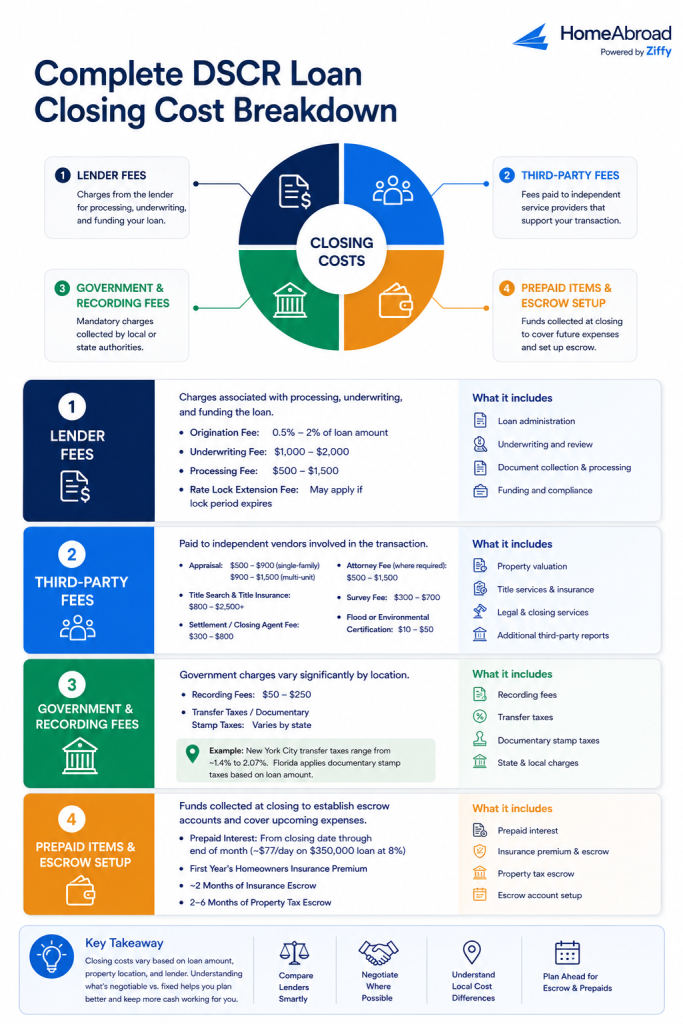
DSCR loan closing costs fall into four categories: lender fees, third-party fees, government charges, and prepaid items collected at closing. Each category affects your cash-to-close differently and should be reviewed separately on the Loan Estimate.
Lender Fees
Lender fees are the charges associated with processing, underwriting, and funding the loan. The largest line item is usually the origination fee, which typically ranges from 0.5% to 2% of the loan amount. This fee covers loan administration, underwriting, and overall file management.
Some DSCR loan programs also include an underwriting fee, which commonly ranges from $1,000 to $2,000. In certain cases, underwriting costs are bundled into the origination fee rather than disclosed as a separate charge. Processing fees generally range from $500 to $1,500 and cover document collection, file preparation, and coordination with third-party vendors.
Foreign national transactions often require longer closing timelines because international wire verification, entity documentation reviews, and source-of-funds checks add steps that are not typically present in domestic transactions.
The distinction here is that origination fees and discount points are separate line items on your Loan Estimate. A lender quoting “no origination fee” may still be charging points to achieve the quoted interest rate. Review both lines before comparing offers.
Third-Party Fees
Third-party fees are paid to independent vendors involved in the transaction.
An appraisal typically costs $500 to $900 for a single-family rental property and $900 to $1,500 for a multi-unit property. DSCR appraisals generally include a market rent analysis using Form 1007, which can increase costs compared to a standard conventional appraisal.
Title search and title insurance usually range from $800 to $2,500+, depending on the state and purchase price. Most transactions include a lender’s title policy, while many investors also purchase an owner’s title policy for additional protection.
Other common charges include:
- Settlement or closing agent fee: $300 to $800 for coordinating document execution and fund disbursement.
- Attorney fee: $500 to $1,500 in states where attorney involvement is required or customary.
- Survey fee: $300 to $700 when property boundary verification is required by the title company or lender.
Attorney involvement is common in states such as Florida, New York, Georgia, South Carolina, Massachusetts, and Connecticut, where attorney participation is often required or customary.
Government and Recording Fees
Recording fees are typically modest, often ranging from $50 to $250, but state and local transfer taxes can add thousands of dollars to total closing costs. Across the foreign national transactions we finance, transfer taxes and documentary stamp taxes are among the most common sources of closing cost surprises because they vary dramatically from one market to another.
For example, New York City transactions may include transfer taxes ranging from approximately 1.4% to 2.075%, while Florida applies documentary stamp taxes based on the loan amount. Because these charges are location-specific, they should be reviewed early when estimating cash-to-close.
Prepaid Items and Escrow Setup
Prepaid items are not lender fees. They are funds collected at closing to establish escrow accounts and cover upcoming expenses.
Prepaid interest covers the period from the closing date through the end of the month. On a $350,000 loan at 8% interest, prepaid interest is approximately $77 per day.
Borrowers also typically pay:
- The first year’s homeowners insurance premium
- Approximately two months of insurance escrow
- Two to six months of property tax escrow, depending on the local tax schedule
One expense that often surprises first-time DSCR borrowers is the size of the prepaid and escrow requirement. On a $400,000 loan closing in a high-tax market, prepaid items and escrow deposits alone can add $5,000 to $8,000 to the total cash needed at closing.
The fee that surprises investors most often isn’t the appraisal or underwriting charge. It’s the escrow and prepaid portion of the Closing Disclosure. We regularly see borrowers focus on lender fees and overlook several thousand dollars in taxes, insurance escrows, and prepaid interest.

Additional Closing Costs Foreign Nationals Pay That Domestic Borrowers Don’t
Foreign national borrowers face several costs and closing requirements that do not typically appear in domestic DSCR transactions. These expenses are typically tied to identity verification, international fund transfers, entity structuring, and cross-border compliance requirements.
ITIN-Related Title and Settlement Delays
Foreign national investors who do not have a Social Security Number typically close using an Individual Taxpayer Identification Number (ITIN). Many title companies perform additional identity verification on ITIN-based files because these records are not validated through the same automated systems commonly used for Social Security Number verification.
As a result, investors may be asked to provide additional documentation, notarizations, or apostille certifications before closing can proceed.
The direct cost is usually modest, but the impact on timing can be significant. A delayed verification can push closing beyond the original rate lock period, creating additional extension costs. Investors should confirm title requirements early rather than waiting until final closing preparations begin.

Lucas Hernandez
Mortgage Loan Originator
HomeAbroad
NMLS #2171747The cost that surprises our foreign national clients most isn’t the origination fee. It’s the combination of international wire costs, source-of-funds documentation, and a re-lock fee when funds arrive later than expected. If your closing funds are coming from outside the US, build an extra two to three business days into your timeline.
International Wire Transfer Fees and Compliance Costs
Most foreign national investors fund their down payment and closing costs through international wire transfers. Sending banks commonly charge $25 to $60 per wire, and intermediary banks may deduct additional fees before the funds reach the closing agent.
The larger consideration is often compliance documentation rather than the wire fee itself. Anti-money laundering (AML) reviews and source-of-funds verification may require bank reference letters, translated account statements, or additional documentation showing how investment funds were accumulated. These requirements do not always create direct closing costs, but they can create administrative expenses and extend the closing timeline.
LLC Formation and Entity Structuring Costs (If Applicable)
Many foreign national investors purchase US investment property through an LLC for liability protection and estate planning purposes. If the entity has not yet been established, state filing fees generally range from $50 to $500, while registered agent services often cost $100 to $300 annually.
To be clear, purchasing through an LLC is often the right decision for foreign nationals managing US estate tax exposure, but it adds cost and documentation requirements. Entity formation should be addressed before going under contract, not after, to avoid delays during underwriting and closing.
FIRPTA Withholding Considerations at Closing
FIRPTA withholding is generally a seller obligation rather than a buyer closing cost. However, when purchasing from a foreign national seller, the required withholding can affect negotiations and the seller’s net proceeds.
Foreign nationals should confirm FIRPTA withholding requirements early in the transaction. A withholding issue discovered shortly before closing can delay funding, disrupt settlement calculations, and create last-minute negotiation challenges between buyer and seller. See our full guide to FIRPTA obligations for foreign nationals for a detailed explanation.
What Affects Your Total DSCR Closing Costs
Four variables create most of the variation in DSCR closing costs: loan size, property type, purchase state, and loan pricing structure.
Loan Size
Many lender fees are calculated as a percentage of the loan amount, so larger loans generally produce higher dollar costs. However, smaller loans can carry a higher effective cost because some fees are fixed.
For example, a $1,500 underwriting fee represents 0.75% of a $200,000 loan, but only 0.25% of a $600,000 loan. This is one reason closing costs often represent a larger percentage of the loan amount on smaller investment properties.
Property Type
A single-family rental (SFR) is typically the least expensive property type to finance because it requires the simplest appraisal and underwriting review. Multi-unit and short-term rental properties generally require additional analysis, which can increase third-party costs.
Short-term rental (STR) properties can increase costs further because appraisers often need to complete additional market rent and income analysis. In many markets, STR appraisals cost $200–$400 more than standard long-term rental appraisals due to the additional documentation and valuation work required.
Location-Based Taxes and Fees
State and local taxes can add thousands of dollars to closing costs even when the loan amount stays the same. State-specific transfer taxes, documentary stamp taxes, recording requirements, and attorney-closing rules can create significant differences between otherwise identical transactions.
Transfer taxes can add several thousand dollars to closing costs in some markets, while other states impose little or no transfer-tax burden. A purchase in New York may carry materially higher closing costs than a similar transaction in Texas or Tennessee, even when the loan amount is identical.
Lender Selection and Rate-Fee Tradeoffs
Not all lenders structure pricing the same way. Some offer “no closing cost” DSCR loans, but the costs are typically exchanged for a higher interest rate rather than eliminated.
Investors also have the option to purchase discount points. One point equals 1% of the loan amount and reduces the interest rate. Paying discount points generally makes the most sense when the expected hold period is long enough to recover the upfront cost through lower monthly payments. Investors planning to sell or refinance within a few years often do not reach that break-even point before exiting the loan.

Steven Glick
Director of Mortgage Sales, HomeAbroad
The fee I always encourage clients to negotiate is the origination fee, especially on larger loan amounts where even a small percentage difference can represent thousands of dollars. Third-party costs like title and appraisal fees are generally set by outside vendors, but origination pricing often provides the most room for discussion.
How to Reduce Closing Costs on Your DSCR Loan
Five areas typically offer the greatest opportunity to reduce DSCR closing costs: origination fees, title and settlement charges, lender credits, closing-date timing, and international wire planning. Here’s how each one can affect your cash-to-close.
1. Review the Origination Fee
The origination fee is one of the largest closing cost line items on a DSCR loan. Origination charges can range from 0.5% to 2% or more of the loan amount. Because the fee is calculated as a percentage of the loan amount, even a small adjustment can translate into meaningful savings on larger investment property loans.
2. Compare Title and Settlement Costs
Title insurance is shoppable in many states. Obtaining title and settlement quotes before services are ordered can reduce closing costs by several hundred dollars without affecting the loan structure or terms.
3. Ask About Lender Credits
Some investors prefer to accept a slightly higher interest rate in exchange for credits that offset closing costs. This approach reduces upfront cash requirements, although the long-term impact on monthly payments should be evaluated carefully.
4. Schedule Closing Near Month-End
Closing near the end of the month can reduce prepaid interest costs because interest is collected from the closing date through the end of the month. Closing on the 28th instead of the 5th may reduce prepaid interest by several weeks, lowering the amount due at settlement.
5. Send International Wires Early
International wire transfers should be planned well before closing. Consolidating funds into a single international wire helps minimize transfer charges, and sending funds at least five business days before closing reduces the risk of delays that can trigger rate lock extension fees.
The honest answer is that DSCR loan closing costs are generally higher than those associated with conventional financing, and there is no strategy that eliminates them completely. The approaches above can reduce costs by a few hundred to a few thousand dollars, but a total closing cost range of 2% to 5% of the loan amount remains a realistic expectation for most foreign national investors.
What to Have Ready Before Your DSCR Closing
Most DSCR closings are straightforward when funds, documentation, and third-party requirements are organized before the scheduled closing date. Use the checklist below to avoid last-minute delays.
Funds
- Closing funds wired in USD at least 3–5 business days before closing
- International wire initiated early to allow time for intermediary and correspondent bank processing
- Required reserve funds documented and verified in a US or internationally recognized financial institution
Documents
- Valid passport available for all borrowers and signing parties
- ITIN documentation available if a Social Security Number is not being used
- Confirmation that the title company has received and verified all required identification documents
- LLC documents ready, if applicable, including Articles of Organization, Operating Agreement, and EIN confirmation
- Source-of-funds documentation prepared if requested by the title company or compliance team
Confirmations
- Closing Disclosure reviewed at least three business days before closing
- Homeowners insurance binder provided and accepted by the lender
- Final walkthrough completed and any outstanding property issues addressed

Most foreign national closings go smoothly when documentation and wire transfers are prepared in advance. The transactions that encounter last-minute delays are usually tied to wire timing or missing entity documents, both of which can be avoided with early preparation.
Next Steps: Get a Closing Cost Estimate for Your Deal
Transfer taxes, escrow requirements, title charges, and foreign-national-specific expenses can all affect the amount you’ll need at closing.
HomeAbroad loan specialists provide a Loan Estimate within 1–3 business days after reviewing your file, allowing borrowers to review estimated lender fees, third-party costs, prepaid items, and total cash-to-close requirements before moving forward.
For a deeper understanding of qualification requirements, loan structures, and financing strategies, read our complete guide to DSCR loans for foreign nationals. You can also use our DSCR calculator to estimate property cash flow and determine whether a rental property meets DSCR loan requirements.
Ready to get started? Get Pre-Qualified for a Foreign National DSCR Loan today.
Frequently Asked Questions
Can closing costs be rolled into a DSCR loan?
No, not on most purchase transactions. DSCR loan closing costs must generally be paid at closing and cannot be added to the loan balance. On a DSCR cash-out refinance, certain lender fees may be financed into the new loan amount, subject to loan-to-value (LTV) limits and program guidelines.
How much does it cost to close a DSCR loan as a foreign national?
Foreign national investors should budget approximately 2% to 5% of the loan amount for closing costs, plus any required reserves. On a $350,000 DSCR loan, total cash needed at closing often ranges from $90,000 to $105,000, including the down payment, closing costs, and reserve requirements.
Do DSCR loans have higher closing costs than conventional loans?
Yes, DSCR loans are non-QM products and often include higher lender-side costs than conventional investment property loans. Appraisal, title, and recording fees are generally similar, but origination charges, pricing adjustments, and other lender-related costs can increase the overall cost of financing.
What are the closing costs on a DSCR refinance vs. a purchase?
A DSCR refinance typically costs 1.5% to 3% of the loan amount, compared with 2% to 5% for a purchase transaction. Refinances often cost less because transfer taxes, settlement charges, and certain state-specific fees are reduced or eliminated, although appraisal, title, lender, and prepaid costs still apply.