



Editorial Integrity
Making informed real estate decisions starts with having the right knowledge. At HomeAbroad, we offer US mortgage products for foreign nationals & investors and have a network of 500+ expert HomeAbroad real estate agents to provide the expertise you need. Our content is written by licensed mortgage experts and seasoned real estate agents who share insights from their experience, helping thousands like you. Our strict editorial process ensures you receive reliable and accurate information.
Australians can legally buy and finance US rental property without a Green Card, US residency, or US credit history through foreign national mortgage programs designed for international investors.
DSCR loans qualify based on the property’s rental income rather than your personal income, making them a practical financing option for Australian investors without US income or credit history.
Cross-border tax planning is essential. Understanding the Section 871(d) election, FIRPTA withholding, and US estate tax rules can help you avoid costly surprises and plan your investment more effectively.
You can complete the entire purchase remotely from Australia. With the right financing partner and preparation, everything from pre-qualification and underwriting to settlement and closing can be managed without travelling to the United States.
Table of Contents
Australian investors are increasingly looking beyond their home market to build rental property portfolios in the United States. Many US real estate markets offer higher gross rental yields and lower entry prices than Australia’s largest property markets, while also providing exposure to US dollar-denominated assets and a large, diversified real estate market.
According to the latest National Association of REALTORS data, foreign buyers purchased $56 billion worth of US residential property, highlighting the continued demand for US real estate among international investors.
Australian citizens can legally buy and finance US rental property without a US credit history, Green Card, Social Security Number, or US residency. Foreign national mortgage programs, including DSCR loans, allow eligible investors to qualify based on the property’s rental income rather than their personal income or Australian credit profile.
This guide explains how Australians can finance US investment property, navigate key tax considerations such as Section 871(d) and FIRPTA, and complete the purchase remotely without relocating to the United States.
Can an Australian Buy Property in the USA?
Yes. Australians can legally buy US investment property without a visa, Green Card, US residency, citizenship, or a US credit score. Australian citizens have the same property ownership rights as US buyers. The main difference is how the purchase is financed and what documentation is required to qualify for a mortgage.
Australian investors generally have two financing options. A DSCR (Debt Service Coverage Ratio) loan qualifies based on the property’s expected rental income rather than your personal income, making it the preferred option for many non-resident real estate investors. A full-documentation mortgage qualifies you using verified income, assets, and supporting financial documents from Australia, making it a better fit for properties that may not meet DSCR requirements.
What You Need Instead of US Credit
A lack of US credit history does not prevent Australians from qualifying for a mortgage, but it does change how lenders evaluate the application.
Instead of a US credit score, lenders typically review:
- A valid Australian passport or government-issued photo ID
- A down payment of approximately 25%, plus the required post-closing cash reserves
- A documented source of funds showing how money is transferred from Australia to the United States
- Property details, including an appraisal and estimated market rent
Depending on how you plan to own the property, you may also need an Individual Taxpayer Identification Number (ITIN) or a US limited liability company (LLC). We’ll cover both later in this guide.
Why Australians Invest in US Rental Property
For many Australian investors, the attraction of US real estate comes down to value, income potential, and diversification. Compared with Australia’s largest property markets, many US metropolitan areas offer lower purchase prices alongside higher gross rental yields, making it possible to generate stronger rental cash flow without committing the same amount of capital.
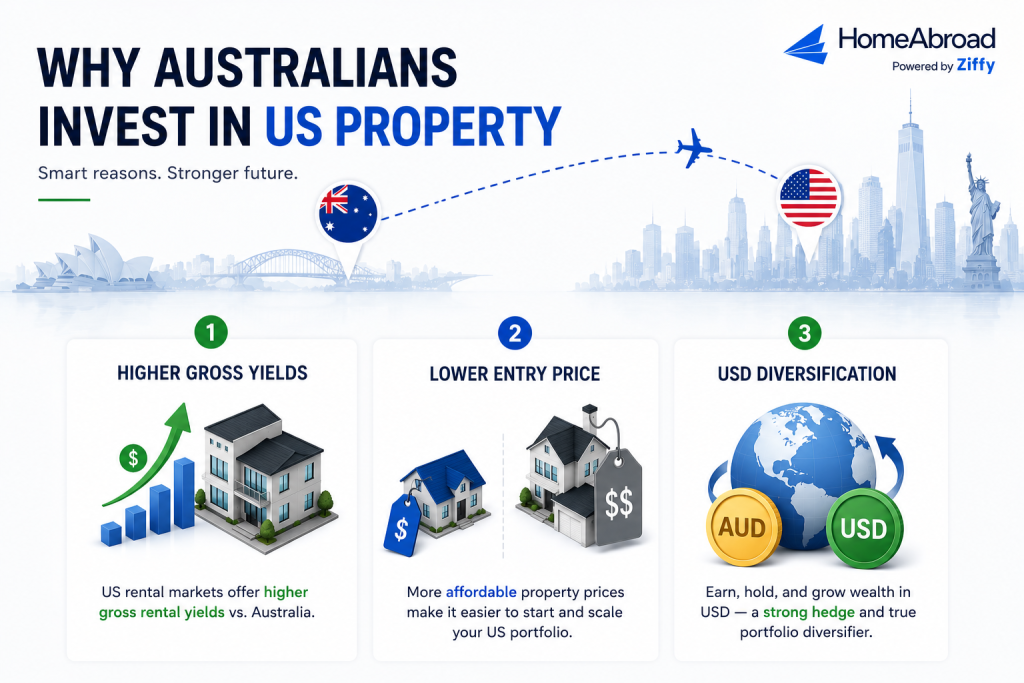
The US market also gives Australians exposure to US dollar-denominated assets. Rather than concentrating their wealth in a single property market and currency, investors can diversify across a large, established real estate market while holding assets denominated in US dollars.
The opportunity is compelling, but cross-border investing comes with additional planning. Financing requirements differ from those in Australia, tax rules such as Section 871(d) and FIRPTA affect investment returns, and purchasing remotely requires careful coordination of documentation, fund transfers, and closing. Understanding these requirements before making an offer can help avoid unnecessary delays and costly mistakes.
Most of the Australians I work with aren’t chasing a holiday home. They’ve run the numbers and found that a US rental property can produce stronger cash flow than a comparable investment at home. The part that surprises them is how straightforward the financing process becomes once they’re qualifying based on the property instead of trying to fit into a standard US mortgage.

The opportunity is clear, but financing a US investment property differs from financing real estate in Australia. Understanding how foreign national mortgages work is often the next step for investors who want to turn that opportunity into a purchase.
How DSCR Loans Work for Australian Investors
For many Australian investors, a Debt Service Coverage Ratio (DSCR) loan is the simplest way to finance a US rental property. Instead of qualifying you based on your Australian salary, tax returns, or employment, a DSCR loan evaluates whether the property’s expected rental income is sufficient to cover its monthly housing expenses.
HomeAbroad evaluates a property’s Debt Service Coverage Ratio (DSCR) by comparing its expected monthly rental income with its PITIA (principal, interest, taxes, insurance, and association dues).
How a DSCR Loan Is Calculated
Here’s a simplified example based on the type of transactions HomeAbroad regularly finances for Australian investors.
An Australian client was purchasing a long-term rental property expected to generate $2,486 per month in rental income. The property’s monthly PITIA (principal, interest, taxes, insurance, and association dues) was $1,963.
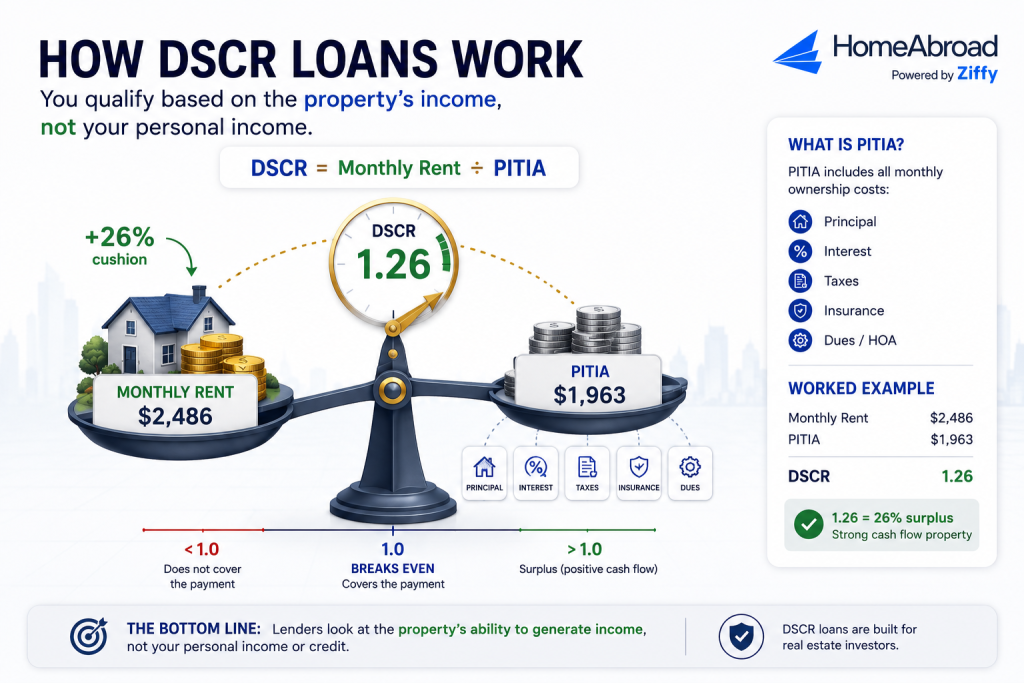
- Monthly rental income: $2,486
- Monthly PITIA: $1,963
- DSCR = $2,486÷ $1,963= 1.26
A DSCR of 1.0 means the property’s rental income is enough to cover its monthly housing expenses. A DSCR of 1.26 means the property generates 26% more rental income than those expenses, giving lenders additional confidence that the property can comfortably support the mortgage.
Because the property’s cash flow comfortably supported the mortgage, HomeAbroad was able to evaluate the application based primarily on the investment property’s income rather than the borrower’s Australian salary or local credit profile.
Foreign national DSCR loans require a down payment of around 25%, together with post-closing cash reserves. Pricing is also typically around 0.5% higher than comparable loans available to US-based real estate investors, reflecting the additional underwriting involved in cross-border lending. These trade-offs allow investors to qualify without a US credit history while preserving capital for future investments instead of making an all-cash purchase.
DSCR vs. Full-Documentation Loans for Australians
While DSCR loans are the preferred choice for many Australian investors, they are not the only option.
A DSCR loan qualifies based on the property’s rental income. It usually requires less documentation because the focus is on the investment property’s ability to generate cash flow rather than your personal earnings. This often results in a faster underwriting process and removes the need to translate Australian employment and income documents.
A full-documentation mortgage qualifies you using verified overseas income and assets. This option can make sense when the property’s rental income does not meet DSCR requirements or when your personal financial profile provides a stronger basis for qualification.
DSCR and full-documentation mortgages are designed for different financing scenarios. Which financing program fits best comes down to the property’s cash flow, your financial profile, and your investment objectives. HomeAbroad helps Australian investors determine which program best fits their purchase before they begin underwriting.
What HomeAbroad Needs from an Australian Borrower
To begin the financing process, HomeAbroad typically requests:
- A valid Australian passport or government-issued photo ID
- A down payment of approximately 25%, plus evidence of the required post-closing cash reserves
- Bank statements documenting the source of funds and the transfer of money from Australia to the United States
- A property appraisal, including an estimated market-rent schedule
- Entity documentation, such as an LLC or EIN, if the property will be purchased through a company structure
If you already have a US credit history, it can be considered during underwriting. If you don’t, you can still qualify through foreign national lending programs.

Steven Glick
Director of Mortgage Sales · HomeAbroad
The deals that stall aren’t the ones with no US credit. That’s normal for us. They stall when the reserves or the source-of-funds trail aren’t ready. Get your statements and the paper trail for the deposit sorted before you’re under contract, and a no-US-credit file can move just as efficiently as a domestic one.
Preparing your documentation before you begin property shopping gives HomeAbroad’s underwriting team everything needed to evaluate your application efficiently. For answers to other common questions about financing US investment property, explore our Foreign National Mortgage FAQs.
Taxes & FIRPTA for Australian Owners: What the US-Australia Tax Treaty Does and Doesn’t Cover
Taxes are one of the biggest differences between buying investment property in Australia and owning rental real estate in the United States. Australian investors need to understand how US tax rules apply while they own the property, when they sell it, and how estate tax may affect long-term ownership.
The US–Australia income tax treaty helps reduce the risk of double taxation in certain situations, but it does not eliminate US tax obligations on rental property. Understanding where the treaty applies and where it does not can help you plan your investment more effectively.
Rental Income While You Hold the Property
By default, rental income earned by a foreign owner is generally treated as Fixed, Determinable, Annual, or Periodical (FDAP) income and may be subject to a 30% withholding tax on the gross rental income, without allowing deductions for expenses.
Many Australian investors instead make a Section 871(d) election, which allows rental income to be treated as Effectively Connected Income (ECI). Under this election, tax is calculated on net taxable income rather than gross rental receipts.
This means eligible expenses, including:
- Mortgage interest
- Property taxes
- Insurance
- Repairs and maintenance
- Property management fees
- Depreciation
may be deducted before taxable income is calculated.
Section 871(d) is a tax election, not a benefit provided by the US-Australia income tax treaty. Most foreign investors choose this election because it allows tax to be calculated on net rental income after eligible deductions rather than on gross rental receipts.
When You Sell: FIRPTA
When a foreign owner sells US real estate, the Foreign Investment in Real Property Tax Act (FIRPTA) may require the buyer to withhold part of the sale proceeds and remit those funds to the Internal Revenue Service (IRS).
FIRPTA is not a separate tax, nor is it automatically 15%. It is a withholding mechanism that serves as a prepayment toward the seller’s eventual US tax liability.
Depending on the transaction, FIRPTA withholding may be:
- 0% if the sale price is $300,000 or less and the buyer intends to use the property as a residence.
- 10% if the sale price is over $300,000 but not more than $1,000,000 and the buyer will use it as their residence
- 15% all other sales (any sale above $1,000,000, or where the buyer won’t occupy the property)
The US–Australia income tax treaty does not reduce FIRPTA withholding. Instead, the treaty helps Australian investors avoid double taxation by allowing foreign tax credits to be claimed under Australian tax rules where applicable.
Estate Tax Exposure
Estate planning is another area that deserves attention before purchasing US property.
For US estate-tax purposes, nonresident aliens generally receive an exemption of only $60,000 of US-situs assets. By comparison, US citizens and residents currently benefit from a substantially higher exemption.
Australia is one of the few countries that has an estate tax treaty with the United States. Depending on your circumstances, the treaty may allow Australian investors to claim a pro-rated portion of the US estate-tax exemption available to US citizens and residents. The calculation is complex and depends on the value of your worldwide estate and other treaty provisions, so it should not be assumed automatically.
Before purchasing US real estate, Australian investors should discuss ownership structure and estate planning with a qualified cross-border estate attorney and tax advisor. Learn more in our Foreign-Buyer US tax guide.
LLC vs Personal Name for Australian Investors
One of the most common questions Australian investors ask is whether they should purchase US real estate in their own name or through a Limited Liability Company (LLC). Both ownership structures can work well for Australian investors. The best option depends on how you plan to finance the property, how many US rentals you expect to own, and your long-term investment strategy.
An LLC is often a good fit if you’re financing the property, planning to build a portfolio of US rentals, or want an additional layer of liability separation between your personal assets and your investment property. Purchasing in your personal name can be appropriate for investors acquiring a single property with cash in a stable market where a simpler ownership structure meets their objectives.

If you’re financing and planning more than one property, an LLC usually makes sense for how we structure the loan and your liability. For a single all-cash purchase it can be unnecessary. And if you’re asking about buying through your super fund, slow down and get a cross-border advisor involved first. That’s a structuring decision, not a loan decision.
For US tax purposes, a foreign-owned single-member LLC is generally treated as a disregarded entity, so rental income continues to be reported by the owner. An LLC is primarily an ownership and liability structure. It does not, by itself, eliminate US taxes or exempt a property sale from FIRPTA withholding.
Australian investors also frequently ask whether they can purchase US real estate through a Self-Managed Super Fund (SMSF). While this may be possible, it involves additional Australian superannuation rules, ownership-structure considerations, and US tax implications. Because these requirements vary depending on the investment and fund structure, it’s important to seek advice from professionals with expertise in both Australian and US regulations before proceeding.
To help determine which structure aligns with your investment strategy, read our guide on LLC vs personal name for foreign investors.
Closing on a US Property Remotely from Australia
Buying a US investment property doesn’t require travelling to the United States. Australian investors can complete the entire transaction remotely, from signing loan documents to funding the purchase and recording ownership, provided the process is planned early and the required documentation is prepared in advance.
The key is coordinating legal documents, international fund transfers, and settlement timelines so everything is ready before closing.
Apostilled Power of Attorney
Many Australian investors complete their purchase using a Power of Attorney (POA) that authorizes documents to be signed on their behalf during closing.
The POA must be prepared according to the title company’s requirements and apostilled in Australia before it can be used in the United States. Because preparing and apostilling these documents can take time, it’s best to begin the process as soon as your purchase contract is signed rather than waiting until the week of settlement.
Moving Your Deposit from Australia to the US
International wire transfers require more preparation than a domestic bank transfer. Maintain a clear paper trail showing how your funds moved from your Australian accounts to the United States. Bank statements, savings history, and supporting documentation should be readily available, as lenders and settlement parties may require them to verify the source of funds during the financing and closing process.
International wires also require anti-money laundering (AML) verification. While transfer times vary by financial institution, investors should allow approximately 5 to 10 business days for funds to clear compliance reviews. Large unexplained deposits during the documentation period may result in additional underwriting questions or requests for supporting evidence.
Planning the currency conversion and wire transfer well before settlement gives funds time to clear AML reviews and arrive in the United States before closing.
HomeAbroad coordinates the underwriting, appraisal, title work, signing, funding, and recording process across Australian and US business hours, allowing borrowers to complete the transaction without travelling internationally.
I’ve had Australian clients close without ever setting foot in the US. With an apostilled power of attorney set up early and the wire planned around the AML review, the time difference becomes a scheduling detail rather than a problem. The biggest mistake is leaving the POA until the final week before closing.
Once the property has closed, the focus shifts from completing the transaction to managing the investment efficiently and planning for future growth.
How HomeAbroad Supports Australian Investors End-to-End
Purchasing US real estate from Australia involves more than securing a mortgage. It requires financing designed for foreign nationals, coordination across multiple service providers, and a team that understands every stage of a cross-border transaction.
HomeAbroad has financed more than 500 foreign-national loans across over 40 countries, helping international investors purchase US investment properties with confidence. From your initial consultation through closing, our team works with you to simplify what can otherwise be a complex international transaction.
HomeAbroad’s foreign national mortgage programs are built specifically for international investors purchasing US real estate. Our underwriting process is designed for cross-border borrowers, allowing us to evaluate overseas income, assets, and supporting documentation while matching investors with the financing solution that best fits their property and investment goals.
Beyond financing, HomeAbroad connects investors with experienced real estate agents, coordinates appraisals, title and escrow services, and manages the remote closing process so purchases can be completed without travelling to the United States.
Get pre-qualified with HomeAbroad today and discover how our foreign national mortgage programs can help you finance your next US investment property.
Frequently Asked Questions
Can Australians get a US mortgage without a US credit history?
Yes. Australian investors can qualify for a US mortgage without a US credit score through foreign national mortgage programs. A DSCR loan qualifies primarily on the property’s rental income rather than your personal income or Australian credit history.
How much deposit do Australians need to buy US investment property?
Most foreign national mortgage programs require a down payment of approximately 25%, along with sufficient post-closing cash reserves. The exact amount depends on the property, loan program, and overall borrower profile.
Can I buy US property through my Self-Managed Super Fund (SMSF)?
Possibly, but it can be complex. Purchasing US real estate through an SMSF involves Australian superannuation rules, ownership-structure decisions, and US tax considerations. Before proceeding, consult advisers who understand both Australian SMSF regulations and US real estate taxation.
Does the US-Australia tax treaty reduce my US property taxes?
Not directly. The treaty helps reduce the risk of double taxation by allowing foreign tax credits in certain situations, but it does not eliminate US tax on rental income or reduce FIRPTA withholding. Planning strategies, including the Section 871(d) election, are often more significant for reducing taxable rental income.
Can I close on a US property without travelling to the United States?
Yes. Australian investors can complete the entire purchase remotely using an apostilled Power of Attorney (POA) that meets the title company’s requirements. HomeAbroad coordinates underwriting, title, funding, and closing so the transaction can be completed from Australia.
Do I need an ITIN or a US LLC?
It depends on how you plan to own the property. Many Australian investors obtain an Individual Taxpayer Identification Number (ITIN) for US tax filing purposes, while an LLC may be appropriate for liability protection or portfolio ownership. The right structure depends on your investment strategy and should be discussed with a qualified tax or legal advisor.
Are foreign national mortgage rates higher than US domestic mortgage rates?
Generally, yes. Foreign national mortgage rates are typically around 0.5% higher than comparable loans for US-based investors because they involve additional underwriting and cross-border documentation. The exact rate depends on factors such as the property, loan-to-value ratio, reserves, and overall borrower profile.