


Editorial Integrity
Making informed real estate decisions starts with having the right knowledge. At HomeAbroad, we offer US mortgage products for foreign nationals & investors and have a network of 500+ expert HomeAbroad real estate agents to provide the expertise you need. Our content is written by licensed mortgage experts and seasoned real estate agents who share insights from their experience, helping thousands like you. Our strict editorial process ensures you receive reliable and accurate information.
Full Documentation Loans help eligible foreign nationals finance residential property in the US by qualifying based on verified income, assets, employment, and creditworthiness, even without a traditional US credit history.
Preparing the right documentation early can streamline the application process. Depending on your financial profile, you may need income documents, bank statements, an International Credit Report, and other supporting records.
The right loan depends on your financial situation and property goals. Full Documentation Loans are often a better fit for borrowers with documentable income, while DSCR Loans may be more suitable for income-producing investment properties.
Foreign nationals can complete the mortgage process remotely, but should plan ahead for document verification, international fund transfers, and closing requirements.
If you want to buy US property but your income and credit history sit outside the United States, a Full Documentation Loan is one of the main ways HomeAbroad helps you qualify. It uses the financial record you already have at home, your income, your assets, and your credit from your own country, instead of asking for a US credit score you have not had the chance to build.
This guide explains what the program is, who it fits, how qualification works, and how it compares with a DSCR loan so you can tell which path matches your situation before you apply.
Table of Contents
What is a Full Documentation Loan?
A Full Documentation Loan is a non-QM (Non-Qualified Mortgage) loan that allows eligible foreign nationals and US newcomers to qualify for a mortgage by verifying their income, assets, employment, and overall financial profile through financial documents from their home country.
Unlike a DSCR loan, which qualifies borrowers primarily based on a property’s rental income, a Full Documentation Loan evaluates the borrower’s personal ability to repay the loan. This financing option is designed for buyers who have stable, verifiable income but may not have an established US credit history or traditional US employment records.
At HomeAbroad, applicants demonstrate creditworthiness through international credit reports, bank reference letters, or other approved financial documentation. Because a Full Documentation Loan is a non-QM mortgage, it follows a different underwriting approach than conventional loans backed by government-sponsored enterprises.
Instead of relying solely on standard US documentation, underwriters review alternative forms of income and financial records to determine whether the borrower can responsibly repay the loan. Final qualification depends on the lender’s underwriting guidelines and current program requirements.
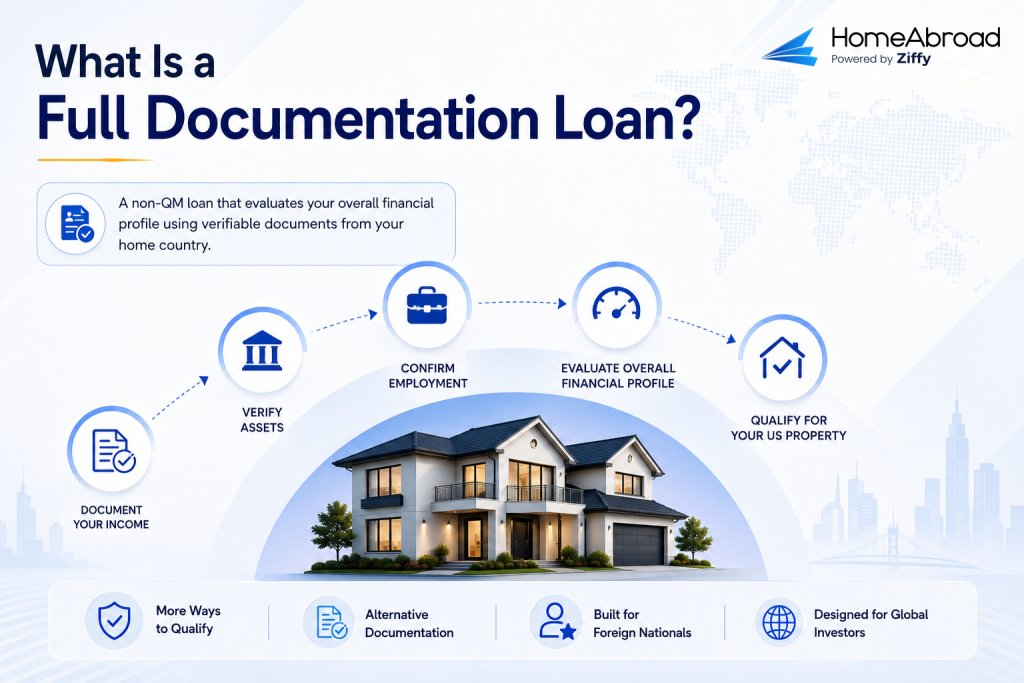
For many foreign national buyers, a Full Documentation Loan provides an alternative when a DSCR loan is not the best fit. For example, if a property’s expected rental income is insufficient to meet DSCR requirements but the borrower has strong, well-documented personal income, a Full Documentation Loan may offer a more suitable financing path.
Who Is a Full Documentation Loan Designed For?
A Full Documentation Loan is designed for borrowers who can verify their income and financial standing but may not meet the documentation requirements of a conventional US mortgage. For many international buyers, it provides a financing option that recognizes financial records from their home country.
This loan is generally a good fit for the following borrower groups:
Foreign Nationals
Foreign nationals are individuals who are not US citizens or permanent residents but want to purchase property in the United States. Many have strong income, assets, and credit histories in their home countries but lack the US credit profile or employment documentation required for conventional financing.
A Full Documentation Loan allows eligible foreign nationals to qualify by providing verified financial documents such as income records, bank statements, tax documents, and approved international credit references.
US Newcomers
US newcomers are individuals who have recently relocated to the United States for work, business, or other long-term reasons. Although they may have legal residency or valid work authorization, they often have limited US credit history because they have only recently established financial accounts in the country.
Depending on the program guidelines, a Full Documentation Loan may allow these borrowers to qualify using a combination of US and international financial documentation.
Borrowers With Strong, Verifiable Income
Regardless of where they live, this loan is best suited for borrowers who have a well-documented financial profile. Underwriters evaluate factors such as income stability, available assets, employment or business income, and creditworthiness to determine the ability to repay the loan.
If your income can be clearly documented but a property’s rental income is not strong enough to qualify for a DSCR Loan, a Full Documentation Loan may be the more appropriate financing option.

Steven Glick
Director of Mortgage Sales · HomeAbroad
Self-employed foreign nationals often worry that their income won’t qualify because it’s documented differently than in the US. What matters is providing clear, consistent records that help underwriters understand your business income and verify your ability to repay the loan.
How Do You Qualify for a Full Documentation Loan?
A Full Documentation Loan qualifies borrowers by evaluating their personal financial profile rather than relying primarily on a property’s rental income. During underwriting, HomeAbroad reviews your income, assets, employment or business history, and creditworthiness to determine your ability to repay the loan.
For foreign nationals, this means your financial documents from your home country play a central role in the qualification process. Instead of requiring a long US credit history or traditional US employment records, HomeAbroad reviews alternative documentation that demonstrates financial stability and repayment capacity.
Qualification rests on three things: documented income, evidence of creditworthiness, and enough cash on hand.
Income: This is what separates a Full Documentation Loan from a DSCR loan. The program verifies your personal income directly, using records such as foreign tax returns, employer letters, pay records, or profit and loss statements for the self-employed.
Credit: “No US credit history required” is accurate for this program, but it does not mean no credit review. We assess your creditworthiness through other evidence: an international credit report where one exists, or approved alternatives such as bank reference letters and accountant certifications from your home country. Your credit is still being evaluated. The source of the evidence is what changes.
Reserves: We want to see that you can cover the mortgage for a period after closing. “Reserves” are liquid funds you hold after your down payment and closing costs are paid. Foreign borrowers should plan for around six months of reserves, documented through bank statements.
The full document list depends on your borrower category and is more granular than a single section can usefully hold. Check out our complete foreign national document checklist guide for that purpose.
Full Documentation Loan Terms at a Glance
The table below summarizes the key eligibility requirements and loan terms for HomeAbroad’s Full Documentation Loan program. Use it as a quick reference to understand the minimum qualifications, documentation expectations, and financing options available to eligible borrowers.
Requirement | Foreign Investors |
|---|---|
Credit Score | No US credit needed |
Debt-to-Income Ratio: | Less than 43% |
Down Payment | 20%-25% |
Loan Term | Up to 30 Years |
Cash Reserves | 6 months |
Income Documents | Foreign income and asset documents. International Credit Report or alternative proof of creditworthiness from home country |
Approval Time | Within 30 Days |
“DTI” is the debt-to-income ratio, the share of your gross monthly income that goes to debt payments. A maximum around 43% means your total monthly obligations, including the new mortgage, should generally stay under that share of your documented income.
You can review the current program details directly on the Full Documentation Loan program page.
Documents You’ll Need to Apply
As a foreign national borrower, you’ll need to provide documents that verify your identity, legal status, income, assets, and creditworthiness. Preparing these documents in advance can help make the underwriting process smoother and reduce delays during your application.
Identity Documents
To verify your identity, you’ll need:
- A valid, unexpired passport
Legal Status Documentation
If you’re applying while living or working in the US, you’ll also need documentation confirming your legal status.
This may include:
- A valid visa (such as an E-1, E-2, or H-1B visa)
- A visa extension document if your current visa is nearing expiration
Note: Holding a valid visa does not automatically qualify you for a mortgage. Your application is evaluated based on the complete underwriting criteria.
Income Documentation
HomeAbroad verifies that your income is stable and sufficient to support the mortgage. Depending on your employment type, you may be asked to provide:
- Recent pay stubs (or payslips)
- Employer verification letter
- Personal tax returns
- Profit and loss (P&L) statement for self-employed borrowers
What is a Profit and Loss (P&L) Statement?
A Profit and Loss statement summarizes your business income and expenses over a specific period and helps demonstrate the financial performance of your business
Credit Documentation
A US credit history is not always required. Instead, HomeAbroad may evaluate your creditworthiness using:
- An International Credit Report (ICR)
- Other approved forms of credit documentation, when applicable
What is an International Credit Report (ICR)?
An ICR provides information about your borrowing and repayment history in your home country when you do not have an established US credit history.
Asset Documentation
You’ll also need to demonstrate that you have sufficient funds for your down payment, closing costs, and required cash reserves.
Commonly requested documents include:
- Foreign bank statements converted to US dollars
- Documentation showing at least 6 months of cash reserves
What are cash reserves
Cash reserves are funds that remain available after closing to show you can continue making mortgage payments if your income is temporarily interrupted.
Housing History
To demonstrate a history of making regular housing payments, you may be asked to provide:
- A 12-month rental history or mortgage payment history
Additional Supporting Documents
Depending on your country of residence and how your documents are prepared, additional documentation may be required, including:
- Apostille certification for certain official documents
- Notarized forms if documents are signed outside the US
What is an Apostille?
An apostille is an official certification that authenticates certain public documents for use in another country.

What does notarized mean?
A notarized document has been signed in the presence of a licensed notary, who verifies the identity of the signer and helps confirm the document's authenticity.
Eligible Property Types and Occupancy
A Full Documentation Loan can be used to finance different types of residential properties, but your intended use of the property is an important part of the underwriting process. Your intended use, whether as a primary residence, second home, or investment property can influence the loan terms, down payment, and other program requirements.
Primary Residence
If you plan to live in the property as your main home, it will be considered a primary residence. During the application process, you’ll need to indicate that you intend to occupy the property as your principal place of residence.
Second Home
A second home is a property that you plan to use for personal occupancy on a part-time basis rather than as your primary residence. It is not intended to be rented out as a full-time investment property.
Why Occupancy Matters
Your occupancy intention is more than just a checkbox on a mortgage application. It helps determine which loan program is most appropriate for your purchase and may affect factors such as down payment requirements, reserve requirements, pricing, and other underwriting guidelines.
For example, a borrower purchasing a rental property may have different qualification requirements than someone buying a home to live in full-time. Accurately disclosing how you plan to use the property helps ensure you’re matched with the most suitable financing option from the start.
How the Full Documentation Loan Application Process Works
Buying a home in the US from another country can seem complex, but the mortgage process follows a clear sequence. Understanding each step in advance can help you prepare the required documents, avoid delays, and move through underwriting with greater confidence.
Step 1: Get Pre-Approved
The first step is obtaining a mortgage pre-approval. During this stage, HomeAbroad reviews your financial profile, including your income, assets, credit documentation, and other eligibility requirements, to determine how much you may qualify to borrow.
Getting pre-approved before you begin your property search helps you understand your budget and demonstrates to sellers that you’re a serious buyer.
Step 2: Find a Property and Sign a Purchase Agreement
Once you’ve identified a property, you’ll submit an offer to the seller. If your offer is accepted, both parties sign a purchase agreement, which outlines the terms of the sale and becomes the basis for your mortgage application.
At this stage, you’ll typically make an earnest money deposit, which is a good-faith payment showing your commitment to purchasing the property. The funds are generally credited toward your down payment or closing costs at closing.
Step 3: Complete Your Loan Application
After the purchase agreement is signed, you’ll submit your formal mortgage application along with the required documentation.
This includes documents verifying your identity, income, assets, legal status (if applicable), and creditworthiness. Your loan advisor will review the file and request any additional information needed before underwriting begins.
Step 4: Underwriting Review
During underwriting, HomeAbroad evaluates your complete financial profile to confirm that you meet the program requirements.
The underwriting team verifies your documentation, reviews your income and assets, assesses your credit profile, and confirms that the property meets the applicable lending guidelines. If additional information is needed, you’ll receive a request before a final lending decision is made.
The smoothest loan process starts with complete and well-organized documentation. Responding quickly to document requests helps underwriting move forward and can prevent unnecessary delays before closing.

Step 5: Property Appraisal and Title Review
Before the loan can close, the property undergoes an appraisal to determine its market value. This helps confirm that the property’s value supports the requested loan amount.
A title company also reviews the property’s ownership history to identify any existing liens, ownership disputes, or legal issues that could affect the transfer of ownership.
Step 6: Secure Insurance and Prepare for Closing
Before closing, you’ll need to obtain any required insurance for the property and review your Closing Disclosure, which outlines your final loan terms and estimated closing costs.
Closing costs are the fees associated with completing the transaction and may include lender fees, appraisal fees, title charges, recording fees, and other applicable expenses.
Step 7: Close on Your Property
The final step is closing, where you’ll sign the required loan and property documents, complete the remaining funds needed to close, and officially take ownership of the property.
For many foreign national borrowers, remote closing may be available, allowing documents to be signed from abroad when permitted by the transaction requirements and applicable laws. Your loan team will explain the available options based on your location and the property’s closing requirements.
If you’re transferring funds from another country, it’s important to plan ahead to ensure your cash to close arrives before the scheduled closing date. Cash to close includes your down payment, closing costs, and any other funds required to complete the purchase.
Full Documentation Loan vs. DSCR Loan: Which One Is Right for You?
Both Full Documentation Loans and DSCR Loans are financing options for foreign nationals buying property in the US, but they are designed for different borrowing situations.
A Full Documentation Loan evaluates your personal financial profile, while a DSCR Loan focuses primarily on the property’s ability to generate enough rental income to cover its mortgage payment. Choosing the right loan depends on how you plan to use the property and how you qualify for financing.
Feature | Full Documentation Loan | DSCR Loan |
|---|---|---|
Primary Qualification Method | Personal income and financial profile | Property’s rental income (DSCR) |
Income Documentation | Required | Generally not required |
Personal DTI Considered | Yes | No |
US Credit History Required | No | No |
Best Suited For | Borrowers with strong, documentable income | Real estate investors purchasing income-producing properties |
Primary Focus | Borrower’s ability to repay | Property cash flow |
When a Full Documentation Loan May Be the Better Choice
A Full Documentation Loan may be a better fit if you:
- Have stable, verifiable personal or business income.
- Are comfortable providing financial documentation during underwriting.
- Are purchasing a primary residence or second home.
- Are investing in a property that may not yet generate enough rental income to qualify for a DSCR Loan.
When a DSCR Loan May Be the Better Choice
A DSCR Loan may be more suitable if you:
- Are purchasing an income-producing investment property.
- Prefer to qualify based primarily on the property’s rental income rather than your personal income.
- Have limited or difficult-to-document personal income but are buying a property with strong cash flow.
- Plan to expand a US real estate investment portfolio.
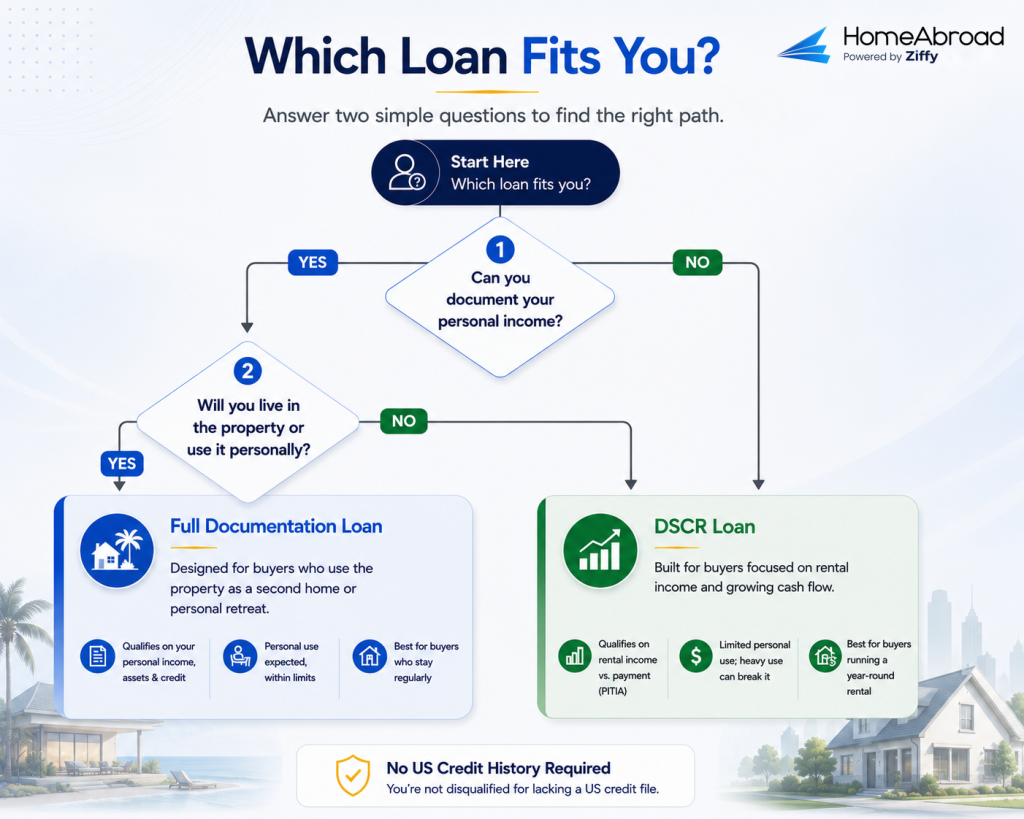

The best loan isn’t always the one with the fewest documents. It’s the one that matches how you earn income and how you plan to use the property. Taking the time to choose the right financing option upfront can make the approval process much smoother.
Limitations, Trade-Offs, and What to Verify Before You Apply
A Full Documentation Loan can provide a financing path for eligible foreign nationals who can verify their income and financial profile. However, like any mortgage program, it comes with requirements and considerations that are important to understand before applying.
Be Prepared for More Documentation
Unlike loan programs that rely primarily on a property’s cash flow, a Full Documentation Loan requires underwriters to review your personal financial profile. This means you’ll typically need to provide documents verifying your income, assets, employment or business activity, and creditworthiness.
If your documents are issued outside the US, you may also be asked to provide notarized forms or apostille certification, depending on the document type and where it was issued. Gathering these documents in advance can help reduce delays during underwriting.
Down Payment and Reserve Requirements
Foreign national borrowers are generally expected to make a meaningful down payment and demonstrate sufficient cash reserves after closing. These requirements help show that you have the financial capacity to manage the mortgage over the long term.
The exact down payment, reserve requirements, and other eligibility criteria depend on the loan program and your individual borrower profile.
A Mortgage Does Not Provide Immigration Benefits
Obtaining a mortgage to purchase property in the US does not grant immigration status, permanent residency, or authorization to live or work in the country. Loan eligibility and immigration status are separate matters and are evaluated independently.
Tax and Legal Matters Require Professional Advice
Buying property in the US may have tax, legal, and regulatory implications that vary based on your country of residence, ownership structure, and investment goals. Consider consulting a qualified tax advisor or attorney who is familiar with cross-border real estate transactions.
How to Get Started With HomeAbroad
HomeAbroad has helped more than 500 foreign national investors from over 40 countries finance US real estate, using the Full Documentation Loan, DSCR, and other programs built specifically for international buyers. If you have documentable income and want to know what you qualify for, the useful next step is a conversation that turns your specific profile into real numbers.
You can start your Full Documentation Loan pre-approval with HomeAbroad and a loan officer will walk through your income, credit evidence, and goals with you. If you would rather compare programs first, the foreign national mortgage options overview lays out how each path qualifies you.
Ready to take the next step? Get Pre-Qualified to discuss your financing options with a HomeAbroad loan advisor.
Frequently Asked Questions
Can I qualify without a US credit history?
Yes. A Full Documentation Loan does not require a US credit score. HomeAbroad assesses your creditworthiness through an international credit report or approved alternatives such as bank reference letters and accountant certifications from your home country. Your credit is still reviewed; the evidence simply comes from your own country rather than a US credit file.
Do I need a visa to get a Full Documentation Loan?
Not necessarily. Borrowers from visa waiver countries generally do not need a visa for this loan, and for others a visa is preferred but not always required. Foreign investors can typically close on a property without visiting the United States. Your specific situation is confirmed during pre-approval.
What is the difference between a Full Documentation Loan and a DSCR loan?
A Full Documentation Loan qualifies you on your documented personal income and can be used for a primary residence, second home, or investment property. A DSCR loan qualifies the property on its rental income, requires no personal income verification, and is limited to investment properties. Which one fits depends on how easily you can document your income and how you plan to use the property.
How much do I need for a down payment?
On the current program, foreign national borrowers should plan for a down payment of 20% to 25%. The exact figure depends on your profile and the property, and is confirmed at pre-approval.
Can I use this loan for a home I plan to live in?
Yes. Because the Full Documentation Loan qualifies you on your own income, it can finance a primary residence or a second home, not only a rental. This is a key advantage over a DSCR loan, which is limited to investment property.