





Editorial Integrity
Making informed real estate decisions starts with having the right knowledge. At HomeAbroad, we offer US mortgage products for foreign nationals & investors and have a network of 500+ expert HomeAbroad real estate agents to provide the expertise you need. Our content is written by licensed mortgage experts and seasoned real estate agents who share insights from their experience, helping thousands like you. Our strict editorial process ensures you receive reliable and accurate information.
Rent paid to a foreign owner is subject to 30% federal withholding on the gross amount unless the owner gives the property manager a valid Form W-8ECI and makes the Section 871(d) election on their tax return.
Your property manager is a withholding agent under US tax law. A manager who has never asked a foreign owner for a W-8 form is a warning sign, not a convenience.
California withholds a further 7% of rent paid to owners who live outside the state. Other states must be checked individually.
Rent is earned in US dollars and your HomeAbroad mortgage is paid in US dollars. Keep them in the same currency and convert only what is left.
The property management agreement, not the manager’s reputation, is what protects an owner who cannot sign notices, attend hearings, or inspect the property in person.
Table of Contents
You can run a US rental from another country without ever setting foot in it. Thousands of foreign owners do. What changes when you manage rental property remotely as a nonresident is not the tenant side of the business. It is the money: who holds the rent, what gets withheld from it before you see it, what forms your property manager must file because you live abroad, and how you keep a US mortgage paid on time from a bank account nine time zones away.
This article covers the operating side of remote ownership: rent collection across borders, federal and state withholding, the compliance calendar, and the terms your property management agreement needs when you cannot show up. If you have not yet chosen a manager or decided between long-term and short-term rental, start with the guide to setting up property management before closing, then come back here.
What Changes When the Rental Owner Lives Outside the US
A landlord in Ohio who owns a rental in Texas and a landlord in Dubai who owns the same house face the same tenant, the same lease, and the same water heater. The differences are structural, and there are four of them.
Presence, Authority, and Who Can Sign
Someone in the US has to be able to act for you. Late-rent notices need a signature. Eviction hearings need an appearance. A burst pipe at 2 a.m. Texas time is 11 a.m. in Dubai, which is fine, but a contractor waiting for approval on a $900 repair at 2 p.m. Texas time is waking you at 11 p.m.
For most owners the answer is written delegation inside the property management agreement, covered later in this article. If you hold the property through a limited liability company (LLC), every state also requires the LLC to name a registered agent: a person or company with a physical address in the state who receives legal notices on the company’s behalf. The registered agent is not your manager and does not run the property, but without one the LLC is not in good standing.
Rent Is Earned in US Dollars and So Is Your Mortgage
Your tenant pays in dollars. Your HomeAbroad loan payment, property tax, insurance premium, and repair invoices are all in dollars. The only reason to convert rent to your home currency is to spend it there.
Owners who convert every disbursement and then wire money back to the US for the mortgage pay the exchange spread twice and add a transfer delay to a payment with a due date. The rest of this article assumes a simpler setup: rent stays in dollars until the property’s own bills are paid.
The Owner Is Usually a Nonresident Alien for Tax Purposes
“Nonresident alien” is a tax term, not an immigration term. It means a person who is neither a US citizen nor a US tax resident under the green-card test or the substantial-presence test. A visa status, a passport, and a tax residency are three separate tests, and one does not determine another. The US tax guide for foreign real estate buyers explains the tests.
Most owners reading this are nonresident aliens, and the withholding rules below are written for that situation. If you have moved to the US since buying, or you hold the property through a US corporation or partnership, the rules differ, and a tax professional should confirm which set applies to you. Nothing in this article is personal tax advice.
How Rent Collection Works When You Live Abroad
Follow one month’s rent from the tenant’s bank to yours and every cross-border issue shows up in order.
Rent Lands in a US Account First
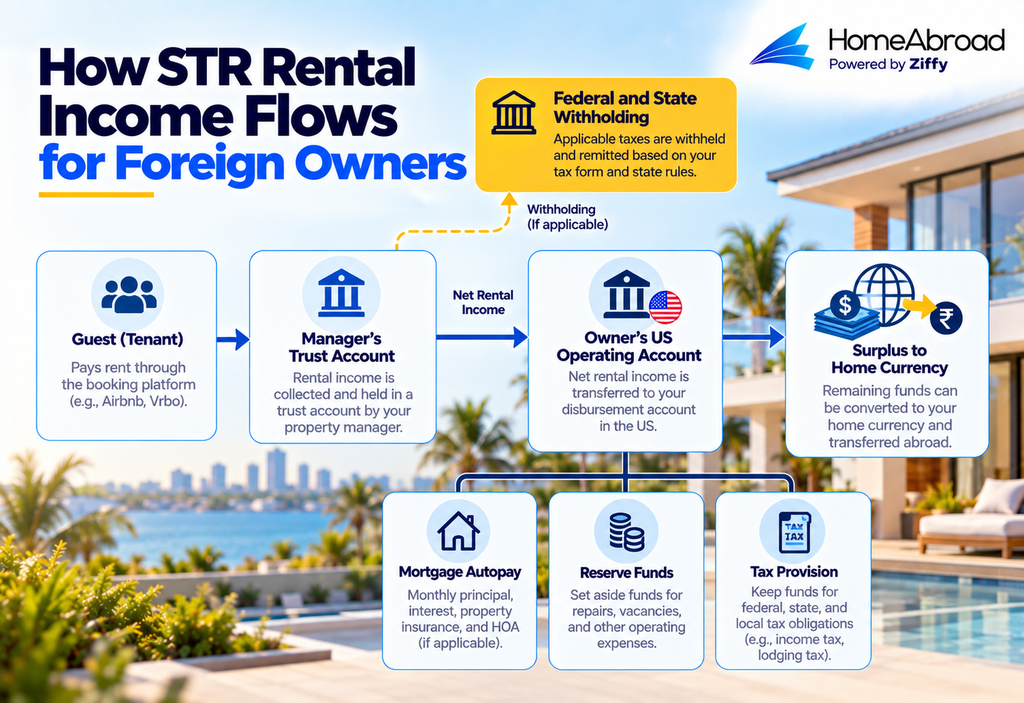
The tenant pays the property manager. Licensed managers in most states must hold client money in a trust account, a bank account regulated by the state real estate authority and kept separate from the manager’s own funds. From that account the manager deducts the management fee and any approved repair costs, applies any withholding the law requires (next section), and disburses the balance to you.
That disbursement almost always goes to a US bank account. Managers set up ACH transfers to US accounts as standard practice; international wires are possible with some firms but add fees and days, and a few will not do them at all. Your mortgage servicer, insurer, county tax office, and utility companies all expect US payments too.
Opening a US account from abroad is possible but bank practice varies. Expect to provide a passport, proof of foreign address, and a US taxpayer number (an ITIN for individuals or an EIN for an LLC), and to complete identity verification in person at some banks. Owners who already have a US account from the closing process should keep it open and use it as the property’s operating account.
Paying Your HomeAbroad Mortgage From Rent
Set the mortgage payment to draft automatically from the US operating account on the due date. Do not schedule it from abroad each month. A wire that clears a day late because of a public holiday in your country is still a late payment on a US loan.
Your monthly payment may or may not include property tax and insurance, depending on whether the loan has an escrow account (an account the servicer holds to pay those bills on your behalf). If your loan does not escrow, the tax bill arrives once or twice a year and the insurance renewal arrives annually, and both must be paid from the same account.
Keep one to two months of the full payment (principal, interest, taxes, insurance, and any HOA dues, together called PITIA) sitting in the operating account at all times. A vacant month or a large repair should never put the loan payment at risk. Size the buffer with the cash flow calculator using your actual rent, fees, and payment.

Steven Glick
Director of Mortgage Sales
HomeAbroad
NMLS #1231769For foreign owners, we recommend keeping the mortgage payment in a US account with a PITIA buffer because it removes unnecessary timing and currency risks. When owners wire each payment from abroad, holidays, transfer delays, exchange-rate fluctuations, or bank issues can turn a routine payment into a late one. Keeping enough cash in the US account gives the mortgage payment a clear path, even when rent or international transfers are delayed.
Converting Rent to Your Home Currency
Convert surplus only. After the mortgage draft, the reserve top-up, and a provision for the annual tax bill, whatever remains is yours to move.
A bank wire is the simplest route and usually the most expensive: banks price the exchange rate two to four percent from the interbank rate and add a wire fee. Specialist foreign-exchange providers price closer to the interbank rate and let you hold dollars until the rate suits you. Either way, download the confirmation.
Your US tax return is filed in dollars, and if your home country taxes foreign rental income, you will need the conversion record there too. Reporting rules for income earned abroad vary widely by country and are outside the scope of this article; a tax adviser in your home country can tell you what applies.
Reading the Monthly Owner Statement
A statement from a manager who works with foreign owners has a line the domestic version does not: withholding. The statement should show gross rent collected, the management fee, any leasing or renewal fee, itemized repairs with invoices attached, any federal or state withholding remitted, and the net amount sent to you. Reconcile the net figure to your bank deposit every month. If the two do not match, ask the same day.
Line | No W-8ECI on file | Valid W-8ECI on file |
|---|---|---|
Gross rent collected | $2,400 | $2,400 |
Management fee (10%) | ($240) | ($240) |
Approved repair | ($150) | ($150) |
Federal withholding (30% of gross rent) | ($720) | $0 |
Same house, same tenant, same manager. The only difference is a one-page form. That is the subject of the next section.
Federal Tax Withholding on Rent: The 30% Default and How Owners Stop It
Rent paid to a nonresident alien is, by default, taxed at a flat 30% of the gross amount with no deductions. The tax is collected at source, before you receive anything. The Section 871(d) net election explains the election in full; this section covers how it works month to month between you and your manager.
Why Your Property Manager Is a Withholding Agent
Federal law puts the withholding duty on whoever has control, receipt, or custody of the rent. For an owner abroad that is the property manager, or the tenant if there is no manager. The IRS treats the withholding agent as liable for the tax if it is not withheld, which is why an experienced manager asks a foreign owner for a Form W-8 before the first disbursement.
That request is a sign of competence. A manager who has never asked, never heard of Form 1042, and pays a foreign owner exactly as they pay a domestic one is exposing both of you.
Form W-8ECI and the Section 871(d) Election
Stopping the 30% withholding takes two separate steps, and owners regularly do one without the other.
First, you elect on your tax return to treat the rental income as effectively connected with a US trade or business. The election is a statement attached to Form 1040-NR. Once made, it applies to all later years unless revoked. The IRS allows revocation without approval by amending the original return within the normal amendment window; after that, revocation needs IRS consent.
Second, you give your property manager Form W-8ECI. The form certifies, under penalty of perjury, that the rent is effectively connected income and that you are reporting it. With a valid W-8ECI on file, the manager stops withholding. The IRS requires the form in the first year the election is made and in later years when required; keeping the manager’s copy current is the owner’s responsibility, not the manager’s.
Do the second step without the first and the manager has stopped withholding on income you have not elected to report on a net basis. Do the first without the second and the manager keeps sending 30% of your gross rent to the IRS, which you then reclaim by filing, a year later. The rental property tax deductions guide for foreign owners shows why net-basis taxation usually matters: mortgage interest, depreciation, management fees, insurance, and repairs are all deductible once the election is in place, and none of them are without it.
Form 1042-S, Form 1040-NR, and the ITIN
Three documents close the loop each year.
Form 1042-S is the manager’s annual statement of rent paid to a foreign owner and any tax withheld. It is the foreign-owner equivalent of the Form 1099-MISC a domestic landlord receives, and it is furnished by March 15. A foreign owner who receives a 1099-MISC instead has a manager who has classified them as a US person, and that needs correcting before the manager’s own filings go in.
Form 1040-NR is the nonresident alien income tax return. Rental income and expenses are reported on Schedule E once the election is in place. The return is due April 15 for most filers, or June 15 for nonresident aliens who did not receive wages subject to US withholding.
An Individual Taxpayer Identification Number (ITIN) is required to file. Owners without one apply on Form W-7, submitted with the first return. The application takes weeks, sometimes months, so start it well before the first filing deadline.
State and Local Compliance for a Nonresident Owner
Federal rules are the same in every state. State and city rules are not, and a few of them exist only because the owner lives somewhere else.
State Nonresident Withholding: California’s 7% Rule
California requires a property manager who collects rent for an owner living outside the state to withhold 7% of the rent, after deducting the management fee, once payments to that owner exceed $1,500 in a calendar year. The manager remits the withholding to the Franchise Tax Board (FTB) quarterly on Form 592 and gives the owner a Form 592-B statement by January 31 of the following year. A manager who fails to withhold can be held liable for the amount.
An owner can apply to the FTB for a full waiver on Form 588 or a reduced rate on Form 589. The manager may only stop or reduce withholding after receiving the FTB’s written determination, so apply before the first rent check, not after. The 7% is a prepayment against California income tax, reconciled when the owner files a California nonresident return.
California is the clear example. Other states in HomeAbroad’s lending footprint should be checked one at a time, because a rule like this can exist at the state level without appearing in any general landlord guide.
Rental Registration, Licensing, and Inspections
Many cities require rental properties to be registered, licensed, or inspected periodically, and some require a local contact person on file. Your manager typically handles this, but the registration is in the owner’s name and lapses are the owner’s problem. Ask which registrations apply to your address and when each renews.
Federal law also requires the lead-based paint disclosure and pamphlet for any home built before 1978, delivered to the tenant before the lease is signed. Short-term and mid-term rentals carry their own permits and occupancy-tax filings, covered in the guides to buying a US vacation rental as a foreign investor and mid-term rentals.
Security Deposits, Notices, and Landlord-Tenant Law
Deposit limits, the deadline to return a deposit after move-out, notice periods for rent increases and non-renewal, and the rules for entering the unit are all set by state law and sometimes tightened by city ordinance. For an owner who cannot handle a dispute in person, the cost of a slow eviction process or a missed deposit deadline is higher than it is for a local landlord, which is why the landlord-friendly states guide frames those differences as operational friction.
One rule does not vary: federal fair housing law applies to every rental in the country regardless of where the owner lives, and the manager’s screening process must comply with it.
Entity Owners: Registered Agent, Form 5472, and Annual Reports
Owning the rental through a US LLC adds three recurring items.
The registered agent renews annually and must stay current. The state requires an annual or biennial report, and some states charge a franchise tax on LLCs whether or not they earn a profit. And a single-member LLC owned by a foreign person, though disregarded for income tax, must file Form 5472 with a pro forma Form 1120 every year to report transactions between the LLC and its owner. The penalty for not filing is $25,000 per year.
Beneficial ownership reporting to FinCEN has changed more than once. As of the March 2025 interim final rule, companies formed in the US were exempt from reporting.
Structuring the Property Management Agreement for a Remote Owner
The pre-closing guide covers how to choose a manager. This section covers what the contract has to say once you have chosen one, because a good manager on a thin contract still leaves an absent owner exposed.
Clauses That Protect an Owner Who Cannot Show Up
Read the agreement for these terms before signing. If one is missing, ask for it in writing.
- A repair approval threshold, typically $300 to $500, below which the manager acts without asking, and a definition of “emergency” that lets them exceed it for water, gas, heat, and security failures.
- Deposit handling: which trust account holds tenant deposits, and who owns the interest if the state requires interest to be paid.
- Reporting cadence and portal access: monthly statements with invoices attached, and an owner portal you can log into at any hour.
- Tax responsibilities named explicitly: that the manager will withhold under federal and state law where required, hold your W-8ECI, and issue Form 1042-S and any state statement by the legal deadline.
- The manager’s own insurance: general liability and errors-and-omissions coverage, with certificates on request.
- Authority to serve notices, file for eviction, and appear at hearings on your behalf where state law permits.
- Inspection schedule: at minimum move-in, move-out, and one mid-lease inspection with photos or video.
- Termination: notice period, what it costs to leave, and a commitment to transfer tenant files, deposits, and keys within a set number of days.
Keep your rent roll, current lease, and owner statements organized from the start. When you apply for another DSCR loan or refinance, those records help underwriting verify the property’s rental income and payment history. Having 12 months of consistent statements available can make the documentation process much cleaner.

Verifying the Manager’s License, Trust Account, and Complaints
Most states require anyone managing rental property for others to hold a real estate broker’s license or work under one; a few exempt certain arrangements. Look the license up on the state real estate commission’s public search, confirm it is active, and check for disciplinary history. Ask for the name of the bank holding the trust account. Membership in the National Association of Residential Property Managers is a useful secondary signal, not a substitute for the license check.
The Monthly and Annual Oversight Routine
Once a month: reconcile the statement to the deposit, open every attached invoice, and read the inspection or maintenance notes. Once a quarter: confirm any state withholding remittance matches the statement. Once a year: confirm your W-8ECI is still on file, decide on lease renewal at least 90 days before expiry, check the insurance renewal, and file the state entity report. Fifteen minutes a month prevents most of the surprises absent owners report.
Insurance, Repairs, and Emergencies From Another Time Zone
Landlord Insurance and What Your Lender Requires
A rental is insured under a landlord policy (often called a dwelling policy), not a homeowners policy. The policy must name your lender’s servicer under a mortgagee clause so the insurer notifies the lender of cancellation and pays the lender first on a covered loss.
If the policy lapses, the servicer buys lender-placed coverage and bills you for it. That coverage is far more expensive than a policy you choose, and it protects the lender’s interest in the building, not your contents, liability, or lost rent. Loss-of-rent coverage, which replaces rental income while the home is uninhabitable after a covered event, is an optional add-on worth pricing for an owner with no other US income.
Dorian Adams-Walker
Mortgage Loan Originator, HomeAbroad
NMLS #2442830 ✓ Licensed LOAn insurance lapse can create a serious problem for a foreign owner because you may not find out until the servicer places coverage on the property and charges it to your loan. Lender-placed insurance can be significantly more expensive and may provide less protection for you as the property owner. Keep your policy active, track renewal dates, and make sure the servicer has the updated declarations page before the existing policy expires.

Repair Authority and After-Hours Emergencies
The threshold and emergency definition in your agreement do the work here. Add one operational detail: give the manager a written list of what you consider urgent enough for a same-day call regardless of the hour, and confirm the number they will use. The setup guide covers threshold levels and escalation in more detail.
Turnover and Vacancy When You Cannot Visit
Turnover is where absent owners lose money, so make the manager show their work. Require a move-out condition report with timestamped photos, a written deposit disposition sent to the tenant inside the state deadline, and a move-in report signed by the new tenant. Ask for a video walkthrough of the vacant unit before it is relisted. If the manager charges a leasing fee for placing a new tenant, the report is what you are paying for.
How Remote Management Affects Your HomeAbroad Mortgage
The way you run the property affects the loan you already have and the loans you may want next.
Keeping Loan Terms: Occupancy, Insurance, and Ownership Changes
An investment-property loan assumes the home is rented, not occupied by you or your family. If a relative moves in, tell your loan officer first; occupancy affects the terms you qualified under.
Moving the property into an LLC after closing is a change of ownership. Most mortgages include a clause allowing the lender to call the loan due when title transfers, and lender consent is needed before the deed is recorded. The same applies to adding or removing a co-owner.
Keep your contact details with the servicer current. A tax or insurance notice that goes to an old address abroad is the kind of small failure that turns into a lapse.
Using Your Property Manager’s Statements for the Next DSCR Loan or a Refinance
The manager’s statements are your financing file. A DSCR loan qualifies on the property’s rental income rather than the borrower’s personal income, and it is available to foreign nationals without an established US credit history. When you apply for the next property or for a refinance, underwriting wants a current lease, a rent roll, and twelve months of owner statements showing the rent actually collected.
Owners whose statements are clean and consistent close faster. The DSCR loan calculator shows how the ratio works with your current rent and payment, and the guide to buying multiple rental properties as a foreign national covers how a second and third purchase are financed.
For a second DSCR loan, having your property records organized can make the process much more straightforward. A foreign owner living abroad should have the current lease, rent roll, and recent owner statements ready. Much of that documentation is available directly through the property manager’s portal, so keeping those records current throughout the year saves time when it is time to apply.
If Cash Flow Slips, Contact the Servicer Early
A tenant who stops paying in month four is a problem you can see coming from the statement. Call your servicer before a payment is missed, not after. Options depend on the loan and the situation, and no outcome can be promised here, but a conversation in advance is always better than a conversation after a late payment is reported.
Remote Owner Compliance Calendar and Checklist
When | What | Who | Form or document |
|---|---|---|---|
Before first rent | Give manager Form W-8ECI; apply for CA waiver if applicable | Owner | W-8ECI; FTB Form 588 or 589 |
Before first rent | Confirm landlord policy with mortgagee clause | Owner | Insurance declarations page |
Monthly | Reconcile owner statement to bank deposit | Owner | Owner statement |
Monthly | Mortgage autopay draft | Servicer | Loan statement |
Quarterly (CA) | Remit 7% withholding | Manager | FTB Form 592 and 592-V |
Jan 31 | State withholding statement to owner (CA) | Manager | FTB Form 592-B |
Mar 15 | Annual statement of rent paid and tax withheld | Manager | Form 1042-S |
Apr 15 or Jun 15 | Nonresident income tax return, with 871(d) statement in the first year | Owner and tax adviser | Form 1040-NR, Schedule E |
Annually (LLC) | Foreign-owned entity information return | Owner and tax adviser | Form 5472 with pro forma 1120 |
Annually (LLC) | State annual report and registered agent renewal | Owner | State filing |
90 days before lease end | Renewal or non-renewal decision | Owner and manager | Lease |
Annually | Insurance renewal; confirm W-8ECI still current | Owner | Policy; W-8ECI |
Manage Your US Rental With Confidence From Abroad
Managing a US rental property from another country becomes much easier when the financial, tax, and property management systems are set up correctly from the beginning. Keeping rent and mortgage payments in US accounts, maintaining adequate reserves, staying current on withholding requirements, and keeping property records organized can help you manage the investment without being physically present.
At HomeAbroad, we help foreign investors finance US investment properties with mortgage programs designed for international borrowers. If you are planning to purchase another rental property or refinance an existing investment, our team can help you understand the available financing options and documentation requirements for your situation.
Planning your next US investment property or refinance? Request a DSCR loan quote from HomeAbroad to explore your financing options.
FAQs
Can my property manager send rent directly to my bank account outside the US?
Some will, by international wire, usually at a fee and with a delay of several days. Most disburse only to US accounts. Either way, the withholding rules apply before the money leaves the manager’s trust account, and you still need a US account for the mortgage, taxes, and insurance.
Does having an ITIN stop the 30% withholding?
No. An ITIN lets you file a return. Withholding stops only when the manager holds a valid Form W-8ECI from you, which depends on your having made the Section 871(d) election on your return.
My manager never withheld and I never filed. What should I do?
Talk to a tax professional who works with nonresident owners before the next filing deadline. Late returns can be filed, and the IRS provides relief for a late election in some circumstances, but the facts of your case decide what is available. Do not let another year pass.
Do I ever need to visit the property?
Not for legal or lending reasons. Owners who visit once every year or two tend to catch deferred maintenance the statements do not show, but a manager with a proper inspection schedule and video reporting covers most of that gap.
Can a relative in the US manage the property instead of a licensed manager?
In some states, yes, for an unpaid family member; in others, managing property for anyone else requires a license. Whoever collects the rent becomes the withholding agent under federal law, so the relative takes on the same 30% withholding duty and the same liability a professional manager would. Check the state licensing rule before deciding.