



Editorial Integrity
Making informed real estate decisions starts with having the right knowledge. At HomeAbroad, we offer US mortgage products for foreign nationals & investors and have a network of 500+ expert HomeAbroad real estate agents to provide the expertise you need. Our content is written by licensed mortgage experts and seasoned real estate agents who share insights from their experience, helping thousands like you. Our strict editorial process ensures you receive reliable and accurate information.
Quick Answer
A foreign national who owns US rental property can claim the same rental property tax deductions a US investor claims, including mortgage interest, property taxes, insurance, management fees, repairs, and depreciation. The catch is that none of them apply by default. Rental income paid to a nonresident alien is taxed at a flat 30% of the gross rent unless the owner makes a Section 871(d) election, and that election has a filing deadline that cancels every deduction if it passes.
Deductions for foreign owners are conditional. Without a Section 871(d) election, US rental income is taxed at a flat 30% on gross rent with no expenses subtracted.
A nonresident alien who files more than 16 months after the original due date loses the right to claim deductions for that year, and the IRS grants relief only by waiver.
The $10,000 state and local tax cap does not apply to property taxes on a rental. Those go on Schedule E in full.
Mortgage interest is usually the largest single line on the deduction stack, which is why a financed purchase and an all-cash purchase produce very different tax outcomes on the same property.
Table of Contents
Can Foreign Owners Deduct Rental Property Expenses?
Yes, but only after a specific filing choice, and the default is worse than most investors expect.
When a nonresident alien collects rent on a US property, the IRS treats that rent as FDAP income, which stands for fixed, determinable, annual, or periodical income. FDAP income is taxed at a flat 30% of the gross amount. Not the profit. The gross. A property that collects $30,000 in rent and spends $22,000 running it still produces a $9,000 federal tax bill under the default rules because expenses never enter the calculation.
Section 871(d) of the Internal Revenue Code lets a nonresident alien elect to treat income from US real property as ECI (Effectively Connected Income). Once that election is in place, the rent is taxed on net profit at graduated rates instead, and it is reported on Schedule E, the IRS form for rental income and expenses, attached to Form 1040-NR. That single election is what turns the rest of this article from a list of interesting facts into money.
It is an election, not a treaty benefit and not an automatic status. You have to claim it. The full mechanics, including the statement wording and how to make a late election, are covered in the Section 871(d) net election guide.
One more thing worth setting straight early, because it comes up in almost every first conversation: a tax treaty between your country and the US generally does not change any of this for an individual owner. Treaties matter for other categories of income. Rental real estate is largely outside their reach, and so is the withholding that applies when you eventually sell. More on where treaties do and do not help in the US tax treaties and real estate guide.
The Two-Step Most Owners Miss
Making the Section 871(d) election and stopping the 30% withholding are two separate steps.
The Section 871(d) election is made by attaching a statement to your Form 1040-NR, allowing your rental income to be taxed as effectively connected income (ECI).
Form W-8ECI serves a different purpose. You give it to your property manager or other withholding agent to certify that your rental income is effectively connected income, allowing them to stop withholding 30% from your rental payments. It is provided to the withholding agent, not the IRS.
Completing one step does not automatically complete the other. Both are important for foreign owners who want to report rental income on a net basis and avoid unnecessary withholding.
The 16-Month Deadline That Cancels Every Deduction
This is the rule that costs foreign owners the most money, and it is almost invisible in the tax content written for US investors, because it does not apply to them.
The IRS states that a nonresident alien who does not file within sixteen months of the original due date, without regard to extensions of time to file, is not permitted to claim deductions from gross income and is ineligible to claim certain credits, unless the IRS grants a waiver. The authority sits in Section 874(a) of the Internal Revenue Code, and the IRS explains it in Section 7 of Publication 519, its tax guide for aliens.
The deadline runs from the original due date. Extensions do not move it. And the consequence is not a penalty calculated on tax owed. The consequence is that your deductions cease to exist for that year, so tax is calculated on gross rent even if the property lost money.
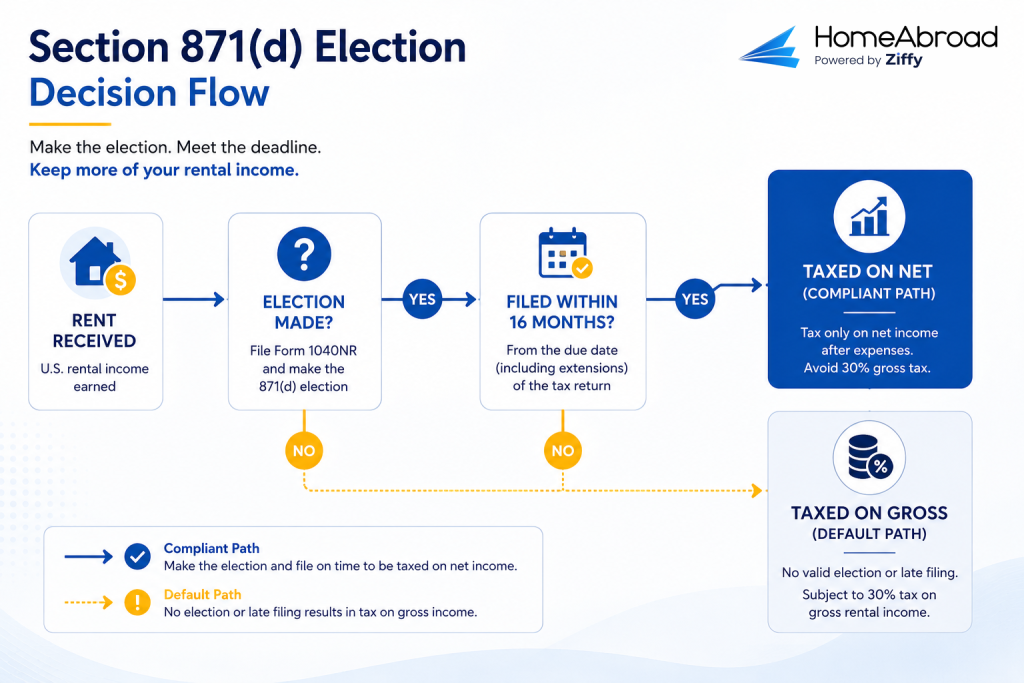
Here is what those three outcomes look like side by side on the same property.
A single-family rental collects $30,000 in gross annual rent. Deductible expenses for the year total $22,000, made up of mortgage interest, property taxes, insurance, management fees, repairs, and depreciation. Assume the owner is a nonresident alien with no other US income.
Scenario | What gets taxed | Amount subject to tax |
|---|---|---|
No Section 871(d) election | Gross rent, flat 30% FDAP | $30,000 → $9,000 in tax |
Election made, return filed on time | Net profit at graduated rates | $8,000 |
Election made, return filed past 16 months | Gross rent at graduated rates, deductions disallowed | $30,000 |
The gap between row two and row three is the whole point. Same property, same expenses, same election. The only variable is a filing date, and it moves the taxable base from $8,000 to $30,000.
Waivers exist, and a late election can sometimes be made on an amended return with a reasonable cause statement. Neither is routine, and neither is something to plan around. If you are behind on a US return for a rental you already own, that is a conversation for a cross-border CPA this month, not next filing season.
Rental Property Tax Deductions Foreign Owners Can Claim
With the election in place and the return filed on time, the deduction list opens up. What follows is what actually appears on a foreign owner’s Schedule E, and the wrinkle attached to each one.
Mortgage Interest
For most financed properties, this is the biggest number on the page. Interest on a loan used to acquire or improve a rental property is deductible against that property’s rental income. It goes on Schedule E as a rental expense, which is a different treatment from the mortgage interest deduction homeowners take on a primary residence.
The wrinkle for foreign owners is structural. An investor who buys all-cash with funds wired from abroad has no interest to deduct, because there is no loan. That is not a small difference. On a typical financed purchase, interest can account for more of the annual deduction than property taxes, insurance, and management fees combined during the early years of the loan, when the payment is mostly interest.
Financing through a US lender also produces clean US-sourced interest reporting, which is the documentation your CPA needs to support the deduction without reconstructing anything.
This is where HomeAbroad fits. Our DSCR loan program qualifies international investors on the property’s rental income rather than personal income or a US credit score, which is the structure most of our foreign national investors use for rental purchases. DSCR (Debt Service Coverage Ratio) measures whether a property’s rental income is enough to cover its monthly housing payment (PITIA), including principal, interest, taxes, insurance, and applicable association dues.

Steven Glick
Director of Mortgage Sales · HomeAbroad
When international investors compare financing with an all-cash purchase, they usually focus on the interest cost without looking at how the loan fits into their overall investment strategy. Reviewing the financing structure before making an offer leads to more informed decisions.
Property Taxes
Property taxes on a rental are deductible in full against rental income on Schedule E.
The $10,000 cap on state and local tax deductions that dominates US tax coverage is an itemized personal deduction limit. It applies to the taxes on your own home. It does not cap what you deduct on an investment property reported on Schedule E, and foreign owners routinely undercount here because they read domestic guidance and assume the ceiling follows them.
Rates vary enormously by state, and the difference shows up in cash flow before it ever shows up on a return. See the state-by-state property tax rates for where your target market sits.
Insurance Premiums
Landlord policies, hazard coverage, flood insurance, liability coverage, and loss-of-rent coverage are all deductible operating expenses.
Foreign capital concentrates in Florida and Texas, and in those markets insurance has stopped being a minor line item. For a coastal Florida rental it can rival or exceed the property tax bill. That makes it a top-three deduction rather than an afterthought, and it makes underinsuring a false economy twice over.
Property Management Fees
Deductible in full, and close to universal for this audience. A US investor an hour from their rental can self-manage and forgo the deduction. An owner in Mumbai or Dubai cannot. The management fee, usually a percentage of collected rent, is a cost of remote ownership and it reduces taxable income accordingly.
Your manager is also usually the withholding agent holding your Form W-8ECI, which links this line back to the mechanics above. The same relationship that generates the deduction is the one that stops the 30% withholding.
Repairs and Maintenance
Repairs are deducted in the year you pay them. Improvements are capitalized and depreciated over years.
The practical test: fixing what broke is a repair. Making the property better, longer-lived, or adapted to a new use is an improvement. Patching a roof leak is a repair. Replacing the roof is an improvement.
For foreign owners the friction is documentation. A US contractor’s invoice supports the deduction on its own. Anything paid from abroad, or paid in cash to someone your manager arranged, needs a paper trail that will still make sense to a CPA nine months later.
Depreciation
Depreciation lets you deduct part of the building’s value each year without spending anything that year. Residential rental property is depreciated over 27.5 years, commercial over 39. Land is never depreciated, only the building.
It is the deduction with the longest tail and the most trade-offs, including cost segregation, bonus depreciation, and the passive loss limits that decide how much of it you can actually use. Those are covered in full in the rental property depreciation guide.
The trade-off in one line: every dollar of depreciation you claim lowers your basis in the property, which raises the gain when you sell. That reckoning is depreciation recapture, and it is worth understanding before you accelerate anything.
HOA Dues, Utilities, and Professional Fees
HOA dues are deductible on a rental. HOA stands for homeowners association, the body that maintains shared areas in a community or condo building and charges owners a recurring fee.
Utilities are deductible when the landlord pays them rather than the tenant. Professional fees are deductible too, and this is a line foreign owners should not shrink from. The CPA fee for a Form 1040-NR with a Schedule E, an 871(d) election, and a depreciation schedule runs well above a domestic return. Legal fees and the annual cost of maintaining an LLC, if you hold the property in one, are deductible on the same basis.
Travel to the Property
Travel expenses may be deductible when the trip has a genuine business purpose, such as inspecting the property, meeting with your property manager, or overseeing repairs. Travel that is primarily personal is not, and adding a property walkthrough to a family visit does not convert the trip.
The IRS scrutinizes this category for domestic investors already. For a nonresident alien flying in from another continent, the cost is high enough to be worth claiming and conspicuous enough to be worth documenting properly. Establish the business purpose in writing before you travel, keep the itinerary, and let a CPA decide the allocation.
Deduction Summary
Deduction | Where reported | Available without the 871(d) election? | Foreign-owner note |
|---|---|---|---|
Mortgage interest | Schedule E | No | Only exists if the purchase was financed |
Property taxes | Schedule E | No | The $10,000 SALT cap does not apply |
Insurance | Schedule E | No | Often a top-three cost in FL and TX |
Management fees | Schedule E | No | Your manager usually holds your W-8ECI |
Repairs | Schedule E | No | Improvements capitalize instead |
Depreciation | Schedule E, Form 4562 | No | Lowers basis, raises tax at sale |
HOA, utilities, professional fees | Schedule E | No | Cross-border CPA fees are deductible |
Travel | Schedule E | No | Business purpose must be documented first |
The biggest mistake we see in the first year is inconsistent recordkeeping. Save invoices, management statements, insurance documents, and repair receipts as they happen. Recreating that paperwork at tax time is much harder than keeping it organized from day one.

What Foreign Owners Cannot Deduct
Shorter list, and every item on it shows up in real returns.
Land value: Only the building depreciates. Your allocation between land and building has to be defensible, and using the county assessor’s ratio is the usual starting point.
Principal repayment: Your mortgage payment has two parts, and only the interest is deductible. The principal portion is you buying the asset, which is not an expense.
Personal-use periods: Weeks you or your family occupy the property come out of the deductible share. If you use the place at all, the allocation rules get involved and they are stricter than people expect.
Pre-service expenses: Costs incurred before the property was available for rent do not deduct in that year. They generally get added to basis.
Home-country taxes: Tax you pay in your own jurisdiction is not a US deduction. Whether you get relief for the US tax at home is a question for a tax professional in your country, and it works in the opposite direction from how most people assume.
Principal Is Not Interest: The most common miscalculation among first-time foreign landlords. A $1,800 monthly mortgage payment does not generate a $21,600 annual deduction. Only the interest portion counts, and your lender's year-end statement tells you exactly what that was.
Why Big Deductions Do Not Always Mean a Smaller Tax Bill
Here is the part the domestic guides skip, and it changes how you should think about the entire list above.
Rental activity is generally passive under Section 469 of the Internal Revenue Code. Passive losses can offset passive income, and what is left over is suspended and carried forward rather than refunded. For a US investor with a salary and a portfolio, there is often other income around for a rental loss to work against. For a foreign owner whose only US income is the rental itself, there frequently is not.
That produces a result that surprises people. You run a cost segregation study, generate a large first-year depreciation deduction, and the property posts a paper loss. There is nothing for that loss to offset. It suspends. It sits on your return, carried forward, waiting.
Suspended losses are not lost. They generally free up when you dispose of the property in a fully taxable sale, and they can offset passive income from other US rentals in the meantime, which is one of the arguments for building a portfolio rather than holding a single property. The IRS covers the mechanics in Publication 925.
So the honest framing for this whole subject: your deductions decide when you get the benefit at least as often as they decide whether you get it. Accelerating a deduction you cannot use this year, into a suspended loss, while lowering the basis you will be taxed on at exit, is a decision with two sides. Model both before you pay for a cost segregation study.

Most international investors start by looking at the interest rate, but the better question is whether the loan supports their investment goals. The right financing structure should provide sustainable monthly cash flow while fitting the property’s long-term strategy.
How to Claim Rental Property Deductions as a Foreign Owner
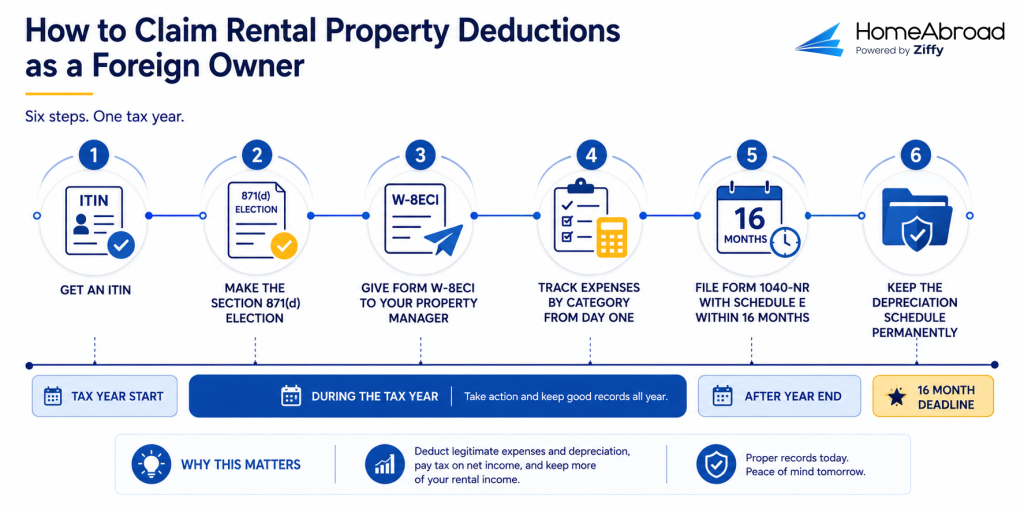
- Get an ITIN if you do not have one: An ITIN is an Individual Taxpayer Identification Number, the IRS identifier for people who need to file a US return and are not eligible for a Social Security Number. You cannot file without one.
- Make the Section 871(d) election: A statement attached to your Form 1040-NR for the first year the election applies. Once made, it stays in effect for later years unless properly revoked.
- Give Form W-8ECI to your property manager: This stops the 30% withholding on rent going forward. It goes to the manager, not to the IRS.
- Track expenses by category from day one: Not at filing time. The categories in the table above are the ones your Schedule E will ask for.
- File Form 1040-NR with Schedule E within 16 months of the original due date: Treat this as immovable, because extensions do not move it.
- Keep the depreciation schedule permanently: You will need it at sale, and the IRS will assume you took the depreciation whether you claimed it or not.
Two boundaries worth stating plainly. Buying and renting US property does not grant a visa, residency, immigration status, or citizenship, and nothing about a rental portfolio changes your immigration position.
How Your Loan Structure Affects Your Deductions
Circle back to the first item on the list, because it is the one you control at purchase.
Mortgage interest is typically the largest deduction available to a foreign owner, and it only exists if the property is financed. That reframes the cash-versus-mortgage question. Leverage is a way to acquire more property with the same capital, and it is also what creates the largest line on your Schedule E.
At HomeAbroad, we finance US property for foreign nationals, and the structure most rental investors use with us is a DSCR loan, which qualifies on the property’s rental income rather than your personal income, employment, or US credit history. If your income sits in your home country and you need it counted, our full documentation mortgage program considers foreign income and assets.
One decision to make before closing rather than after: entity titling. Holding a property personally, through a US LLC, or through a foreign entity changes your reporting, your filing obligations, and sometimes your tax rate.
It also interacts with estate tax exposure, where the federal exemption for a nonresident alien is $60,000, a figure that catches people who assume the multi-million dollar US resident exemption applies to them. Restructuring after closing is expensive and occasionally triggers tax on its own. Get a cross-border CPA on the call before you sign.
Related Tax Rules That Affect Your Deductions
When you sell, FIRPTA applies: The Foreign Investment in Real Property Tax Act requires the buyer to withhold from the sale proceeds. The withholding runs on a tiered structure of 0%, 10%, or 15% depending on the price and the buyer’s intended use, and a great deal of published material mentions only the top tier. Details in the FIRPTA guide for foreign investors.
Treaties rarely help here: For an individual nonresident alien seller, a tax treaty generally does not reduce FIRPTA withholding, and it generally does not change how rental income is taxed either. Our guide to US tax treaties and real estate explains when treaties matter and when they do not.
Depreciation comes back at sale: Depreciation reduces your taxable rental income during ownership, but those deductions can affect your tax bill when you sell. Depreciation recapture determines how previously claimed depreciation is treated at the time of sale. Our Depreciation recapture guide for foreign investors explains how it works and what to expect.
Building a Larger Rental Portfolio: If you own multiple rental properties, suspended passive losses from one property may be available to offset passive income from another, depending on your circumstances and the applicable tax rules. As your portfolio grows, tax planning becomes more important. Learn more in our guide to buying multiple rental properties.
Ready to Invest in US Rental Property?
Understanding your tax deductions is only one part of owning a successful investment property. Choosing the right financing can also improve your monthly cash flow and long-term returns.
At HomeAbroad, we help foreign national investors finance rental properties across the US with mortgage programs designed for international buyers, including DSCR Loans and Full Documentation Loans. Our team can help you understand your financing options before you invest.
Speak with a HomeAbroad loan specialist to find the financing solution that fits your investment goals.
Frequently Asked Questions
Can a foreign national deduct mortgage interest on a US rental property?
Yes, once a Section 871(d) election is in place. Interest on a loan used to acquire or improve the rental is deductible against rental income on Schedule E. Without the election, rent is taxed at a flat 30% of the gross amount and no interest deduction is available.
What happens if I never made a Section 871(d) election?
Your rental income has been taxed as FDAP income at a flat 30% of gross rent, with no deductions. A late election can sometimes be made on an amended Form 1040-NR with a reasonable cause statement, and no advance IRS permission is required to make one. The timing rules are specific and the outcome depends on your facts, so this is a question for a cross-border CPA rather than a self-fix.
Is the $10,000 SALT cap applied to my rental property taxes?
No. The $10,000 state and local tax cap is a limit on itemized personal deductions. Property taxes on a rental are a business expense reported on Schedule E and are deductible in full against rental income.
Do I need an ITIN to claim rental property tax deductions?
Yes. An Individual Taxpayer Identification Number is required to file Form 1040-NR, and you cannot claim deductions without filing a return.
Can I deduct my flight to the US to inspect the property?
Possibly, if the trip has a genuine business purpose and you can document it. A trip that is primarily personal does not become deductible because you visited the property while you were there. Establish and record the business purpose before you travel, and have a CPA determine the allocation.
Does a tax treaty with my country increase my deductions?
Generally no. Treaties do not typically change how US rental income is taxed for an individual owner, and they do not typically reduce FIRPTA withholding when you sell. The Section 871(d) election, not a treaty, is what makes deductions available.