





Editorial Integrity
Making informed real estate decisions starts with having the right knowledge. At HomeAbroad, we offer US mortgage products for foreign nationals & investors and have a network of 500+ expert HomeAbroad real estate agents to provide the expertise you need. Our content is written by licensed mortgage experts and seasoned real estate agents who share insights from their experience, helping thousands like you. Our strict editorial process ensures you receive reliable and accurate information.
Foreign investors should calculate rental cash flow after vacancy, operating expenses, debt service, currency conversion, and applicable taxes.
Currency conversion costs and exchange-rate movements can reduce the cash flow ultimately received in the investor’s home currency.
Section 871(d) can change how rental income is taxed, making professional cross-border tax advice an important part of the investment analysis.
DSCR financing affects cash flow through the mortgage payment, so investors should model debt service using realistic loan terms before evaluating a property.
Table of Contents
Cash flow in real estate is the money a rental property leaves in your pocket after you collect the rent and pay every operating cost and the mortgage. For a foreign investor, that number usually lands lower than a standard calculator suggests, because several costs come out before the money ever reaches your home bank account.
The four that catch most nonresident owners off guard are currency conversion on each transfer, US tax withholding on rental income earned by a nonresident, professional management for a property you cannot drive to, and the larger cash reserves a remote owner needs.
Add those to the usual formula and you get your true net cash flow, the figure that tells you whether the deal actually works. This article shows how to build that number step by step, with a worked example that compares a standard calculation to a foreign investor’s real position, and where HomeAbroad financing fits into the math.
What Cash Flow Really Means for a Rental Property
Before adding the foreign investor layers, it helps to agree on the base number, since most online calculators and quick projections start the same way.
Cash flow is what remains after a property’s income pays its own bills. You begin with the rent, subtract the cost of running the property, subtract the mortgage payment, and whatever is left is your cash flow. It is usually tracked monthly and then checked across a full year, because some costs, like a vacancy or a new water heater, do not show up every month.
Net Operating Income, in Plain Terms
Two terms do most of the work. Net operating income, or NOI, is the property’s income after operating costs but before the mortgage. Operating costs include property tax (an annual tax US local governments charge on real estate), insurance, repairs and maintenance, a set-aside for big future repairs (often called CapEx, short for capital expenditures), property management, and an allowance for vacancy (the weeks between tenants when no rent comes in). Cash flow is then NOI minus the mortgage payment.
How Cash Flow Differs From Cap Rate and DSCR
Cash flow answers a narrow question: how much money the property puts in your account. Two related numbers answer different questions. Cap rate (short for capitalization rate) measures the property’s return before any mortgage, which helps you compare one property against another.
DSCR, or Debt Service Coverage Ratio, measures whether the rent covers the loan payment, which is how a lender decides if the property qualifies for financing. For the full comparison of when to lean on each, HomeAbroad covers how cap rate, cash flow, and DSCR differ separately. Here, the focus stays on cash flow.
A "gross yield" is annual rent divided by price, before any costs. It always looks better than what you actually keep. The number that matters for a buying decision is the net figure, after every expense in this article. Treat any gross yield as a starting point only.
The Standard Cash Flow Formula, and Where Calculators Stop
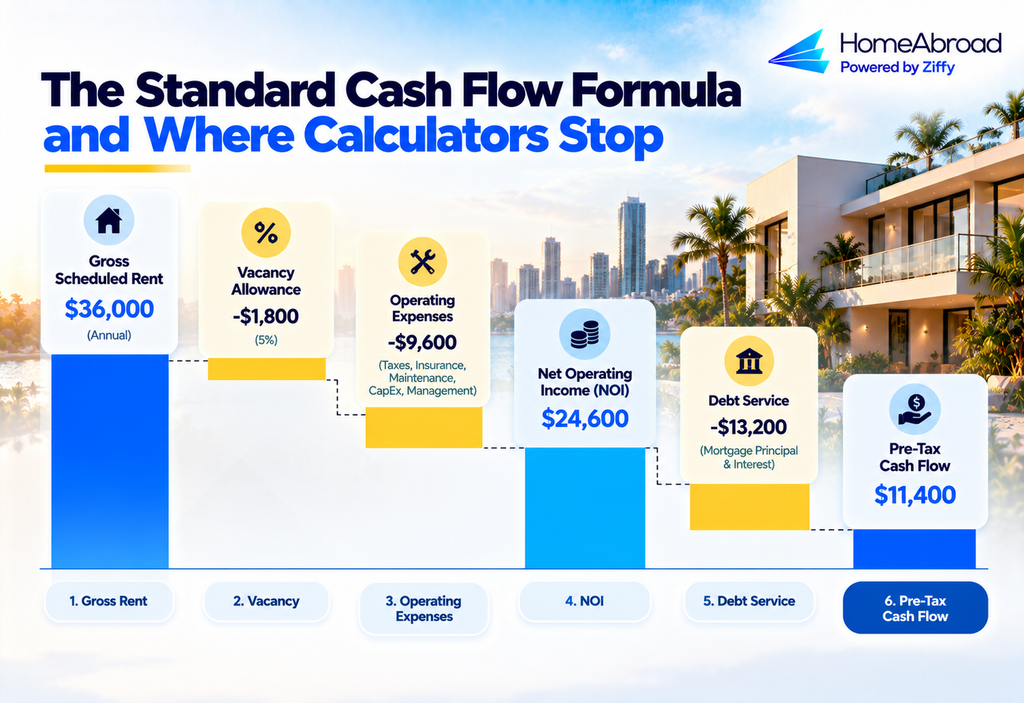
Here is the model almost every rental calculator uses:
- Start with gross scheduled rent, the full annual rent if the unit stays occupied all year.
- Subtract a vacancy allowance.
- Subtract operating expenses: tax, insurance, maintenance, CapEx, and management.
- That gives NOI.
- Subtract annual debt service, your mortgage principal and interest.
- What remains is pre-tax cash flow.
For a US-based investor, that is usually the whole story. For a foreign investor, it is only the first half. The costs the standard model leaves out are the subject of the next section.
How Financing Drives the Debt Service Line
The mortgage payment is often the single largest line in the model, so the loan you qualify for shapes the result. Foreign nationals investing in US rentals frequently finance with a DSCR loan, which qualifies you on the property’s rental income rather than US tax returns or an established US credit history.
HomeAbroad offers DSCR loans built for this borrower, using the property’s rent to support the payment. Underwriting relies on the appraiser’s market rent estimate, not the figure a listing advertises, so the rent in your model should match what an appraiser is likely to support. For the full qualification picture, see the current DSCR loan requirements for investment property.
The Four Costs Foreign Investors Must Add
This is where a foreign investor’s real number separates from the textbook one. Each cost below comes out of the money the standard model says you keep. None of them is exotic. They are simply the costs of owning US property from another country and in another currency.
Currency Conversion: The Cost of Moving Money Home

Your rent arrives in US dollars and your mortgage is paid in US dollars, but your savings and eventually your profit live in your home currency. Moving money between the two costs something every time.
Two things eat into the number. The first is the spread. Banks usually build a margin into the exchange rate they give you, and they often add a wire fee on top. Specialist transfer services tend to cost less, though there is still a cost. Confirm the exact figure with your provider, because the mid-market rate you see online usually understates what you will actually pay. The second is timing. Exchange rates move, so a fixed monthly cash flow in dollars is worth a little more or less in your currency from one month to the next.
In the model, apply a conservative conversion cost to the money you move home, then run one scenario where your currency strengthens against the dollar to see how much the home-currency return softens. Money flowing the other way counts too: your down payment and reserves convert into dollars when you buy, and any month the property runs short, you top it up in dollars.
US Tax Withholding on a Nonresident’s Rental Income
This is the line that changes deals, and the one most new foreign investors have never heard of until a withholding notice arrives.
By default, rent paid to a nonresident for US property is US-source income subject to a flat 30% withholding on the gross rent, with no deductions allowed. The party paying you, often your property manager or tenant acting as the “withholding agent,” is responsible for taking that 30% out and sending it to the IRS, the US federal tax authority. On a property that collects $30,000 a year, that is about $9,000 withheld before you account for a single expense.
There is a well-established alternative. Under a provision of US tax law known as the Section 871(d) election, a nonresident who owns US real estate for the production of income can elect to treat the rental income as “effectively connected” to a US business. The income is then taxed on a net basis at the regular graduated rates, so you deduct mortgage interest, property tax, insurance, management, depreciation, and the rest before any tax applies. In the early years, depreciation alone often brings taxable income close to zero, which is why the cash tax cost under the election is usually well below the 30% gross withholding.
A few practical points matter for your cash flow:
- The Section 871(d) election is a feature of US domestic tax law and is available regardless of your home country. It does not come from a tax treaty. (IRS, Effectively Connected Income)
- To stop the 30% withholding at the source, you give the withholding agent a completed Form W-8ECI. (IRS, About Form W-8ECI)
- You report the income and claim deductions on a US nonresident return, Form 1040-NR, which requires an Individual Taxpayer Identification Number, or ITIN, a tax ID for people who cannot get a Social Security Number. (IRS, About Form 1040-NR; IRS, ITIN)
- Withholding is a cash timing problem even when some of it comes back. Money the IRS holds for a year is money that is not compounding for you.
The sale is a separate event with its own rules. When you sell, a withholding regime called FIRPTA applies at tiered rates of 0%, 10%, or 15% of the sale price, and US income tax treaties generally do not reduce FIRPTA for individual nonresident sellers. Keep that in your exit planning and out of your monthly cash flow model. HomeAbroad covers it in the FIRPTA guide for foreign investors.
Remote Property Management: The Fee You Cannot Skip
A local investor can self-manage, screen tenants, and fix a leaking tap over the weekend while keeping the full rent. From another country and several time zones away, that is rarely realistic. Most foreign owners hire a professional property manager, and that fee belongs in the model from day one.
Management usually costs a percentage of the rent collected, with separate charges for placing a new tenant and for coordinating larger repairs. Build the ongoing fee into operating expenses, and leave room for the leasing fee in any year you turn over a tenant. There is a useful overlap worth noticing: the manager who collects your rent is frequently the same party acting as your tax withholding agent, so a manager who understands nonresident owners can make the tax side run smoother too.
Reserves: Larger Buffers for an Owner Who Is Not Local
Every rental needs a cash cushion for vacancies and repairs. A remote foreign owner needs a bigger one, because you cannot drive over to handle a problem cheaply, and a currency transfer to cover a shortfall takes days to clear.
Separate two kinds of reserves in your planning. Lenders set their own reserve requirement as a condition of the loan, usually a set number of months of payments held in an accessible account. On top of that, hold your own operating buffer: money for vacancy, for the capital items that eventually come due, and for the gap while a transfer clears. Reserves sit outside your monthly cash flow, but underfunding them is how a cash-flowing property turns into a stressful one.
Worked Example: How a Foreign National’s Rental Cash Flow Works
To see how this works in practice, let’s look at a recent foreign national investor we worked with who purchased a US rental property using DSCR financing. The property had a $260,000 purchase price, generated $2,600 in monthly rent, and was financed with a $195,000 mortgage.
Property And Financing
- Purchase price: $260,000
- Down payment: $65,000
- Loan amount: $195,000
- Interest rate: 7.25%, 30-year fixed
- Monthly rent: $2,600
- Annual gross rent: $31,200
- Vacancy allowance: 5%
- Property management: 10% of collected rent
- Maintenance and CapEx: 10% of rent combined
- Property taxes: $3,600 per year
- Insurance: $1,500 per year
- HOA: None
Property-Level Cash Flow
The first step is to calculate the property’s NOI after vacancy and operating expenses.
Cash Flow Item | Annual Amount |
|---|---|
Gross scheduled rent | $31,200 |
Less vacancy (5%) | -$1,560 |
Effective gross income | $29,640 |
Property taxes | -$3,600 |
Insurance | -$1,500 |
Net operating income (NOI) | $24,540 |
The property generates $24,540 in annual NOI, or approximately $2,045 per month, before the mortgage.
PITIA And Debt Service
For the financing side, the mortgage payment can be viewed through PITIA, which stands for principal, interest, taxes, insurance, and association dues.
PITIA Component | Monthly Amount |
|---|---|
Principal & interest | ~$1,330 |
Property taxes | $300 |
Insurance | $125 |
HOA dues | $0 |
Total PITIA | ~$1,755 |
The property’s annual principal-and-interest payments are approximately $15,963.
Because property taxes and insurance have already been deducted above, they should not be deducted again when calculating cash flow after the mortgage.
$24,540 − $15,963 = $8,577
That leaves approximately $8,577 per year, or $715 per month, before income taxes and any property-specific costs such as property management, maintenance, repairs, or CapEx.
What This Shows
The property generates $2,600 in monthly rent, but vacancy, property taxes, insurance, and mortgage payments reduce the amount available to the investor. Based on the costs included in this transaction analysis, approximately $715 per month remains before income taxes and other property-specific expenses.
Property management, maintenance, repairs, CapEx, and other expenses should be added based on the actual property and operating arrangement. These costs can vary significantly from one investment to another, so they should not be treated as universal fixed percentages.
For a foreign national investor, the next step is to evaluate the property’s US tax treatment separately. Tax withholding and final tax liability depend on the investor’s circumstances and should be reviewed with a qualified cross-border tax professional.
Cash Flow Rules of Thumb, and Their Limits for Foreign Investors
A few shortcuts circulate widely. They work for a first glance and mislead as a final answer, especially from abroad.
- The 1% rule says monthly rent should be at least 1% of the purchase price. In the example above, $2,600 on a $260,000 property meets it exactly, yet the deal is only thin once real costs go in.
- The 50% rule assumes operating expenses, excluding the mortgage, run about half of rent. For a remote owner paying full management, that estimate can be too low.
- “Good” monthly cash flow is often quoted as $100 to $200 per unit. A foreign investor should aim higher, because currency swings and the tax timing described above can erase a thin margin.
Use these to screen out obviously weak deals, then run the full model before you commit.
Financing That Makes the Model Work
The debt service line is where financing meets cash flow, and the right loan structure can be the difference between a deal that clears and one that does not. HomeAbroad provides DSCR loans designed for foreign nationals and international investors. Qualification is based on the property’s rental income, so you do not need US income documents or an established US credit history. Because approval centers on whether the rent supports the payment, the same cash flow math in this article is what the loan is built around.
That alignment is useful. When you model a property conservatively, with the four foreign investor costs included, you are seeing the deal much the way underwriting will. A property with healthy, realistic cash flow tends to be a property that qualifies cleanly.
Ready to see what you can finance? Get a DSCR loan quote from HomeAbroad.
Your Next Steps
Three moves turn this from reading into a decision.
- Build the full model. Run the property through a rental cash flow calculator with the four foreign investor costs included, using conservative rent and expense numbers.
- Settle the tax question early. Ask a cross-border tax advisor whether the Section 871(d) election fits your situation and what it does to your net. This one answer moves the result more than any other line.
- Line up financing. Get pre-approved so the debt service line in your model reflects a real loan. HomeAbroad can quote a DSCR loan based on the property’s rental income.
For the wider picture of evaluating a US rental before you make an offer, the foreign investor deal analysis framework walks through the full process, and newer investors can start with the basics of rental property investing. More resources for international buyers sit in the US real estate hub for international buyers.
Frequently Asked Questions
What Is a Good Cash Flow for a Foreign-Owned Rental Property?
There is no fixed cash flow amount that makes a rental property a good investment. A foreign investor should evaluate cash flow after vacancy, operating expenses, debt service, currency conversion costs, and applicable tax obligations. A property producing a small monthly surplus may have little room for exchange-rate changes, unexpected repairs, or vacancies.
Should Foreign Investors Calculate Cash Flow in US Dollars or Their Home Currency?
Calculate the property’s operating cash flow in US dollars first, because the rent, expenses, and mortgage are generally denominated in US dollars. Then convert the expected surplus into your home currency using a conservative exchange-rate assumption. This shows how currency movements can affect the return you actually receive.
Does a DSCR Loan Affect Rental Property Cash Flow?
Yes. A DSCR loan adds mortgage principal and interest to the property’s expenses, so the loan structure directly affects monthly cash flow. The interest rate, loan amount, and other financing terms determine the debt service used in the calculation. Final loan terms depend on the transaction and underwriting.
Do Foreign Investors Need to Include Reserves in Their Cash Flow Analysis?
Yes. Reserves are not normally treated as a monthly operating expense, but they should be part of the investment plan. A foreign investor may need additional liquidity to cover vacancies, repairs, property expenses, or temporary funding gaps when transferring money internationally. Loan-specific reserve requirements also vary by program and transaction.