


Editorial Integrity
Making informed real estate decisions starts with having the right knowledge. At HomeAbroad, we offer US mortgage products for foreign nationals & investors and have a network of 500+ expert HomeAbroad real estate agents to provide the expertise you need. Our content is written by licensed mortgage experts and seasoned real estate agents who share insights from their experience, helping thousands like you. Our strict editorial process ensures you receive reliable and accurate information.
Table of Contents
International wire transfers are one of the biggest reasons foreign national mortgage closings miss their original closing date. In most cases, the delay is not caused by underwriting or missing loan documents. The loan may already be fully approved while the transaction remains stuck waiting for the borrower’s wire transfer to clear intermediary banks, AML (anti-money laundering) review, or final escrow confirmation.
Across 500+ foreign national mortgage closings HomeAbroad has supported, wire-related delays consistently create more last-minute closing problems than credit issues or appraisal conditions. A wire may show as “sent” on the borrower’s side while the receiving bank still has the funds under compliance review, or the escrow account receives less than expected because intermediary-bank deductions reduced the final amount delivered.
This article is designed for foreign nationals, non-resident aliens, and international investors wiring funds from overseas accounts into US escrow accounts for foreign national mortgage closings
How Wire Transfers Work in Foreign National Mortgage Closings
What Funds Are Wired at Closing
Most foreign national mortgage closings involve two separate wire transfers. The first is the earnest money deposit (EMD), typically sent shortly after the purchase contract is signed. In most residential transactions, the EMD ranges from 1% to 3% of the purchase price and is later credited toward the buyer’s final closing balance.
The second wire covers the remaining cash-to-close amount before closing day. This includes the down payment, closing costs, prepaid reserves, and any remaining balance after applying the earnest money credit. The exact amount appears on the Closing Disclosure, and the escrow balance must match precisely before the transaction can record.
The Closing Disclosure also triggers the federal TRID waiting-period requirement. Once the final CD is issued, a mandatory three-business-day waiting period begins before the loan can close. International wire timing often overlaps with this final scheduling window, which is why late wires frequently push closings past the original date.
Who Sends and Receives the Wire
The borrower sends the wire from their personal or business bank account directly to the title company or closing attorney’s escrow account. The title company provides the official wiring instructions, including the account number, routing details, SWIFT/BIC code for international transfers, and escrow reference information.
HomeAbroad separately wires the mortgage loan proceeds into the same escrow account once the loan is approved and the closing package is complete. Before the deed can record, the title company must confirm receipt of both the borrower’s funds and the lender’s funds in cleared status.
International wires also move differently than most borrowers expect. Instead of traveling directly from the sending bank to escrow, many transfers route through intermediary banks before reaching the title company. That is why the amount ultimately received often differs slightly from the amount originally sent because of intermediary-bank deductions and currency-conversion adjustments.

Steven Glick
Director of Mortgage Sales,
HomeAbroad
NMLS #1231769Borrowers should never send closing funds based only on emailed wire instructions, even if the email looks legitimate. Always call the title company directly using the phone number from the original engagement letter or official website and verify the instructions verbally before initiating the transfer.
How Long Wire Transfers Take: Domestic vs. International
Domestic Wire Transfer Timeline
Domestic wire transfers within the United States usually move quickly when both banks operate through the Fedwire or CHIPS network. If the borrower initiates the transfer before the sending bank’s cutoff time, typically between 2:00 PM and 4:00 PM ET, the wire often arrives at the escrow account the same business day or by the following morning.
Fedwire transactions settle individually in real time, while CHIPS processes payments on a net settlement basis later in the day. For most borrowers, the practical difference is timing. A wire submitted late Friday afternoon may not fully clear until Monday because banks do not process settlement activity on weekends or federal holidays.
Even domestic wires can create closing delays if the transfer is initiated too close to the signing appointment. Most title companies and lenders recommend sending domestic closing funds at least one full business day before closing so escrow has time to confirm receipt and cleared status before recording begins.
International Wire Transfer Timeline
International wire transfers follow a very different process. Most overseas transfers move through the SWIFT network and typically require three to five business days under normal conditions before reaching the receiving US bank.
The bigger timing issue is usually AML (anti-money laundering) review after the funds arrive in the United States. Receiving banks frequently place international wires into compliance review before releasing the funds into the escrow account. That review can add another five to ten business days depending on the transfer amount, source country, transaction history, and documentation attached to the wire.
What many foreign investors underestimate is that AML review starts after the wire reaches the receiving bank, not while the money is still moving internationally. A borrower may see the transfer marked as “completed” on their side while the escrow account still cannot access the funds because compliance review remains pending.
Transfers involving enhanced due diligence or higher-risk jurisdictions can extend beyond fifteen business days. Currency conversion can also slow processing if the wire is sent in foreign currency instead of pre-converted USD.
The honest answer is that there is no guaranteed arrival date for an international wire. AML review timelines are controlled by the receiving bank’s compliance department, and neither the borrower nor the lender can expedite that review once the transfer enters compliance screening.
Wire Type | Processing Time | AML Review | Total Realistic Timeline |
|---|---|---|---|
Domestic (US bank → US escrow) | Same day – 1 business day | Rarely triggered | ~1 business day |
International SWIFT (standard) | 3–5 business days | 5–10 business days | 8–15 business days |
International (enhanced due diligence) | 3–5 business days | 10–15+ business days | 13–20+ business days |
Platform transfer (Wise, Revolut, etc.) | 1–3 business days | Varies by platform and receiving bank | 6–13 business days |
Proof and Documentation Lenders Require for Wire Transfers
Standard Wire Documentation
Every mortgage wire transfer creates a documentation trail that underwriting and the title company use to verify where the funds came from, how they moved, and whether the final amount received matches the borrower’s closing balance.
The first document lenders typically request is the wire confirmation receipt from the sending bank. This document shows the transfer reference number, date, sender name, beneficiary information, account details, and transfer amount tied to the transaction.
For international wires, underwriting often also requests the SWIFT MT103 confirmation. This is the international payment-trace document generated through the SWIFT system and is one of the most important records for foreign national mortgage files. The MT103 identifies the originating account, receiving account, intermediary banks, transfer references, and settlement routing used during the transaction.
Lenders also need the supporting account statements behind the transfer itself. That usually includes:
- the bank statement showing the debit leaving the borrower’s account, and
- the corresponding statement or escrow confirmation showing the funds credited into the US account.
The purpose is not simply to confirm that money moved. Underwriting needs to verify that the funds originated from an account already disclosed in the mortgage file and that the transfer path matches the borrower’s documented assets.
Additional Documentation for Foreign National Wires
Foreign national wire transfers usually require an additional layer of documentation because intermediary banks, currency conversion, and cross-border compliance checks create discrepancies that domestic wires do not.
Currency-conversion documentation is also critical on foreign national mortgage files. Underwriting needs to see the exchange rate applied and the final USD-equivalent amount delivered into escrow. Without that documentation, the transfer may appear inconsistent because the foreign-currency withdrawal and the US-dollar deposit will not match exactly.
A pattern HomeAbroad sees repeatedly across foreign national mortgage files is international wires arriving slightly short of the original transfer amount even when the transfer itself is legitimate and fully documented.
A borrower may send $50,000 internationally while the escrow account receives $49,942 after intermediary-bank deductions and conversion adjustments. Underwriting treats those as two separate reconciliation items, which means both differences need supporting documentation.
Foreign national borrowers may also need to provide source-of-funds documentation tracing where the money originally came from, especially for large down-payment transfers. If the funds moved through multiple accounts before reaching the United States, the lender may request a complete transfer trail showing every account hop between the source account and final escrow account.
When underwriting requests a Letter of Explanation (LOE), the LOE needs to reconcile each discrepancy individually instead of treating the transfer as one combined issue.

Jason Saylor
Sr. Customer Loan Specialist, HomeAbroad
One of the biggest mistakes foreign investors make is assuming a single wire confirmation completes the file. Underwriting usually needs the full transfer trail from the source account through the final escrow receipt, especially when intermediary-bank fees or currency-conversion differences affect the amount received.
AML and Compliance Review on International Mortgage Wires
When AML Review Delays a Scheduled Closing
AML (anti-money laundering) review becomes a closing problem when the international wire reaches the receiving bank but has not yet been released into escrow. At that point, the mortgage itself may already be fully approved, the closing package may already be signed, and the lender may even be ready to fund the loan.
The issue is that title companies cannot disburse or record the transaction until the borrower’s funds are fully cleared and available inside the escrow account. A wire appearing as “completed” on the sender’s side does not mean the receiving bank has released the funds from compliance review.
When that happens, the entire closing timeline can stall unexpectedly. Recording appointments may need to be pushed, possession dates may move, and sellers may request formal contract extensions if the delay extends beyond the original closing date.
International mortgage wires are screened against OFAC sanctions databases, politically exposed person (PEP) lists, fraud-monitoring systems, intermediary-bank routing records, and internal compliance rules established by the receiving bank. Those reviews happen independently from the mortgage approval itself.
To be clear, neither HomeAbroad nor the title company can contact the receiving bank’s compliance department to accelerate AML review. The review follows the bank’s internal compliance procedures, and the borrower’s only real control point is initiating the wire early enough to absorb possible delays.
Steven Glick
Director of Mortgage Sales
HomeAbroad
NMLS #1231769We have seen fully approved foreign national files sit for more than a week waiting for AML clearance on the borrower’s incoming wire. The loan was ready, the documents were signed, and the closing date had already arrived, but the escrow account still could not release funds because compliance review had not finished. That delay pushed recording and possession several days past the original closing schedule.
How Wire Timing Affects Your Underwriting and Closing Schedule
Reserve Verification and Wire Timing
Foreign national mortgage underwriting does not only review whether reserve funds exist. The lender also needs to verify how long the funds have been held and whether they meet seasoning requirements before closing.
Reserve transfers become more complicated when funds move from an overseas account into a US account shortly before closing. If the lender cannot clearly trace the transfer from the original foreign account into the receiving US account, underwriting may classify the incoming funds as newly deposited assets instead of seasoned reserves.
That creates an unseasoned-funds condition, which pauses the file while additional statements, transfer records, and source-of-funds documentation are reviewed. In some cases, underwriting may require another full statement cycle before the reserves can be counted toward approval.
The safest approach is moving reserve funds well before the anticipated closing timeline, ideally sixty to ninety days before the property is expected to close.
Last-Minute Wire Risks
Many foreign national buyers wait until the loan is clear-to-close before initiating their down-payment wire. That creates a timing conflict between the mortgage-closing schedule and the international banking system.
If AML review delays the incoming wire, the closing date may need to be extended even though the mortgage itself is fully approved. Once the scheduled closing date is missed, the transaction can trigger rate-lock extension fees, seller extension negotiations, revised escrow schedules, and potential per-diem penalties under the purchase contract.
Rate-lock extensions alone can become expensive. Depending on the lender and extension period, borrowers may pay roughly 0.125% to 0.375% of the loan amount for each extension.
Another common issue appears when escrow receives less than the amount required on the Closing Disclosure because of intermediary-bank deductions or exchange-rate differences. Title companies cannot record until the escrow balance matches exactly, which may require a supplemental wire transfer shortly before funding.
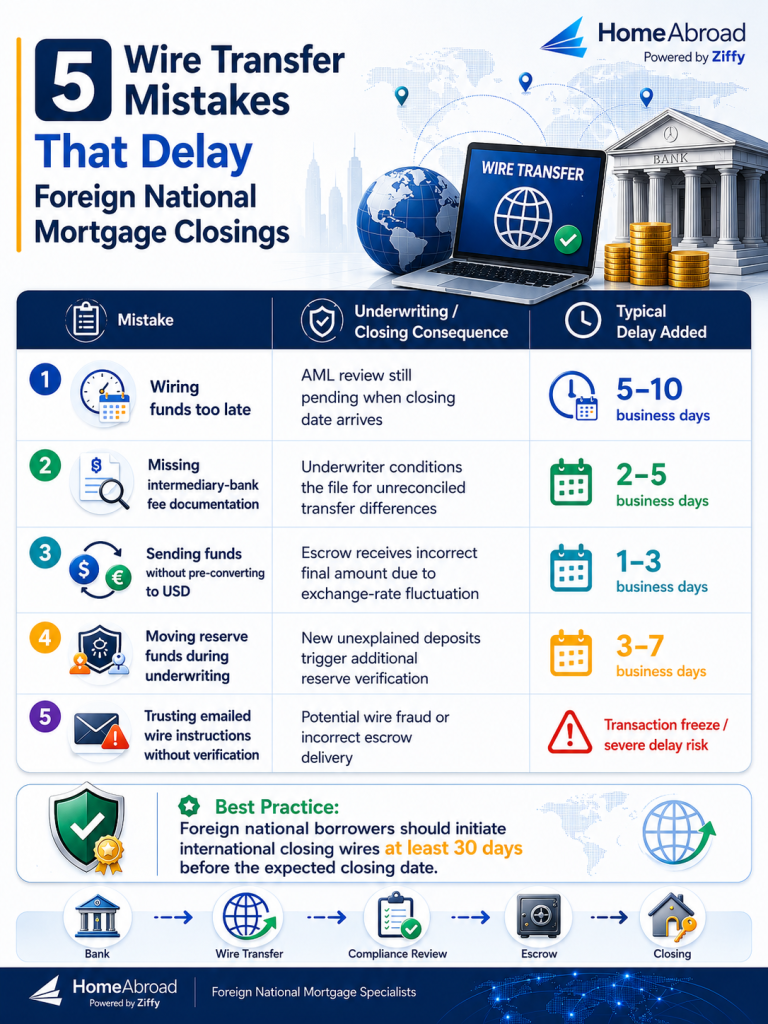
We advise foreign national borrowers to initiate their down-payment wire at least thirty days before the expected closing date. When a wire arrives late, the closing date can shift, the rate lock may need to be extended at the borrower’s expense, and the seller’s side starts questioning whether the transaction will close on time.

5 Wire Transfer Mistakes That Delay Foreign National Closings
Wiring Funds Too Late
Many foreign national buyers wait until the loan is clear-to-close before initiating their international wire. The problem is that AML review often begins after the funds arrive in the United States, not while they are moving internationally. Even fully approved loans can miss the scheduled closing date if the borrower’s wire is still under compliance review.
Missing Intermediary-Bank Fee Documentation
International wires rarely arrive for the exact amount originally sent because intermediary banks deduct processing fees during the transfer path. A borrower may send $50,000 while escrow receives $49,942 after intermediary deductions and exchange adjustments. The underwriting issue is usually not the fee itself, it is the missing documentation explaining why the escrow amount differs from the outgoing wire confirmation.
Jason Saylor
Sr. Customer Loan Specialist, HomeAbroad
A mistake we see often is borrowers assuming DSCR qualification means the lender will review source-of-funds documentation less aggressively. That is not how international mortgage underwriting works. Whether the loan is DSCR or full documentation, the wire trail still has to reconcile completely from the source account to the escrow receipt.
Sending Funds Without Pre-Converting to USD
Some foreign buyers send closing funds in their home currency and rely on the receiving bank to convert the transfer into US dollars after arrival. Exchange-rate fluctuations can create small but important shortfalls between the expected cash-to-close amount and the final escrow balance. If escrow receives less than required on the Closing Disclosure, the transaction may require a supplemental wire before recording can proceed.
Moving Reserve Funds During Underwriting
Reserve transfers made after the mortgage application is submitted frequently create new underwriting conditions. Each transfer generates another documentation trail that underwriting must trace and verify before the loan can move forward. International reserve transfers are especially sensitive because lenders may request additional source-of-funds records, updated statements, or seasoning verification.
Trusting Emailed Wire Instructions Without Verification
Real-estate wire fraud caused more than $145 million in reported losses during 2023, and foreign buyers are frequently targeted because large international transfers move close to closing. Borrowers should never rely solely on emailed wire instructions. Always verify escrow instructions verbally by calling the title company directly using the number listed on the original engagement letter or official company website.
Best Practices Before Wiring Funds for a Foreign National Closing
International wire delays are significantly easier to prevent before closing than to fix during closing week. The earlier reserve funds, wire documentation, and escrow instructions are organized, the lower the risk of AML-related delays or last-minute underwriting conditions.
Around thirty days before closing, borrowers should begin preparing the actual down-payment wire from the account that will be used for settlement. Borrowers should retain the sending-bank confirmation, SWIFT MT103 receipt, currency-conversion record, intermediary-bank fee documentation, and the bank statement showing the outgoing transfer.
Before sending the wire, confirm the exact cash-to-close amount from the Closing Disclosure because escrow balances must match exactly before the property can record. If the funds are held in a non-USD account, pre-converting them into US dollars before wiring usually reduces the risk of exchange-rate shortfalls. Wire instructions should always be verified verbally with the title company using the phone number from the original engagement letter or official company website.
After the wire is sent, immediately save the transfer confirmation showing the reference number and forward it to both the loan officer and title company. Then call the title company directly to confirm receipt. A debit showing on the sending account does not necessarily mean the escrow account has received or cleared the funds.
If a wire is sent incorrectly or fraud is suspected, contact the sending bank immediately and request a SWIFT recall. Borrowers should also notify the title company and loan officer right away so the closing timeline can be adjusted if needed. Suspected wire fraud should be reported to the FBI’s Internet Crime Complaint Center (IC3) as quickly as possible.
SWIFT recalls are not immediate reversals. Once requested, the originating bank must coordinate with intermediary and receiving banks to locate and return the funds. Depending on where the transfer is in the settlement process, recalls can take several business days and are not guaranteed to succeed if the funds have already been released into another account.
Timeline | Action | Documentation to Save |
|---|---|---|
60–90 days before closing | Move reserves into a verifiable account | Bank statements showing balances and deposits |
30+ days before closing | Prepare down-payment wire | SWIFT MT103, conversion receipt, bank confirmation |
After CD issuance | Confirm exact cash-to-close amount | Closing Disclosure copy |
Day of wire | Verify instructions by phone and initiate transfer | Wire confirmation with reference number |
After wire is sent | Confirm receipt with title company | Escrow/title acknowledgment |
Across foreign national mortgage closings, the files that experience the fewest funding delays are usually the ones where reserve transfers and wire documentation were prepared weeks before closing.
Start Your Foreign National Mortgage Pre-Qualification
Wire-transfer preparation is one of the most controllable parts of a foreign national mortgage closing. Most last-minute delays happen because reserve funds were moved too late, wire documentation was incomplete, or international transfers entered AML review too close to the scheduled closing date.
At HomeAbroad, we guide foreign national investors through the process from the beginning so wire timing, reserve planning, underwriting preparation, and closing coordination are aligned early instead of becoming last-minute funding issues that delay the transaction.
Ready to invest? Get pre-qualified for a foreign national mortgage with HomeAbroad and work with a team experienced in DSCR financing, cross-border underwriting, reserve planning, and international mortgage closings.
Frequently Asked Questions
How long does a wire transfer take for closing?
Domestic wire transfers usually arrive the same business day if initiated before the bank’s cutoff time. International SWIFT wires typically require three to five business days for transfer processing plus another five to ten business days for AML (anti-money laundering) review after the funds reach the United States. For foreign national mortgage closings, the realistic timeline is usually eight to fifteen business days total.
What proof of wire transfer do I need for my mortgage closing?
Most lenders and title companies require the wire confirmation receipt, bank statement showing the outgoing debit, and escrow confirmation showing the incoming credit. International wires also usually require the SWIFT MT103 document and currency-conversion receipt if the funds were converted into USD. Foreign national mortgage files may additionally require source-of-funds documentation and explanations for intermediary-bank fee deductions.
Can I use Wise or Revolut to wire closing funds?
Platform-based transfers such as Wise or Revolut are generally acceptable, but they often create additional documentation requirements because the transfer path may include intermediary holding accounts before the funds reach escrow. The receiving US bank still conducts AML review regardless of which platform initiated the transfer.
What happens if my wire does not arrive before closing?
The transaction cannot close until the title company confirms receipt of all borrower funds in cleared status. If the wire is delayed, the closing date may need to be extended, which can trigger seller negotiations, moving delays, or rate-lock extension fees on the mortgage.
Can I wire closing funds from a foreign bank account?
Yes. Foreign nationals regularly send down-payment and closing funds from overseas accounts into US escrow accounts. The transfer must be fully traceable to a documented source account, and the receiving US bank will still conduct AML review before releasing the funds for closing.