



Editorial Integrity
Making informed real estate decisions starts with having the right knowledge. At HomeAbroad, we offer US mortgage products for foreign nationals & investors and have a network of 500+ expert HomeAbroad real estate agents to provide the expertise you need. Our content is written by licensed mortgage experts and seasoned real estate agents who share insights from their experience, helping thousands like you. Our strict editorial process ensures you receive reliable and accurate information.
Florida’s investment market has split into two segments in 2026. Single-family homes remain relatively stable, while many condominiums face pricing pressure from stricter reserve funding and inspection requirements.
Financing is available for eligible foreign investors, but insurance costs, property taxes, and rental income can significantly affect DSCR loan qualification and overall investment returns.
Owning a Florida rental involves more than the purchase price. Insurance, property taxes, association dues, federal tax rules, and regulations such as SB 264 should all be evaluated before making an offer.
Successful investing starts with property-level analysis. Review local market conditions, estimate realistic operating costs, and compare financing scenarios before committing to a Florida investment property.
Table of Contents
Florida added more residents from abroad in 2025 than any other US state, even as the number of Americans moving in fell to almost nothing. That single fact tells a foreign investor more about this market than any price chart. The domestic buyers who drove Florida’s pandemic boom have mostly stopped arriving. International demand has not.
For a foreign national buying now, the setup in late 2026 is unusual. Property values in most Florida markets remain below where they were a year ago, rents are still rising in most markets, and the buyers you are competing against are increasingly people like you rather than out-of-state Americans paying cash for a second home.
This guide is written for that buyer. It explains what the latest market data says, what a Florida rental property may actually net after taxes and insurance, whether the ownership rules under SB 264 apply to you, and how financing works when you don’t have an established US credit history.
Florida Market Conditions in 2026: What the Latest Data Shows
Florida Realtors released second-quarter data on July 17, 2026. Two markets are moving at different speeds.
Metric | Single-Family | Condo and Townhouse |
|---|---|---|
June 2026 median sale price | $432,000, up 4.9% year over year | $305,000, up 1.7% year over year |
June 2026 closed sales | 26,036, up 9.3% | 8,900, up 14% |
Months of supply | 4.5 | 8.1 |
A definition for readers outside the US market: months of supply measures how long it would take to sell every listed property at the current sales pace. Around six months is considered balanced. Florida single-family sits just under it.
Florida condos sit well above that level. Part of the elevated inventory reflects older buildings facing higher reserve funding requirements, insurance costs, and special assessments, topics discussed later in this guide.
The Headline Price Is Not the Value Trend
The median sale price rose. Property values, measured differently, fell. Both are true, and a foreign buyer underwriting from abroad needs to know why before trusting either number.
A median sale price is the midpoint of what sold in a month. It moves when the mix of what sells changes. A home value index estimates what comparable properties are worth whether or not they sold, which removes that mix effect.
Measured against Zillow’s city-level value index through June 30, 2026, the underlying trend is down across most of the state:
- 390 of 556 Florida cities, about 70%, are below their June 2025 value.
- The median Florida city is down 1.5% year over year and down 5.2% from its own peak.
- For most cities that peak fell in May 2024, so the correction is roughly two years old.
The practical rule, especially if you’re evaluating a property remotely, is to underwrite using comparable sales in the property’s immediate submarket alongside a home value index. The statewide median is a mixed statistic, and your property is not.
Why Florida Is Still a Foreign-Buyer Market When Domestic Demand Has Cooled
This is the part of the Florida story that matters most to an international buyer and gets almost no coverage aimed at one.
Census Bureau estimates for the year ending June 30, 2025 show Florida’s net domestic migration fell to 22,517, down from 183,646 two years earlier and 310,892 at the 2022 peak. Domestic migration has slowed sharply over the past few years, coinciding with higher housing costs, insurance premiums, and a less affordable market.
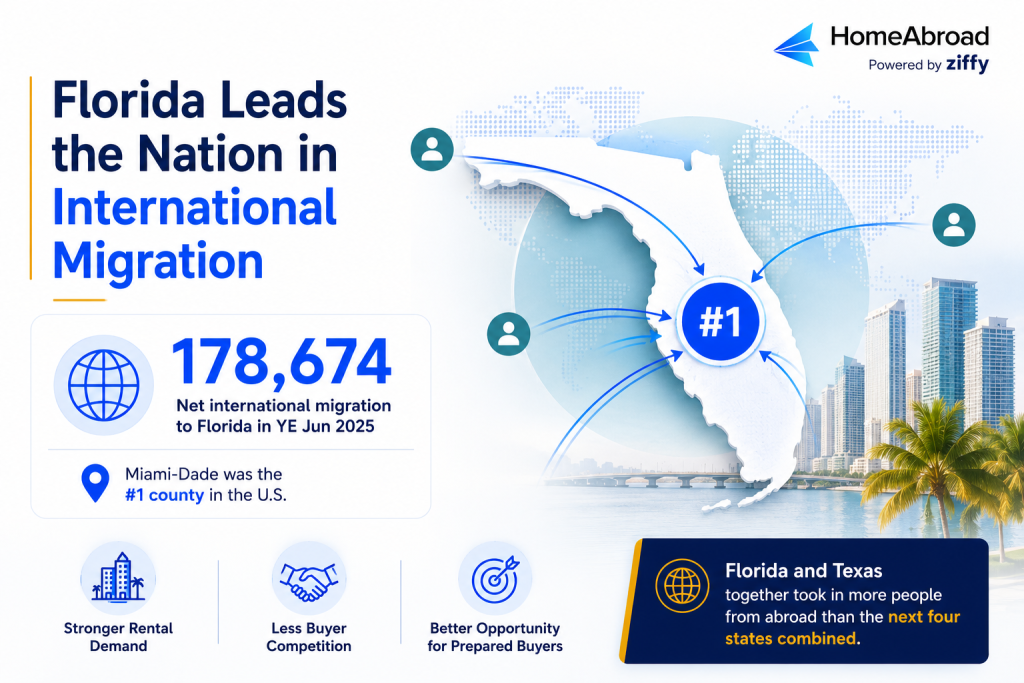
Over the same period, Florida led the entire nation in net international migration, adding 178,674 residents from abroad. Miami-Dade was the single largest county in the country for international migration. Florida and Texas together took in more people from abroad than the next four states combined.
For a foreign investor, three things follow from that.
First, international buyers and residents represent an increasingly important part of the demand base for both rentals and eventual resale, which tends to support exactly the property types and locations international buyers favor.
Second, the competition has thinned. The out-of-state American cash buyer who frequently drove bidding wars during the pandemic boom is far less prevalent today, which is part of why prices have softened and why sellers are negotiating.
Third, this is a slower, more selective market than the boom years, and that favors a prepared buyer who has financing arranged and can move on a specific property.
One caution worth stating plainly. International migration nationwide fell sharply in 2025, from 2.7 million to 1.3 million, and every state saw lower numbers than the year before. Florida still led, but the direction is down, not up. This is a market supported by international demand, not a market where that demand is accelerating.
Where Rental Demand Actually Holds: Look for the Anchor, Not the Metro
Statewide population growth does not put a tenant in your specific property. What does is a durable local reason for people to live nearby: a hospital system, a university, an airport, a port, a research cluster, or a diversified set of employers.
A foreign buyer who cannot easily visit a property should place greater weight on these anchors than a local investor, because they can be evaluated remotely and tend to remain relevant even when the broader market slows.
A few examples of what a durable anchor looks like, without pretending this is an exhaustive map:
- Miami’s airport and trade corridor: Around Doral and Medley sits one of the largest cargo and logistics hubs in the country. Tenant demand there is supported by airport, logistics, and professional-services employment rather than relying primarily on future price appreciation.
- University and medical clusters: In Orlando’s Lake Nona, the areas around the University of Central Florida, the University of South Florida in Tampa, and Florida International University in western Miami-Dade generate steady rental demand from students, faculty, and healthcare workers. These employment and education hubs can provide a more stable source of rental demand, even during slower market conditions.
- Jacksonville’s port and logistics corridors: On the Northside offer lower entry prices than South Florida while serving port, distribution, and transportation employment.
The point is not these specific neighborhoods. It is the method. Before you make an offer on a property you may never stand in front of, identify the specific demand driver that is most likely to support occupancy, and confirm the rent works on a normal twelve-month lease rather than on a best-case short-term or student arrangement.
In parts of Tampa and Orlando, landlords are currently offering concessions to attract tenants, so the advertised rent may be higher than the rent actually collected. Underwrite using effective rent rather than asking rent.

Steven Glick
Director of Mortgage Sales · HomeAbroad
Market headlines and appraised value are not the same thing. An appraisal is based on comparable sales, the property’s condition, and lender underwriting standards, not on statewide price trends. We qualify loans using property-specific documentation, so investors should underwrite the individual asset instead of assuming a headline applies to every neighborhood or building.
Florida Rental Yields in 2026: What the Data Actually Shows
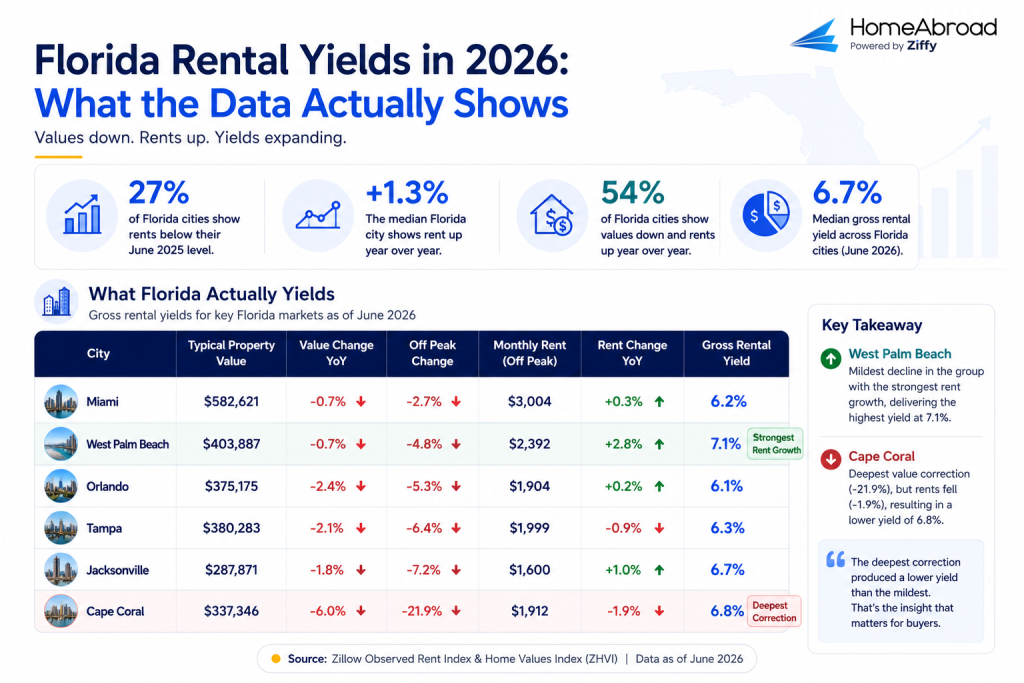
The widely repeated story is that Florida rents are falling. Measured across the state, they are not. Using Zillow’s observed rent index through June 2026, across 259 Florida cities with data in both periods:
- Only 27% of Florida cities show rents below their June 2025 level.
- The median Florida city shows rent up 1.3% year over year.
Rent growth has slowed sharply from the 2021 and 2022 pace, and specific metros absorbing large volumes of new apartment construction have seen declines. But statewide, rents are still grinding upward while values fall.
That combination is the most important thing in this article for a buyer entering now. Values down plus rents up equals yield expansion. Of 282 Florida cities with paired data, 153, or 54%, show property values down year over year and rents up over the same period.
Investment Properties on Sale in Florida
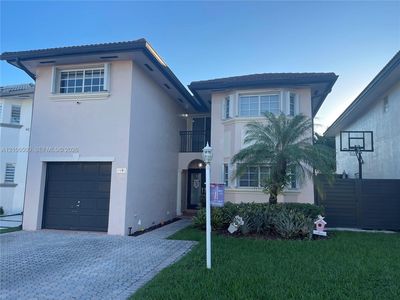



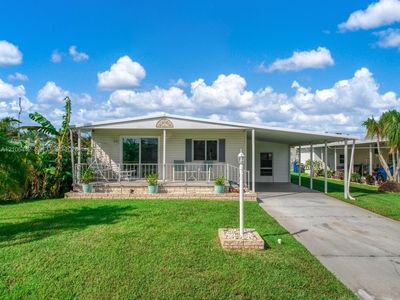
What Florida Actually Yields
Comparing annual rent with property values across Florida cities produces a gross rental yield that can be independently verified rather than inferred.
The median Florida city gross rental yield is 6.7% as of June 2026.
Six cities cover most of where international investors actually buy, and between them they show the full range of what the correction has done.
City | Value | Value change YoY | Off peak | Monthly rent | Rent change YoY | Gross yield |
|---|---|---|---|---|---|---|
Miami | $582,621 | -0.7% | -2.7% | $3,004 | +0.3% | 6.2% |
West Palm Beach | $403,887 | -0.7% | -4.8% | $2,392 | +2.8% | 7.1% |
Orlando | $375,175 | -2.4% | -5.3% | $1,904 | +0.2% | 6.1% |
Tampa | $380,283 | -2.1% | -6.4% | $1,999 | -0.9% | 6.3% |
Jacksonville | $287,871 | -1.8% | -7.2% | $1,600 | +1.0% | 6.7% |
Cape Coral | $337,346 | -6.0% | -21.9% | $1,912 | -1.9% | 6.8% |
West Palm Beach shows the mildest decline in the group alongside the strongest rent growth, and it still yields 7.1%. That is what a healthy setup looks like on this data: the price held, the income grew, and the yield came from the rent side.
Cape Coral fell 21.9% from its peak, by far the deepest correction here, and yields 6.8%. Less than West Palm Beach. Its rents fell 1.9% over the same period, which cancelled most of what the price decline would otherwise have handed an investor.
The deepest correction produced a lower yield than the mildest. That is not a coincidence, and it is the single most useful thing in this data for a remote buyer.
The Highest Yields in Florida Are a Warning, Not an Opportunity
Sorting every Florida city by how far it has fallen from its peak, and then looking at what each group yields, produces a clear pattern:
Correction depth | Median gross yield | Median decline from peak | Median rent growth YoY |
|---|---|---|---|
Deepest quartile | 7.2% | -14.7% | +0.6% |
Third quartile | 7.1% | -7.7% | +1.5% |
Second quartile | 6.4% | -5.2% | +1.2% |
Shallowest quartile | 5.9% | -2.6% | +2.1% |
The markets showing the highest yields are the markets that have fallen furthest, and they have the weakest rent growth. The markets with the strongest rent growth show the lowest yields, because their values have held.
The yield is high because the price collapsed, not because the rent rose.
At the extreme this becomes obvious. The highest-yielding places in Florida right now are small South Florida municipalities where values sit far below their surrounding metro and have fallen 20% to 30% from peak.
Several show gross yields between 10% and 18%. Their price points, well under half the Miami and Fort Lauderdale metro median, are characteristic of condominium-dominated housing stock, which points back to the reserve and warrantability problem described above.
A 15% gross yield on a unit in a building facing a $60,000 assessment and unable to obtain conventional financing is not a 15% yield. It is a discount pricing in a liability, and the liability may be larger than the discount.
A practical rule for investors is this: treat an unusually high Florida yield as a question rather than an answer. Find out what happened to the price first.
What a Florida Rental Actually Nets
Gross yield ignores everything after the tenant pays. Here is the full walk using real Jacksonville figures.
Property inputs, actual data
- Property value: $287,871, rounded to $288,000 (Zillow, Jacksonville, June 2026)
- Monthly rent: $1,600 (Zillow, Jacksonville, June 2026)
- Annual gross rent: $19,200
- Gross yield: 6.7%
Annual operating costs
Line item | Amount | Basis |
|---|---|---|
Property tax | $2,160 | Calculated at 0.75% of the property’s just value. Requires the county property appraiser’s millage for the parcel. |
Insurance, landlord policy | $4,500 | Requires a real DP-3 quote. |
Vacancy allowance | $941 | 4.9% of gross rent |
Property management | $1,643 | 9% of collected rent |
Maintenance and capital reserve | $1,536 | 8% of gross rent |
Net operating income (NOI): $8,420 Net yield on value: 2.9%
A 6.7% gross rental yield becomes a 2.9% net yield after typical operating expenses. In this example, operating costs consume about 56% of the annual rental income before any mortgage payment, US federal income tax, or currency conversion costs associated with repatriating rental income.
Insurance alone represents about 42% of the operating cost stack in this example. In many other US markets, it would be a much smaller expense, which is why understanding Florida’s insurance market is an important part of underwriting an investment property.
The Cost Stack: Insurance, Property Taxes, and Association Dues
Insurance Has Turned, and That Is New
Florida property insurance rose steeply from 2020 through 2024, and the story has been repeated so often that the 2026 reversal has barely registered.
Citizens Property Insurance, the state’s insurer of last resort, received approval for a statewide average multiperil rate reduction of 8.8%, with the new rates taking effect on July 1, 2026. Several private insurers also filed rate decreases during the same period, marking the first broad easing in Florida’s property insurance market after several years of increases.
Citizens has also shrunk from roughly 1.42 million policies in October 2023 to roughly 395,000 in January 2026 as private carriers took policies back through the state depopulation program. A shrinking insurer of last resort generally indicates that more policies are moving back into the private insurance market.
The Policy an Investor Actually Buys
Almost every published Florida insurance average describes a homeowner policy on an owner-occupied house. That is not the policy on a rental.
A non-owner-occupied rental is written on a landlord policy, commonly a DP-3 form. It prices differently, covers differently, typically excludes tenant possessions, and adds loss-of-rent coverage. Quoting a rental against an owner-occupied average will understate the cost.
Two Florida-specific features catch international buyers:
- Hurricane and windstorm deductibles are usually a percentage of dwelling coverage, not a flat sum. A 2% deductible on $288,000 of dwelling coverage is $5,760 before the policy responds.
- Flood is a separate policy. Standard property insurance does not cover flood anywhere in the US, and many parts of Florida are located in FEMA-designated flood hazard areas.
The practical instruction for a remote buyer is simple and firm: get an address-specific landlord quote before you make an offer, not an estimate and not after the inspection period. Insurance variance inside Florida tracks distance from open water and hurricane loss history far more than property value, so a number that worked for one property tells you very little about the next.

Pre-approval uses estimated housing costs, but the final insurance binder provides the actual premium used for underwriting. If that amount comes in higher than expected, we recalculate the payment and determine whether any adjustments to the loan structure are needed before closing.
Property Tax on a Non-Homestead Property
Florida gives large property tax benefits to owner-occupiers who claim homestead status. An investment property receives none of them.
A homestead property gets an exemption on part of its assessed value and a 3% annual cap on assessment increases under Save Our Homes. A non-homestead property, which includes every rental and second home, gets no exemption and a 10% annual cap. That 10% cap does not apply to school district levies, so the school portion can rise faster.
The mechanic that breaks pro formas is the reset. Under Section 193.1554, Florida Statutes, a non-homestead property is reassessed at just value on January 1 following a change of ownership. If the seller held for years under a capped assessment, their bill reflects that history. Yours will not.
Underwriting to the listing’s tax figure, or to last year’s county bill, produces an error in year two that runs in one direction only. When evaluating a purchase, estimate property taxes using the expected assessed value after purchase rather than the seller’s current tax bill.
Florida also requires the new owner to report the change of ownership. Section 193.1556 provides for back taxes, interest at 15% per year, and a penalty of 50% of avoided taxes where notice is not given.
A Ballot Measure Worth Tracking
On June 2, 2026 the Florida Legislature passed HJR 1-F in special session. It appears on the November 3, 2026 ballot and requires approval by at least 60% of voters.
Most coverage concerns an expanded homestead exemption, which does not apply to a rental. The clause that matters here would reduce the non-homestead assessment cap from 10% to 5%, effective January 1, 2027. That covers rentals, second homes, and commercial property, which is essentially everything a foreign investor holds.
This is a proposal, not law. A lawsuit filed in Leon County Circuit Court on June 11, 2026 challenges the ballot title and summary, with a hearing set for July 29, 2026.
No purchase decision should rest on a vote that has not happened. It is worth knowing because it affects holding cost on a property bought this year.
Association Dues Are Currently a Variable Cost
In a normal market, association dues behave like a fixed expense you can model years out. For Florida condominiums in 2026 they do not. Master insurance premiums flow directly into association budgets, reserve requirements have raised the baseline, and special assessments arrive on top. A flat dues assumption on a Florida condo is the modeling equivalent of assuming a fixed rate on a variable loan.
Where the Numbers Work Right Now
Statewide averages mask meaningful regional differences, and those differences are pronounced enough in 2026 to influence where investors should focus their search.
The Gulf Coast has taken the deepest damage: The North Port, Sarasota, and Bradenton area sits about 18% below its peak. Cape Coral and Fort Myers sits about 17% below. Individual communities in both run 20% to 26% down. Rents in both metros are also falling, which is the combination that should slow an investor down, because the price decline is not being offset on the income side.
These markets offer some of the largest price discounts in Florida, but weaker rental trends mean investors should confirm that projected income supports the investment rather than assuming lower prices alone create value.
Central Florida looks like the cleanest current setup: The Lakeland and Winter Haven area combines a modest 6% decline from peak with rent growth above 2% and the highest metro yield in the state at roughly 7.8%. Port St. Lucie and the Daytona Beach area both show rent growth above 3% with mild corrections. Together, these indicators suggest a market where prices have adjusted without a comparable deterioration in rental demand, creating a more balanced environment for long-term investors.
Miami holds the strongest rental fundamentals and the heaviest condo exposure at once: Values held better than the state, and rents are up, while the reserve and assessment problem concentrates in exactly this housing stock. Which factor dominates is a building-level question, not a market-level one.
The Panhandle has been the quiet exception: Pensacola is among the few Florida cities where values rose year over year, with rent growth alongside it. Prices are lower, and insurance is cheaper away from the peninsula’s highest-risk coastline. Rental demand is generally less diversified than in Florida’s largest metro areas, which can affect both occupancy and resale liquidity over time.
For a city-by-city comparison, see our guide to the best Florida cities for rental property
Can Foreign Nationals Buy Florida Investment Property? SB 264 and Ownership Rules
Most foreign nationals can buy Florida investment property without ownership restrictions. Only a limited group of buyers is subject to SB 264, despite frequent reports suggesting the law applies to all foreign purchasers.
Senate Bill 264, codified at Sections 692.201 through 692.205, Florida Statutes, took effect July 1, 2023. It is not a general ban on foreign buyers. It has two tiers.
The first tier applies to “foreign principals” connected to seven countries of concern: China, Russia, Iran, North Korea, Cuba, Syria, and the Maduro regime in Venezuela. It restricts the purchase of agricultural land and real property located within 10 miles of specified military installations or critical infrastructure facilities.
The second tier is narrower and stricter. It applies to entities and individuals connected to the People’s Republic of China, including individuals domiciled in China who are not US citizens or lawful permanent residents. It restricts acquisition of any Florida real property, subject to exceptions.
The exceptions are important. A natural person holding a valid non-tourist visa or granted asylum may purchase one residential parcel of up to two acres not within five miles of a military installation, subject to registration. De minimis indirect interests in SEC-registered entities are exempt. Property acquired before July 1, 2023 is generally grandfathered, though registration is still required.
Where the law applies, registration is mandatory, and the penalties for failing to comply are significant. Late registration carries a civil penalty of $1,000 per day, with criminal exposure for violations.
On November 4, 2025 the US Court of Appeals for the Eleventh Circuit decided Shen v. Simpson and upheld the law. The court found the individual plaintiffs lacked standing to challenge the purchase restriction because they were domiciled in Florida rather than China, and dismissed that portion for lack of jurisdiction. One plaintiff was found to have standing to challenge the registration requirement. SB 264 remains enforceable.
Domicile, not citizenship, is the operative concept in the second tier. It is a legal determination resting on where a person actually lives and intends to remain. If any of this may apply to you, have a Florida real estate attorney make that determination before you make an offer.
For a detailed explanation, see our Florida foreign ownership rules guide.
Financing a Florida Investment Property as a Foreign National
Foreign buyers finance US real estate more often than the cash-buyer stereotype suggests. NAR’s 2025 International Transactions report found 47% of foreign buyers paid all cash, against 28% of all US buyers. The majority still financed.
The obstacle for a nonresident is rarely the property. Conventional underwriting expects a US credit report, US tax returns, and US employment income, and a buyer living abroad has none of those. HomeAbroad addresses this gap with mortgage programs designed specifically for foreign national investors, using qualification methods that reflect the realities of cross-border investing rather than traditional US borrower profiles.
DSCR Loans
A DSCR (Debt Service Coverage Ratio) loan qualifies primarily on the property’s ability to generate enough rental income to support the proposed mortgage payment rather than on the borrower’s personal income, US tax returns, or an established US credit history.
In simple terms, DSCR compares the property’s qualifying rental income with its monthly housing expense, known as PITIA (principal, interest, taxes, insurance, and association dues). A DSCR of 1.0 means the property’s qualifying rental income equals its monthly housing payment.
Many investors focus on the purchase price, but we evaluate the property’s full operating profile. Property taxes, insurance premiums, HOA dues, and the appraiser’s market rent can all influence the final DSCR calculation and the financing options available. Reviewing those costs early helps avoid surprises during underwriting.

Every investment property qualifies on its own merits. A property’s appraised market rent, insurance costs, taxes, and HOA dues can all affect the final DSCR calculation, which is why we encourage investors to review financing scenarios before making an offer.
Full Documentation Loans
Where a borrower’s foreign income, assets, and credit profile can support qualification, a Full Documentation Loan considers those directly rather than relying on the property’s income. For a foreign national with strong documented income at home, this can be the better route, particularly in Florida markets where rental income alone may not support the desired financing structure.
The program may consider foreign income documentation, asset statements, and either an International Credit Report or approved alternative credit evidence such as bank reference letters. It is a non-QM product. It does not conform to Fannie Mae or Freddie Mac guidelines and should not be described as conventional.
What You Will Need
Documentation requirements vary by loan program, property type, and borrower profile. The documents required for a foreign national living abroad differ from those required for a visa-holding US resident.
A nonresident investor living abroad will generally be asked for a passport, proof of funds and reserves, foreign asset or bank documentation, property and purchase documents, appraisal and rent documentation, and entity formation documents where applicable.
A visa-holding US resident will generally face a different set, closer to employment and income verification, US bank statements, identification, proof of residence, and immigration status documentation.
Immigration status, tax residency, and mortgage classification are three separate things, and one does not determine another.
Many foreign national transactions can be completed remotely through a power of attorney or remote online notarization, although the process varies by state, lender, and title company.
For a detailed breakdown of eligibility and documentation, see our guides to DSCR loans for foreign nationals and Full Documentation Loan pages.
US Tax Obligations for a Florida Rental
Florida has no state individual income tax. That is a genuine advantage for rental property investors, but it does not eliminate US federal tax obligations.
Rental income taxation: By default, US rental income paid to a nonresident is taxed as fixed, determinable, annual, or periodical income at a flat rate on the gross amount, with no deduction for expenses. Section 871(d) of the Internal Revenue Code allows a nonresident to elect to treat that income as effectively connected with a US trade or business, permitting deduction of expenses including depreciation.
The election is made with the IRS. It is not a treaty benefit and does not apply automatically. Given that costs consumed about 56% of gross rent in the example above, the difference between gross and net treatment is substantial.
FIRPTA: The Foreign Investment in Real Property Tax Act requires withholding on the sale of US real property by a foreign person. The applicable withholding rate can be 0%, 10%, or 15%, depending on the sale price and whether the buyer intends to use the property as a residence. It is frequently described as a flat 15%, which is wrong. US income tax treaties generally do not reduce FIRPTA withholding for individual nonresident alien sellers.
Estate tax: A nonresident alien’s US federal estate tax exemption is $60,000, against a multi-million dollar exemption for US persons. A single Florida rental can exceed that several times over. Raise it with a US tax professional before purchase.
Transaction taxes: Florida documentary stamp tax on deeds and certain loan documents, along with the state’s nonrecurring intangible tax on mortgages, are transaction and financing costs rather than ongoing ownership expenses. They are not added to the property’s depreciable basis.
This section summarizes general US tax rules and is not legal or tax advice. Your obligations depend on your tax residency, home country, ownership structure, and investment objectives. Before purchasing a Florida investment property, consult a qualified US tax professional with experience in cross-border taxation.
How to Read the Florida Market Before You Buy
One of the most important conclusions from the current data is that an unusually high Florida rental yield often reflects a significant price correction rather than exceptional rental growth. Verify which is driving the yield before making an offer.
A working checklist for a specific property:
- Check why the property’s yield is above average. A yield well above the statewide median deserves an explanation before you make an offer.
- Confirm SB 264 does not apply to you. If domicile is at all uncertain, get a legal opinion first.
- For a condominium, obtain the reserve study, milestone report, and written assessment disclosure before going under contract. Read twelve months of board minutes.
- Obtain an address-specific landlord insurance quote during due diligence, rather than relying on a general estimate or waiting until after the inspection period.
- Estimate property taxes using the expected assessed value after purchase rather than the seller’s current tax bill.
- Review financing scenarios before making an offer. Small changes in rent, insurance, property taxes, or association dues can materially affect loan qualification and cash flow.
- Separate the qualifying ratio from the cash flow. Run both.
- If the strategy depends on short-term rental income, confirm legality at the municipal level. Florida rules vary by city and county, and a property can be permitted on one side of a boundary and prohibited on the other.
- Account for FIRPTA and estate tax exposure at the planning stage, not at exit.
If you’re evaluating a specific Florida investment property, HomeAbroad can prepare a financing scenario using the property’s projected rent, estimated taxes, insurance costs, and other property-specific inputs rather than relying on statewide averages. This helps you evaluate how the property may perform before you make an offer.
Take the Next Step
The Florida market offers opportunities for foreign investors, but successful investing starts with choosing a property that fits both your investment objectives and your financing strategy. Understanding how the numbers work before making an offer can make the buying process more predictable and efficient.
HomeAbroad offers mortgage solutions designed specifically for foreign national investors, including DSCR, Full Documentation, and other non-QM loan programs. Our team works with international buyers to navigate cross-border financing requirements, documentation, and loan qualification for US investment properties.
Get pre-qualified with HomeAbroad and start your US real estate investment journey with confidence.
Frequently Asked Questions
Is 2026 a good time to buy investment property in Florida?
For a buyer entering now, the setup is better than it has been in several years. Values are down in about 70% of Florida cities while rents in most of them are still rising, which expands yields for a new purchase. The trade is that carrying costs are high and financing requires more equity than in most US markets. It is a better market to buy into than it has been to hold through.
Why are Florida condo prices falling while house prices are not?
Largely because of financing availability. Florida law now requires condo associations to fully fund reserves for major structural components and complete milestone inspections on older buildings.
Buildings that fall short can be classified as non-warrantable, which removes conventional mortgage financing for units there and shrinks the buyer pool to cash purchasers and non-agency lenders. Fewer eligible buyers produces lower clearing prices.
Which Florida market has the best rental yields right now?
In June 2026, the Lakeland and Winter Haven area shows the strongest combination among major metros, with a 7.8% median gross yield, rent growth of 2.4%, and a relatively mild 6.2% decline from peak.
Port St. Lucie and the Daytona Beach area also show yields near 7% with rent growth above 3%. The highest raw yields in Florida sit in South Florida municipalities that have fallen 20% to 30% from peak, and those figures reflect distressed pricing rather than strong rental demand.
What is a non-warrantable condo, and can a foreign buyer still finance one?
A non-warrantable condominium is a project that fails eligibility rules applied by lenders selling loans to Fannie Mae or Freddie Mac. Common causes include an incomplete reserve study, an open milestone finding, insufficient reserve funding, a pending special assessment, or inadequate master insurance.
Do I need US credit to get a Florida investment property mortgage?
No, HomeAbroad’s foreign national mortgage programs do not require an established US credit history; you qualify based on the property’s rental income.