





Editorial Integrity
Making informed real estate decisions starts with having the right knowledge. At HomeAbroad, we offer US mortgage products for foreign nationals & investors and have a network of 500+ expert HomeAbroad real estate agents to provide the expertise you need. Our content is written by licensed mortgage experts and seasoned real estate agents who share insights from their experience, helping thousands like you. Our strict editorial process ensures you receive reliable and accurate information.
New York offers distinct investment opportunities, from high-cost NYC properties to more affordable upstate markets with stronger potential rental yields.
Syracuse, Buffalo, Rochester, and Albany stand out for different reasons, including affordability, rental demand, economic growth, and income potential.
NYC offers deeper international demand and investment infrastructure, but higher property prices can result in lower gross rental yields.
Foreign nationals can use HomeAbroad’s DSCR financing for rental properties, with the property’s rental income playing a central role in the qualification process.
Table of Contents
New York remains one of the most closely watched real estate markets in the world, and foreign investors continue to account for a sizable share of its investment property transactions. But the state’s investment picture in 2026 extends well beyond Manhattan. Several upstate cities are posting stronger rental yields, faster rent growth, and more accessible entry prices than New York City itself.
This analysis covers the current state of New York’s investment property market, identifies the top markets for rental property based on a composite of yield, affordability, appreciation, demand, and economic fundamentals, and explains how foreign nationals can finance these purchases.
New York State Investment Snapshot
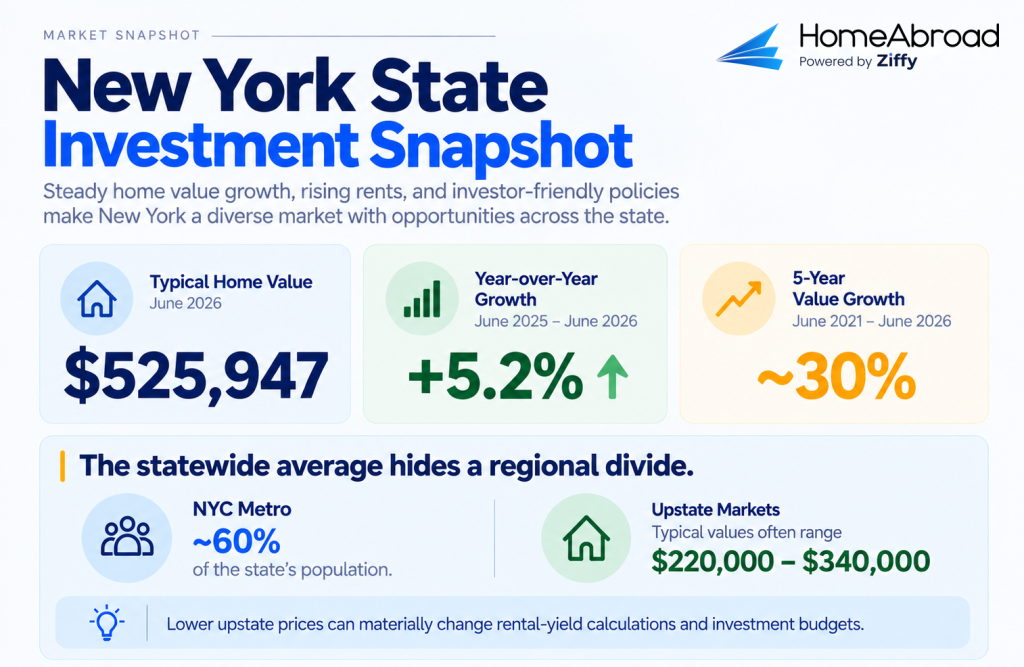
As of June 2026, Home Value Index places the typical New York State home at $525,947, up 5.2% year over year from $499,869 in June 2025. Over five years, values have climbed roughly 30%, from $404,663 in mid-2021.
Period | Home Value | Change |
|---|---|---|
June 2022 | $445,172 | +10.0% |
June 2023 | $446,540 | +0.3% |
June 2024 | $477,640 | +7.0% |
June 2025 | $499,869 | +4.7% |
June 2026 | $525,947 | +5.2% |
Two patterns stand out. First, the post-2022 cooldown was brief. After a flat year in 2022-2023, appreciation resumed at a pace that has held between 4.7% and 7% annually. Second, the statewide number is heavily influenced by the New York City metro, which contains about 60% of the state’s population. Upstate markets tell a different price story, with typical values often running $220,000 to $340,000, which matters directly for yield calculations and for investors working with a defined budget.
On the rent side, data shows that average rents across New York metros have climbed steadily. Among the metros tracked in this analysis, five-year rent growth ranges from 26.9% (Kingston) to 50.1% (Binghamton), with the major investment metros covered below falling between 30% and 42%.
For foreign investors, New York offers a practical advantage: no state-level restrictions on nonresident property ownership. Foreign nationals may purchase residential and commercial property, hold title individually or through a US-based entity, and finance the purchase through lenders that serve international borrowers.
Top 6 New York Markets for Rental Property Investment
City | Typical Home Value | Monthly Rent | Gross Yield | Rent YoY | Value YoY | 5-Year Rent Growth |
|---|---|---|---|---|---|---|
Syracuse | $226,448 | $1,546 | 8.2% | +3.5% | +5.3% | +33.1% |
Rochester | $249,152 | $1,532 | 7.4% | +3.2% | +4.4% | +33.5% |
New York City | $832,934 | $4,133 | 6.0% | +5.7% | +3.9% | +45.4% |
Albany | $335,126 | $1,611 | 5.8% | +5.8% | +4.4% | +29.4% |
Yonkers | $671,397 | $2,754 | 4.9% | +3.9% | +4.8% | +30.6% |
Buffalo | $249,040 | $1,430 | 6.9% | +2.8% | +3.1% | +29.0% |
1. Syracuse
Syracuse leads this ranking with the highest gross rental yield at 8.2% and the lowest entry price among the six markets. A typical home costs $226,448, while city-level rents average $1,546 per month, according to the data.
The numbers are only part of the story. Rents across the Syracuse metro have grown 36.8% over five years, the strongest five-year rent growth among the six ranked markets. At the city level, rents are up 15.8% over three years and 3.5% year over year.
Syracuse also has a specific economic catalyst that none of the other markets in this analysis can match. Micron Technology is building a semiconductor fabrication complex in the Clay suburb, a project with an announced investment of up to $100 billion. The company poured first concrete in mid-2026, and the facility is expected to create thousands of direct manufacturing jobs plus a multiplier of construction and supply-chain positions.
For a metro area with roughly 650,000 people, that scale of employer arrival is the kind of structural demand shift that supports both rent growth and property appreciation over the next decade.
Within the metro, city-level data also show strong rents in nearby Liverpool ($2,421/month) and Baldwinsville ($1,867/month), indicating that rental demand extends beyond the city center.
What to watch: Syracuse’s home values are rising faster than its rents (5.3% value growth vs. 3.5% rent growth), which could gradually compress yields if the pattern continues. Investors should also verify that specific neighborhoods near the Micron development are zoned for the property types they intend to purchase.
Investment Properties Listed Today on Sale in Syracuse, NY
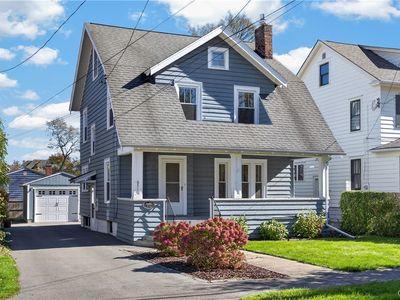


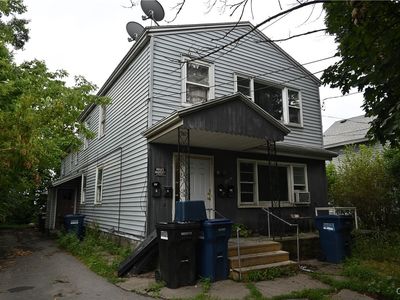
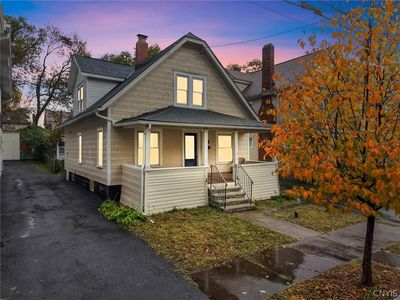

Micron is a meaningful long-term demand driver for Syracuse, but investors should still underwrite the property based on today’s rental income and expenses. The opportunity is strongest when the current numbers make sense on their own, with the expected employment growth viewed as potential upside rather than something the investor has to rely on to make the deal work.
2. Rochester
Rochester combines a 7.4% gross yield with consistent growth across every metric. The typical home value sits at $249,152, and city-level rents average $1,532 per month.
Rochester’s five-year rent growth of 33.5% at the city level trails only Syracuse among the upstate markets, and metro-level rents have followed a similar path, reaching $1,580 per month with 31.7% growth over the same period. The city was ranked the No. 2 housing market in the US for 2026 by at least one national analysis, driven by job growth, affordability relative to the Northeast, and limited new construction keeping the supply side tight.
Suburban pockets within the Rochester metro command higher rents. Pittsford ($2,580/month), Fairport ($1,774/month), and Canandaigua ($1,746/month) all track above the city average in the ZORI data, reflecting demand from families and professionals who rent before buying.
Rochester’s economy is anchored by healthcare (University of Rochester Medical Center is the region’s largest employer), education, and a growing optics and photonics corridor. That diversification matters for investors because it reduces the risk that a single employer downturn will weaken rental demand.
What to watch: Home values are appreciating at 4.4% annually while rents grow at 3.2%, a spread that bears monitoring over time. Inventory remains tight, which supports prices but can make it harder to find properties that meet DSCR underwriting thresholds at current rents.
Investment Properties Listed Today on Sale in Rochester, NY
3. New York City
New York City does not win on yield. At 6.0%, its gross rental yield ranks third in this analysis, and the $832,934 typical home value makes it the most expensive market by a wide margin. It earns its composite ranking through the strongest rent growth numbers in the group: 5.7% year over year at the city level and 45.4% over five years, the highest five-year rent growth among the six markets.
What $832,934 represents varies enormously across the five boroughs. The ZORI data in these files records the city under Queens County, showing $4,133 per month in average rent. In practice, rental prices range from roughly $1,800 for a one-bedroom in parts of the Bronx and eastern Brooklyn to well over $5,000 in Manhattan.
That spread means investors can find entry points well below the citywide typical value, particularly in emerging neighborhoods in Brooklyn, Queens, and the Bronx where rents are rising faster than the borough average.
NYC’s role in a foreign investor’s portfolio is often different from an upstate market. The city offers deep liquidity (properties sell faster and to a larger buyer pool), currency-hedge characteristics (NYC real estate has historically held value during global downturns), and brand-name recognition that simplifies property management through established management firms familiar with nonresident owners.
What to watch: New York City’s regulatory environment adds layers that upstate markets do not have. Rent-stabilization rules, local transfer taxes, and co-op board restrictions on investor purchases can affect both returns and exit strategy. Confirm the property type and any rent-regulation status before underwriting.
Investment Properties Listed Today on Sale in New York City, NY
4. Albany
Albany scores well on rent growth, posting 5.8% year-over-year increases at the city level, the highest single-year rent growth rate in this analysis. The typical home value of $335,126 places it in the middle of the range, and the $1,611 monthly rent produces a 5.8% gross yield.
The Capital District’s economic base is unusual among the upstate markets because it is anchored by state government, which provides a baseline of stable, recession-resistant employment. Beyond government, the region’s nanotechnology corridor (centered on SUNY Polytechnic and GlobalFoundries in Malta) has attracted semiconductor and advanced-manufacturing investment that broadens the employment base.
At the metro level, Albany-Schenectady-Troy rents have risen 30.1% over five years, reaching $1,679 per month. Within the metro, Saratoga Springs ($2,374/month) and Troy ($1,501/month) show that rental demand extends across the region. Troy, in particular, has seen 34.2% rent growth over five years at the city level, making it an area worth evaluating alongside Albany proper.
What to watch: Albany’s 4.4% home-value appreciation is roughly in line with its rent growth, which is a healthier balance than markets where values outpace rents. However, the $335,126 entry point is noticeably higher than Syracuse, Rochester, or Buffalo, so investors focused purely on yield per dollar deployed may find better numbers elsewhere.
Investment Properties Listed Today on Sale in Albany, NY
5. Yonkers
Yonkers occupies a unique position as a lower-cost entry into the New York City metro. The typical home value of $671,397 is about 20% below the NYC average, while rents at $2,754 per month reflect the city’s proximity to Manhattan and the Bronx.
At 4.9%, Yonkers has the lowest gross yield in this analysis, but its 4.8% year-over-year home-value appreciation is among the strongest in the group. Over five years, rents have risen 30.6%, and the city benefits from the same demand dynamics that drive the broader NYC metro: population density, mass-transit access (Metro-North commuter rail), and a constrained housing supply.
Yonkers has invested heavily in its downtown waterfront over the past decade, with mixed-use development along the Hudson River attracting both renters and buyers. For foreign investors, the practical advantage is that Yonkers properties are typically easier to acquire than Manhattan or prime Brooklyn, with fewer co-op restrictions and lower per-unit costs.
What to watch: Yonkers is part of Westchester County, which carries some of the highest property-tax rates in the state. Property taxes directly affect net operating income and DSCR calculations, so investors financing through a DSCR loan should model tax costs carefully before committing.
Investment Properties Listed Today on Sale in Albany, NY
6. Buffalo
Buffalo rounds out the ranking with a 6.9% gross yield and the lowest entry price alongside Syracuse. The typical home value is $249,040, and city-level rents average $1,430 per month.
Buffalo’s composite score is held back by the slowest year-over-year growth rates in the group: 2.8% rent growth and 3.1% value appreciation. Over five years, rent growth of 29.0% also trails the other markets. That said, Buffalo’s story is one of stability rather than momentum. The city went through its boom years earlier, and prices have settled into a moderate, steady growth pattern.
The metro area tells a broader story. Williamsville ($2,167/month), Depew ($1,505/month), and East Amherst ($2,108/month) all show higher rents than the city center, suggesting that suburban Buffalo has a separate rental market serving a different tenant profile. The Buffalo-Niagara region’s economy leans on healthcare (Kaleida Health), financial services (M&T Bank headquarters), and higher education, with a growing advanced-manufacturing sector.
What to watch: Buffalo homes go to pending status in about 10 days, indicating a competitive purchase market despite the slower growth rates. The low price point makes it accessible, but investors should verify that the specific property’s actual rent, not the metro average, supports positive cash flow after accounting for Buffalo’s property taxes and insurance costs.
Investment Properties Listed Today on Sale in Buffalo, NY
How We Ranked These Markets
Yield alone does not make a market investable. A city with a high rent-to-price ratio but declining rents and stagnant values may produce a worse total return than a lower-yield market with strong growth.
This analysis scores six New York markets across five factors, using Zillow data from the datasets:
- Gross rental yield
- Year-over-year rent growth
- Year-over-year home-value growth
- Purchase affordability
- Five-year rent trajectory
Each city receives a rank-based score in each category, and the composite total determines the final order. The methodology is transparent so you can re-weight the factors based on your own priorities.
Financing an Investment Property in New York as a Foreign Investor
Foreign nationals, nonresident investors, US newcomers, and expats looking to finance a New York investment property have options beyond conventional US mortgages. One common path is a DSCR loan, which evaluates the property’s rental income relative to its debt payments rather than relying primarily on the borrower’s personal income or US employment.
DSCR stands for Debt Service Coverage Ratio. In a typical DSCR loan, the lender calculates whether the property’s expected rental income covers the monthly mortgage payment, including principal, interest, taxes, insurance, and any association dues. A ratio above 1.0 generally means the property’s income exceeds its debt obligations.
This structure can work well for foreign investors because it typically does not require a US tax return, W-2, or domestic employment history. The property’s income potential is the primary qualification factor, though borrowers will still need to provide identification, proof of funds, and other documentation.

Steven Glick
Director of Mortgage Sales · HomeAbroad
For foreign nationals, DSCR financing can simplify the qualification process because the focus is on the rental property’s ability to cover its debt obligations. We advise investors to evaluate the property’s projected rent, taxes, insurance, and other recurring costs carefully before moving forward, since those numbers directly affect the financing analysis.
HomeAbroad offers DSCR loan programs designed for foreign nationals and international investors purchasing US rental property. Program terms, including down payment, reserve requirements, eligible property types, and DSCR thresholds, may vary by borrower category and state, so verify the current requirements for your situation.
Whether you are a foreign national purchasing your first US rental property, a visa holder already living in the US, or an overseas investor expanding a multi-property portfolio, HomeAbroad can help you explore your foreign-national mortgage options and get started with a pre-approval assessment.
You can also use the DSCR calculator to estimate whether a specific property’s rental income would meet typical lender thresholds before you begin the formal application.
Frequently Asked Questions
Can a foreign national buy investment property in New York?
Yes. New York has no state-level restrictions on foreign nationals owning residential or commercial property. You can hold title in your name or through a US-based entity such as an LLC. Buying property does not grant a visa, residency, or immigration status.
What kind of rental yields can I expect in upstate New York?
Based on June 2026 data, gross rental yields in the upstate markets covered in this analysis range from 5.8% (Albany) to 8.2% (Syracuse). Net yields after property taxes, insurance, maintenance, and vacancy will be lower. Property taxes in New York are among the highest in the US, so always model those costs before projecting returns.
Do I need a US credit history to get a mortgage on a New York investment property?
Not necessarily. Some lenders, including HomeAbroad Loans, offer mortgage programs that do not require an established US credit history. A DSCR loan, for example, qualifies primarily on the property’s rental income. However, “no US credit history required” does not mean there is no documentation or creditworthiness review.
What is the minimum down payment for a foreign national buying in New York?
Down payment requirements vary by lender, loan program, property type, and borrower category. DSCR loan programs for foreign nationals may require 25% or more as a down payment. Verify current terms directly with the lender, as these can change.
Is New York City or upstate New York better for rental property investment?
It depends on your investment goals. New York City offers higher absolute rents, stronger long-term appreciation, and deep market liquidity, but the entry cost is significantly higher and the regulatory environment is more complex. Upstate markets like Syracuse, Rochester, and Buffalo offer higher gross yields and lower price points, making them more accessible for investors focused on cash flow. Many foreign investors hold properties in both regions for diversification.
What taxes will I pay as a foreign investor owning a New York rental property?
Foreign investors are generally subject to US federal income tax on rental income, New York State income tax, and local property taxes. Upon sale, FIRPTA (Foreign Investment in Real Property Tax Act) withholding may apply. The specifics depend on your tax residency, how you hold title, and whether any tax treaties apply. Consult a cross-border tax advisor before purchasing.