



Editorial Integrity
Making informed real estate decisions starts with having the right knowledge. At HomeAbroad, we offer US mortgage products for foreign nationals & investors and have a network of 500+ expert HomeAbroad real estate agents to provide the expertise you need. Our content is written by licensed mortgage experts and seasoned real estate agents who share insights from their experience, helping thousands like you. Our strict editorial process ensures you receive reliable and accurate information.
Foreign nationals can buy and finance US vacation rentals without US citizenship, a Green Card, or a US credit history through specialized mortgage programs.
How you plan to use the property matters from day one. Your occupancy strategy influences financing options, taxes, and how the property is classified.
Local short-term rental rules are just as important as federal ownership laws. City ordinances and HOA restrictions can determine whether your investment strategy is allowed.
Planning financing, ownership structure, and tax considerations before making an offer can help avoid costly surprises during underwriting and after closing.
Table of Contents
Yes, a foreign national can buy a US vacation rental, and can finance one without US citizenship, a green card, a SSN (Social Security Number), or any US credit history. No federal law stops a nonresident from owning US rental or vacation property.
Some states and many city governments do set their own conditions, so the rules are national in one sense and hyper-local in another. Owning the property changes nothing about your immigration status. It grants no visa, no residency, and no path to citizenship on its own.
The part that surprises most overseas buyers comes before financing. The phrase “vacation rental” hides a decision that shapes your loan options, down payment, tax treatment, and even whether you can legally rent the property in the first place. This guide walks through that decision first, then the local rules, the tax picture, and how financing works when you have no US credit file.
Can a Foreign Investor Buy a US Vacation Rental?
There is no citizenship or visa requirement to own US real estate held for rental or personal use. A buyer living in London, Dubai, Toronto, Mumbai, or Sydney has the same basic right to hold title to a US home as a US resident does. That right covers single-family homes, condominiums, townhomes, and the kind of second homes people run as vacation rentals.
There are a few important exceptions. Some states have enacted laws restricting foreign ownership of certain property types, most commonly farmland or land near sensitive sites. The restrictions vary by state and, in some cases, by the buyer’s country of origin.
Federal sanctions and reporting requirements may also apply to certain individuals or transactions. Before purchasing, confirm the rules for the specific property and state where you plan to invest.
If you’re planning your first US real estate purchase, our complete guide to foreign nationals buying US property explains the buying process, financing options, ownership structures, and closing requirements in greater detail.
Vacation Rental, Second Home, or Investment Property? Why the Label Decides Everything
“Vacation rental” is a description of how you plan to use a home, not a loan category or a tax category. Lenders and the IRS both sort your property into a class based on how much you use it yourself and how much you rent it out.
That classification, decided before you sign, drives your financing terms and your tax treatment for years. Getting it wrong can become an expensive mistake because it affects both financing and tax treatment from the start.
Second-Home Occupancy and Personal-Use Limits
A second home is a property you occupy for part of the year and may rent out the rest of the time. Lenders generally expect a second home to be a reasonable distance from your primary residence, to be suitable for year-round use, and to stay under your control rather than a management company’s full control.
Second-home financing often carries different down payment and rate expectations than pure investment financing, and personal-use rules apply. Exact terms depend on the program and are worth confirming for your situation.
Investment Property Occupancy
An investment property is one you buy primarily to generate rental income. If your plan is to list the home on Airbnb or Vrbo year-round and rarely stay in it yourself, you are buying an investment property in the eyes of most lenders.
This is the classification that opens the door to a Debt Service Coverage Ratio (DSCR) loan, which qualifies you on the property’s rental income rather than your personal income. For foreign nationals without US pay stubs or tax returns, that distinction is often what makes financing possible at all.
How Your Use Plan Changes Financing and Taxes
Here’s where many buyers run into problems. If you finance a home as an investment property and then use it heavily for personal vacations, or finance it as a second home and run it as a full-time short-term rental, you can create a mismatch between how the loan was underwritten and how the property is actually used. Personal-use days also affect how rental income and deductions are treated on your US tax return.
The cleanest approach is to decide your real use pattern before going under contract, because occupancy structure, rental strategy, and ownership setup all shape which financing path fits and which tax rules apply.
Consideration | Second Home | Investment Property |
|---|---|---|
Primary purpose | Personal use, some rental | Rental income |
Qualifies on | Borrower profile and program terms | Property rental income (DSCR path available) |
Personal use | Expected, within limits | Limited; heavy use can break the classification |
Typical down payment | 20%-25% | 25% |
Best fit for | Buyers who will stay regularly | Buyers running a year-round rental |
Quick Decision Guide
- Choose a Second Home if you’ll regularly use the property for personal vacations and only rent it occasionally.
- Choose an Investment Property if rental income is the primary goal and personal use will be limited.
- If you’re unsure, discuss your intended occupancy with HomeAbroad before making an offer. Choosing the right financing structure upfront can help prevent underwriting issues later.

Steven Glick
Director of Mortgage Sales · HomeAbroad
The occupancy strategy should be one of the first financing decisions, not something you figure out after finding a property. Before a buyer goes under contract, we look at how they genuinely plan to use the home because that affects which mortgage program is the best fit and what documentation we’ll need during underwriting. Taking the time to align the financing structure with the buyer’s long-term plans helps prevent surprises later in the process.
Where Foreign Investors Buy US Vacation Rentals
Vacation-rental returns depend on travel demand, and travel demand is not spread evenly. The strongest short-term rental markets tend to sit near coastlines, theme parks, ski areas, national parks, and major event cities. Central Florida is a familiar example for international buyers because of steady, year-round tourism, and you can see how those submarkets break down in this Orlando investment guide.
What Makes a Market Work for Short-Term Rentals
Look past headline occupancy numbers to the shape of the demand. A beach town that fills for ten summer weeks and empties the rest of the year carries different risk than a market with steady bookings across all four seasons.
This matters for financing because lenders and appraisers evaluate a property’s expected year-round rental performance, not just its strongest seasonal results. A property that earns well during a holiday stretch still has to show it can cover its costs across a normal year. Build your numbers around conservative, year-round performance.
STR-Friendly Versus Restricted Jurisdictions
Two homes a few miles apart can face completely different rules. Within the same region, one municipality may welcome vacation rentals while a neighboring city or county restricts or bans them, or limits them to primary residences only.
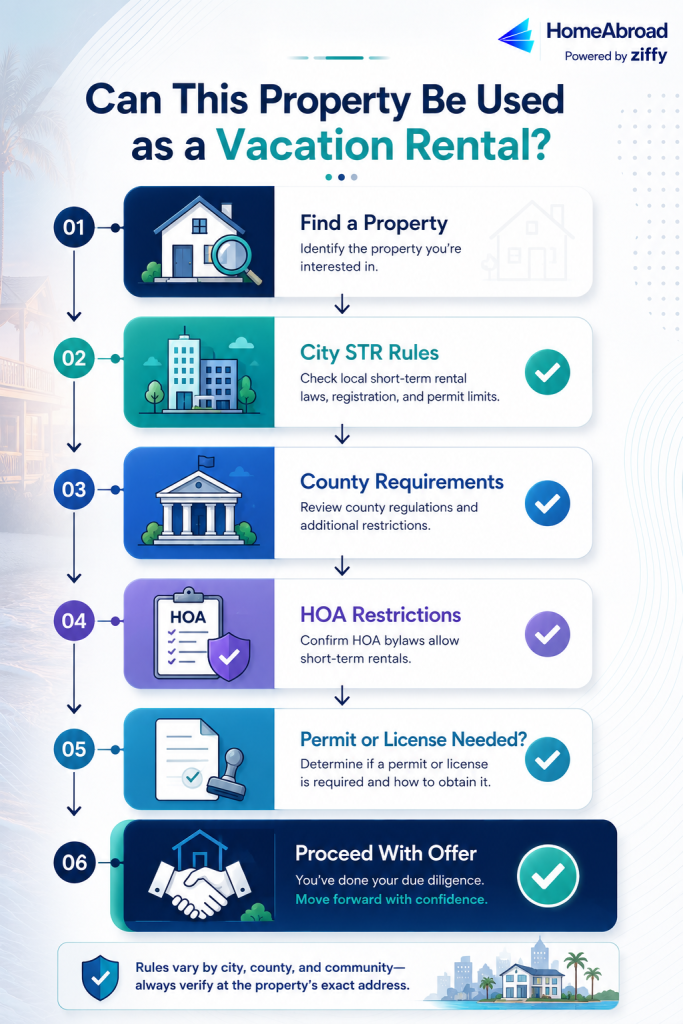
Before making an offer, confirm the rules for the specific city, county, and neighborhood where the property is located. Those local requirements can determine whether your investment strategy is even possible.
Short-Term Rental Rules and Permits Foreign Buyers Often Miss
Strong tourism demand doesn’t automatically make a property a viable vacation rental. Local regulations and community rules can limit or even prohibit short-term rentals at a specific address. Overseas buyers who research national ownership rights, then skip local short-term rental law, are the ones who get caught. Before you sign a contract, check for the following at the property’s specific location:
- Local short-term rental permits and licenses: Many cities require registration, a permit, or an annual license to rent for stays under a set number of nights. Some cap the number of permits issued.
- Zoning and use limits: Some areas allow short-term rentals only in certain zones, or only when the owner also lives on site.
- Occupancy and night caps: A city may limit how many guests you can host or how many nights per year you may rent when you do not live there.
- Homeowners association (HOA) rules: Many condominiums and planned communities have HOA bylaws that restrict or prohibit short-term rentals. Even if local laws allow vacation rentals, HOA rules may prevent you from operating one.
How a US Vacation Rental Is Taxed for Foreign Owners
A US vacation rental owned by a nonresident carries a US tax profile that differs from what a US resident faces, and short-term rentals add a further layer. The rules below are the framework a qualified US tax professional will apply to your specific facts.
Rental Income and the Net Election
By default, a nonresident alien’s US rental income can be treated as fixed, determinable, annual, or periodical (FDAP) income and taxed at a flat 30 percent on the gross rent, with no deductions allowed. That default is harsh, because it ignores your mortgage interest, property tax, insurance, management fees, and depreciation.
The common fix is the Section 871(d) election. Section 871(d) is an election you make with the IRS to treat your US real property income as income effectively connected with a US trade or business (ECI). Once elected, you are taxed on net rental income after deductions rather than on gross rent. This is an IRS election, not a treaty benefit, and it must be filed correctly.
The Short-Term Rental Wrinkle
How the IRS treats your rental activity can shift depending on the average length of guest stays and the level of services you provide. Short average stays, the kind typical of nightly vacation rentals, can move a property out of ordinary passive rental treatment and change how income, losses, and deductions are handled.
This affects passive activity loss rules and can carry other consequences. The exact treatment is fact-specific and governed by IRS rules, so confirm your reporting position with a CPA rather than assuming standard long-term rental treatment applies.
FIRPTA When You Sell
When a foreign person sells US real property, the Foreign Investment in Real Property Tax Act (FIRPTA) generally requires the buyer to withhold a portion of the sale price and remit it to the IRS as an advance against the seller’s US tax. FIRPTA withholding is tiered. Depending on the sale price and how the buyer intends to use the property, the rate is generally 0 percent, 10 percent, or 15 percent.
It is not a flat 15 percent in every case, and it is a withholding mechanism rather than your final tax. Note also that US income tax treaties generally do not reduce FIRPTA withholding for individual nonresident alien sellers, so do not assume your home country’s treaty removes it.
Estate Tax Exposure Owners Underestimate
US real estate is a US-situated asset, which brings nonresident owners into the US estate tax system on that asset at death. The federal estate tax exemption for a nonresident alien on US-situated assets is only 60,000 dollars, far below the multi-million-dollar exemption available to US citizens and residents. For a property worth several hundred thousand dollars or more, that gap can create meaningful exposure.
Financing a US Vacation Rental Without US Credit
This is where HomeAbroad works directly with foreign investors. The core problem for most international buyers is that traditional US mortgages lean on a US credit score and US income documents, and a newly arrived or nonresident buyer has neither.
HomeAbroad’s programs are built to qualify you on other evidence. Financing depth for short-term rentals specifically lives in our dedicated resources; the summary below covers how the main paths fit a vacation rental.
DSCR Loans for Vacation Rentals
A DSCR loan qualifies you on the property’s income rather than your personal income. The ratio compares gross rental income to the property’s debt payment, commonly expressed as gross rent divided by PITIA, which stands for principal, interest, taxes, insurance, and HOA dues. The exact income and payment components a program will accept should be verified against the current program, because definitions vary.
For a foreign national buying a vacation rental as an investment, a DSCR loan is often the natural fit, since it sidesteps the need for US pay stubs, US tax returns, or a US credit history. Underwriting will assess the short-term rental income on realistic market occupancy, not peak-season numbers. You can explore program terms on the DSCR loan for foreign investors.
When a Full Documentation or Second-Home Loan Fits Better
If you plan meaningful personal use, or if your full financial profile earns you stronger terms, a different path may serve you better. A Full Documentation Loan considers your home-country income, assets, and credit through international credit reports or approved alternatives, and can suit buyers treating the home partly as a personal retreat.
Which route wins depends on your use plan and your finances, and comparing them is exactly the conversation to have before you shop. See the full range of foreign investor mortgage programs to see how they line up.
What “No US Credit History Required” Actually Means
This phrase is widely used and widely misread. It does not mean no creditworthiness review, no documentation, and no verification. HomeAbroad still confirms your identity, checks foreign credit or bank references where relevant, verifies assets and reserves, and documents the source of your funds.
What “no US credit history required” means you are not disqualified simply because you have never built a US credit file.
Program | Qualifies mainly on | Often fits | Verify before use |
|---|---|---|---|
DSCR Loan | Property rental income vs PITIA | Year-round investment vacation rental | Ratio, down payment, reserves, rate |
Full Documentation Loan | Home-country income, assets, credit | Buyers with strong global profile or personal use | Down payment, term, documents |

With DSCR loan, we’re evaluating whether the property’s expected rental income can realistically support its debt obligations. For short-term rentals, we don’t base that analysis on the busiest season or a few exceptional months. We look at market-supported income that reflects the property’s earning potential over time, which gives both the borrower and the lender a more reliable picture of the investment.
The Buying Process for Overseas Investors
Buying from abroad follows a recognizable sequence, and knowing the order keeps you from getting stuck at closing.
Pre-Approval Before You Shop
When you need financing, get pre-approved before you start touring listings. Pre-approval is a lender’s conditional confirmation of how much you can borrow, and it tells you and any seller that your offer is real. It also surfaces documentation gaps early, while you still have time to fix them.
Offer, Underwriting, Appraisal, and Title
Once a seller accepts your offer and you sign the purchase agreement, the formal mortgage application follows. Underwriting reviews the file, the lender orders an appraisal to confirm the property’s value, and a title search confirms the seller can legally transfer ownership free of hidden claims. Escrow, a neutral third party holding funds and documents, coordinates the money and paperwork through to closing. Exact sequencing varies by state, property, and transaction.
Closing Remotely From Abroad
You usually do not need to fly to the US to close. Two tools make remote closing work: a power of attorney (POA), which lets someone sign on your behalf, and remote online notarization (RON), which allows notarized signing over secure video where permitted. Documents signed abroad may need authentication through an apostille or embassy process, and international wire timing is a frequent source of delay. Plan those steps early. HomeAbroad coordinates remote closings for foreign buyers regularly, and you can see how the workflow runs in this guide to closing on US property remotely.
One cost note for budgeting: loan-related taxes such as documentary stamp, intangible, and mortgage recording taxes are financing costs. They are part of your closing costs, not additions to the property’s cost basis for later gain calculations. Your tax professional will treat them accordingly.
The most common delays we see aren’t caused by the property. They’re caused by moving funds across borders at the last minute or incomplete documentation for those transfers. Buyers who organize their source-of-funds documents early and plan international wire transfers well before closing usually have a much smoother path to funding.

Operating a US Vacation Rental From Abroad
The purchase is the start. Running a short-term rental from another country is a real operation, and thinking it through before closing keeps the investment healthy.
Property Management and Guest Operations
Most overseas owners work with a local property manager or a short-term rental management company to handle listings, guest communication, cleaning, turnovers, and maintenance. Management fees for short-term rentals typically run higher than long-term rental management because the work is more frequent. Build those fees into your projections from the start rather than treating them as an afterthought.
Banking, Currency, and Source-of-Funds Documentation
Two banking realities shape a cross-border purchase. First, you will generally want a way to receive US rental income and pay US expenses, which often means US banking arrangements. Second, and more immediately, underwriting requires you to document the source of your funds. The challenge is rarely the amount of money.
It is proving where the money came from. Funds that move through several international accounts, undocumented transfers, or unexplained deposits can trigger extra conditions and slow approval even when the property itself qualifies. Clean, well-documented statements move a file faster.
Insurance and Ownership Structure
A short-term rental needs insurance suited to transient guest use, which differs from a standard owner-occupant or long-term landlord policy. Confirm your coverage matches how the property will actually operate.
Many investors also consider holding the property through a limited liability company (LLC), a US business structure, for liability and estate-planning reasons. The tax and liability implications of an LLC for a nonresident are significant and belong with a qualified tax and legal professional, not a default choice.
Steven Glick
Director of Mortgage Sales · HomeAbroad
Buying the property is only the beginning. International owners who have a clear plan for property management, maintenance, and local support tend to have a much smoother ownership experience than those trying to organize everything after closing.
Is a US Vacation Rental Right for You?
A US vacation rental can be an excellent investment for foreign nationals, but success depends on making the right decisions before you buy. That means choosing a market with sustainable demand, confirming local short-term rental regulations, understanding your tax obligations, selecting the right financing program, and building realistic income projections based on year-round performance.
When It Makes Sense
A vacation rental is often a good fit when:
- Short-term rentals are permitted by the city, county, and HOA.
- The market has consistent year-round demand rather than relying on a short peak season.
- The property’s projected income supports your investment goals under conservative occupancy assumptions.
- You have discussed your US tax obligations with a qualified CPA or tax attorney.
- Your financing is pre-qualified before you begin making offers.
- You plan to enjoy personal use of the property while generating rental income when you’re not using it.
When It Does Not
A vacation rental may be a weaker investment if:
- Local regulations or HOA rules prohibit short-term rentals.
- The property’s cash flow depends on optimistic occupancy or peak-season pricing.
- You have not budgeted for professional property management, STR insurance, maintenance, and ongoing operating costs.
- You are unprepared for the US tax reporting requirements that apply to foreign owners.
In those situations, a long-term rental property or a different market may provide a more predictable investment.
How HomeAbroad Helps Foreign National Investors
Buying and financing US real estate from another country involves more than securing a mortgage. It requires understanding financing options, ownership structures, documentation requirements, tax considerations, and local market regulations.
At HomeAbroad, we specializes exclusively in helping foreign nationals invest in US real estate. Whether you’re purchasing your first vacation rental or expanding an existing portfolio, our team provides end-to-end support throughout the entire journey, from finding the right investment property and selecting the right loan program to underwriting, closing, and beyond.
HomeAbroad has helped more than 500 foreign national investors from over 40 countries finance US real estate through DSCR, Full Documentation, and other foreign national mortgage programs built for international buyers, providing the expertise and support needed to simplify every stage of the investment journey.
Get pre-qualified, and start your US real estate investment journey with confidence.
Frequently Asked Questions
Do I Need to Visit the US to Buy a Vacation Rental?
No. HomeAbroad supports remote closings, allowing many foreign national buyers to complete their purchase without traveling to the US. Depending on the transaction, this may involve remote online notarization or a power of attorney. You should also plan for document authentication and international wire transfer timing.
Can I Use the Property Myself and Still Get Investment Financing?
Personal use affects both your loan classification and your taxes. Heavy personal use can move a property out of investment classification. Decide your real use pattern before applying, because it determines which financing path fits.
Do I Need an LLC to Own a US Vacation Rental?
No, an LLC is not required. Some investors use one for liability or estate-planning reasons, but the tax and cost implications for a nonresident are significant. Discuss it with a US tax and legal professional before deciding.
How Is Airbnb Income Taxed if I Live Abroad?
A nonresident owner’s US rental income is subject to US tax, often through the Section 871(d) election that allows taxation on net income after deductions. Short-term rentals can carry additional tax nuances. Confirm your position with a CPA.
Can I Get Financing if the Property’s DSCR Is Below 1.0?
Yes. HomeAbroad offers a No-Ratio DSCR option for eligible properties with a DSCR between 0 and 1.0. This program allows qualified foreign national investors to finance properties that may not initially meet the standard DSCR requirement.