



Editorial Integrity
Making informed real estate decisions starts with having the right knowledge. At HomeAbroad, we offer US mortgage products for foreign nationals & investors and have a network of 500+ expert HomeAbroad real estate agents to provide the expertise you need. Our content is written by licensed mortgage experts and seasoned real estate agents who share insights from their experience, helping thousands like you. Our strict editorial process ensures you receive reliable and accurate information.
Quick Answer:

A delayed financing mortgage lets you refinance a property shortly after purchasing it with cash, helping you recover capital without selling the property.

For foreign national investors, it can be a practical way to unlock equity from a recent cash purchase while retaining ownership and using the funds for future investments. Qualification depends on factors such as the property's value, loan-to-value (LTV) limits, DSCR requirements, applicable program guidelines, and underwriting.
A delayed financing mortgage lets eligible investors refinance soon after a cash purchase without waiting through the standard cash-out seasoning period.
The maximum loan amount is limited by factors such as the property’s appraised value, LTV limits, and DSCR underwriting requirements.
Delayed financing can help foreign national investors recover capital from a recent cash purchase while retaining ownership of the property.
Gift funds used for the original cash purchase generally cannot be reimbursed through delayed financing, so the source of funds should be planned carefully before closing.
Proper documentation, including proof of the cash purchase and source of funds, is essential for a successful delayed financing refinance.
Table of Contents
What Delayed Financing Means
You buy a property outright. No lender is involved, so there is no mortgage on title. A few months later you apply for a loan against that same property, take the proceeds in cash, and put your original capital back to work somewhere else. The property stays yours and the rent keeps arriving. That sequence is delayed financing.
Investors use it because paying cash wins deals. A seller comparing two offers will often take the one that carries no financing contingency and no appraisal condition, even at a slightly lower price. Delayed financing lets you compete on those terms without leaving your capital parked in a single asset indefinitely.
The mechanics of the refinance itself are ordinary. What makes delayed financing distinct is timing. Lenders normally want a property to have been owned for a period of time before they will allow cash to be taken out of it, and delayed financing is the route that shortens or removes that wait.
The Fannie Mae Delayed Financing Exception, In Plain Terms
The phrase comes from the Fannie Mae Selling Guide, section B2-1.3-03, which covers cash-out refinance transactions. Fannie Mae is a government-sponsored enterprise that buys mortgages from US lenders, and its rulebook sets the standards a loan must meet to be sold to it.
The general rule in that section is that at least one borrower must have been on title to the property for at least six months before the new loan disburses. The delayed financing exception sets that waiting period aside for borrowers who bought within the previous six months, measured from the purchase date to the disbursement date of the new loan, provided every one of the following is satisfied:
- The original purchase was an arm’s length transaction, meaning buyer and seller were unrelated and acted independently.
- The borrower meets Fannie Mae’s general borrower eligibility requirements. The property may have been bought by a natural person, an eligible revocable trust, an eligible land trust, or an LLC or partnership in which the borrower holds 100% ownership.
- A settlement statement confirms that no mortgage financing was used to buy the property. Where no settlement statement was issued, a recorded trustee’s deed showing the amount paid can substitute.
- A preliminary title search confirms there are no existing liens against the property.
- The sources of the funds used to buy are documented, through bank statements, personal loan documents, or a home equity line on another property.
- Where the purchase money came from an unsecured loan or a loan secured by some other asset, the refinance must pay that loan off or pay it down, and any remaining balance counts against the borrower’s debt-to-income ratio.
- The new loan amount cannot exceed the documented amount the borrower originally invested, plus financed closing costs, prepaid fees, and points, and it remains subject to the maximum loan-to-value ratios that apply to cash-out transactions based on the current appraised value.
Two details in that list matter more than they first appear. Cash-out pricing applies, so the loan is priced as a cash-out refinance rather than a purchase. And funds received as a gift and used to buy the property may not be reimbursed with proceeds from the new loan.
Why the Term Works Differently for Foreign National Investors
The delayed financing exception is a rule inside Fannie Mae’s rulebook. It is available on a loan Fannie Mae would buy, which means using it depends first on qualifying for a conforming loan.
That is where the path diverges for most of the investors reading this. Fannie Mae addresses non-US citizen borrower eligibility in a separate section of its guide, and the eligibility question sits upstream of the delayed financing question entirely. If a nonresident investor whose primary home is abroad does not qualify for the conforming loan, the exception attached to that loan is not the mechanism available to them.
The practical consequence is narrow and worth stating plainly. The strategy is available to you. The label is borrowed from a program that usually is not. What governs your timeline, your maximum loan, and your documentation is the foreign national program you actually use.
None of this is a statement about how difficult you are to finance. Immigration status, tax residency, and mortgage classification are three separate things, and a nonresident investor is simply underwritten under a different set of rules.
How HomeAbroad Structures Delayed Financing for Foreign Buyers
HomeAbroad lends to foreign nationals, nonresident investors, US newcomers, and expats buying US property, which means the delayed financing conversation starts from a different place. There is no conforming eligibility hurdle to clear first. The question is which program fits the property and what it will support.
DSCR Cash-Out Refinance After a Cash Purchase
For a rental property, this is the primary route. DSCR stands for Debt Service Coverage Ratio, and a DSCR loan qualifies based on the income the property produces rather than on your personal income. There are no W-2 forms to supply, no US tax returns, and no requirement for an established US credit history.
The ratio itself is straightforward. You divide the property’s gross monthly rent by its PITIA, which is the monthly total of principal, interest, taxes, insurance, and any homeowners association dues. A DSCR of 1.0 means the rent exactly covers that payment. Above 1.0 and the property carries itself with room to spare.
On the terms currently published for the DSCR program, a cash-out refinance is available up to 70% LTV, which is lower than the 75% available on a purchase or a rate-and-term refinance. Reserves of six months are required and must still be in place after closing, calculated on the new payment rather than the old one. LLC ownership is supported on most DSCR files, with entity documents included in the package.
Worth being precise about one point, because it gets compressed elsewhere. No established US credit history required does not mean no creditworthiness review, no documentation, no identity verification, and no assessment of assets. It means your qualification does not depend on having built a US credit file. Underwriting still happens.

Steven Glick
Director of Mortgage Sales · HomeAbroad
For early cash-out refinances, underwriting focuses on documenting the original cash purchase and verifying the source of funds. The most common delays come from incomplete wire records or gaps in the funding trail, especially on international transactions.
How Much Cash You Can Actually Recover
Most investors approach this expecting to get back what they put in. The arithmetic rarely allows it, and understanding why before you buy is more useful than discovering it during underwriting.
The Three Ceilings That Cap Your Proceeds
Three separate limits apply at the same time. Your loan is capped by the lowest of them, and your cash in hand is that figure minus closing costs and any payoff of loans used to fund the purchase.
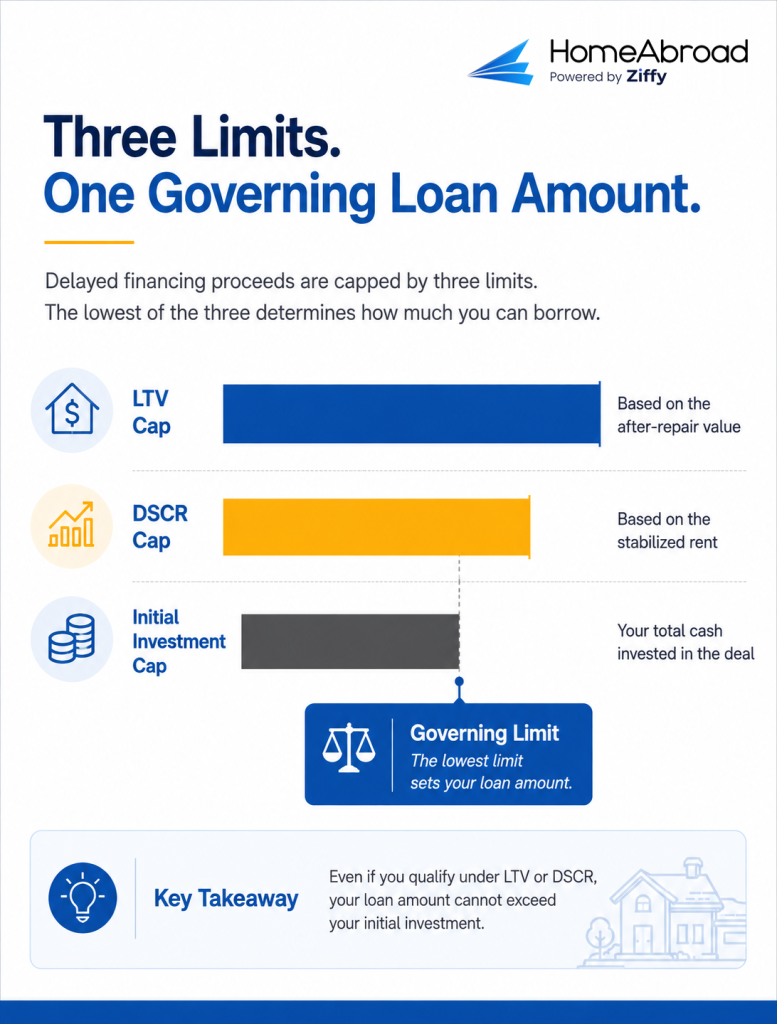
Ceiling one, the LTV cap. Maximum loan equals the cash-out LTV limit multiplied by the current appraised value. Note that this runs on appraised value at refinance, not on what you paid. If the appraisal comes in below your purchase price, this ceiling drops.
Ceiling two, the DSCR cap. This is the largest loan whose resulting PITIA still produces a qualifying DSCR. It runs on the property’s rent. Borrowing more raises the payment, which lowers the ratio, so the rent itself sets a hard maximum regardless of how much equity sits in the property.
Ceiling three, the initial investment cap. This one applies only on a conforming delayed financing loan, and it is the documented amount you originally invested plus financed closing costs, prepaids, and points. It is the reason the Fannie Mae exception returns capital rather than extracting equity.
Real Example: How DSCR Is Evaluated in a Delayed Financing Refinance
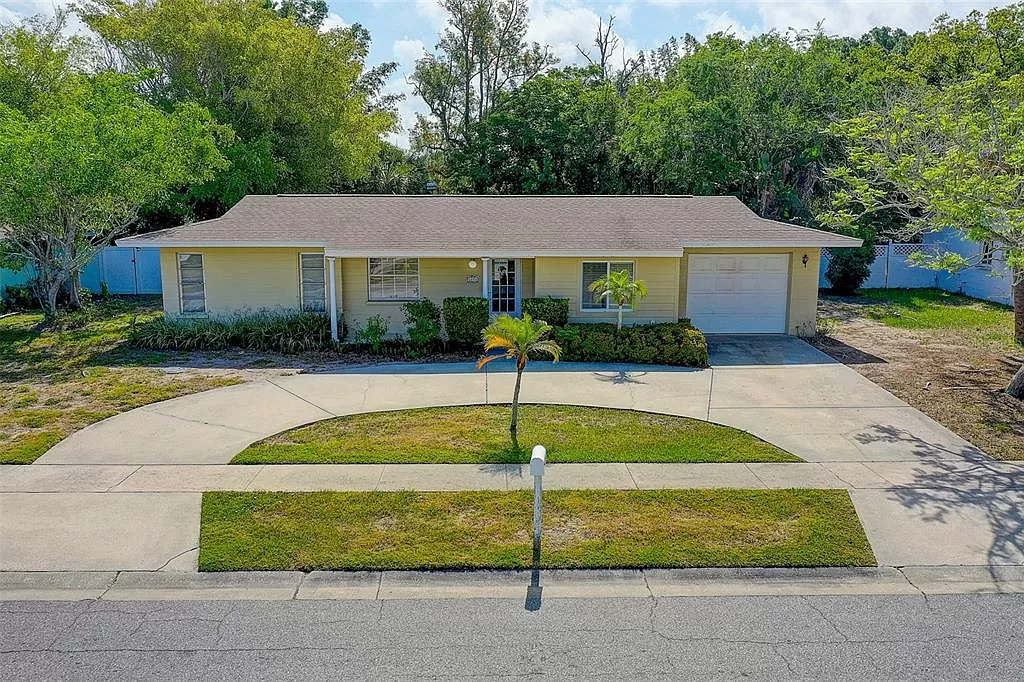
We recently worked with a foreign national investor who used DSCR cash-out refinancing to recover capital after a cash purchase. Here’s how the transaction worked.
Metric | Transaction Details |
|---|---|
Purchase Price (Cash) | $77,800 |
Appraised Value | $140,000 |
Loan Amount | $84,000 |
Monthly Rent | $1,275 |
Monthly PITIA | $938 |
DSCR | 1.36 |
Cash to Investor | $79,640 |
Although the property had significant equity after appreciating from $77,800 to $140,000, underwriting still evaluated whether the rental income could support the proposed mortgage payment. The property’s 1.36 DSCR met program requirements, allowing the investor to complete the refinance and recover $79,640 to use as the down payment for another investment property.
This example illustrates that available equity alone does not guarantee approval. Even when a property has substantial equity, the proposed loan must still satisfy the lender’s DSCR underwriting requirements.
Result: The investor accessed equity through a delayed financing refinance while keeping the property and used the recovered capital as the down payment for another investment property.
While this transaction satisfied both the property’s DSCR requirements and the applicable LTV limits, the balance between those constraints varies by property. In lower-yielding markets, DSCR may become the limiting factor. In higher-yielding markets, the LTV cap is more likely to determine the maximum loan amount.
Want to estimate how a property’s rental income could affect DSCR? Use the HomeAbroad DSCR Loan Calculator to run your own numbers.

Many investors focus on the maximum LTV, but that’s only one limit. In practice, the property’s rental income often determines the final loan amount because the DSCR still has to meet program requirements. That’s why it’s important to evaluate both cash flow and equity before planning how much capital you can recover.
Why Full Capital Recovery Is Not Guaranteed
The example above represents one successful delayed financing transaction. Not every refinance produces the same outcome.
Several factors can reduce the amount you receive. The cash-out LTV limit applies from the outset, closing costs reduce the available proceeds, and the appraised value may come in below expectations. In addition, lenders require post-closing reserves, so not all of the proceeds you receive are immediately available to reinvest.
Waiting longer may improve the outcome. If the property appreciates or renovations increase its value, a higher appraisal can support larger proceeds. A longer rental history may also strengthen the file during underwriting. The trade-off is that your capital remains tied up for a longer period, so the right timing depends on your investment strategy.
Documents You Need to Qualify
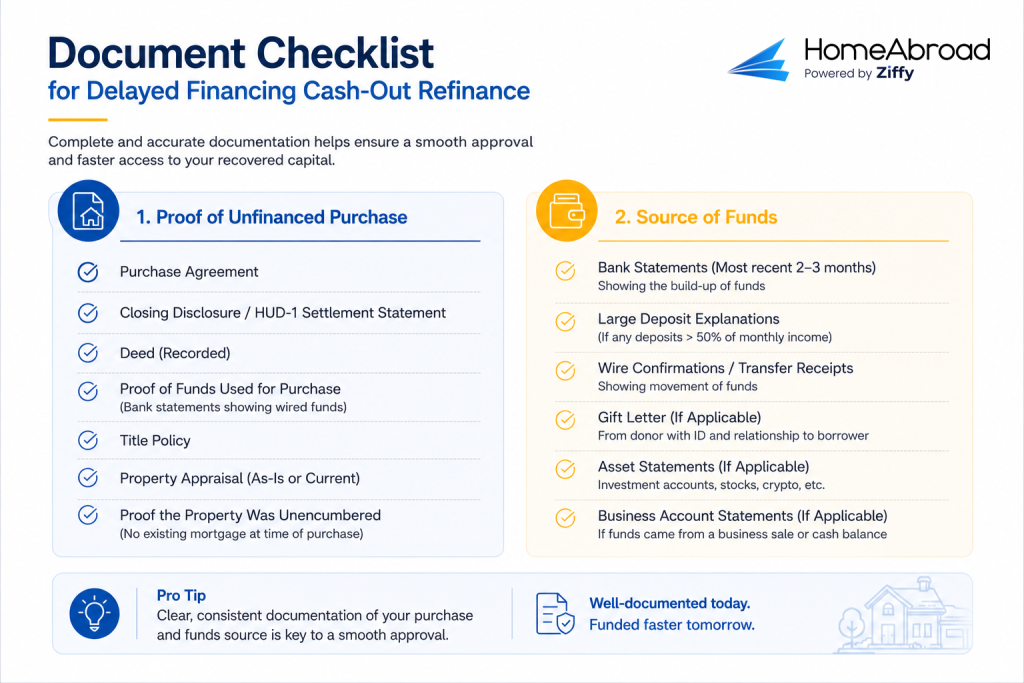
A delayed financing file asks for two things a standard refinance does not: proof that the purchase was genuinely unfinanced, and a traceable account of where the purchase money came from.
Proving the Purchase Was Unfinanced
Underwriting needs to establish that no lender has a claim on the property and that you did not use purchase money financing. That is done with a settlement statement from the original purchase showing no loan, and a preliminary title report confirming no liens are recorded. Where no settlement statement was issued at the time of sale, a recorded trustee’s deed showing what you paid can take its place.
Keep these documents from the day you close on the cash purchase. Reconstructing a settlement statement months later, from another country, in a market where you no longer have an active relationship with the closing agent, takes longer than it should.
Documenting Source of Funds Across Borders
This is where international files diverge most from domestic ones. Underwriting is looking for a clean path from where the money originated to where it landed at closing, and the questions get harder the more steps that path took.
Expect to supply bank statements covering the relevant period, records of the international wire or wires, and documentation of the currency conversion. If the funds sat in several accounts before closing, or moved through an intermediary bank, or came from the sale of an asset abroad, each step needs its own paper.
Two patterns cause the most delay. Funds assembled from multiple sources shortly before closing require documentation for every source. And money that passed through an account belonging to a family member, even briefly, changes the character of the file in a way covered in the next section.
The most common documentation delays happen when funds move through multiple accounts without a clear paper trail. Before closing on an all-cash purchase, keep your bank statements, wire confirmations, currency conversion records, and any supporting documents organized. That preparation can save weeks during underwriting.

Where Gift and Family Funds Create a Problem
Fannie Mae’s rule on this is explicit. Funds received as a gift and used to buy the property may not be reimbursed with the proceeds of the new loan. If a family member gave you the purchase money, the conforming delayed financing route will not return it to you.
This matters here more than it would in a domestic article. A large share of international purchases are funded wholly or partly by family transfers from abroad, and the distinction between a gift and a loan is frequently informal in practice and undocumented on paper.
What is safe to say now: settle this before you buy, not after. If money is coming from family, document at the time of transfer whether it is a gift or a loan, and put it in writing. That single step preserves options that are difficult to recover later.
Delayed Financing vs Waiting for Standard Seasoning
Seasoning refers to the length of time you have owned a property before becoming eligible for certain refinance transactions under a loan program’s guidelines. Neither option is better in the abstract. They suit different situations.
Refinance early through delayed financing | Wait for standard seasoning | |
|---|---|---|
Capital returned | Sooner, which matters if it is committed elsewhere | Later |
Appraised value used | Value close to your purchase date | Value after any appreciation or completed work |
Rent history available | Short, which can limit the DSCR ceiling | Longer, which underwriting can rely on more heavily |
Documentation burden | Higher. Settlement statement, clear title, and full source of funds | Lower on the source-of-funds side |
Pricing | Cash-out pricing | Cash-out pricing |
Best suited to | An investor with an identified next use for the capital | An investor improving the property or with no immediate deployment |
A reasonable decision rule: refinance early when you have a specific, time-bound use for the money that earns more than the debt costs you. Wait when the property still has value to gain or the rent has yet to stabilize. If neither is true, and the capital would simply sit in an account after closing, doing nothing is often the better answer than paying cash-out pricing to move money from one place to another.
Costs, Rate, and Cash Flow Trade-Offs
Cash-Out Pricing and Closing Costs
A cash-out refinance prices differently from a purchase or a rate-and-term refinance. That difference exists because taking equity out of a property changes the lender’s risk position, and it applies whether you refinance in month three or month thirteen.
Closing costs reduce what reaches your account. They can often be financed into the loan, which is convenient and has a consequence: a larger loan means a larger payment, a larger payment lowers DSCR, and on a file where DSCR is already the binding ceiling, financing your costs can reduce the loan you qualify for. Ask for both versions of the number before you decide.
HomeAbroad does not publish rates, and any figure you see quoted in an article is not a quote. Pricing on a DSCR file moves with the market and with the specifics of your property, leverage, and reserves.
What Happens to Your Monthly Cash Flow
A property owned free and clear produces rental income without a mortgage payment. After a delayed financing refinance, part of that rental income is used to cover the new monthly loan payment.
In the example above, the property generated $1,275 in monthly rent against a monthly PITIA of $938, resulting in a DSCR of 1.36. The refinance met both the property’s DSCR requirements and the applicable LTV limits while allowing the investor to recover $79,640 in capital for another investment.
Whether that is a good trade depends on what the recovered capital does next. If it funds another investment property that generates additional cash flow or appreciation, the financing can help accelerate portfolio growth. If the proceeds remain idle, the investor still incurs borrowing costs while the recovered capital produces no additional return. This is the calculation to make before starting a delayed financing refinance.
Tax and Reporting Considerations to Review With Your CPA
Three points are worth knowing, and all three need review against your own facts.
A refinance is not a sale. FIRPTA withholding, which stands for the Foreign Investment in Real Property Tax Act, applies to dispositions of US real property interests. Refinancing is not a disposition, so a cash-out refinance does not itself trigger FIRPTA withholding. That does not change how FIRPTA will apply when you eventually sell.
Refinance proceeds are generally not taxable income. You are borrowing against an asset you already own, not realizing a gain on it.
Deductibility of the interest depends on what you do with the money. Where the proceeds are redeployed matters, particularly if capital leaves the property or leaves the US, and the analysis is fact-specific.
Tax treatment depends on your individual circumstances, your tax residency, and how the proceeds are used. Consult a qualified CPA or tax attorney experienced in cross-border property before acting on any of the above.
When Delayed Financing Is the Wrong Move
There are situations where the answer is no, and a lender willing to say so is more useful than one that is not.
- The property has no lease or unstable rent. DSCR will not support a meaningful loan, and pushing the file forward early usually produces a smaller loan than waiting would.
- The appraisal is likely to come in at or below your purchase price. Your LTV ceiling is set by appraised value. If you overpaid or the property needs work, the ceiling drops with it.
- You have no identified use for the capital. Cash-out pricing to move money into a savings account is an expense without a return.
- Reserves would be thin after closing. Six months of reserves on the new payment must remain, and an investor who clears that requirement by a narrow margin has no cushion for a vacancy.
- The purchase money was gifted and cannot be documented as a loan. See the section above. This may close the route entirely.
How to Start a Delayed Financing Refinance With HomeAbroad
- Initial review. Share the property, the purchase details, the current lease if one is in place, and the source of your purchase funds. HomeAbroad reviews whether the timing works and which program fits.
- Proceeds estimate. Run the three ceilings against your actual rent and appraised value expectation, so you know the realistic number before the file opens rather than after.
- Documentation. Settlement statement, title, source of funds, entity documents where an LLC holds title, and reserve verification.
- Appraisal and rent analysis. Ordered through the lending process. The rent figure underwriting accepts is the one that drives DSCR.
- Underwriting. Program terms, DSCR, reserves, and documentation reviewed together.
- Closing. Remote closing is supported for eligible foreign investors, so travel to the US is not always necessary.
To start, request a rate quote for a DSCR cash-out refinance, and a HomeAbroad loan officer will review the timing and proceeds question against your specific property. Terms, eligibility, and available proceeds depend on the property, the documentation, and the current program.
Steven Glick
Director of Mortgage Sales · HomeAbroad
Before you refinance, have a clear plan for the capital you’re recovering. Delayed financing works best when those funds are being redeployed into another investment or business objective, not simply sitting idle after closing.
Explore Your Delayed Financing Options With HomeAbroad
If you purchased a US investment property with cash, delayed financing may allow you to recover a portion of your capital without selling the property. The right strategy depends on factors such as the property’s rental income, appraised value, documentation, and the financing program you qualify for. Final loan terms and proceeds are determined through underwriting.
HomeAbroad works with foreign nationals and international real estate investors to evaluate their delayed financing options. A HomeAbroad loan officer can review your purchase, estimate potential proceeds, explain the documentation requirements, and help you understand the financing options available based on your investment goals.
If you’re considering refinancing after an all-cash purchase, contact HomeAbroad to discuss your property and receive a personalized assessment of your available options.
Frequently Asked Questions
Can I get back the full amount I paid for the property?
Usually not. The cash-out LTV limit sits below 100% of appraised value, closing costs reduce your proceeds, and on many properties the rent caps the loan below the LTV limit. Recovering a majority of your capital is a realistic goal; recovering all of it is not.
Does it matter that my LLC owns the property rather than me personally?
LLC ownership is supported on most DSCR files, with entity documents included in the package. Under Fannie Mae’s conforming rules an LLC purchase can qualify for the delayed financing exception where the borrower holds 100% ownership, though the property must be transferred out of the LLC to close that particular transaction. The treatment differs between the two routes, so confirm which applies to your file.
Do I need US credit history?
No. HomeAbroad’s Foreign National Mortgage programs qualify borrowers based on the property’s rental income rather than their personal income or US credit history.
Will refinancing trigger FIRPTA withholding?
No. FIRPTA applies to dispositions of US real property, and a refinance is not a disposition. It will apply when you sell. Review your own position with a CPA.
What happens if the appraisal comes in lower than I expected?
Your LTV ceiling falls with it, since that ceiling runs on appraised value rather than purchase price. If the appraisal is well below expectations, the usual options are to accept a smaller loan, complete planned improvements and revisit later, or wait for the market to support a higher value.