


Editorial Integrity
Making informed real estate decisions starts with having the right knowledge. At HomeAbroad, we offer US mortgage products for foreign nationals & investors and have a network of 500+ expert HomeAbroad real estate agents to provide the expertise you need. Our content is written by licensed mortgage experts and seasoned real estate agents who share insights from their experience, helping thousands like you. Our strict editorial process ensures you receive reliable and accurate information.
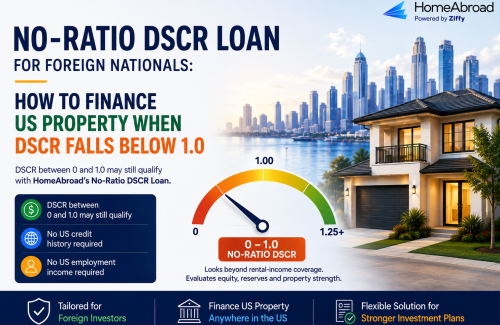
A DSA DSCR below 1.0 does not automatically make a US rental property unfinanceable. HomeAbroad’s No-Ratio DSCR program is designed for eligible properties with a DSCR between 0 and 1.0.
Qualification looks beyond rental income coverage. HomeAbroad evaluates factors such as the borrower’s equity, reserves, property strength, ownership structure, and overall transaction profile.
Foreign nationals can qualify without US credit history or personal income verification. The program focuses on the investment property and the overall strength of the transaction.
Investors should generally expect more equity, a lower maximum LTV, and a rate adjustment compared with a standard DSCR loan, so the property’s economics should justify the structure.
Table of Contents
Can You Get a DSCR Loan With a DSCR Below 1.0?
A No-Ratio DSCR Loan allows eligible foreign national investors to finance a US rental property even when the property’s projected rental income does not fully cover its PITIA (principal, interest, taxes, insurance, and association dues), resulting in a DSCR below 1.0.
At HomeAbroad, our No-Ratio DSCR program is available for properties with a DSCR between 0 and 1.0. Instead of relying solely on rent-to-debt coverage, we evaluate the overall strength of the file, including the property’s equity position, available reserves, and borrower profile. The tradeoff is typically an approximate 5% reduction in maximum loan-to-value (LTV) and a rate adjustment.
Eligible foreign national investors can qualify without US credit history, US tax returns, or US employment income. This financing option is commonly used for properties in high-appreciation markets, seasonal rental locations, and other situations where long-term investment potential remains strong despite a DSCR below 1.0.
What “DSCR Below 1.0” Really Means (and How We Underwrite Around It)
When the Rent Doesn’t Cover the Carry
A DSCR below 1.0 simply means the property’s projected rental income is lower than its monthly housing expenses.
For example, suppose a rental property generates $2,400 per month in rental income and the monthly PITIA (principal, interest, taxes, insurance, and association dues) equals $2,700 per month.
In this scenario, the property generates only $0.89 of income for every $1.00 of housing expense. Under a standard DSCR loan, that ratio would typically fall below the minimum requirement because the property is not fully supporting its debt obligations through rental income alone.
This situation is more common than many investors realize. Properties in high-appreciation markets, vacation destinations, and supply-constrained cities often experience periods where property values and financing costs rise faster than rental rates. The result is a property that may have strong long-term investment potential but a DSCR below 1.0.
A DSCR below 1.0 changes how the transaction is evaluated because rental income alone is no longer the primary qualification factor. In reality, the question becomes whether the overall transaction can be structured in a way that offsets the additional risk.
How a No-Ratio Approval Is Structured Instead
This is where a No-Ratio DSCR Loan differs from a traditional DSCR program.
Rather than focusing solely on whether rental income covers PITIA, we evaluate the broader strength of the transaction. The underwriting conversation shifts from “Does the rent fully cover the payment?” to “Does the overall file support the investment despite the lower DSCR?”
Key factors include the investor’s down payment, reserve position, property equity, ownership structure, and overall risk profile. A stronger equity position and additional reserves help offset a property’s lower rent-to-debt coverage.
Qualification Factor | Standard DSCR Loan | No-Ratio DSCR Loan |
|---|---|---|
Typical DSCR Requirement | 1.0+ | 0.0–1.0 |
Primary Focus | Rental income coverage | Overall file strength |
Maximum LTV | Higher | Approximately 5% lower |
Reserve Expectations | Standard program requirements | Strong reserve position required |
Rate Structure | Standard DSCR pricing | Rate adjustment applies |
US Credit Required | Not required | Not required |
US Income Required | No | No |
For foreign national investors, this distinction is particularly important. We are not qualifying the loan based on US employment income, US tax returns, or a US credit score. Instead, we evaluate the investment property, available equity, reserve strength, and the overall quality of the file.
In other words, a DSCR below 1.0 may change how we structure the loan, but it does not automatically eliminate financing as an option.
Qualifying as a Foreign National: Down Payment, Reserves & Property Eligibility
Down Payment Expectations
Foreign national investors typically contribute a larger down payment than domestic borrowers, and that requirement often increases when a property’s DSCR falls below 1.0.
For a standard foreign national DSCR loan, down payments commonly start at 25%, depending on the property, DSCR, and overall file strength. With a No-Ratio DSCR Loan, borrowers should generally expect to contribute more equity, with down payments often ranging from 30% to 35%.
when rental income does not fully cover the property’s housing expenses, additional equity helps offset the increased risk. A larger down payment reduces leverage, strengthens the overall transaction, and creates a larger buffer against market fluctuations.
Borrowers should also expect pricing adjustments compared to a standard DSCR loan. The exact rate impact varies based on the property, DSCR, reserves, and overall file strength, but No-Ratio loans generally carry higher interest rates because the property’s rental income does not fully support the debt obligation.
Reserve Requirements and Foreign Assets
Reserves play an important role in No-Ratio DSCR underwriting because they demonstrate the borrower’s ability to support the property if rental performance fluctuates.
At HomeAbroad, reserve requirements are often around six months of PITIA, although requirements can vary based on the transaction and property profile. This reserve requirement is frequently lower than what some conventional lenders require for higher-risk investment scenarios.
One advantage for foreign national investors is that reserves may remain in overseas accounts. Underwriting reviews account ownership, available balances, source of funds, and currency conversion where applicable. Providing reserve accounts early in the process helps avoid last-minute documentation requests and gives underwriting a clearer picture of the overall file strength.

Steven Glick
Director of Mortgage Sales
HomeAbroad
NMLS #1231769A No-Ratio DSCR Loan isn’t about ignoring the property’s cash flow. It’s about looking at the entire transaction. When an investor brings significant equity and strong reserves to the table, a DSCR below 1.0 becomes one factor in the file, not the only factor.
Property Eligibility
Property eligibility is generally driven by the asset itself rather than the DSCR ratio alone.
Eligible properties commonly include single-family homes, warrantable condominiums, townhomes, and 2–4 unit residential properties. The property must generally be purchased as an investment property rather than a primary residence.
Not every property will qualify, however. Condo projects with warrantability issues, properties with title concerns, and assets located in markets with significant operational restrictions may face additional scrutiny.
Investors should also pay attention to how rental income is treated. Long-term rental properties typically provide more predictable income streams, while short-term rentals can introduce additional variability through occupancy fluctuations and seasonal demand patterns. When a property already has a DSCR below 1.0, that variability becomes even more important because underwriting must evaluate whether the overall transaction remains supportable under realistic operating assumptions.
For this reason, the strongest No-Ratio files usually combine three elements: meaningful borrower equity, documented reserves, and a property with a clear long-term investment strategy.
For short-term rental properties, income qualification depends on the loan program and property history. Underwriting may rely on appraisal-supported income projections, historical operating performance, or other approved documentation methods. Because seasonal income can create additional variability, short-term rentals with DSCRs below 1.0 often receive closer review than comparable long-term rental properties.
Real Qualification Scenarios & Investor Use Cases
A No-Ratio DSCR Loan is not designed for every investment property. It is most often used when a property’s long-term investment potential is stronger than its current rent-to-debt coverage.
The Appreciation Play
One common scenario involves investors purchasing in high-cost markets where property values have increased faster than rental rates.
One scenario we see periodically involves high-cost markets where appreciation has outpaced rent growth. For example, a foreign investor purchasing a $950,000 rental property may generate only $4,100 in monthly rent against a PITIA of approximately $4,500, producing a DSCR of roughly 0.91.
The property may not qualify under a standard DSCR program, but the investor is often focused on long-term ownership, location quality, and equity growth rather than immediate cash flow. In situations like this, additional equity and reserves can help support a No-Ratio DSCR structure.
The Short-Term Rental or Seasonal Market Property
We also see this structure used for vacation-rental properties in seasonal markets. A property may generate strong revenue during peak travel periods yet produce a qualifying DSCR of 0.95 once annual occupancy assumptions and lender-approved income calculations are applied.
From an operational perspective, the property may perform well. From an underwriting perspective, the seasonal nature of the income creates additional variability that can push the qualifying ratio below 1.0.
For investors targeting vacation rentals, a No-Ratio DSCR Loan can provide financing flexibility when seasonal income patterns create a temporary qualification challenge.
The Portfolio Expansion or Pre-Stabilization Property
We also see No-Ratio financing used by experienced investors who are expanding a portfolio or acquiring a property before rental performance has fully stabilized.
Another example is a recently renovated rental property that has not yet reached stabilized occupancy. We occasionally work with investors purchasing assets that are between tenants, transitioning rental strategies, or completing improvements. The property’s current DSCR may fall to 0.75–0.95 because the rent roll has not fully caught up to the property’s long-term operating potential.
For portfolio investors, a No-Ratio DSCR Loan can provide a bridge between acquisition and stabilization, with the option to evaluate refinancing opportunities once rental performance improves.

Jeff Larrabee
Senior Customer Loan Specialist, HomeAbroad
The files that qualify most smoothly are usually the ones where the investor already understands why the DSCR is below 1.0 and has a plan for the property. Strong reserves and meaningful equity often tell us more about the transaction than the ratio alone
In some cases, investors later improve rental performance and pursue refinancing options through a traditional DSCR program once the property becomes fully stabilized. The key is having a financing structure that aligns with the property’s current stage rather than forcing every investment into the same qualification model.
The Trade-Offs: When a No-Ratio DSCR Loan Is Right and When It Isn’t
A No-Ratio DSCR Loan can solve a qualification problem, but it is not automatically the best financing option.
The most important tradeoff is cost. Because the property’s rental income does not fully cover its housing expenses, borrowers should generally expect a larger down payment, a lower maximum LTV, and a rate adjustment compared to a standard DSCR loan. The property may also produce less immediate cash flow because it is already operating near or below break-even from a debt-coverage perspective.
For some investors, waiting may be the better strategy. If rental income is expected to improve in the near future through lease renewals, completed renovations, or stabilized occupancy, allowing the property to season before financing could result in a stronger DSCR and more favorable loan terms.
In other situations, restructuring the acquisition may make more sense than pursuing a No-Ratio loan. Increasing the down payment, negotiating a lower purchase price, or selecting a different property can sometimes move the DSCR above 1.0 and open the door to standard DSCR financing.
A standard DSCR loan is usually the better fit when the property already generates sufficient rental income, the investor’s goal is maximizing cash flow, or there is no need to accept the additional tradeoffs associated with sub-1.0 qualification.
The availability of a No-Ratio DSCR Loan is only part of the decision. Investors should determine whether it aligns with the property’s economics, their cash-flow expectations, and their long-term investment strategy.
Investors should also consider the full life cycle of the investment. Financing is only one part of the equation. Ownership structure, tax planning, and eventual exit strategy can all affect long-term results. For example, foreign investors should understand how FIRPTA may apply when the property is eventually sold.
Get Pre-Qualified for a No-Ratio DSCR Loan
Not every investment opportunity fits inside a standard DSCR box. That’s where a No-Ratio DSCR Loan may become part of the conversation. With the right combination of equity, reserves, and property fundamentals, eligible foreign national investors may still qualify for financing through HomeAbroad’s No-Ratio DSCR program.
At HomeAbroad, we’ve helped investors from more than 40 countries close over 500 DSCR loans for US investment properties. Our team works with foreign nationals throughout the entire process, from evaluating DSCR and reviewing property eligibility to documenting source of funds, verifying reserves, and navigating underwriting requirements.
Beyond financing, we help investors build the foundation for successful US real estate ownership through tailored mortgage solutions, AI-Native US Real Estate Investing Platform, LLC formation assistance, US bank account setup guidance, and remote-closing support.
Whether you’re purchasing your first rental property or expanding an existing portfolio, our team can help you determine whether a No-Ratio DSCR Loan is the right fit for your investment strategy.
Get pre-qualified with HomeAbroad today to explore your financing options, and evaluate properties with a DSCR below 1.0 before you go under contract.
Frequently Asked Questions About No-Ratio DSCR Loans
What Does “No-Ratio DSCR” Mean?
A No-Ratio DSCR Loan allows eligible investors to qualify for financing even when a property’s DSCR falls below 1.0. Instead of relying solely on rent-to-debt coverage, HomeAbroad evaluates factors such as equity, reserves, property strength, and overall file quality.
What’s the Lowest DSCR HomeAbroad Will Finance?
HomeAbroad’s No-Ratio DSCR program is designed for properties with a DSCR between 0 and 1.0. Qualification depends on the overall strength of the transaction, including down payment, reserves, property type, and borrower profile.
Can Foreign Nationals Get a No-Ratio DSCR Loan Without US Credit?
Yes. Eligible foreign national investors may qualify without a US credit score.
For most eligible foreign national No-Ratio DSCR transactions, borrowers also generally do not need:
– An International Credit Report
– Proof of credit tradelines from their home country
– US or foreign tax returns
– Personal income documentation
– Employment verification
Underwriting focuses on the property, down payment, available assets, applicable reserves, property type, and overall strength of the transaction.
Borrowers generally need a valid passport, a visa if available, proof of sufficient assets for the down payment and closing costs, and a signed purchase contract for a purchase transaction. Additional property, entity, reserve, or source-of-funds documents may be requested depending on the file.
What’s a Good DSCR Ratio for an Investment Property?
A DSCR of 1.0 means the property’s rental income exactly covers its housing expenses. Many standard DSCR programs prefer ratios above 1.0, while stronger ratios such as 1.20 or 1.25 provide additional cash-flow cushion. However, some properties with DSCRs below 1.0 may still qualify through a No-Ratio DSCR Loan.
Is a No-Ratio DSCR Loan Non-Recourse?
Not necessarily. No-Ratio and non-recourse refer to different aspects of a loan. A No-Ratio DSCR Loan describes how the property qualifies, while non-recourse refers to the lender’s ability to pursue personal assets in the event of default. Loan structure varies by program and borrower profile.
Can I Get a No-Ratio DSCR Loan for a Short-Term Rental Property?
In some cases, yes. Eligibility depends on the property, market, income documentation method, and program guidelines. Short-term rental properties may require additional review because seasonal income fluctuations can affect qualification.