





Editorial Integrity
Making informed real estate decisions starts with having the right knowledge. At HomeAbroad, we offer US mortgage products for foreign nationals & investors and have a network of 500+ expert HomeAbroad real estate agents to provide the expertise you need. Our content is written by licensed mortgage experts and seasoned real estate agents who share insights from their experience, helping thousands like you. Our strict editorial process ensures you receive reliable and accurate information.
A refinance is worth doing when a specific trigger has changed, not simply because rates moved. The five triggers are set out below.
The break-even calculation must include the prepayment penalty. Leaving it out is the most common reason an investor refinances too early.
A larger loan means a larger monthly payment, which lowers your Debt Service Coverage Ratio and can reduce the cash you are actually able to take out.
Refinancing a US property is not a sale. It does not trigger FIRPTA withholding, and the cash you receive at closing is loan proceeds rather than income. Confirm your position with a US tax professional.
HomeAbroad qualifies foreign national investors on the property’s rental income, so a refinance does not require US personal income documentation or an established US credit history. Program terms vary and are confirmed at quote.
Table of Contents
Refinancing a US rental property is a timing question before it is a rate question. If you financed a property between 2023 and 2025, the interest rate on your existing loan is only one of four things that decide whether refinancing now makes financial sense. The other three are your prepayment penalty position, whether you have held the property long enough to qualify, and whether the property’s income still covers the new payment at the level your lender requires.
Get those four right and a refinance can add years of cash flow to a property. Get the timing wrong and you can pay tens of thousands of dollars to move from one loan to a slightly cheaper one.
This page explains how to run that decision as a foreign national investor, including the parts that generic refinance advice written for US homeowners leaves out.
What Makes a Foreign Investor Refinance Different
Most refinance guidance is written for homeowners refinancing their primary residence. Those borrowers are typically evaluated based on their salary, US credit history, and debt-to-income ratio, which measures how much of their monthly income goes toward debt payments. For a foreign investor financing a rental property, the qualification process works differently.
At HomeAbroad, we qualify foreign national investors through a DSCR (Debt Service Coverage Ratio) loan, which evaluates whether the property’s rental income can cover its monthly loan obligations. The payment used in this calculation is typically expressed as PITIA: principal, interest, property taxes, insurance, and HOA.
You can also review our foreign national mortgage guide for more on how financing works for international investors.
For a refinance, this means we focus heavily on the property’s income, value, existing debt, and overall cash flow. An established US credit history is not required, and eligible borrowers do not need a green card, US visa, or US tax returns to be considered.
Property-income qualification still involves underwriting. We verify items such as identity, source of funds, reserves, insurance, title, and the property’s rental income. “No US credit history required” refers to the type of credit history needed for qualification, not the absence of an underwriting review.
The Five Triggers That Justify a Refinance
A refinance costs real money to execute. It is worth doing when something has changed since you closed the original loan. In order of how often they actually justify the cost:
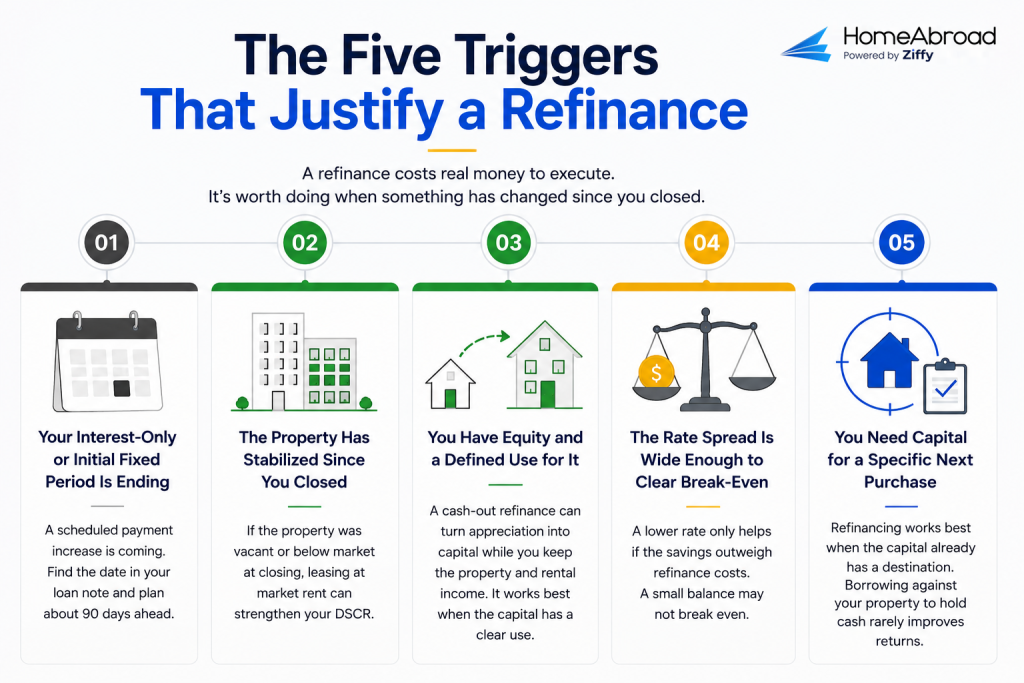
Your Interest-Only or Fixed Period Is Ending
If your loan carried an interest-only period or a fixed period on an adjustable structure, the date that period ends is a hard deadline. Your payment will change on a schedule set in your loan documents, and the change is usually upward. This trigger has a date attached to it, which makes it the easiest of the five to plan around and the least excusable to miss. Find the date in your note, then work backward roughly 90 days to start the refinance.
The Property Has Stabilized Since You Closed
Investors frequently close on a property that is vacant, partly occupied, or renting below market. The loan is priced against those numbers. Once the property is fully leased at market rent, the DSCR on the same loan balance is stronger than it was at closing, and stronger DSCR can change the terms available to you. This trigger is common after a renovation or after a first full lease cycle.
Appreciation Has Created Equity You Cannot Use
If the property has gained value, that gain sits on paper until you either sell it or borrow against it. A cash-out refinance converts part of it into deployable capital while you keep the asset and its rental income. This is the trigger most often used to fund a second acquisition.
The Rate Spread Is Wide Enough To Clear Break-Even
Rate movement matters, but only in relation to what the refinance costs. A one-point improvement on a small balance may never pay for itself. The next section sets out how to test this properly.
For context, Freddie Mac’s Primary Mortgage Market Survey put the average 30-year fixed rate at 6.67%, against 6.58% a year earlier. That survey covers owner-occupied conforming purchase loans, so it is a directional benchmark rather than a quote for an investment property, and investor pricing sits differently. Use it to see where the market is moving, not to estimate your own rate.
Check the latest DSCR loan interest rates before estimating your potential refinance savings.
You Need Capital for a Specific Next Purchase
Refinancing to release capital works best when the capital already has a destination. Borrowing against Property A to sit on cash rarely improves returns, because you begin paying interest on the larger balance immediately.

Lucas Hernandez
Mortgage Loan Originator · HomeAbroad
The mistake I see most often is investors waiting until they need the capital before they start looking at a refinance. If you know you may want to pull equity for another purchase, or your prepayment penalty is approaching a step-down, start reviewing the numbers early. Waiting can leave you with fewer options and a higher cost of capital than necessary.
How To Run the Break-Even Math
The test is simple. Divide what the refinance costs by what it saves each month. The result is the number of months you must hold the property before the refinance has paid for itself.
Break-even months = total refinance cost ÷ monthly payment reduction
The figures below are illustrative and use assumed inputs to demonstrate the method. They are not a quote, a rate offer, or a representation of terms available to you. Payments are rounded to the nearest dollar and cover principal and interest only.
Assumed scenario
Input | Value |
|---|---|
Existing loan balance | $300,000 |
Existing rate and term | 8.25%, 30-year fixed |
New rate and term | 7.00%, 30-year fixed |
Estimated closing costs | $9,000 |
Prepayment penalty if still inside the window | $9,000 (3% of balance) |
Result
Line | Amount |
|---|---|
Current monthly principal and interest | $2,254 |
New monthly principal and interest | $1,996 |
Monthly reduction | $258 |
Break-even, penalty already expired | $9,000 ÷ $258 = 35 months |
Break-even, penalty still payable | $18,000 ÷ $258 = 70 months |
The same rate improvement takes just under three years to pay for itself in one case and closer to six years in the other. The only variable that changed is whether the prepayment penalty had expired.
Two limitations worth holding on to. First, the new loan restarts a 30-year amortization schedule, so a lower monthly payment does not automatically mean less total interest paid across the life of the debt. Second, a break-even calculation tells you nothing about whether you will be approved, at what rate, or for how much. It is a screening tool you run before you request a quote, not a substitute for one.
You can test your own figures with the DSCR loan calculator and the cash flow calculator. Both produce estimates.
Why the Prepayment Penalty Usually Decides the Timing
Investment property loans commonly carry a prepayment penalty, which is a fee charged for paying the loan off ahead of schedule. Refinancing pays the old loan off, so refinancing inside the penalty window triggers it.
These penalties are often structured to step down over time, reducing each year until they reach zero.
The step-down structure is what makes this a timing question rather than a cost question. In the illustrative scenario above, waiting until the penalty expired cut the break-even period roughly in half. If your penalty steps down at a known date, the honest comparison is not “refinance or do nothing.” It is “refinance now at today’s rate and pay the penalty” against “refinance after the step-down at whatever rate is then available.”
Nobody can tell you what rates will be on that future date. What you can calculate precisely is how much rate improvement you would need at that later date to end up ahead. That number is knowable today, and a loan officer can produce it for you in a single conversation.
Find your penalty terms in your original note and closing documents. If you cannot locate them, your current servicer will provide a payoff statement showing the penalty amount as of a given date.
Seasoning: How Soon Can You Refinance After You Buy
Seasoning refers to how long you must own a property before a lender will refinance it. Requirements differ by loan type, by whether you are taking cash out, and by how the property was originally purchased.
Two situations come up repeatedly with international investors.
If you bought recently with a mortgage and rates have moved, seasoning may still be running. Check before you spend anything on an application.
If you bought the property outright with cash, a delayed financing structure can allow a refinance sooner than the standard cash-out seasoning period, letting you recover capital without waiting. The source of the original purchase funds matters here, and gift funds are generally treated differently from your own capital. Plan this before the cash purchase closes rather than afterward, because the documentation you will need is easier to assemble at the time.
The Re-Qualification Risk Most Investors Miss
This is the part that surprises people, and it applies specifically to cash-out refinances.
Investors typically calculate their maximum cash-out from the appraised value and the loan-to-value ceiling, then plan around that number. Loan-to-value, or LTV, is the loan amount as a percentage of the property’s appraised value. The calculation is correct as far as it goes. It just is not the only constraint.
A larger loan carries a larger monthly payment. A larger payment increases PITIA. Increasing PITIA lowers the DSCR. And DSCR affects what terms you qualify for.
Illustrative example, assumed inputs, not a quote
Input | Value |
|---|---|
Appraised value | $500,000 |
Existing balance | $300,000 |
Monthly market rent | $2,600 |
Monthly taxes and insurance | $470 |
Applying a 70% cash-out ceiling gives a maximum new loan of $350,000, which is $50,000 above the existing balance before costs. At an assumed 7.25% on a 30-year fixed, the new principal and interest is roughly $2,388. Add taxes and insurance and PITIA becomes about $2,858. The DSCR is $2,600 ÷ $2,858, or approximately 0.91.
Whether 0.91 clears the program, and on what terms, depends on the current DSCR requirements and how pricing and LTV are tiered against DSCR
The point for planning purposes is that two ceilings apply at once, and the DSCR ceiling can bind before the LTV ceiling does. An investor who plans around the LTV number alone can arrive at closing expecting more cash than the file supports.
The appraisal compounds this. Both the LTV ceiling and the payment are calculated from the appraised value, and appraisals do not always match owner expectations.
The cash-out amount an investor wants can be different from what the property supports. I look at the appraised value, LTV, PITIA, and DSCR together. If DSCR becomes the constraint, we can adjust the cash-out amount, document stronger rental income, or look at a different loan structure.

Rate and Term or Cash Out: Matching the Structure to the Trigger
Two structures exist and they are not interchangeable. A rate and term refinance replaces the existing loan at a similar balance with a better rate, a different term, or both. A cash-out refinance replaces it with a larger loan and returns the difference to you at closing.
Rate and Term | Cash Out | |
|---|---|---|
Loan balance | Stays roughly the same | Increases |
Cash at closing | None | Yes, less costs |
Maximum LTV | Up to 75% | Up to 70% |
Typical pricing | Generally more favorable | Generally priced higher |
Effect on DSCR | Usually improves it | Usually reduces it |
Best suited to | Lowering payments or exiting an interest-only or adjustable period | Releasing equity for a defined next use |
Mapping the structure back to your trigger:
- Interest-only or fixed period ending, or property stabilized: rate and term
- Appreciation you want to deploy, or capital needed for a specific purchase: cash out
- Rate spread alone: rate and term, subject to break-even
Neither option is better in the abstract. They answer different questions, and the right one follows from the trigger that prompted you to look. If you are considering a rate and term refinance, see our guide to rate and term refinance for foreign investors
Cross-Border Factors That Change the Answer
Four cross-border considerations can affect the timing and economics of a refinance. These issues are easy to overlook when the property owner lives outside the US.
A refinance is not a sale: FIRPTA, the Foreign Investment in Real Property Tax Act, generally applies when a foreign person disposes of a US real property interest. A refinance does not transfer ownership of the property, so the transaction itself generally does not trigger FIRPTA withholding. For more detail on how FIRPTA applies to foreign property owners, see our FIRPTA guide.
Cash-out proceeds are borrowed funds: Money received from a cash-out refinance represents loan proceeds and generally is not treated as taxable income simply because you received it. The proceeds create a repayment obligation, and the tax treatment of the loan and its interest can depend on how the funds are used. Confirm your reporting position with a qualified US tax professional.
Interest deductibility depends on use: A nonresident alien may elect under Section 871(d) of the Internal Revenue Code to have income from US real property taxed on a net basis, allowing eligible deductions against that income. The election is made with the IRS and is not automatic. For cash-out refinances, the tax treatment of interest can also depend on the use of the borrowed funds, so investors should discuss the intended use of proceeds with their tax professional before refinancing.
Currency timing can affect the economics: If you plan to transfer cash-out proceeds to your home country, the exchange rate at the time of conversion affects how much capital you ultimately receive in your home currency. Investors who earn rental income and hold debt in US dollars but deploy capital elsewhere should model the refinance in both currencies.
LLC ownership adds documentation: If the property is held through a US limited liability company, the LLC’s formation documents, operating agreement, ownership information, and evidence of good standing may be required as part of the refinance file. Review the entity documents before applying so any missing or outdated records can be addressed early.
This section provides general information, not tax or legal advice. Tax treatment can vary based on residency status, treaty provisions, entity structure, property use, and how refinance proceeds are used. Program requirements may change, and final qualification depends on underwriting.
When Refinancing Is the Wrong Move
Five situations where the answer is to leave the loan alone.
You are inside the penalty window and the spread is narrow. Covered above. Run the number before you run the application.
You intend to sell within the break-even period. If the break-even is 35 months and you expect to exit in 24, the refinance costs you money. Refinancing is a decision about how long you will hold the asset.
The property is not yet stabilized. Refinancing a property with vacancy or below-market rent locks in terms priced against weak income. Lease it first, then refinance against the better numbers.
You are 8 or 10 years into a seasoned amortization schedule. By that point a meaningful share of each payment is going to principal. Restarting a 30-year schedule for a modest payment reduction can increase total interest paid even though the monthly figure looks better.
You expect the appraisal to disappoint. If comparable sales in the area have softened since you bought, the appraisal drives both your LTV ceiling and your DSCR. Paying for an appraisal that undercuts the plan is a poor use of capital. A loan officer can give you a view on this before you order one.
Steven Glick
Director of Mortgage Sales
HomeAbroad
NMLS #1231769I’ve advised investors to hold off when the refinance costs did not justify the savings. In those cases, we look at the break-even point, the prepayment penalty, and the investor’s expected hold period. Sometimes the better decision is to keep the existing loan and revisit the refinance when the numbers improve.

What To Have Ready Before You Request a Quote
A refinance file is not the same as a purchase file. These items are specific to refinancing, and having them ready shortens the process considerably.
Document | Why it affects the outcome |
|---|---|
Current mortgage payoff statement | Sets the balance to be retired and shows any prepayment penalty as of a given date |
Original settlement statement | Establishes purchase price, date, and seasoning position |
Current lease or rent documentation | Supplies the income side of the DSCR calculation |
Insurance declaration page | Feeds the PITIA figure and must reflect the property’s current use |
HOA statement, if applicable | Also feeds PITIA and is frequently overlooked |
How HomeAbroad Structures Refinances for Foreign Investors
At HomeAbroad, we provide refinance financing for foreign national investors through our DSCR loan program, with qualification based primarily on the rental income generated by the investment property. Eligible borrowers can refinance without an established US credit history, US tax returns, or a US visa or residency requirement.
We can accommodate properties held through a US LLC, and remote closing is available for eligible transactions, so you may be able to complete the refinance without traveling to the United States.
We structure refinances as either rate and term or cash out, depending on the property’s value, rental income, existing loan, and the purpose of the new financing. When we review a refinance, we look at the property’s DSCR, LTV, existing loan balance, prepayment penalty, seasoning, and available reserves to determine what the transaction can support.
If you are considering a refinance, we can review these numbers with you before you commit to the transaction. That gives you a clearer view of your potential cash-out amount, break-even point, and eligibility under our current program terms.
FAQs
How Soon Can I Refinance a US Rental Property After Buying It?
It depends on the loan type and whether you are taking cash out. Seasoning requirements set a minimum ownership period, and cash-out refinances generally require longer seasoning than rate and term refinances. If you purchased the property with cash, a delayed financing structure may allow you to recover capital sooner. A loan officer can confirm your eligibility date before you apply.
Will Refinancing Trigger FIRPTA Withholding?
No. FIRPTA withholding applies when a foreign person disposes of a US real property interest. Refinancing replaces the loan and does not transfer the property, so it is not a disposition. Confirm your specific position with a US tax professional.
Does Cash-Out Refinance Money Count as US Taxable Income?
Money received from a cash-out refinance is loan proceeds rather than income, because it carries an obligation to repay. It is generally not treated as taxable income when received. Your reporting position depends on your circumstances and should be confirmed with a qualified US tax professional.
Can I Refinance Without Traveling to the United States?
Remote closing is available to eligible foreign national borrowers, subject to state requirements and the title company handling the transaction. Confirm availability for your specific property early in the process.
Will My New Payment Change How Much Cash I Can Take Out?
Yes, and this catches people out. A larger loan raises the monthly payment, which raises PITIA and lowers the DSCR. Because DSCR affects the terms available to you, the supportable cash-out amount can be lower than the loan-to-value ceiling alone would suggest.
Can I Refinance If the Property Is Held in an LLC?
Yes. Entity-held properties are accommodated. Your operating agreement, formation documents, and evidence of good standing form part of the file, so it helps to confirm the entity paperwork is current before you apply.