





Editorial Integrity
Making informed real estate decisions starts with having the right knowledge. At HomeAbroad, we offer US mortgage products for foreign nationals & investors and have a network of 500+ expert HomeAbroad real estate agents to provide the expertise you need. Our content is written by licensed mortgage experts and seasoned real estate agents who share insights from their experience, helping thousands like you. Our strict editorial process ensures you receive reliable and accurate information.
Every Louisiana market with rent data has a gross rental yield above the US level of 6.34%. The range runs from 6.53% in Ruston to 9.34% in Morgan City.
Baton Rouge ranks first. Its home values are at a record high, up 14.7% in five years, and metro employment grew 3.2% in the year to August 2026.
Lafayette (8.19% gross yield) has a growing population. Shreveport-Bossier City (8.56%) has record home values and a large Air Force base behind its rental demand.
Meta, Amazon, and energy companies have committed tens of billions of dollars to Louisiana. Most of the jobs those projects create are construction jobs that end when building does.
Gross yield is rent before property tax, insurance, vacancy, and management costs. Net returns will be lower.
Table of Contents
Louisiana investment property earns more rent per dollar invested than the US as a whole. Typical home values in the state’s 14 tracked rental markets run from $126,851 to $261,002, against $368,697 nationally. Gross rental yields range from 6.53% to 9.34%, and the US figure is 6.34%.
That income comes with slower growth. Home values are at record highs in only three Louisiana markets, the state’s population is slightly below its 2020 level, and rental vacancy has risen every year since 2022. Choosing the right market is the main decision.
We rank seven Louisiana markets for foreign investors below, led by Baton Rouge, Lafayette, and Shreveport-Bossier City. The final section covers how HomeAbroad finances these purchases for buyers who live outside the US.
Louisiana Investment Property Market at a Glance
Louisiana is a low-price, high-yield state. Homes cost far less than the US norm, rents are discounted by a smaller margin, and that gap is where the yield comes from.
Louisiana Home Values and Rents Compared With the US
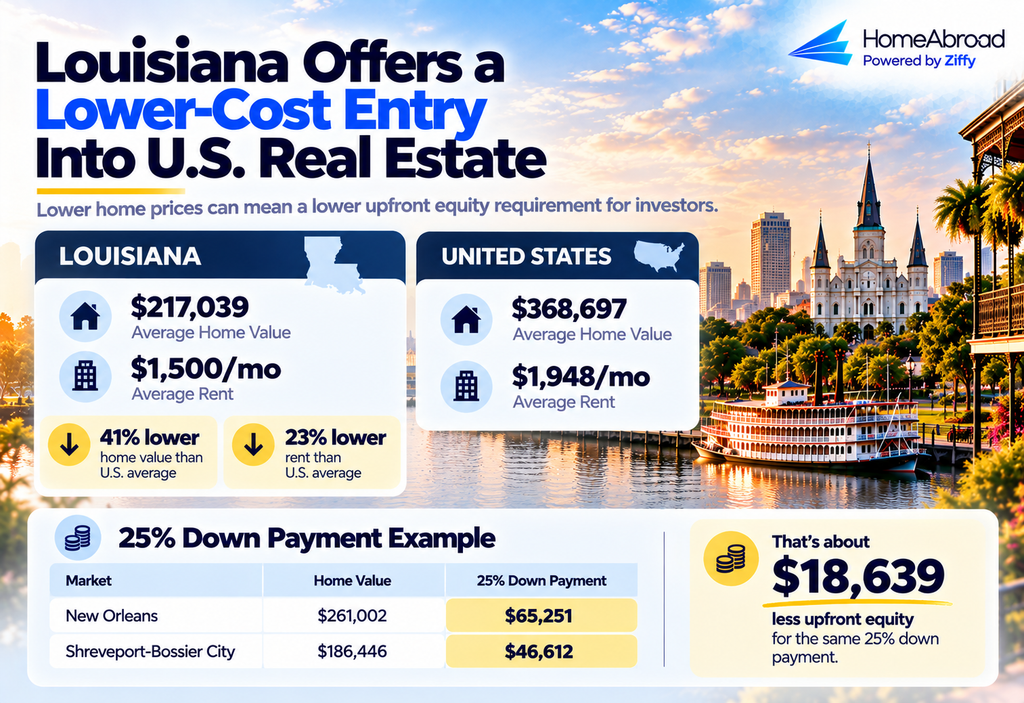
Louisiana’s average home value is $217,039, while the average rent is $1,500 per month, compared with $368,697 and $1,948 nationally. That puts Louisiana’s average home value about 41% below the US level, while average rent is about 23% lower.
Across the 14 Louisiana markets with both home value and rent data, typical home values sit 29% to 66% below the US typical value. Typical rents sit 18% to 49% below the US typical rent.
New Orleans is the most expensive market at $261,002, followed by Baton Rouge at $248,895. Every other market is below $230,000, and two are below $140,000.
For an investor putting 25% down, that lower entry price can significantly reduce the upfront equity requirement. A 25% down payment on a typical New Orleans home is about $65,251, compared with roughly $46,612 for a typical Shreveport-Bossier City property.
Gross Rental Yields Across 14 Louisiana Markets
Gross rental yield is one year of rent divided by the home’s value. It is a quick way to compare markets before costs.
Market | Typical home value | Typical monthly rent | Gross rental yield |
|---|---|---|---|
Morgan City | $126,851 | $988 | 9.34% |
Opelousas | $139,489 | $1,028 | 8.85% |
Shreveport-Bossier City | $186,446 | $1,330 | 8.56% |
Houma | $183,859 | $1,299 | 8.48% |
Monroe | $170,360 | $1,167 | 8.22% |
Fort Polk South | $172,998 | $1,184 | 8.21% |
Lake Charles | $202,113 | $1,381 | 8.20% |
Lafayette | $202,529 | $1,382 | 8.19% |
DeRidder | $207,985 | $1,323 | 7.63% |
New Orleans | $261,002 | $1,598 | 7.35% |
Hammond | $226,925 | $1,348 | 7.13% |
Alexandria | $178,296 | $1,004 | 6.76% |
Baton Rouge | $248,895 | $1,382 | 6.67% |
Ruston | $224,579 | $1,222 | 6.53% |
Eight markets have gross yields above 8%. No market passes the 1% rule, a common screening test that looks for monthly rent equal to 1% of the purchase price. Morgan City comes closest at 0.78%, and Shreveport reaches 0.71%.
Home prices are recovering unevenly across Louisiana. Baton Rouge, Shreveport-Bossier City, and Ruston are at record highs, while several coastal and energy-dependent markets remain below their previous peaks.
New Orleans is 11.8% below its July 2022 peak, Lake Charles is 11.1% below its November 2020 peak, and Houma is 17.1% below its October 2020 peak. That difference matters for investors because a high rental yield can look attractive while the underlying property market is still losing value.
What Is Driving Louisiana Rental Demand in 2026
Louisiana’s population is flat, its job market is growing, and an unusually large wave of industrial investment is under way. Each of those affects rental demand differently, and the effect is very local.
Population and Migration
Louisiana had 4,618,189 residents in July 2025, about 0.9% fewer than in 2020. The state added roughly 3,300 people in the year to July 2025, its second small annual gain in a row.
More people still leave Louisiana for other US states than arrive from them. The net loss to other states was about 14,400 in that year.
Growth is concentrated in a few places. Only 14 of the state’s 64 parishes (Louisiana’s name for counties) have gained population since 2020. The gainers include Livingston (up 9.0%) and Ascension (up 6.8%) outside Baton Rouge, Tangipahoa (up 5.8%) around Hammond, and the Lafayette metro area (up 3.8%).
For a rental investor, that means the statewide number says little. A property in a growing parish and a property in a shrinking one face different tenant demand even at the same yield.
Jobs and the Industrial Investment Wave
Louisiana had about 2.02 million nonfarm jobs in August 2026, up 32,100 or 1.6% from a year earlier. The unemployment rate was 4.2%.
Much of the momentum comes from a small number of very large projects, including data centers in the north and liquefied natural gas (LNG) export terminals in the southwest.
Housing Supply and Rental Vacancy
New supply is modest. Fewer than 15,000 housing units were permitted in Louisiana in 2025, down from about 18,400 in 2021.
Vacancy has still gone up. The statewide rental vacancy rate was 6.9% in 2022, 8.4% in 2023, 9.4% in 2024, and 11.1% in 2025.
Rising vacancy alongside limited building points to soft demand in parts of the state. It is the main reason this ranking gives weight to population and job trends and does not sort markets by yield.
Best Louisiana Markets for Rental Property Investment
Seven Louisiana markets made our 2026 ranking. We considered both current rental economics and the strength of the market’s underlying demand, because a high yield alone does not make a rental market attractive for a long-term investor.
Louisiana Rental Markets: 2026 Ranking
Market | Typical Home Value | Typical Rent | Gross Yield | 1-Year Home Value Change | 1-Year Rent Change | Why It Ranks |
|---|---|---|---|---|---|---|
Baton Rouge | $248,895 | $1,382 | 6.67% | +2.6% | +2.9% | Strongest employment growth and record home values |
Lafayette | $202,529 | $1,382 | 8.19% | +2.8% | +1.1% | High yield with population growth |
Shreveport-Bossier City | $186,446 | $1,330 | 8.56% | +3.4% | +5.7% | Strong cash flow, Barksdale, and new Amazon investment |
Monroe | $170,360 | $1,167 | 8.22% | +2.9% | +9.2% | Strong recent rent growth driven by major investment |
Hammond | $226,925 | $1,348 | 7.13% | +1.0% | +3.5% | Population growth and I-12 corridor location |
New Orleans | $261,002 | $1,598 | 7.35% | +2.1% | +1.4% | Largest market and deeper resale and tenant pool |
| $202,113 | $1,381 | 8.20% | +2.4% | +19.8% | Strong LNG-driven rental demand, but higher storm and cycle risk |
1. Baton Rouge: Strongest Job Growth and Record Home Values
Investment Properties Listed Today on Sale in Baton Rouge
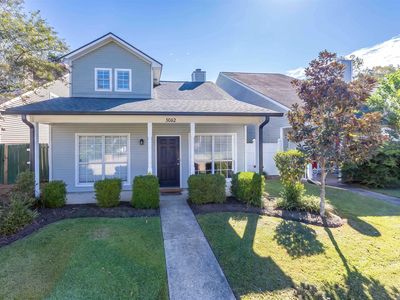


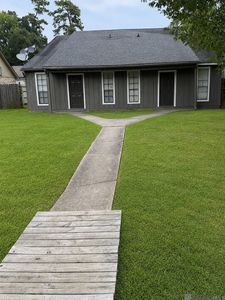
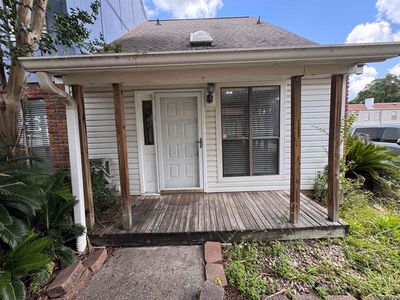
Baton Rouge ranks first because it offers the strongest combination of current rental demand, employment growth, and home value momentum. Its 6.67% gross yield is lower than several markets on this list, but its underlying fundamentals are stronger.
Metro employment reached 438,800 in August 2026, up 3.2% from a year earlier, the fastest growth among Louisiana’s large metros. State government and Louisiana State University, which enrolled 43,385 students in fall 2025, provide a broad employment and renter base.
Industrial investment is adding another source of demand. Hyundai Steel’s $5.8 billion mill and CF Industries’ roughly $4 billion Blue Point plant are both planned in Ascension Parish, downriver from Baton Rouge.
The growth is concentrated outside East Baton Rouge Parish. Ascension Parish has grown 6.8% since 2020, while Livingston Parish is up 9.0%.
There are risks to price into the investment. Construction employment rose 29% over the past year, meaning some of the recent job growth may be temporary. Flood exposure also deserves careful property-level review. During the August 2016 flood, more than half of the damaged properties were outside mapped high-risk flood zones.
Best fit: Investors seeking a balance of rental income and long-term appreciation potential.
2. Lafayette: High Yield With a Growing Population
Investment Properties Listed Today on Sale in Lafayette
Lafayette ranks second because it combines an 8.19% gross rental yield with one of the state’s stronger population trends. The market produces roughly the same typical rent as Baton Rouge on a home that costs about $46,000 less.
The metro has grown every year since 2020, increasing from 408,098 residents to 423,758. Health care and education provide important employment anchors. Ochsner Lafayette General employs close to 4,900 people, while the University of Louisiana at Lafayette enrolled 19,723 students in fall 2025.
The economy is also becoming more diversified. Oil and gas employment was flat over the past year, while MMR Group announced a $55.2 million plant for data center components and Coastal Machine & Supply announced a $25.5 million aerospace and defense manufacturing investment in nearby Carencro.
The main weakness is rental growth. Rents increased only 1.1% over the past year, the slowest among the ranked markets. Apartment vacancy was 11.2% at the end of 2024 following new construction, which could limit near-term rent increases. Home values are also 3.9% below their August 2022 peak.
Best fit: Investors looking for an above-8% gross yield in a market with population growth.
3. Shreveport-Bossier City: Cash Flow Backed by Barksdale and Amazon
Investment Properties Listed Today on Sale in Shreveport
Shreveport-Bossier City ranks third because it offers the highest gross yield among Louisiana metros with more than 300,000 residents, along with improving home values and rent growth.
The market’s 8.56% gross yield is supported by a typical home value of $186,446 and typical monthly rent of $1,330. Home values are at a record high, while rents have increased 22.7% over five years.
Barksdale Air Force Base provides an important source of stable rental demand. The base, home to Air Force Global Strike Command, supports more than 9,000 direct jobs. The Willis-Knighton health system employs about 7,400 people.
Amazon’s planned data center campuses in Caddo and Bossier parishes add another potential demand driver. The company has raised its planned investment to $18 billion, with 750 direct jobs announced, although construction timing has not been confirmed.
Population trends keep Shreveport-Bossier City below the top two markets. The metro has lost 2.3% of its residents since 2020. Caddo Parish declined from 237,010 residents to 224,226, while Bossier Parish grew from 128,647 to 131,867.
HUD described the rental market as slightly soft in April 2024, with vacancy at 12.0%.
Best fit: Cash-flow-focused investors, particularly those evaluating Bossier Parish and neighborhoods near Barksdale Air Force Base.
4. Monroe: The Meta Data Center Effect
Investment Properties Listed Today on Sale in Monroe
Monroe ranks fourth because its recent rental growth is unusually strong, but much of that performance is tied to a major construction project.
Rents have increased 34% over three years, the strongest three-year increase among Louisiana markets with comparable data. Meta’s Hyperion data center in neighboring Richland Parish is a major driver. The project was initially announced at $10 billion and has since increased to $50 billion, with peak construction employment expected to reach about 7,500.
That creates substantial near-term rental demand. Richland Parish has also restricted new RV parks, pushing more project workers toward conventional housing in the Monroe area.
The risk is what happens after the construction phase. Meta expects about 1,000 permanent jobs once the facility is fully built, while the Monroe metro has lost roughly 4,750 residents since 2020. Lumen Technologies has also reduced its Louisiana workforce significantly.
For that reason, today’s rent growth should not automatically be treated as a permanent market trend.
Best fit: Investors willing to underwrite rents supported by the permanent workforce and treat construction-driven rental growth as temporary upside.
5. Hammond: The I-12 Growth Corridor
Investment Properties Listed Today on Sale in Hammond
Hammond ranks fifth because population growth gives it an advantage over several higher-yield Louisiana markets.
Tangipahoa Parish grew from 133,651 residents in 2020 to 141,346 in 2025, a 5.8% increase. Hammond’s location at the intersection of Interstates 12 and 55 also places it between Baton Rouge and New Orleans, supporting its role as a regional employment and distribution hub.
The area has attracted employers such as Medline, which opened a 650,000-square-foot facility in 2023. Southeastern Louisiana University enrolled 15,570 students in fall 2025, its highest enrollment in 13 years.
The trade-off is new housing supply. Tangipahoa Parish permitted 1,163 housing units in 2025, more than twice the statewide rate on a per-capita basis. That additional supply likely contributes to the market’s flat five-year home value performance.
Rents remain healthier, increasing 3.5% over the past year.
Best fit: Long-term investors who prioritize population growth and tenant demand over maximum initial yield.
6. New Orleans: The Largest Market, Priced Below Its Peak
Investment Properties Listed Today on Sale in New Orleans
New Orleans ranks sixth despite having Louisiana’s highest typical home value and rent because its recent population and employment trends are weaker than those of the markets above it.
The market offers a 7.35% gross yield, with typical rent of $1,598. Home values have recovered slightly, rising 2.1% over the past year, but remain 11.8% below their July 2022 peak.
The market has several durable demand sources. New Orleans attracted 19.46 million visitors who spent $10.8 billion in 2025. Ochsner Health and LCMC Health are major employers, while Tulane University adds a large student and research population.
A $1.8 billion Louisiana International Terminal in St. Bernard Parish could provide another economic catalyst after its targeted 2028 opening.
The risks are population loss and slower employment growth. The metro had 970,849 residents in July 2025, down 3.6% from 2020. Employment grew only 0.3% over the year to August 2026, while leisure and hospitality employment declined 3.6%.
Foreign investors should also verify local short-term rental rules before assuming an Airbnb strategy will work. The city regulates short-term rentals through a permit system.
Best fit: Investors who value a larger tenant and resale market and are prepared to select properties carefully based on neighborhood, flood exposure, insurance, and local regulations.
7. Lake Charles: LNG Construction Boom With Storm Risk
Investment Properties Listed Today on Sale in Lake Charles
Lake Charles ranks seventh because its 8.20% gross yield and 19.8% annual rent growth are offset by substantial construction-cycle and storm-related risks.
The area is at the center of Louisiana’s LNG construction activity. Woodside’s $17.5 billion Louisiana LNG terminal was 28% complete in August 2026, with peak construction employment of about 4,400 workers. Venture Global’s CP2 terminal is also under construction nearby, while Commonwealth LNG reached a final investment decision in May 2026.
A $2.3 billion replacement for the Interstate 10 bridge over the Calcasieu River also broke ground in April 2026.
These projects help explain the sharp increase in rents. However, the five-year rent increase is only 10.3%, showing how recent much of the growth has been.
Lake Charles continues to recover from Hurricanes Laura and Delta, which damaged about 50,000 housing units in 2020. The metro population remains 3.9% below its 2020 level, employment is still 11,400 jobs below February 2020, and home values are 11.1% below their November 2020 peak.
Energy projects can also be delayed or canceled. Energy Transfer suspended development of a separate Lake Charles LNG terminal in December 2025.
Best fit: Experienced investors who can accurately price insurance and storm exposure and who underwrite rental income conservatively after the current construction cycle.
How We Ranked These Markets
Our ranking considers five factors:
- Gross rental yield: Current rental income relative to property value.
- Home value and rent trends: Recent appreciation and rental growth.
- Population and employment: Whether the market is gaining residents and jobs.
- Demand base: Major employers, universities, military installations, and large investment projects that support tenant demand.
- Risk: Vacancy, new housing supply, storm and insurance exposure, and dependence on a single employer or temporary construction cycle.
The ranking is an editorial assessment based on these factors, not a mathematical score. Market-level yields use Zillow Home Value Index and Zillow Observed Rent Index data for August 2026. Gross yield is calculated as 12 months of typical rent divided by typical home value. These figures are market indicators, so investors should underwrite an individual property’s actual rent, expenses, insurance, taxes, and financing costs.
High-Yield Louisiana Markets That Need Extra Caution
Four of the six highest gross yields in Louisiana belong to markets we did not rank. In each case the yield is high partly because home values have fallen or stayed low while rents held.
Coastal and Energy-Dependent Markets
Morgan City (9.34%) depends on boat building, marine services, and offshore oil and gas work. The local economy follows the offshore cycle, and the population has declined for 15 years.
Opelousas (8.85%) has seen home values fall 16.5% in five years. Its population has slipped from 82,546 in 2020 to 80,765 in 2025.
Houma (8.48%) is the largest of the three and the hardest to judge. Home values are down 13.9% in five years and fell another 2.7% in the past year. The metro has lost 3.6% of its residents since 2020, and Hurricane Ida in 2021 damaged much of its housing.
There are positives in Houma. Bollinger Shipyards began work in 2026 on US Coast Guard cutters that will be assembled there, and the $4.9 billion Morganza to the Gulf levee system is under construction. Storm and insurance exposure remains among the highest of any market in this article.
Single-Employer and College Markets
Fort Polk South (8.21%) and DeRidder (7.63%) depend on the US Army’s Fort Polk, which supports more than 13,300 direct jobs and about a fifth of the region’s payroll employment. Vernon Parish, where the base is located, has gone from 52,737 residents in 2010 to 45,091 in 2025. Rental demand here rises and falls with Army staffing decisions.
Ruston (6.53%) has the lowest yield in the state and some of its steadiest numbers. Home values are at a record high and rents are up 27.9% in five years, the largest five-year increase among the six Louisiana markets with data that far back. Louisiana Tech University enrolled 12,145 students in fall 2025. The market is small, with about 48,000 people in the parish, so there are fewer buyers and sellers at any given time.
Alexandria (6.76%) is a regional hub for central Louisiana with flat employment and a metro population that has slipped from 151,805 in 2020 to 147,952 in 2025. Its typical rent of $1,004 is among the lowest in the state.
Risks That Shape Returns in Louisiana
Three risks deserve a close look before you buy in Louisiana.
Insurance and Storm Exposure
Insurance is the cost most likely to turn a strong gross yield into a thin net one. Several insurers failed or withdrew from coastal Louisiana after the 2020 and 2021 hurricanes, and coverage near the coast is still limited.
Pricing has calmed. Average homeowners rate increases approved in Louisiana slowed from 14% in 2023 to 6.6% in 2024, 4.6% in 2025, and 0.1% so far in 2026.
Flood insurance is a separate policy from homeowners insurance in the US. Ask for both quotes on any property you are serious about.
Insurance is part of the property’s monthly PITIA, so a higher-than-expected premium can materially reduce the DSCR. I recommend getting an insurance quote early in the process, especially in markets with significant storm exposure. Waiting until late in the transaction can force an investor to revisit the property’s cash flow assumptions or financing structure.

Construction-Cycle Demand
Lake Charles has been through this before. During its last industrial building boom, Calcasieu Parish approved six temporary worker housing sites with 11,000 beds. In 2018 the one site that had opened had filled 800 of its 2,500 beds.
Rental demand built on construction crews can arrive late, peak briefly, and leave. In Monroe, Lake Charles, and parts of the Baton Rouge area, compare the asking rent with what the permanent local workforce pays.
Population Loss and Vacancy
Louisiana’s rental vacancy rate of 11.1% means roughly one rental home in nine was empty in 2025. In a market that is losing residents, a vacant property can take longer to fill.
Build a vacancy allowance into your numbers before you buy. The cash flow calculator can help you test a property’s numbers.
Which Louisiana Market Fits Your Investment Goal
The ranking is a general order. Your own goal can change it, so start from what you want the property to do.
If your priority is | Look first at | What supports it | What to check |
|---|---|---|---|
Monthly cash flow | Shreveport-Bossier City, Lafayette | Gross yields of 8.56% and 8.19% with large, established employers | Vacancy in the specific neighborhood |
Income plus appreciation | Baton Rouge | Record home values, up 14.7% in five years, and 3.2% job growth | Flood history and insurance cost |
Long-term population growth | Hammond | Parish population up 5.8% since 2020 | Competition from new construction |
Demand from major projects | Monroe, Lake Charles | Meta’s $50 billion campus; LNG terminals under construction | Rents after construction ends |
Resale depth and a larger tenant pool | New Orleans | The state’s largest metro, with home values 11.8% below peak | Insurance, flood zone, and short-term rental rules |
If you are buying from abroad, you may not be able to visit every neighborhood, so local knowledge matters. HomeAbroad can connect you with an international-buyer real estate agent who works with overseas clients.
Steven Glick
Director of Mortgage Sales · Ziffy Mortgage
For remote investors, the neighborhood should be evaluated at the street level, not just by the city’s overall market numbers. Look at tenant demand, nearby employment centers, property condition, flood and insurance exposure, and comparable rents. A reliable local property manager is equally important because they can help verify the property’s rent potential, identify maintenance concerns, and manage the property after closing.
To see what is for sale, HomeAbroad’s AI-native investment property platform lists Louisiana properties alongside estimated rental income and return figures, so you can compare a specific home against the market numbers in this article.
Financing a Louisiana Investment Property as a Foreign National
HomeAbroad provides mortgage financing for foreign nationals buying Louisiana investment properties, including investors who live abroad and do not have an established US credit history. For eligible rental properties, a DSCR loan qualifies primarily based on the property’s rental income and cash flow.
Your personal DTI does not determine DSCR loan qualification. HomeAbroad evaluates the property’s rental income, expenses, and cash flow as part of the underwriting process.
Beyond financing, HomeAbroad’s AI-native investment property platform helps international investors find and compare US rental properties. Investors can also access support with property search, US real estate agents, LLC setup, US bank account setup, and other parts of the investment process.
Ready to invest in Louisiana? Get pre-approved with HomeAbroad and explore your financing options.
Frequently Asked Questions
Is Louisiana a Good Place to Buy Rental Property?
It depends on your goal. For rental income, Louisiana compares well: gross yields in its 14 tracked markets run from 6.53% to 9.34%, against 6.34% for the US. For appreciation it is weaker. The best five-year home value gain in the state is Baton Rouge’s 14.7%, below the US gain of 20.3%.
Which Louisiana City Has the Highest Rental Yield?
Morgan City has the highest gross rental yield at 9.34%, followed by Opelousas at 8.85%. Both are small markets with falling populations. Among metros with Which Louisiana City Has the Highest Rental Yield?more than 300,000 residents, Shreveport-Bossier City leads at 8.56%, ahead of Lafayette at 8.19%.
Are Louisiana Home Values Rising or Falling in 2026?
Mostly rising. Typical home values increased in 10 of 14 Louisiana markets in the year to August 2026, led by Shreveport-Bossier City and Alexandria at 3.4% each. Values fell in Houma, DeRidder, Opelousas, and Morgan City.
Can Foreign Nationals Buy Investment Property in Louisiana?
Foreign nationals can generally buy US real estate, subject to federal, state, and local rules that apply to the buyer and the property. Owning property does not grant a visa or residency. The basics are explained in Can Foreigners Buy Property in the US?