


Editorial Integrity
Making informed real estate decisions starts with having the right knowledge. At HomeAbroad, we offer US mortgage products for foreign nationals & investors and have a network of 500+ expert HomeAbroad real estate agents to provide the expertise you need. Our content is written by licensed mortgage experts and seasoned real estate agents who share insights from their experience, helping thousands like you. Our strict editorial process ensures you receive reliable and accurate information.
Missouri offers a range of rental property markets, with differences in home prices, rental yields, and long-term appreciation potential.
Joplin, Fort Leonard Wood, and St. Louis stand out for their gross rental yields among the six markets analyzed.
Comparing rental income, home value growth, and rent growth can help investors assess potential returns across Missouri markets.
Foreign investors can use DSCR loans from HomeAbroad to finance Missouri rental properties without an established US credit history.
Table of Contents
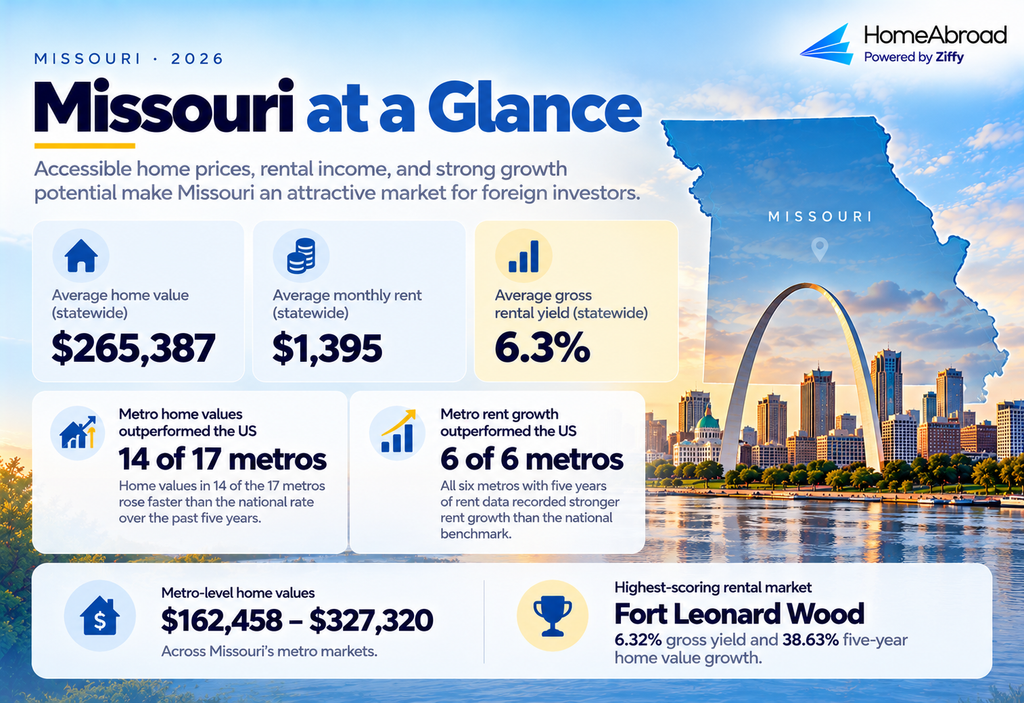
Missouri offers foreign investors access to the US rental property market at a relatively accessible price point. The average home value in Missouri is $265,387, with average monthly rent of $1,395 and an average gross rental yield of 6.3%. These figures provide a starting point for evaluating the state’s investment potential, while individual markets vary in property prices, rental income and growth prospects.
Missouri’s average gross rental yield of 6.3% offers investors a useful starting point for evaluating rental income potential. At the metro level, yields vary depending on local property prices and rents. Home values in 14 of the 17 metros rose faster than the national rate over the past five years, while all six metros with five years of rent data recorded stronger rent growth than the national benchmark.
We compared Missouri’s rental markets using gross rental yield, rent growth and home value appreciation. Fort Leonard Wood, Joplin, St. Joseph, St. Louis, Branson and Columbia ranked among the strongest options under our scoring method. Each section explains the market’s investment potential, the trade-offs to consider and the type of investor it may suit.
Missouri at a Glance
- Average home value statewide: $265,387
- Average monthly rent statewide: $1,395
- Average gross rental yield statewide: 6.3%
- Metro-level home values: $162,458 to $327,320
- Metros where home values grew faster than the national rate over five years: 14 of 17
- Highest-scoring rental market: Fort Leonard Wood, with a 6.32% gross yield and 38.63% five-year home value growth
Missouri Real Estate Market Overview
Three factors shape Missouri’s rental property market: relatively accessible home prices, an average gross rental yield of 6.3% statewide, and home value growth that has outpaced the national rate in most of its metro markets over the past five years.
Entry Prices Are Well Below the US
The most expensive Missouri metro, Kansas City, has a typical home value of $327,320, still 11% below the US typical value. Ten of the 17 metros cost less than two-thirds of the US figure, led by Sikeston ($162,458), Kirksville ($191,822) and Farmington ($192,951). For an investor paying a 25% down payment on a mid-tier home, that gap changes how much cash each property ties up.
Gross Yields Sit Close to the National Level
Gross rental yield measures annual rental income as a percentage of a property’s value, before expenses. Missouri’s statewide average gross yield is 6.3%, while individual metro markets show different results. Sedalia, Joplin and Sikeston have some of the highest calculated yields in the metro comparison.
These figures can help investors identify markets for further research, but actual returns depend on the property’s purchase price, achievable rent, taxes, insurance, vacancy, maintenance and management costs.
Rents and Values Have Grown Faster Than the US
Six Missouri metros have five full years of Zillow rent data, and all six beat the US rent increase of 23.09% from August 2021 to August 2026. Their gains run from 26.88% in Springfield to 45.86% in Columbia. Home values tell the same story over the same period, with 14 of 17 metros ahead of the US gain of 20.34%.
Over the past year, values rose in 16 of 17 metros. Branson was the exception, with a 0.24% dip.
Because rents have climbed faster than prices in most of the state, gross yields have held up. In 11 of the 12 metros with three years of rent data, the gross yield is higher today than it was in August 2023.
St. Louis and Kansas City Against the US
Missouri’s two large metros are where most investors start their search, so it helps to see them side by side.
Metric | St. Louis | Kansas City |
|---|---|---|
Typical home value | $275,704 | $327,320 |
Typical monthly rent | $1,443 | $1,529 |
Gross rental yield | 6.28% | 5.60% |
5-year rent growth | 30.24% | 30.38% |
St. Louis offers the better yield of the two at a lower price. Kansas City has grown at almost exactly the same pace but asks about $51,600 more for the typical home, which pulls its gross yield down to 5.60%.
Missouri Rental Markets Compared
Fort Leonard Wood and Joplin lead clearly; the gap between fourth and sixth place is small.
Metro | Typical home value | Typical monthly rent | Gross yield | 3-yr rent growth | 5-yr value growth |
|---|---|---|---|---|---|
Fort Leonard Wood | $233,313 | $1,228 | 6.3% | 24.41% | 38.63% |
Joplin | $228,639 | $1,268 | 6.6% | 14.53% | 32.44% |
St. Joseph | $216,378 | $1,046 | 5.8% | 17.22% | 29.31% |
St. Louis | $275,704 | $1,443 | 6.2% | 12.85% | 24.44% |
Branson | $246,364 | $1,265 | 6.1% | 13.93% | 19.15% |
Columbia | $321,371 | $1,444 | 5.3% | 20.11% | 29.09% |
Markets in the upper right combine above-average yield with strong value growth. Jefferson City and Rolla grew fast but sit left of the 5% yield floor, which is why they were screened out.
The 6 Best Places to Invest in Missouri Real Estate
The six markets below reach the top of the ranking in different ways. Two lead on yield, two on growth, and two balance both.
1. Fort Leonard Wood: Fastest Growth in Missouri
Investment Properties Listed Today on Sale in Fort Leonard Wood, MO
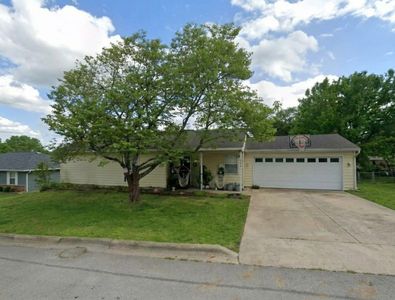


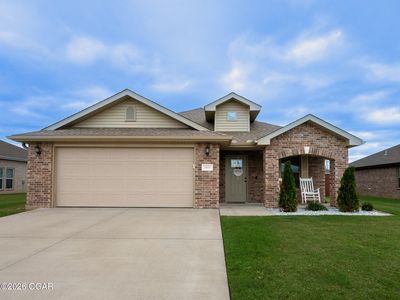
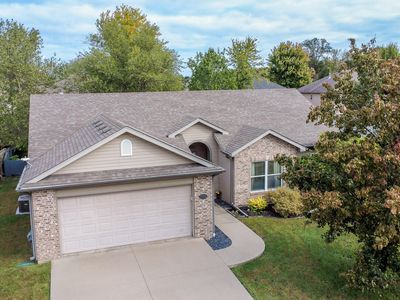
Fort Leonard Wood tops the ranking because it leads Missouri on growth without giving up yield. Its typical home value of $233,313 rose 38.63% over five years, the fastest gain of all 17 Missouri metros, and another 5.00% over the past year.
Rents have kept pace. The typical rent of $1,228 a month is up 24.41% since August 2023 and 8.08% in the past year alone, the fastest one-year rent growth of any market we scored. That produces $14,737 in annual gross rent and a 6.32% gross yield, second only to Joplin among the scored markets. The yield has widened from 5.90% in August 2023 even as prices climbed.
The caution is size. Zillow ranks Fort Leonard Wood 580th among US metros, the smallest market on this list, and its rent data only begins in April 2023. The metro takes its name from the US Army installation it surrounds, so rental demand depends heavily on one institution. A small market also means fewer comparable rentals for an appraiser to use when confirming rent during underwriting.
Fort Leonard Wood suits an investor who wants growth and current yield in one place and is comfortable relying on a local property manager in a small market.

Steven Glick
Director of Mortgage Sales · HomeAbroad
In smaller markets, limited rental comparables can make the appraiser’s market rent estimate especially important for a DSCR loan. Before making an offer, overseas investors should review rents for similar properties, confirm local rental demand, and account for the possibility that the appraiser’s estimate may be lower than expected. That difference can affect the property’s DSCR and the financing terms available.
2. Joplin: Highest Gross Yield Among Ranked Markets
Investment Properties Listed Today on Sale in Joplin, MO
Joplin offers the most rent for the money of any market we scored. A typical home costs $228,639 and rents for $1,268 a month, or $15,218 a year, a 6.66% gross yield. Put another way, each $100,000 of home value in Joplin corresponds to about $6,656 a year in gross rent, compared with $6,340 for the US.
Joplin has the lowest price-to-rent ratio among the 12 markets compared, at 15.0. Its gross rental yield increased from 6.35% at the beginning of the three-year measurement period to 6.66% at the end. Rents rose 14.53% over those three years, while home values increased 9.19%. Over five years, home values appreciated 32.44%.
Price growth has cooled lately, to 2.59% in the past year, which is below its three-year pace. Joplin’s rent data also starts in November 2021, so there is no five-year rent comparison. Investors who put monthly income ahead of appreciation will find Joplin’s numbers the most direct case in this list.
3. St. Joseph: Lowest Entry Price in the Top Six
Investment Properties Listed Today on Sale in St. Joseph, MO
St. Joseph is the cheapest way into a top-ranked Missouri market. The typical home costs $216,378, about 59% of the US typical value, and rents for $1,046 a month, or $12,554 a year. The gross yield is 5.80%.
Its strength is price momentum. Values rose 17.37% over three years, the most of any market we scored, and 5.71% in the past year, the fastest one-year gain in the top six. Over five years, rents are up 38.18%, measured from the first month of Zillow’s St. Joseph rent series in August 2021.
Rent growth has slowed sharply, though, to 2.13% in the past year, the weakest of the 12 scored markets. St. Joseph is the only one of the 12 where the gross yield did not rise after August 2023 (5.81% then, 5.80% now). If rents stay slow while prices keep climbing, yields will narrow. It suits an investor with a smaller budget who is buying mainly for value growth.
4. St. Louis: Missouri’s Deepest Rental Market
Investment Properties Listed Today on Sale in St. Louis, MO
St. Louis pairs a yield within a few hundredths of Fort Leonard Wood’s with by far the largest market in the state, ranked 21st among US metros by Zillow. A typical home costs $275,704 and rents for $1,443 a month, giving $17,315 in annual gross rent and a 6.28% gross yield.
Over five years, St. Louis rents rose 30.24% and home values rose 24.44%, both ahead of the US (23.09% and 20.34%). Its rent index also moved the least from month to month of any market we scored, which makes rent projections easier to defend. A large metro offers more homes, more comparable sales and more property managers to choose from, which matters when you are buying from abroad.
Growth is steadier than spectacular. Rents rose 12.85% over three years, second slowest among the scored markets. St. Louis City is also an independent city, separate from St. Louis County, so tax rates and local rules depend on which side of the line a property sits. For a first US rental, St. Louis is the most straightforward starting point on this list.
5. Branson: Yields Rising as Prices Ease
Investment Properties Listed Today on Sale in Branson, MO
Branson is the only market among the six where home values declined over the most recent one-year measurement period. Its typical home value of $246,364 fell 0.24% over the year and was 2.94% lower than at the beginning of the three-year measurement period. Over those three years, rents increased 13.93%, including 5.84% over the most recent year.
The result is a gross yield of 6.16%, up from 5.25% three years ago. That 0.91-point gain is the largest yield improvement of the 12 scored markets. The typical rent is $1,265 a month, or $15,179 a year.
Branson may appeal to investors who can identify a property at a suitable purchase price. Its five-year home value growth of 19.15% trails the national benchmark of 20.34%, and its available rental history is relatively limited. The rent figures used in this comparison reflect long-term rental conditions and do not establish potential income from short-term or vacation rentals. Investors considering nightly bookings should evaluate local regulations, occupancy, seasonal demand and short-term rental revenue separately.
6. Columbia: Missouri’s Strongest Long-Run Rent Growth
Investment Properties Listed Today on Sale in Columbia, MO
Columbia has the strongest five-year rent growth among the six Missouri metros with sufficient historical data. Rents increased 45.86% over five years, compared with the national benchmark of 23.09%. They rose 20.11% over three years and 5.57% over the most recent year, indicating continued rental growth across the measurement periods.
The trade-off is price. Columbia’s typical home value of $321,371 is the second highest in Missouri, and its 5.39% gross yield is the lowest in the top six. The typical rent of $1,444 a month produces $17,332 a year. Values rose 29.09% over five years and 2.89% in the past year.
Because rents are outrunning prices, Columbia’s yield has widened from 4.94% in August 2023. It suits a growth-focused investor with a larger budget who can accept a thinner yield today in exchange for rent momentum.
Missouri Markets That Just Missed the List
A different weighting would change the bottom of the top six, so these markets deserve a look before you rule them out.
Kansas City: Kansas City has a gross rental yield of 5.60% and a typical home value of $327,320, the highest among Missouri’s metros. Five-year rent growth of 30.38% and home value growth of 25.66% indicate continued market growth. Investors considering Kansas City should weigh its larger purchase price against rental income potential and compare individual properties with alternatives such as St. Louis.
Cape Girardeau: A $228,626 typical home, a 5.59% gross yield and steady growth on every measure, without leading on any.
Springfield: Springfield’s values rose 29.80% over five years and rents rose 4.66% in the past year, but its three-year rent growth of 12.06% was the slowest of any market we scored.
Two groups never reached the scoring stage. Sedalia (6.71%) and Sikeston (6.63%) have the highest gross yields in Missouri, but Zillow’s rent data covers about two years for Sedalia and a single month for Sikeston, too short to judge. Jefferson City, Rolla and Warrensburg grew quickly but fell below the 5% gross-yield floor.
For how Missouri compares with markets in other states, see the best places to buy rental property in the US.
What Missouri’s Market Data Does Not Tell You
Market-level yields help you choose where to look. They cannot tell you whether a specific property will pay for itself, so check these three points before you make an offer.
Gross Yield Is Not Net Yield
Every yield in this article is gross: rent divided by price, before property taxes, landlord insurance, vacancy, maintenance, property management and mortgage payments. Your net yield will be lower, and by how much depends on the specific home and county. Run the property’s real costs through the rental property ROI calculator before you commit.
A Metro Average Is Not Your Property
The typical home value represents a middle-tier property across a metro, while average rent figures may cover different property types. A specific house can rent for more or less than the metro average. Quick screening methods, such as the 1% rule for rental property, can help investors compare listings, but none of the Missouri metros reaches that threshold at the market level. Joplin’s typical monthly rent, for example, is approximately 0.55% of its typical home value.
If the appraiser’s market rent comes in below your estimate, the lender may use the lower figure to calculate the DSCR, which can affect loan eligibility or terms. I recommend building in a rent cushion when evaluating a property so that a more conservative appraisal does not derail your financing plans.

How We Ranked Missouri’s Rental Markets
We compared Missouri’s rental markets using three measures: gross rental yield, three-year rent growth and five-year home value growth. These metrics help investors evaluate current rental income potential, changes in rental demand and long-term property appreciation.
Measure | What It Tells You |
|---|---|
Gross Rental Yield | How much annual rental income a property’s value generates before expenses |
3-Year Rent Growth | How much rents have increased over the past three years |
5-Year Home Value Growth | How much property values have appreciated over the past five years |
Three rules shaped the comparison:
- Sufficient rental data. A market needed continuous monthly rent data from August 2023 to August 2026 to qualify for the comparison. This left 12 of Missouri’s 17 metros. Sedalia, Sikeston, Lebanon, Kirksville and Farmington were excluded because their rent data had gaps or insufficient historical coverage.
- A 5% gross-yield threshold. Jefferson City (4.35%), Warrensburg (4.63%) and Rolla (4.10%) were excluded because their gross rental yields fell below 5%. A lower yield leaves less rental income available to cover property taxes, insurance, vacancy, maintenance, management and mortgage payments.
- Balanced evaluation. We considered rental yield, three-year rent growth and five-year home value growth together. This approach helps distinguish markets with stronger current rental income from those with greater rent growth or property appreciation.
Buying Missouri Property as a Foreign National
Foreign nationals can generally buy residential property in Missouri, subject to federal, state and local rules. There is no federal law that bars non-US citizens from owning US homes, and you do not need a visa, green card or US residency to buy. Buying property does not give you a visa, residency or any other immigration status.
A few Missouri-specific points are worth knowing:
- Agricultural land is treated differently. Missouri law bars foreign individuals and businesses from acquiring agricultural land once foreign holdings exceed 1% of the state’s agricultural acreage (RSMo 442.571). A home in a city or suburb is a different category, but if a listing includes farmland or acreage, have a Missouri attorney review it before you sign.
- Local rent control is not allowed. Missouri cities and counties may not set rents on privately owned rental property (RSMo 441.043).
- Plan for taxes on the way out. When a foreign owner sells US property, the buyer generally must withhold part of the sale price under FIRPTA withholding rules. Speak with a US tax professional about your situation before you buy.
- Decide on ownership structure early. Many foreign investors buy through a US limited liability company (LLC). The LLC considerations for foreign real estate investors affect financing, liability and taxes.
HomeAbroad connects international buyers with real estate agents experienced in foreign-national purchases, who can help you compare neighborhoods within these metros and arrange viewings remotely. For the full buying process, see how foreign nationals buy property in the US.
DSCR Loans for Foreign Investors in Missouri
A DSCR loan lets international investors finance a Missouri rental property based primarily on its rental income rather than personal income or US tax returns. The debt service coverage ratio (DSCR) compares the property’s monthly rent with its full monthly housing payment, including principal, interest, taxes, insurance and any HOA dues.
Markets such as Joplin, Fort Leonard Wood and St. Louis offer relatively strong gross rental yields, which may provide more room to cover mortgage payments than higher-priced markets such as Columbia. However, actual qualification depends on the property’s rental income, financing costs, taxes, insurance and other expenses.
HomeAbroad offers DSCR financing for foreign national investors, with no established US credit history required. Down payment requirements, cash reserves and eligibility for properties with a DSCR below 1.0 depend on the applicable loan program and borrower profile.
You can use our DSCR loan calculator to estimate potential cash flow for a Missouri rental property. For more information on eligibility and financing options, visit our Missouri DSCR loan program page.

Overseas investors should have their passport, recent bank statements, proof of funds for the down payment and closing costs, and details of the Missouri rental property ready before pre-qualification. Incomplete documentation or delays in verifying the source of funds can slow the process. Preparing these documents in advance helps the lender review the application more efficiently.
Finance Your Missouri Rental Property With HomeAbroad
Considering an investment property in Missouri? HomeAbroad helps international investors explore DSCR financing based on rental property income, without requiring an established US credit history.
Connect with HomeAbroad to explore your DSCR loan options and get guidance on financing your Missouri rental property as an international investor. Get pre-qualified today!
Frequently Asked Questions
Is Missouri a Good Place to Buy Rental Property in 2026?
Missouri may suit foreign investors seeking relatively accessible property prices and rental income potential. The statewide average home value is $265,387, average monthly rent is $1,395 and average gross rental yield is 6.3%. At the metro level, property prices, rental yields and appreciation vary, so investors should compare local market conditions and calculate the expected costs and returns of each property before purchasing.
What Is the Average Rental Yield in Missouri?
Missouri’s average gross rental yield is 6.3%, based on the statewide figures used in this article. Metro-level yields vary, with calculated figures ranging from 4.10% in Rolla to 6.71% in Sedalia. Gross yield measures annual rent against property value before expenses, so investors should account for taxes, insurance, vacancy, maintenance, property management and financing costs when evaluating a specific property.
Can I Get a Mortgage in Missouri Without a US Credit History?
Yes. HomeAbroad’s DSCR loan does not require an established US credit history for foreign nationals and qualifies the loan mainly on the property’s rental income. The lender still verifies identity, assets and reserves, and approval depends on the property and the current program.
Which Is Better for Rental Investing, St. Louis or Kansas City?
St. Louis has a higher gross rental yield than Kansas City, at 6.28% compared with 5.60%, and a lower typical home value of $275,704 compared with $327,320. Both metros recorded similar five-year home value growth. The better choice depends on the specific property’s rental income, purchase price, operating expenses and financing terms.
Are Home Prices Rising in Missouri?
Home values increased over the most recent one-year measurement period in 16 of Missouri’s 17 metros. Jefferson City recorded growth of 7.29%, followed by St. Joseph at 5.71%. Branson was the exception, with home values declining by 0.24%.
Can Foreign Nationals Buy Property in Missouri?
Yes. Foreign nationals can generally buy residential property in Missouri, subject to federal, state and local rules. Missouri restricts foreign ownership of agricultural land once foreign holdings pass 1% of the state’s farmland, so a property that includes farmland needs legal review. Buying property does not grant a visa, residency or citizenship.