




Editorial Integrity
Making informed real estate decisions starts with having the right knowledge. At HomeAbroad, we offer US mortgage products for foreign nationals & investors and have a network of 500+ expert HomeAbroad real estate agents to provide the expertise you need. Our content is written by licensed mortgage experts and seasoned real estate agents who share insights from their experience, helping thousands like you. Our strict editorial process ensures you receive reliable and accurate information.
Lodging taxes are set by address. A single booking can carry state, county, and city taxes, and the platform may collect only some of them.
Some states tax stays well beyond 30 nights, so a mid-term rental can still owe lodging or sales tax.
By default, a nonresident owner’s US rental income is taxed at 30% of gross with no deductions. Net taxation requires an election and a timely filed Form 1040-NR.
Airbnb withholds 30% from payouts on US listings unless a valid Form W-8ECI is on file, and it reports your payouts on Form 1042-S at gross.
Property tax can rise when a home is used as an STR, which increases the monthly payment used to calculate a DSCR loan.
Table of Contents
If you own a US vacation rental from outside the country, short-term rental taxes come in three layers. Guests pay lodging and sales taxes on each stay, and someone has to collect that money and send it to the state, county, or city. You owe US income tax on the rental income, reported on Form 1040-NR. A booking platform may also act as a withholding agent. For example, Airbnb generally withholds 30% from payouts to non-US hosts with US listings when a valid W-8ECI is not provided.
Most STR tax advice written for US hosts stops at occupancy tax and Schedule E. For a nonresident owner, the withholding and filing rules carry as much weight as the rate on the guest’s bill, because they decide whether you are taxed on gross bookings or on actual profit. This article walks through each layer, explains how property tax fits in, and shows where these costs affect financing an STR with HomeAbroad.
The Three Tax Layers on a US Short-Term Rental Owned From Abroad
Each layer has a different payer, a different collector, and a different agency on the receiving end. Keeping them separate is the easiest way to avoid paying twice or missing a filing.
Layer | Who Bears the Cost | Who Collects and Remits | Where It Is Filed | What Changes for a Foreign Owner |
|---|---|---|---|---|
Lodging, occupancy, and sales tax | The guest | The platform in some jurisdictions; the owner or manager everywhere else | State, county, or city tax office | Registration and returns still have to be handled from abroad, often through a manager |
Federal income tax | The owner | The owner, with platform or manager withholding as a prepayment | IRS, on Form 1040-NR | Default is 30% of gross rent unless you elect net taxation |
Platform withholding and reporting | The owner (withholding is credited against the final tax) | Airbnb, Vrbo, or a property manager acting as withholding agent | Reported to you on Form 1042-S | US hosts get Form 1099-K instead; nonresidents need a W-8 form on file |
Property tax | The owner | County or local assessor | Local tax office | STR use can change how the property is classified and assessed |
“Short-Term” Means Different Things Under Different Tax Rules
Three different definitions apply to the same property, and they rarely line up.
City and county zoning rules usually define a short-term rental as a stay of fewer than 30 consecutive nights. State lodging and sales taxes use their own cutoffs, which, according to NCSL’s 50-state review, range from 27 days in Maine to 185 days in New Hampshire. For federal income tax, the number that matters is the average length of guest stays across the year, and a seven-day average triggers different treatment under the passive activity rules covered later in this article.
A property can therefore fall outside a city’s STR permit rules and still owe state lodging tax on every booking. Check each definition separately for the specific address.
Lodging, Occupancy, and Sales Taxes on Guest Stays
Lodging taxes go by several names: transient occupancy tax, hotel occupancy tax, bed tax, tourist development tax, or a sales tax that applies to short stays. There is no federal lodging tax. The rules depend entirely on where the property sits.
Who Levies Lodging Taxes: State, County, and City
Most states tax short stays at the state level and also allow counties and cities to add their own rates on top. A few states, including California and Nevada, leave lodging taxes entirely to local governments.
Texas shows how the layers stack. The state charges a 6% hotel occupancy tax on stays of fewer than 30 consecutive days, and many counties and cities add their own hotel taxes to the same bill. The combined rate can differ between two properties in the same metro area if one sits inside city limits and the other does not.
The table below shows state-level treatment in several markets that attract foreign STR investors. Local taxes are not included and can add several percentage points.
State | State-Level Tax on Short Stays | Stays Covered | Local Taxes Added? |
|---|---|---|---|
Florida | 6% state sales tax | 6 months or less | Yes, county surtax and tourist development tax |
Texas | 6% state hotel occupancy tax | Under 30 days | Yes |
Tennessee | 7% state sales tax | 90 days or less | Yes |
Arizona | 5.5% transaction privilege tax | 30 days or less | Yes |
North Carolina | 4.75% state sales tax | 90 days or less | Yes |
Hawaii | General excise tax plus transient accommodations tax | 180 days or less | Yes |
California | None at the state level | Set locally | Yes, city and county only |
Nevada | None at the state level | Set locally | Yes, required local taxes |
Source: NCSL, State Taxation of Short-Term Rentals.
When Airbnb or Vrbo Collects the Tax, and What Still Falls on You
Airbnb collects and remits occupancy taxes automatically in some jurisdictions. Where it has no collection arrangement, hosts generally need to collect taxes themselves. Coverage is often partial. Airbnb may collect the state tax for a listing but not the city tax, and the portion it does not collect remains your responsibility.
Platform collection also does not always end the owner’s filing duty. Some states still expect hosts to register and file returns that report the revenue, with a deduction for tax the platform has already paid. Washington is one example.
Two more details catch owners out:
- Exemptions. Airbnb’s terms say that when it collects a tax on your behalf, accepting the reservation waives any exemption you believe applies. If you think a stay is exempt, the platform will not apply that exemption for you.
- Other channels. Direct bookings and bookings through a channel that does not collect tax are always the owner’s responsibility.
Registering and Filing Lodging Tax From Outside the US
Where the platform does not collect, the usual sequence is to register with each taxing authority, display any required registration or permit number on the listing, charge the tax to guests, and file returns on the schedule the jurisdiction sets. Filing frequency is typically monthly or quarterly, and some jurisdictions expect a return even for a period with no bookings.
Most foreign owners delegate this work to a local property manager. If you do, confirm in writing which taxes the manager files, which ones the platform covers, and who receives notices from the tax office. The manager’s agreement should also say who pays penalties for late filings. Before you sign, review the property management setup for foreign investors, which lists the questions to ask.
Does a Stay of 30 Nights or Longer Avoid Lodging Tax?
Sometimes, but not everywhere. Florida’s state sales tax applies to rentals of six months or less, New York’s state sales tax applies to stays of up to 90 days, and Hawaii’s lodging taxes reach stays of up to 180 days. A furnished mid-term rental in those states can sit outside the local STR permit rules and still owe state tax on every stay.
Occupancy Tax Is Guest Money
Lodging tax is charged to the guest and passed through to the government. Record it separately from rental revenue so it does not inflate your income figures, your tax return, or the booking history you show a lender.
Federal Income Tax on STR Income for Nonresident Owners
The US taxes nonresidents on income from US property. What varies is the tax base: gross rent or net rental income.
The Default: 30% of Gross Rent With No Deductions
The IRS divides a nonresident’s US income into two categories. Income that is effectively connected with a US trade or business (ECI) is taxed on a net basis at the same graduated rates US residents pay. Fixed, determinable, annual, or periodical (FDAP) income is taxed at a flat 30% with no deductions allowed.
Rental income from US real estate falls into the FDAP category by default. Under that treatment, 30% applies to the full booking revenue, and mortgage interest, cleaning, platform fees, management fees, insurance, property tax, and depreciation do nothing to reduce the bill. For an STR with high operating costs, a 30% tax on gross can exceed the property’s entire net profit.
Paying Tax on Net Income Instead: The Section 871(d) Election
A nonresident can elect under Internal Revenue Code Section 871(d) to treat income from US real property as ECI. Once the election is in place, rental income is reported with its expenses and taxed on the net result at graduated rates. It is an IRS election, and it does not depend on a tax treaty.
Two steps are involved, and they are separate. The election is made by attaching the required Section 871(d) election statement to Form 1040-NR. To stop withholding at the source, you also provide Form W-8ECI to the party making the payment, such as a booking platform or property manager, when the requirements for that form are met. The Section 871(d) net election has its own statement wording and rules for late elections, and the list of rental property tax deductions for foreign owners shows what you can deduct once it applies.
When a Short-Term Rental Starts to Look Like a Business
An STR that provides substantial services to guests, such as daily cleaning, meals, or concierge-style services, may be treated as an active business instead of a rental. For a nonresident, business income connected with the US is generally ECI whether or not a Section 871(d) election is made. That can change how the income is reported and which deductions and filing rules apply.
Nonresident aliens are generally not subject to US self-employment tax, even on business income. Social security agreements between the US and some countries can affect this.
Filing Form 1040-NR: Deadlines, the 16-Month Rule, and Your ITIN
A nonresident with no US wages and no US office or place of business generally has until June 15 to file Form 1040-NR for the prior calendar year. A nonresident who has US wages subject to withholding, or an office or place of business in the US, generally files by April 15.
The deadline that costs foreign owners the most money comes later. The IRS says it can deny deductions and credits on returns filed more than 16 months after the due date. If you miss that window, rental income that should have been taxed on a net basis can end up taxed on gross.
Warning: Late Filing Can Cost You Every Deduction
Treat the first 1040-NR after your purchase as a hard deadline, even if your first year shows a loss. A late return can turn a small net tax bill into a 30% tax on gross bookings.
Filing a 1040-NR requires a taxpayer identification number. Most foreign individual owners are not eligible for a Social Security Number and apply for an Individual Taxpayer Identification Number (ITIN) using Form W-7. Processing takes time, so start the application well before your first filing deadline.
State Income Tax on the Same Rental Income
Most states with an individual income tax also tax nonresidents on rental income from property located in that state, which usually means a state nonresident return in addition to the 1040-NR. Several popular STR states, including Florida, Texas, Nevada, and Tennessee, do not tax individual income.
Platform Withholding and Tax Forms: W-8ECI, W-8BEN, and Form 1042-S
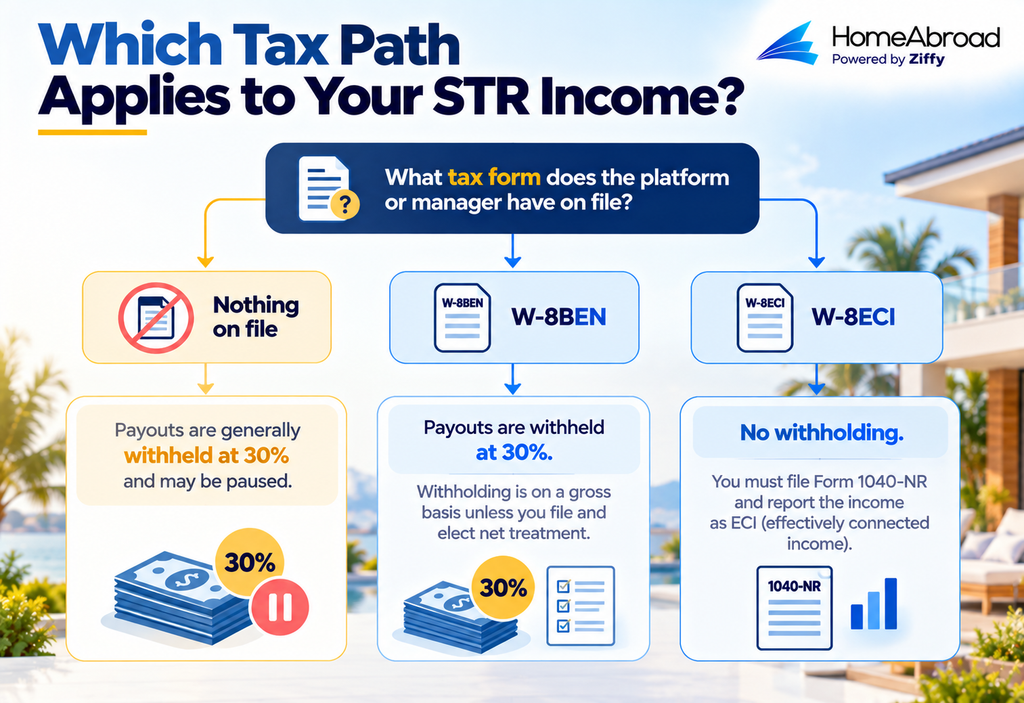
Booking platforms act as withholding agents for payouts from US listings. Airbnb treats payouts from US listings to foreign hosts as income from real property subject to 30% withholding, and it asks non-US hosts for a Form W-8. The form you choose sets how your payouts are handled for the whole year.
Form | Who Provides It | Given To | Effect on Payouts | Year-End Document |
|---|---|---|---|---|
W-8ECI | A foreign owner who files a US return and reports the income as ECI | The platform or property manager | No withholding | Form 1042-S showing gross payouts |
W-8BEN (individual) or W-8BEN-E (entity) | A foreign owner who is not treating the income as ECI | The platform or property manager | 30% withheld and sent to the IRS | Form 1042-S showing payouts and tax withheld |
No form on file | N/A | N/A | Generally 30% withheld; payouts may be paused | Varies |
W-9 | US citizens, US residents, and US entities only | The platform | Not for foreign owners | Form 1099-K |
What Happens If No Tax Form Is on File
Airbnb generally withholds 30% from payouts to a non-US host with a US listing who has not provided a W-8ECI. If the platform has no taxpayer information for you at all, it may suspend payouts and block your calendar until the information is submitted. Set this up before the listing goes live.
Reading Form 1042-S: Why It Shows Gross Payouts
Airbnb issues Form 1042-S to non-US hosts who submitted a W-8 and received US-sourced earnings. The amounts are reported at gross, before Airbnb’s fees are deducted, and the form is issued in January for the previous calendar year.
Your 1040-NR starts from that gross figure, with platform fees and other expenses claimed as deductions. The totals on the 1042-S should match your own booking records, so reconcile them before your tax preparer files.
Withheld Tax Is a Credit Toward Your Final Bill
Any tax withheld from payouts is claimed as a credit on your 1040-NR, and any excess is refunded through that return. Airbnb does not help with the refund process, so you or your tax preparer will handle it.
Property Managers as Withholding Agents
When a property manager collects rent or booking payouts on your behalf, the manager can become a withholding agent with its own obligation to withhold 30% from amounts paid to a foreign owner. In that case, the W-8ECI generally goes to the manager as well. Confirm who holds your W-8 and who issues your 1042-S so the same income is not withheld twice.
Owning Through an LLC: Which Form Goes to the Platform
Many foreign owners hold STRs through a single-member US limited liability company. For federal income tax, a single-member LLC owned by one foreign person is generally disregarded, so the tax form given to the platform usually identifies the foreign owner as the beneficial owner of the income. Airbnb says the W-8ECI should name the person or entity that reports the payouts on a US tax return.
A foreign-owned single-member US LLC that is disregarded for federal income tax purposes may also have separate federal information-reporting obligations. In certain cases, this includes Form 5472 filed with a pro forma Form 1120 when the required reportable transactions occur. Because the penalties can be significant, confirm the filing requirements with a US tax professional.
Property Tax: How STR Use Can Change Your Assessment
Every US property pays local property tax, and STRs are no exception. What changes is how the property is classified, and classification can change the bill.
How States Classify Short-Term Rentals for Property Tax
States handle this differently. Some treat an STR like any other home. Others classify it as commercial property, apply a different assessment ratio, or split the value between residential and commercial use. Tennessee, for example, assesses a property with one STR unit as residential at 25% of value, while a property with more than one STR unit is assessed as commercial at 40% of value, according to NCSL.
The seller’s current tax bill may also reflect a homestead exemption or an assessment cap that ends when the property is sold. Estimate property tax based on how you will use the property. The figure in the listing may understate it.
Why the Property Tax Line Matters for Your DSCR
Property tax is the “T” in PITIA: principal, interest, taxes, insurance, and association dues. That monthly total is the payment side of the Debt Service Coverage Ratio (DSCR) used to qualify a DSCR loan. A higher tax figure raises PITIA and lowers the ratio, which can change your required down payment or whether the property qualifies at all.
HomeAbroad finances investment properties, including short-term rentals, through DSCR loans for foreign investors that qualify primarily on the property’s rental income. No established US credit history is required, although identity, funds, reserves, and property income are still verified.

Steven Glick
Director of Mortgage Sales · HomeAbroad
An underestimated property tax figure can make the property’s cash flow look stronger than it actually is, which can affect the DSCR calculation. Buyers should use the most current property tax information available for the property and account for the projected tax expense when evaluating qualification.
The Short-Term Rental Tax Loophole: What It Means for a Nonresident Owner
The term ‘STR loophole’ is commonly used by real estate investors to describe a Section 469 passive activity rule. When the average period of customer use is seven days or less, the activity generally is not treated as a rental activity for passive-loss purposes. If the owner also materially participates, the activity may be treated as nonpassive for those rules.
For a US resident with a high salary, that can mean using STR losses against wage income. A nonresident owner faces two practical limits. The first is material participation, which is measured by documented hours of personal involvement and is hard to show from another country, especially with a full-service manager. The second is what the losses could offset: a nonresident is taxed only on US-source and US-connected income, so the benefit depends on whether you have other US-taxed income at all.
The bonus depreciation rules for foreign investors cover material participation and the depreciation side in more detail. Treat the loophole as a question for your tax adviser, not a reason to buy a particular property.
How STR Taxes Affect Financing a Short-Term Rental With HomeAbroad
Taxes shape the numbers a lender reviews, from the income shown in your booking history to the cash you need to hold in reserve. Planning for them before you apply keeps the approval process predictable.
How Booking Income Is Reviewed When Lodging Tax Passes Through Your Account
When a platform collects and remits occupancy tax, your payouts already exclude it. When you or your manager collect the tax directly, your bank deposits include money that belongs to the tax office. If those deposits are used to show STR income, the tax portion needs to be separated out so the property’s revenue is not overstated.

If occupancy tax is included in the deposits shown on an STR bank statement, the lender needs to separate that tax from the property’s actual rental income. Only the income attributable to the property should be used when calculating qualifying rental income.
Budgeting for Withholding, Lodging Remittances, and Reserves
Three tax items affect monthly cash flow on a financed STR. Thirty percent withholding on payouts, if a W-8ECI is not in place, reduces the cash available for the mortgage payment until you recover it through your 1040-NR. Lodging tax you collect directly has to be held and paid on the jurisdiction’s schedule. Property tax is usually paid through an escrow account as part of the monthly payment.
Build these into your cash-flow projections and keep reserves separate from lodging tax you are holding for the government. The Airbnb and STR calculator can help you test scenarios. Its results are planning estimates and do not represent a loan approval.
What to Set Up Before Closing
Several tax decisions are easier to make before closing than after the first guest checks in:
- Decide whether you will own the property personally or through an entity, since that determines whose name goes on the W-8 and the tax returns.
- Start your ITIN application if you do not have one.
- Register for the lodging taxes the platform will not collect, so you can charge them from the first booking.
- Confirm your W-8 choice with a US tax professional and submit it to the platform and manager before the listing goes live.
Before closing, a foreign buyer should have the property income documentation, source-of-funds records, and other borrower documents organized and ready for review. Having the STR documentation prepared early helps the lender verify the transaction details and keeps the financing process moving.

Financing a US short-term rental from abroad? HomeAbroad offers DSCR financing that qualifies on the property’s rental income, with no established US credit history required. Get a rate quote for a DSCR loan or run your numbers with the Airbnb and STR calculator.
Annual STR Tax Calendar for Foreign Owners
Dates vary by jurisdiction, but most foreign-owned STRs follow a pattern like this one.
Timing | Task | Filed With or Received From |
|---|---|---|
Monthly or quarterly | File lodging, occupancy, or sales tax returns for taxes the platform does not remit | State, county, or city tax office |
January | Receive Form 1042-S for the prior year’s payouts | Booking platform or property manager |
April 15 or June 15 | File Form 1040-NR, or file an extension request by the same date | IRS |
Same season as the 1040-NR | File a state nonresident income tax return, where required | State revenue department |
Set by the county | Pay property tax, directly or through escrow | County or local tax office |
Annually or as set locally | Renew STR permits and lodging tax registrations | City or county |
Pre-Purchase Tax Checklist for a Foreign-Owned Short-Term Rental
Run through this list before you make an offer:
- Look up every lodging, occupancy, and sales tax that applies to the property’s exact address, including county and city taxes.
- Confirm which of those taxes the platform collects and which you will need to register for and file.
- Check each tax’s length-of-stay cutoff, especially if you plan mid-term stays.
- Estimate property tax at STR use under the state’s classification rules, using a local assessor estimate where possible.
- Decide on personal or entity ownership with a US tax professional.
- Choose your W-8 path and confirm you can meet the 1040-NR filing obligation that comes with a W-8ECI.
- Start your ITIN application.
- Confirm whether you will owe state income tax on the rental income.
- Run projected cash flow net of lodging tax, withholding, property tax, and management fees.
- Get pre-approved so the tax-adjusted numbers are tested against a real loan structure before you commit.
When to Bring In a US Tax Professional
A tax professional who works with nonresidents is worth hiring for your first year regardless, but some situations make it essential:
- You own the property through an LLC, partnership, or foreign company.
- You have STRs in more than one state.
- You offer hotel-style services such as daily cleaning or meals.
- You are unsure whether you count as a US tax resident under the substantial presence test.
- You have a question about how your country’s tax treaty or home-country tax rules apply.
- You are planning a sale, which brings in FIRPTA withholding rules and depreciation recapture.
This article provides general information about US taxes on short-term rentals owned by nonresidents. It is not tax or legal advice for your situation.
Frequently Asked Questions
Do I Have to Pay US Taxes on Airbnb Income If I Live Outside the US?
Yes. Rental income from US property is US-source income, and the US taxes it regardless of where you live. By default it is taxed at 30% of gross payouts, often through platform withholding. If you elect net taxation and file Form 1040-NR on time, you are taxed on net rental income at graduated rates instead.
Does My Country’s Tax Treaty Reduce US Tax on My Airbnb Income?
Usually not. Most US income tax treaties preserve the US right to tax income from real property located in the US, so the treaty generally does not lower the 30% default or replace the Section 871(d) election. See how US tax treaties apply to real estate and confirm the specific treaty article with a tax professional.
Is the 30% Airbnb Withholding My Final Tax?
No. Withholding is a prepayment. If you file Form 1040-NR and report the income on a net basis, the amount withheld is credited against your actual tax, and any excess is refunded through the return.
Do I Need an ITIN to File Taxes on a US Short-Term Rental?
You need a US taxpayer identification number to file Form 1040-NR. Foreign individuals who are not eligible for a Social Security Number generally apply for an ITIN with Form W-7, and the application can accompany a tax return. Start early, because processing takes time.