


Editorial Integrity
Making informed real estate decisions starts with having the right knowledge. At HomeAbroad, we offer US mortgage products for foreign nationals & investors and have a network of 500+ expert HomeAbroad real estate agents to provide the expertise you need. Our content is written by licensed mortgage experts and seasoned real estate agents who share insights from their experience, helping thousands like you. Our strict editorial process ensures you receive reliable and accurate information.
UAE investors can legally buy and finance US investment property without a visa, green card, Social Security Number, or US credit history through foreign national mortgage programs.
DSCR loans qualify based on the property’s rental income rather than your personal income, making them a popular financing option for UAE investors building US rental portfolios.
The UAE dirham’s fixed peg to the US dollar reduces currency risk, but UAE investors should understand US tax rules, including Section 871(d), FIRPTA withholding, and the $60,000 US estate-tax exemption for nonresident aliens.
Planning your financing, ownership structure, and tax strategy before making an offer can help streamline the purchase process and support long-term US real estate investing.
Table of Contents
For investors based in the United Arab Emirates and across the Gulf, US real estate continues to offer access to one of the world’s largest and most established rental property markets. According to the latest National Association of REALTORS data, international buyers purchased approximately $56 billion worth of US existing homes, highlighting the continued global demand for US investment property.
Whether your goal is to generate rental income, diversify into US dollar-denominated assets, or build an international property portfolio, buying US real estate from the UAE is entirely possible without relocating to the United States. Foreign national mortgage programs allow qualified investors to finance US rental properties without a US credit history, Social Security Number, green card, or US residency.
This guide explains every stage of the investment journey. You’ll learn how UAE investors finance US property through DSCR loans, when purchasing through an LLC makes sense, how US tax rules apply to Gulf investors, and what to consider when managing or eventually selling a property from overseas.
Why Gulf Investors Are Buying US Rental Property
For investors based in the UAE and across the Gulf, US real estate offers more than geographic diversification. It provides access to a mature property market, dollar-denominated assets, flexible financing, and thousands of local rental markets with different investment profiles.
Unlike smaller property markets, the United States gives investors the flexibility to pursue a range of strategies. Some focus on cash flow in markets such as Florida, Texas, Tennessee, and the Midwest, while others prioritize long-term appreciation in high-growth metropolitan areas. Investors can also diversify across multiple states, property types, and tenant profiles instead of concentrating their portfolio in a single city or region.
In our experience, Gulf investors often approach US real estate with a portfolio mindset rather than focusing on a single purchase. A common strategy is to finance the first rental property, preserve capital for future acquisitions, and gradually expand into multiple markets instead of concentrating their investment in one location.
The AED-USD peg: no currency risk on your US investment
One advantage that is unique to UAE investors is the dirham’s fixed exchange rate against the US dollar. The UAE dirham has been pegged at 3.67 AED per US dollar for decades, which significantly reduces foreign-exchange volatility when purchasing, financing, or collecting rental income from US property.
For many international investors, currency fluctuations can materially affect investment returns. UAE investors generally do not face that challenge because both their investment capital and rental income remain tied to currencies with a stable exchange relationship.
What’s different vs. buying property in Dubai
While there are similarities between investing in Dubai and the United States, there are also important differences.
US investment properties are subject to recurring property taxes and US tax-reporting requirements. Investors earning rental income must comply with US tax rules, and property ownership alone does not provide US residency or immigration benefits.
By comparison, Dubai does not impose recurring annual property taxes or capital gains tax, and qualifying property investments may support eligibility for the UAE Golden Visa.
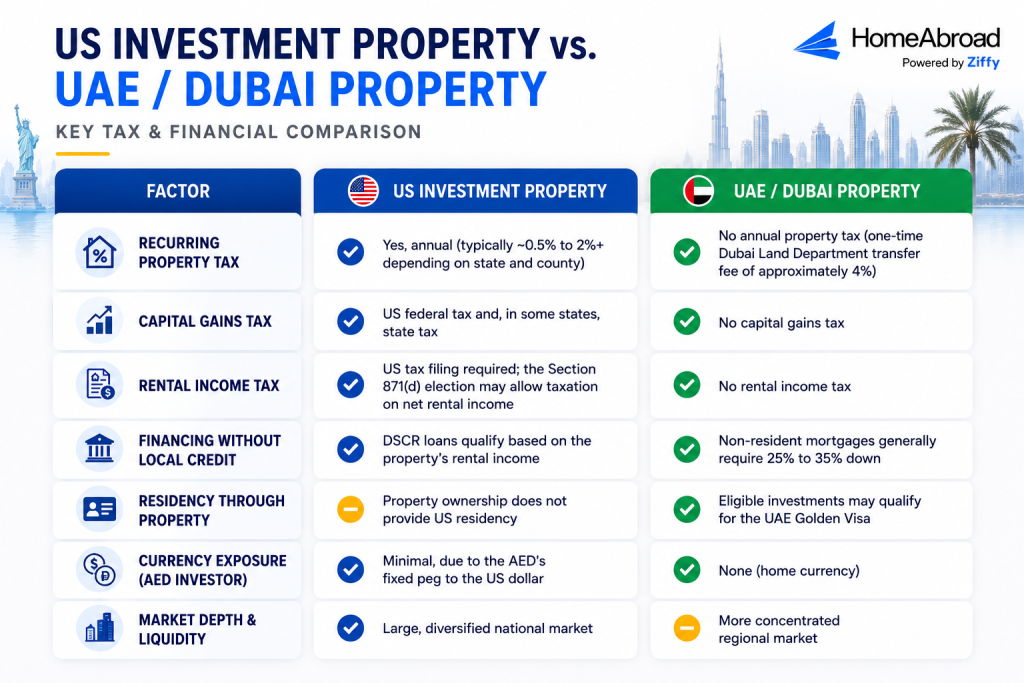
Before investing, compare the full cost of ownership, financing options, tax obligations, and long-term investment objectives. Looking beyond purchase price alone provides a more accurate comparison between US and Dubai real estate.
How UAE Investors Finance US Property: DSCR Loans
For many UAE investors, financing is what makes building a US real estate portfolio possible. Rather than tying up all of your capital in a single purchase, a foreign national mortgage allows you to finance an investment property while preserving cash for future opportunities.
At HomeAbroad, we specialize in helping international investors finance US rental properties through DSCR loans. Unlike conventional mortgages, a DSCR loan qualifies based on the property’s rental income rather than the borrower’s personal income. That means you do not need a US credit history, US employment, a Social Security Number, a visa, or a green card to qualify.
Why DSCR works when conventional financing doesn’t
Traditional US mortgages are designed for domestic borrowers. They typically rely on W-2 income, US tax returns, debt-to-income (DTI) ratios, and established US credit history.
A DSCR loan follows a different approach. Instead of evaluating your personal finances, the lender reviews whether the property’s expected rental income is sufficient to cover its monthly housing expenses (PITIA).
This financing option is particularly well suited for UAE investors purchasing rental properties because qualification is based on the investment itself rather than where the borrower lives or earns income.
Example: How a DSCR Loan Is Evaluated
Suppose you’re purchasing a US rental property with an expected monthly rent of $2,400.
- Monthly rental income: $2,400
- Monthly PITIA (principal, interest, taxes, insurance, and association dues): $2,000
- DSCR: 2,400 ÷ 2,000 = 1.20
Because the property’s rental income exceeds its monthly housing expenses, it demonstrates positive cash flow and satisfy the DSCR requirement for foreign nationals. Exact requirements vary by lender and loan program.
What you’ll need and what to expect
While documentation requirements vary by transaction, most UAE investors should be prepared to provide:
- Valid passport
- Proof of available funds for the down payment and closing costs
- Bank statements and source-of-funds documentation
- Cash reserves required by the loan program
- Purchase contract (once a property is selected)
HomeABroad’s DSCR loans typically require a down payment of 25%, depending on the property, and overall transaction profile.
As of June 2026, foreign national DSCR loan rates start from approximately 7.00%, although the final rate depends on factors such as leverage, reserves, property type, and overall transaction strength.
HomeAbroad’s foreign national transactions close in an average of approximately 27 days, allowing overseas investors to complete purchases efficiently while managing the process remotely.
![Here's the section-by-section drafting brief. A writer should be able to draft straight from this. I've kept every accuracy anchor, the AI-writing guardrails, and the LO-compliance plan baked into each section. --- # Drafting Brief — "Buying US Rental Property from Australia"
**Core article · 2,000–2,800 words · Author: Lucas Hernandez NMLS #2171747 (not quoted) · Reviewer: Amresh Singh #2549148** **Global guardrails (apply to every section):**
- Banned phrase: "powerful tool." No "Not X but Y," no "Whether you're X or Y…" closers, no "One of the most…" openers, no per-section platitude closers, no rule-of-three comma dumps.
- "At HomeAbroad" — **max 2 uses total** across the article. Use "HomeAbroad" as subject instead.
- Hedge discipline: trim often/typically/generally to where they're load-bearing.
- Every LO attribution carries NMLS. 🚫 Never #2594493 (Jason Saylor — unverified).
- Tax/legal claims stay factual + route to a cross-border CPA. LOs speak only to financing/process/structure-as-it-affects-the-loan. --- ## Intro (150–200w) — Authority + Experience **Talking points:**
- Open on motivation, not definition: Australian investors are looking at US rentals for stronger gross yields and lower entry prices than Sydney/Melbourne, plus AUD/USD diversification.
- Anchor stat: foreign buyers purchased **$56 billion** in US residential property (NAR, Apr 2024–Mar 2025). Use the exact figure.
- State the reassuring truth early: an Australian can buy *and finance* US rental property with **no US credit history, no Green Card, no residency**.
- Preview the three problems this guide solves: financing, tax/FIRPTA, and closing from Australia.
**E-E-A-T:** Authority (NAR figure) + Experience teaser ("HomeAbroad has financed 500+ foreign-national loans across 40+ countries").
**Avoid:** "In today's market," "When it comes to." --- ## H2: Can an Australian buy property in the USA? (Quick answer) (200–250w) — Expertise + Trust **Talking points (featured-snippet target — lead with a direct one-sentence answer):**
- First sentence answers it: *Yes — Australians can buy US investment property with no visa, residency, citizenship, or US credit score.*
- Name the two financing paths in one line each: **DSCR** (qualifies on the property's rent) and **full-documentation** (qualifies on your income with translated docs). Signal DSCR is the usual fit for non-resident landlords.
- *H3 — What you need instead of US credit:* passport/ID, **~25% down plus post-closing reserves**, and a documented source of funds. Note an ITIN/LLC may come into play (covered later).
**E-E-A-T:** Expertise (clean two-path framing) + Trust ("no US credit" stated plainly, with the real trade-off: larger down payment).
**Secondary KW:** work "can an Australian buy a house in America" and "can Australian buy property in USA" naturally into the H2/first lines.
**Internal link:** none here (keep snippet clean). --- ## H2: Why Australians invest in US rental property (250–300w) — Authority + Experience **Talking points:**
- Yield + price contrast: many US metros deliver higher gross rental yields than comparable AU property, often at a lower purchase price; diversification away from a single AUD-denominated market.
- Frame the scale with the NAR context (foreign capital into US real estate), without inventing an Australia-specific dollar figure you can't verify — keep it directional.
- Set up that the appeal is real but the *mechanics* (financing, tax, closing) are where Aussies get stuck — which the rest of the guide handles.
**LO QUOTE #1 — Steven Glick (Insight/Experience).** Placement: end of this section.
**E-E-A-T:** Authority (market framing) + Experience (Glick pattern).
**Internal link:** → `/real-estate/guide-home-buying-foreign-national-usa/` (anchor: *the full foreign-national buying process*). --- ## H2: How DSCR loans work for Australian investors (500–650w) — Experience + Trust ⭐ *core section / product showcase* **Talking points:**
- **Mechanism first:** DSCR qualifies the *property*, not the borrower's personal or Australian income. The lender compares the property's rental income against its **PITIA** (principal, interest, taxes, insurance, association dues).
- **Worked example (use round numbers):** rent $2,500/mo vs PITIA $2,000/mo → DSCR 1.25, meaning the property earns 25% more than its payment. Explain what 1.0 vs 1.25 signals.
- **Honest terms (Trust):** foreign-national DSCR usually needs **~25% down** plus reserves; foreign-national DSCR pricing typically runs **about 0.5% above** comparable US-investor pricing. **Do not state a live rate** — link the rates page once `/mortgages/` is cleared.
- *H3 — DSCR vs full-documentation for an Australian:* DSCR = faster, no translated income docs, property-driven; full-doc = needed when the property doesn't carry the ratio and you want to lean on verified overseas income.
- *H3 — What HomeAbroad needs from an Australian borrower:* passport, ~25% down + reserves evidenced in statements, source-of-funds trail for the AUD→USD movement, appraisal with market-rent schedule, and (where used) LLC/EIN. Note US credit is used if it exists but isn't required.
**LO QUOTE #2 — Jeff Larrabee (Process Tip / Warning).** Placement: after the doc checklist.
**E-E-A-T:** Experience ("a pattern we see…") + Trust (real down-payment/pricing trade-offs; "DSCR isn't a workaround for a property that doesn't cash flow").
**Internal links:** → `/dscr-loans/` (anchor: *how DSCR loans work*); → `/real-estate/foreign-national-mortgage-30-faqs/` (anchor: *foreign national mortgage FAQs*).
**🔗 Hold-to-add in revision** (once `/mortgages/` 500/canonical resolves): non-resident-alien-mortgage, foreign-credit-report-vs-alternative-credit, dscr-loan-interest-rates. --- ## H2: Taxes & FIRPTA for Australian owners — what the treaty does (and doesn't) do (450–550w) — Expertise + Trust ⚠️ *accuracy-critical* **Talking points — correct the SERP's two big errors (flat-15% FIRPTA; "treaty lowers your tax"):**
- *H3 — Rental income while you hold:* default US tax is **30% on gross rent** (no deductions). The **Section 871(d) election** lets a foreign owner be taxed on **net** effectively-connected income (deduct mortgage interest, taxes, insurance, repairs, depreciation). Make explicit: **§871(d) is an election, not a treaty benefit.**
- *H3 — When you sell (FIRPTA):* FIRPTA is a **withholding/prepayment**, not a final tax, and it is **tiered 0% / 10% / 15%** of the gross sale price depending on price and use — **never present it as a flat 15%.** The **US–Australia income tax treaty does not reduce FIRPTA**; it helps prevent *double* taxation via foreign tax credits back home.
- *H3 — Estate tax exposure:* a non-resident alien gets only a **$60,000** US estate-tax exemption (vs the multi-million US-person figure). Australia is among the few countries with a **US estate/gift tax treaty** — flag it as a planning factor, but **don't overstate the relief** (it's nuanced; Australia abolished its own death duties, which complicates treaty mechanics). Route to a cross-border estate attorney.
**E-E-A-T:** Expertise (the §871(d)/FIRPTA/estate distinctions competitors blur) + Trust (explicit "consult a cross-border CPA before you buy").
**No LO quote here** (keep LOs out of tax-advice territory).
**Internal links:** → `/real-estate/us-tax-treaties-and-real-estate/` (anchor: *US–Australia tax treaty and FIRPTA*); → `/real-estate/us-taxes-foreign-real-estate-buyers/` (anchor: *foreign-buyer US tax guide*).
**🔗 FIRPTA pillar:** verify live before linking. --- ## H2: LLC vs personal name for Australian investors (250–300w) — Expertise + Decision **Talking points:**
- When an LLC earns its keep: financing through an entity, multi-property/portfolio plans, liability separation. When personal name can be fine: a single all-cash buy in a stable market.
- Note the foreign single-member LLC is generally a disregarded entity for US tax — income still flows to you; the LLC is a structuring choice, not a tax-erasing one (and it doesn't by itself remove FIRPTA).
- **SMSF (self-managed super fund) edge case:** acknowledge the common Aussie question — buying US property via an SMSF is possible but complex (in-house asset rules, structuring, US-side tax). Keep it high-level and route to a cross-border advisor; don't prescribe.
**LO QUOTE #3 — Dorian Adams-Walker (Decision / Edge Case).** Placement: mid-section.
**E-E-A-T:** Expertise + Trust (limits stated; advisor referral).
**Internal link:** → `/real-estate/llc-vs-personal-name/` (anchor: *LLC vs personal name for foreign investors*). --- ## H2: Closing on a US property remotely from Australia (350–450w) — Experience + Trust ⭐ *operational gap nobody owns* **Talking points:**
- *H3 — Apostilled power of attorney:* you can sign from Australia using a POA executed to the title company's requirements and apostilled in Australia. Note timing — set it up early, not the week of closing.
- *H3 — Moving the deposit (AUD→USD):* wires need a clean **source-of-funds paper trail**; international wires typically take **5–10 business days for AML review**, and any unexplained deposit in the look-back window triggers conditions. Flag exchange-rate/timing planning so funds land before settlement.
- Time-zone coordination: HomeAbroad sequences signing, funding, and recording across the AEST/US-business-hours gap.
**LO QUOTE #4 — Steven Glick (Reassurance) — his 2nd quote (max 2, allowed).** Placement: close of section.
**E-E-A-T:** Experience (concrete AML timeline, real mechanics) + Trust (set expectations on lead time).
**Internal link:** → `/real-estate/property-management-in-the-us-for-foreigner/` (anchor: *managing your US rental from overseas*). --- ## H2: How HomeAbroad supports Australian investors end-to-end (150–200w) — Authority + Trust **Talking points:** one connected path — foreign-national DSCR + full-doc programs, manual underwriting built for cross-border files, 500+ loans across 40+ countries, agent network, remote-closing coordination. This is a good spot for one of your two permitted "At HomeAbroad" uses if you want it.
**Reciprocal internal link:** → `/immigration/australians-moving-to-usa-guide/` (anchor: *Australians relocating to the US*). --- ## H2: FAQ (250–350w) — Expertise + Trust · FAQ schema Target the long-tail directly (concise answers, schema markup):
1. Can Australians get a US mortgage with no US credit? (Yes — DSCR.)
2. How much deposit do Australians need? (~25% + reserves.)
3. Can I buy US property through my SMSF? (Possible, complex — advisor.)
4. Does the US–Australia tax treaty lower my US property tax? (No — it prevents double tax; §871(d) and planning do the real work.)
5. Can I close without flying to the US? (Yes — apostilled POA.)
6. Do I need an ITIN or a US LLC? (Depends on structure/tax filing.)
7. Are foreign-national rates higher? (Modestly — ~0.5% over US-investor pricing.) --- ## Next steps + CTA (150–200w) — Authority + Trust Summary of the three solved problems → author box (Lucas Hernandez #2171747) + reviewer (Amresh Singh #2549148).
- **Primary CTA:** Get pre-qualified as an Australian investor — no US credit needed.
- **Secondary:** DSCR pillar · US–Australia tax-treaty pillar. --- # Copy-ready LO quotes **Diversity check:** Insight · Process/Warning · Decision/Edge · Reassurance ✅ — 3 unique LOs, Glick ×2 (max), author Lucas not quoted, #2594493 excluded ✅ > **#1 — Insight/Experience · §"Why Australians invest"**
> "Most of the Australians I work with aren't chasing a holiday home — they've run the numbers and a US rental cash-flows in a way their local market doesn't at the same price. The part that surprises them is how little stands in the way once they stop trying to qualify like a US borrower and start qualifying on the property."
> — **Steven Glick, Director of Mortgage Sales, HomeAbroad · NMLS #1231769** > **#2 — Process Tip / Warning · §DSCR financing**
> "The deals that stall aren't the ones with no US credit — that's normal for us. They stall when the reserves or the source-of-funds trail aren't ready. Get your statements and the paper trail for the deposit sorted before you're under contract, and a no-US-credit file moves as fast as a domestic one."
> — **Jeff Larrabee, Loan Officer, HomeAbroad · NMLS #482306** > **#3 — Decision / Edge Case · §LLC vs personal name**
> "If you're financing and planning more than one property, an LLC usually makes sense for how we structure the loan and your liability. For a single all-cash purchase it can be overkill. And if you're asking about buying through your super fund, slow down and get a cross-border advisor in the room first — that's a structuring decision, not a loan decision."
> — **Dorian Adams-Walker, Mortgage Loan Officer, HomeAbroad · NMLS #2442830** > **#4 — Reassurance · §Remote closing**
> "I've had Australian clients close without ever setting foot in the US. With an apostilled power of attorney set up early and the wire planned around the AML review, the time difference becomes a scheduling detail, not a problem. The mistake is leaving the POA to the last week."
> — **Steven Glick, Director of Mortgage Sales, HomeAbroad · NMLS #1231769** --- **Pre-publish reminders for staging:** verify Key Takeaways block (code-block bug), custom bullet-icon blocks (empty-icon bug), reviewer byline tick artifact (Glicktick/Singhtick), and photo-to-quote pairing. Hold all `/mortgages/[slug]/` links until dev clears the pattern; verify FIRPTA pillar is live before linking. Want me to draft the full article from this brief next, or generate the article banner (746×512 @ 150 DPI) while the draft is in progress?](https://homeabroadinc.com/wp-content/uploads/2026/06/dscr-vs-all-cash-vs-conv-1024x683.png)
Decision: Preserve capital, don’t lock it up
Financing allows investors to keep capital available for future acquisitions instead of committing 100% of their funds to a single property. The equity preserved through a DSCR loan can often become the down payment for a second or third investment as a portfolio grows.

Steven Glick
Director of Mortgage Sales · HomeAbroad
Most of our UAE clients never set foot in the US to close. We run the file remotely. The borrower signs through a power of attorney we coordinate with a notary at the UAE consulate, while we manage the appraisal, title, and funding on our end. The part investors often underestimate is the lead time needed for the power of attorney, so we begin that process as soon as the rate is locked.
Most UAE investors complete the entire financing process remotely. Once pre-qualified, HomeAbroad coordinates underwriting, appraisal, title, and closing while keeping borrowers informed at each stage, making it possible to purchase US investment property without traveling to the United States.
Should you hold US property in an LLC?
For many UAE investors, purchasing US real estate through a Limited Liability Company (LLC) can provide operational and legal advantages. An LLC may help separate personal assets from investment liabilities, simplify ownership when building a portfolio, and make it easier to add partners or transfer ownership interests over time.
The right ownership structure depends on your investment goals, financing strategy, tax considerations, and long-term estate planning. While many foreign investors choose an LLC, it is not the right solution for every situation. HomeAbroad works with investors early in the purchase process to understand how the property will be owned so financing, title, and closing documents are prepared correctly from the outset.
Single-member LLC and the Form 5472 filing you can’t skip
Many foreign investors purchase US property through a single-member LLC because it is generally treated as a disregarded entity for US federal income tax purposes. While this structure can simplify certain aspects of ownership, it also creates reporting obligations.
A foreign-owned single-member LLC is generally required to file IRS Form 5472 together with a pro forma Form 1120 each year, even when the LLC has little or no taxable income. Failure to file these forms correctly can result in a minimum IRS penalty of $25,000, making it important to work with a qualified cross-border CPA.
Because these reporting rules are separate from your mortgage, most UAE investors work with a cross-border CPA who understands both US tax law and foreign ownership requirements.
When estate-tax exposure points to a different structure
An LLC can provide liability protection and administrative benefits, but it does not automatically eliminate US estate-tax exposure for foreign owners.
Depending on the value of your portfolio and your long-term investment strategy, alternative ownership structures, including corporate “blocker” structures, may be appropriate. These decisions involve legal, tax, financing, and estate-planning considerations and should be made with guidance from qualified cross-border professionals before purchasing property.
Process Tip: Form the LLC Early
If you plan to purchase through an LLC, establish the entity before beginning underwriting. Coordinating the ownership entity, insurance, and title work in parallel helps reduce last-minute documentation changes and keeps the transaction moving toward closing.
The mistake I see is investors forming the LLC after they’re already under contract. When the entity isn’t set up before underwriting, we end up re-papering title and insurance at the last minute, and that pushes closing. If you know you want to hold in an LLC, form it first and tell us. We’ll vest the loan correctly from day one.

Whether you’re purchasing your first US rental property or expanding into multiple investments, HomeAbroad can help coordinate financing with your preferred ownership structure while working alongside your legal and tax advisors to keep the transaction on track.
Cross-Border Tax: What Gulf Investors Must Know
For UAE investors, tax planning is one of the biggest differences between buying property in the United States and investing domestically. While financing and property selection often receive the most attention, understanding how US tax rules apply throughout the investment lifecycle can help investors make better ownership decisions from the outset.
The three stages that matter most are earning rental income, selling the property, and planning for long-term ownership and estate transfer.
There is no US-UAE tax treaty (and what that means)
Unlike investors from some other countries, UAE investors generally do not benefit from a bilateral income tax treaty with the United States.
That means US-source rental income remains subject to US tax rules, and there is no treaty provision that reduces or eliminates FIRPTA withholding for individual nonresident-alien property sellers.
This is an important distinction because some online resources incorrectly suggest that tax treaties automatically reduce FIRPTA withholding. Even where tax treaties exist, they generally do not eliminate FIRPTA withholding for individual foreign sellers. For UAE investors, there is no treaty relief to consider.
Rental income and the Section 871(d) election
By default, rental income earned by a foreign investor is treated as Fixed, Determinable, Annual, or Periodical (FDAP) income and may be subject to a 30% withholding tax on gross rental income.
Many foreign investors instead elect treatment under Section 871(d) of the Internal Revenue Code. This election allows rental income to be treated as Effectively Connected Income (ECI), meaning tax is calculated on net taxable income rather than gross rental receipts.
Under ECI treatment, eligible expenses such as mortgage interest, property taxes, insurance, repairs, property management fees, and depreciation may generally be deducted before calculating taxable income.
Most investors also obtain an Individual Taxpayer Identification Number (ITIN) and work with a cross-border CPA to make the election correctly and satisfy ongoing US tax filing requirements.
Selling: FIRPTA withholding is tiered, not a flat 15%
When a foreign owner sells US real estate, the transaction may be subject to the Foreign Investment in Real Property Tax Act (FIRPTA).
FIRPTA withholding is frequently misunderstood because it is often described as a flat 15% tax. In reality, the withholding rules are based on the property’s sale price and whether the buyer intends to use the property as a personal residence.
Depending on the transaction, FIRPTA withholding may be:
- 0% when the buyer (an individual) intends to use the property as a residence, the purchase price is $300,000 or less, and the buyer provides the required occupancy affidavit.
- 10% when the buyer intends to use the property as a residence and the purchase price is between $300,001 and $1 million.
- 15% for properties sold for more than $1 million or when the buyer does not intend to use the property as a residence.
The amount withheld at closing is a prepayment toward the seller’s eventual US tax liability rather than the final tax owed.
Investors planning to sell should review the transaction with a qualified tax professional before closing. A 1031 exchange may defer capital gains tax on a qualifying reinvestment, but it does not eliminate FIRPTA withholding. Foreign sellers generally must obtain an IRS withholding certificate (Form 8288-B) if they want to reduce or eliminate the amount withheld at closing.
The $60,000 estate-tax trap
US estate tax is another area that deserves attention before purchasing property. For US estate-tax purposes, nonresident aliens generally receive an exemption of only $60,000 of US-situs assets. By comparison, US citizens and residents currently benefit from a substantially higher exemption amount.
Unlike investors from certain treaty countries, UAE investors do not have treaty relief that increases this exemption. As a result, larger US property portfolios may create estate-tax exposure if ownership is not structured appropriately.
Depending on the investor’s circumstances, holding property through a different ownership structure, such as a corporate blocker, may be worth evaluating. Because these decisions involve legal, tax, financing, and succession planning, they should be made with guidance from a cross-border estate attorney and CPA before acquiring property.
Stage | The Rule | Planning Response |
|---|---|---|
Earning Rental Income | Default treatment is a 30% withholding tax on gross rental income (FDAP). A Section 871(d) election allows taxation on net Effectively Connected Income (ECI), making eligible expenses and depreciation deductible. | Obtain an ITIN, file the Section 871(d) election where appropriate, and work with a cross-border CPA. |
Selling the Property | FIRPTA withholding follows a 0% / 10% / 15% structure based on the transaction. It is not automatically 15%. | Plan for FIRPTA before listing the property and evaluate whether a withholding certificate or 1031 exchange may be appropriate. |
Estate Planning | Nonresident aliens generally receive only a $60,000 US estate-tax exemption, and there is no US-UAE treaty relief. | Review ownership structure, including whether a corporate blocker or other strategy is appropriate, with a cross-border estate attorney before purchasing. |
Managing and Eventually Selling Your US Property from the UAE
Owning US investment property does not require living in the United States. With the right team and systems in place, UAE investors can manage rental properties, collect income, refinance, and sell their investments while remaining overseas.
At HomeAbroad, we help investors build a framework for long-term ownership that extends beyond financing. From coordinating property management to preparing for future financing or an eventual sale, the goal is to make every stage of ownership as straightforward as the purchase itself.
Remote management, ITIN, and a US banking setup
Most UAE investors appoint a professional US property management company to handle day-to-day operations, including tenant communication, rent collection, maintenance coordination, inspections, and lease renewals.
Investors should also establish the administrative foundation needed for long-term ownership. This typically includes obtaining an Individual Taxpayer Identification Number (ITIN), opening a US bank account to receive rental income and pay property expenses, and maintaining organized financial records for annual tax reporting.
These steps help simplify ongoing ownership while supporting future refinancing or additional property acquisitions.
Exit options: outright sale, 1031 exchange, or cash-out refinance
Selling is only one way to access the value created by a successful investment.
Some investors choose to sell and redeploy capital into another opportunity. Others may qualify for a 1031 exchange, allowing them to defer certain capital gains taxes by reinvesting proceeds into another qualifying US investment property.
Another option is a cash-out refinance. Rather than selling a property, investors can refinance after building equity and use the proceeds to fund another acquisition while continuing to own the original investment.

What we see with our most active UAE investors is that they rarely sell. They refinance. Once a property has built equity, a cash-out refinance frees up capital for the next purchase without triggering a sale. Instead of one property, they’re running three or four inside a couple of years.
A successful investment strategy extends beyond the closing table. By planning for property management, refinancing, and eventual disposition from the outset, UAE investors can build a portfolio that remains flexible as their investment goals evolve.
Common Mistakes UAE Investors Make
The challenges we see most often have less to do with finding the right property and more to do with financing, documentation, ownership structure, and long-term planning. Avoiding the following mistakes can help keep your purchase on schedule and reduce unnecessary costs.
Assuming an All-Cash Purchase Is the Only Option
Some UAE investors plan to pay entirely in cash because they believe financing requires a US credit history or residency. Foreign national DSCR loans allow eligible investors to finance rental properties while preserving capital for future acquisitions.
Forming the LLC After Going Under Contract
Waiting until underwriting has already begun to create an LLC can lead to changes in title documents, insurance policies, and loan paperwork that delay closing. If you intend to purchase through an LLC, establish the entity before starting the financing process.
Ignoring the $60,000 US Estate-Tax Exemption
Estate planning is often overlooked when purchasing a first investment property. As a US portfolio grows, the estate-tax rules that apply to nonresident aliens become increasingly important. Reviewing ownership structure before purchasing additional properties is generally more efficient than restructuring later.
Underestimating Closing Costs and Cash Reserves
Foreign national mortgage programs require more than just a down payment. Investors should also budget for closing costs, required cash reserves, and documented source of funds.

Dorian Adams-Walker
Mortgage Loan Originator, HomeAbroad
Underestimating reserves is what stalls otherwise-strong files. Foreign national DSCR loans carry reserve requirements on top of the down payment, and if that cash isn’t seasoned and documented, we can’t close, no matter how good the rental numbers look.
Most of these issues can be avoided before an offer is submitted. Reviewing your financing, ownership structure, documentation, and cash reserves early helps prevent delays during underwriting and closing.
Next Steps: Finance Your US Investment Property from the UAE
Buying US real estate from the UAE involves more than finding the right property. Financing, ownership structure, tax planning, and long-term portfolio goals all influence how your investment performs over time.
HomeAbroad has helped more than 500 international investors from over 40 countries, including the UAE, finance and purchase US investment properties. Whether you’re acquiring your first rental property or expanding an existing portfolio, our team can guide you through pre-qualification, financing, underwriting, and remote closing from start to finish.
Get Your Rate Quote or Pre-Qualify Today
A HomeAbroad pre-qualification can help you:
- Understand your financing options
- Estimate your purchasing power
- Review down payment and documentation requirements
- Compare investment scenarios before making an offer
- Identify potential qualification issues early
Ready to invest in US real estate from the UAE? Connect with HomeAbroad today to get your personalized rate quote and take the next step toward building your US property portfolio.
Frequently Asked Questions
Can a UAE citizen buy US property without a green card?
Yes. UAE citizens can legally buy, own, rent, and sell US real estate without a green card, visa, Social Security Number, or US residency. Foreign national mortgage programs also allow eligible investors to finance US investment properties while living in the UAE.
Do I need a US credit history to get a mortgage?
No. HomeAbroad’s foreign national DSCR loans do not require a US credit history. Qualification is based primarily on the property’s rental income rather than your personal US credit profile, employment, or tax returns.
Is there a US-UAE tax treaty?
No. The United States and the UAE do not have a bilateral income tax treaty. As a result, UAE investors do not receive treaty relief on US-source rental income or US estate tax. US tax rules apply based on the Internal Revenue Code and IRS regulations.
How much down payment does a DSCR loan require?
Most foreign national DSCR loan programs require a down payment of approximately 25% to 30%, depending on the property, loan amount, borrower profile, and overall transaction.
Will I owe US tax on my rental income?
Generally, yes. Rental income from US property is subject to US tax rules. Many foreign investors elect treatment under Section 871(d), allowing rental income to be taxed as Effectively Connected Income (ECI) so eligible expenses and depreciation can be deducted before taxable income is calculated.