



Editorial Integrity
Making informed real estate decisions starts with having the right knowledge. At HomeAbroad, we offer US mortgage products for foreign nationals & investors and have a network of 500+ expert HomeAbroad real estate agents to provide the expertise you need. Our content is written by licensed mortgage experts and seasoned real estate agents who share insights from their experience, helping thousands like you. Our strict editorial process ensures you receive reliable and accurate information.
Quick Answer:

Yes, a foreign national can buy multiple rental properties in the US, and many investors build portfolios over time rather than stopping after a single acquisition.

DSCR loans make this possible because qualification is based primarily on each property's rental income instead of the borrower's US employment history, personal income, or credit profile. Unlike conventional financing, which becomes more restrictive as borrowers accumulate financed properties, DSCR financing evaluates whether each investment can support its own debt obligations.

As a portfolio grows, the main constraints shift away from personal income and toward available equity, cash reserves, down-payment funds, and source-of-funds documentation. Investors who plan for those requirements can continue expanding their portfolios while using rental income, appreciation, and accumulated equity to support future acquisitions.
Foreign nationals can build a portfolio of multiple US rental properties, even without US citizenship, permanent residency, or an established US credit history.
HomeAbroad’s DSCR loans evaluate a property’s rental income rather than a borrower’s personal income, making them a common financing option for repeat acquisitions.
As a portfolio grows, reserves, available equity, down-payment funds, and source-of-funds documentation often become more important than personal income qualifications.
Cash-out refinancing and accumulated equity can help fund future acquisitions without requiring investors to save an entirely new down payment for every purchase.
Tax and ownership decisions become more important as portfolios expand, particularly when evaluating LLC structures, depreciation, FIRPTA, and estate-planning considerations.
Table of Contents
Why Scaling Looks Different for Foreign National Investors
Foreign nationals can build portfolios of multiple US rental properties, but the path often looks different from that of domestic investors. Many US-based investors rely on conventional financing that evaluates personal income, employment history, credit scores, and debt-to-income (DTI) ratios. Foreign national investors frequently use financing structures designed around the property’s income-producing ability instead.
As a result, portfolio growth is often determined by factors such as liquidity, reserves, equity, and documentation rather than increases in personal income. Understanding those differences can help investors create a more realistic plan for long-term portfolio expansion.
No US Credit or Income Means Personal DTI Isn’t Your Ceiling
Conventional mortgage programs typically evaluate a borrower’s personal income, existing debts, and DTI ratio. As investors acquire additional properties, those obligations can make qualifying for future loans more difficult. Conventional lenders may also impose limits on the number of financed properties a borrower can have.
Many foreign national investors purchase US rental property without a traditional US credit profile, US employment income, or extensive US tax history. HomeAbroad’s DSCR programs are designed for a different type of borrower. Rather than relying primarily on personal income, we evaluate the property’s rental income and overall investment profile.
This difference can create a more scalable path for investors who want to acquire multiple rental properties over time. Instead of focusing on increasing personal income to support each new purchase, investors can focus on acquiring properties with strong rental fundamentals and maintaining the capital needed for future acquisitions.
The Constraints That Actually Limit You: Reserves, Equity, and Documentation
As a portfolio grows, the biggest challenge is rarely qualifying for the next loan. More often, investors are limited by available equity, cash reserves, and documentation requirements.
Reserve requirements also become more important as a portfolio grows. At HomeAbroad, foreign national investors are generally required to maintain six months of PITIA (principal, interest, taxes, insurance, and association dues, where applicable) for each financed property. These reserves help investors manage vacancies, repairs, and unexpected expenses while supporting long-term portfolio stability.
Equity also becomes increasingly important. Many investors use appreciation, principal paydown, or future refinancing opportunities to help fund additional acquisitions. At the same time, source-of-funds documentation often becomes more detailed as larger amounts of capital move across multiple transactions and international accounts.
For many foreign national investors, the question is not whether they can qualify for another property. The real question is whether they have the liquidity, equity position, and documentation needed to support the next acquisition while maintaining a healthy margin of safety across the existing portfolio.
How to Finance Multiple Rental Properties as You Grow
Building a portfolio is not just about finding the next property. The financing strategy that works for your first rental may not be the most efficient option once you own several properties. As portfolios grow, investors often move from standard DSCR financing to more specialized structures that help support additional acquisitions, preserve liquidity, or simplify portfolio management.

Steven Glick
Director of Mortgage Sales · HomeAbroad
The investors who scale most successfully usually begin planning the financing structure for their next acquisition before the current purchase closes. By the third or fourth property, waiting until you’re ready to buy often limits your options.
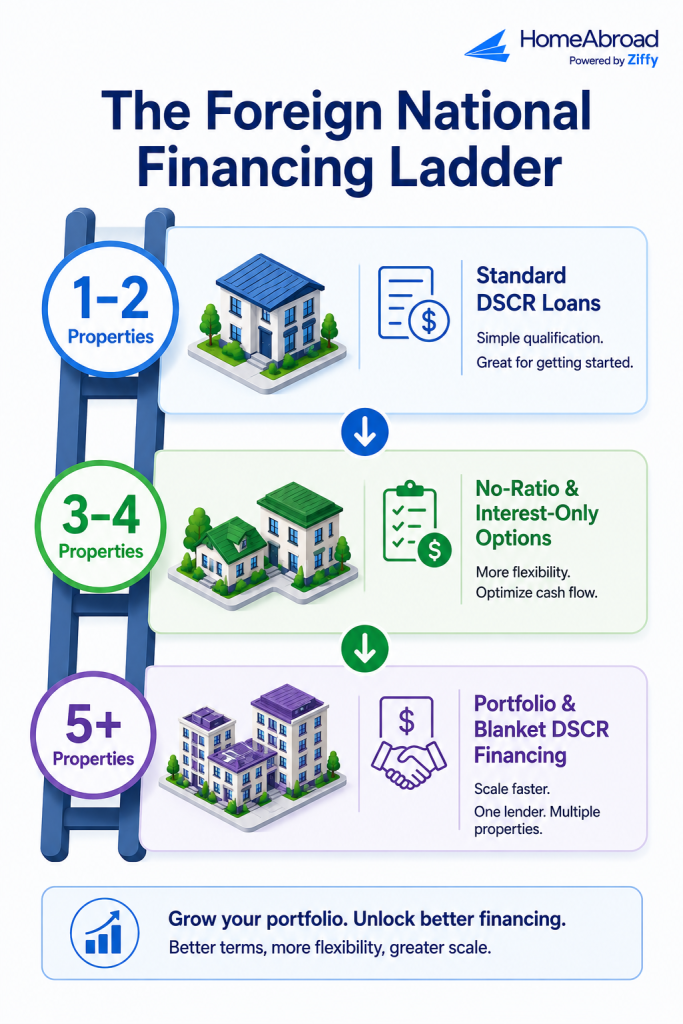
Properties 1–2: Standard DSCR Loans
Many foreign national investors begin with standard DSCR loans. These loans are designed around the property’s rental income rather than a borrower’s US employment history or traditional credit profile, making them a practical option for investors purchasing their first few US rental properties.
Because each property is evaluated individually, investors can focus on acquiring assets with strong rental fundamentals rather than trying to increase personal income to qualify for every new purchase. For many investors, this creates a straightforward path from the first property to the second while maintaining flexibility for future acquisitions.
Properties 3–4: Rising Reserve Requirements and Specialized DSCR Options
As a portfolio grows, financing often becomes less about qualification and more about capital efficiency. Investors typically need to allocate more capital toward reserves, down payments, closing costs, and liquidity as additional properties are acquired, which can influence the pace of portfolio expansion.
At this stage, some investors explore options such as no-ratio DSCR loans or interest-only DSCR loans. Depending on the investment strategy, these products may help preserve liquidity, improve cash flow, or reduce the amount of capital tied up in each acquisition. The right structure depends on the investor’s goals, property type, and portfolio growth plans.
Properties 5+: Portfolio and Blanket DSCR Financing
As portfolios expand, investors often look for financing solutions designed specifically for multiple properties rather than treating each acquisition as a standalone transaction.
Portfolio loans can allow investors to finance several properties under a single lending relationship, while blanket loans may combine multiple properties into one loan secured by several assets. These structures can simplify portfolio management, reduce administrative complexity, and create more flexibility when refinancing or expanding an existing portfolio.
Rather than focusing on a single property’s performance, portfolio-style financing often evaluates the strength of the broader portfolio, including rental income, reserves, equity, and overall asset quality. For investors actively growing beyond five properties, these products can become an important part of a long-term financing strategy.
Why Conventional Financing Caps Investors at 4–10 Properties and DSCR Doesn’t
The limit is more concrete on the conventional side than it first appears. While Fannie Mae guidelines allow borrowers to finance up to 10 properties under certain circumstances, qualification standards become significantly stricter after four financed properties. Reserve requirements increase, documentation requirements become more extensive, and lenders may apply higher credit and underwriting standards.
In addition, every new conventional mortgage affects a borrower’s personal debt-to-income (DTI) ratio. As more properties are added, qualifying for additional conventional loans often becomes increasingly difficult because each new obligation is evaluated against the borrower’s personal income.
DSCR financing approaches qualification differently. Instead of relying primarily on personal income and DTI calculations, the focus is on whether a property’s rental income can support its debt obligations. As a result, portfolio growth is often constrained less by personal income and more by factors such as reserves, available equity, liquidity, and documented funds for future acquisitions.
How Many Rental Properties Do You Actually Need?
There is no universal number of rental properties that guarantees financial independence or a specific monthly income target. The answer depends on factors such as property cash flow, financing terms, operating expenses, vacancy rates, and the markets where you invest.
For foreign national investors, the focus is often less about reaching a specific property count and more about building a portfolio that generates consistent cash flow while remaining manageable from abroad. A well-performing portfolio of three properties may outperform a portfolio of ten properties with weaker fundamentals.
Working Backward From a Monthly Cash-Flow Goal
Many investors begin with an income goal rather than a property target. For example, an investor seeking $5,000 in monthly cash flow would first estimate how much net cash flow each property is expected to generate after mortgage payments, taxes, insurance, maintenance, and property management expenses.
If a property produces approximately $1,000 in monthly cash flow, reaching a $5,000 monthly target could require five similar properties. If each property generates $2,500 per month, the same goal could potentially be achieved with only two properties. The actual number depends on the performance of the assets rather than a fixed portfolio size.
This is one reason many experienced investors focus on cash flow per property rather than simply accumulating doors. Portfolio growth is most effective when each acquisition improves overall income and strengthens long-term returns.
The 1% and 2% Rules and Why They Rarely Hold in 2026
The 1% rule suggests that a rental property’s monthly rent should equal at least 1% of its purchase price. For example, a $300,000 property would ideally generate $3,000 per month in rent.
The 2% rule is even more aggressive, suggesting that monthly rent should equal 2% of the property’s purchase price.
Both rules are harder to hit now because property prices have risen faster than rents in many markets, while higher financing costs have compressed yields. Rising property values, higher financing costs, and stronger competition have compressed yields in many popular investment markets. As a result, investors often evaluate opportunities using more detailed metrics such as cash flow, cap rate, and DSCR rather than relying solely on the 1% or 2% rule.
For foreign national investors using DSCR financing, understanding how rental income supports financing eligibility is often more important than whether a property meets a specific rule-of-thumb benchmark.
A Realistic 1-to-5 Property Acquisition Timeline
Most investors do not build a five-property portfolio overnight. Growth typically happens in stages as equity, rental income, and reserves accumulate over time.
A common path starts with the purchase of a first rental property and a period of stabilization. During the first one to two years, investors focus on building reserves, gaining operational experience, and allowing the property to generate consistent cash flow.
By years two to four, many investors are in a position to acquire a second or third property using additional savings, accumulated rental income, or equity created through appreciation and principal paydown. At this stage, portfolio growth often accelerates because multiple properties contribute to cash flow and overall net worth.
Between years four and six, some investors begin using strategies such as cash-out refinancing to access equity from existing properties and help fund additional acquisitions. This is often the period when investors expand from three properties to four or five and begin evaluating portfolio-level financing and ownership structures.
The pace varies based on available capital, market conditions, property performance, and financing strategy. However, the general progression remains consistent: acquire a property, build reserves, create equity, and use that stronger financial position to support the next acquisition.
Recycling Capital to Fund the Next Deal: Cash-Out Refinance and BRRRR
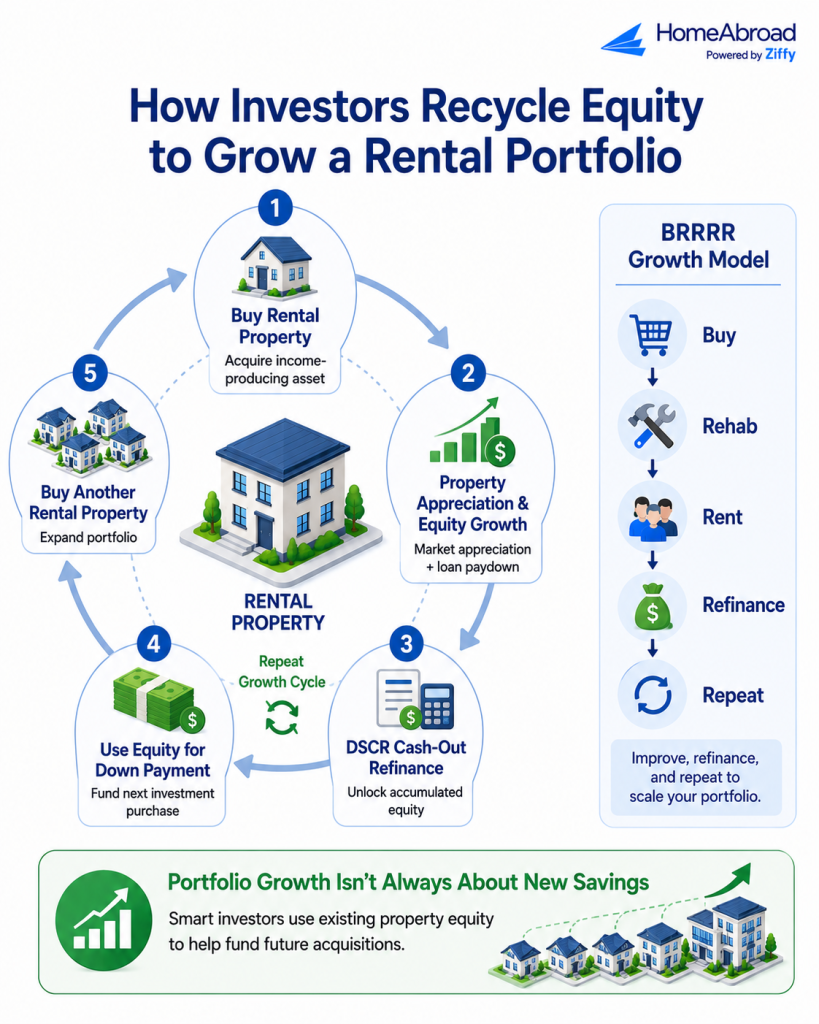
One of the biggest challenges investors face is not qualifying for a rental property loan but finding the capital needed for the next acquisition. While saving for every down payment is one approach, many portfolio investors eventually look for ways to recycle existing equity into new investments.
Two of the most common strategies are DSCR cash-out refinancing and the BRRRR method (Buy, Rehab, Rent, Refinance, Repeat). Both approaches can help investors expand a portfolio without relying solely on new cash contributions, although each comes with different considerations for foreign national investors.
Investors often focus on the equity they can access through a refinance, but the more important question is how the new loan affects cash flow. The goal is to unlock capital without weakening the property’s long-term performance.

How a DSCR Cash-Out Refinance Becomes the Inflection Point for Growth
As a rental property appreciates in value and builds equity, investors may be able to refinance the property and access a portion of that equity through a cash-out refinance. Rather than selling the property, the investor keeps ownership while converting part of the accumulated equity into capital that can potentially be used for future acquisitions.
For foreign national investors, this can be an effective way to fund additional purchases while maintaining ownership of income-producing assets. The rental property continues generating cash flow, and the released equity can help support the down payment and closing costs for another investment property.
The strategy works best when the property has experienced meaningful appreciation, principal reduction, or a combination of both. Investors should carefully evaluate how the new loan terms affect monthly cash flow before proceeding.
BRRRR for Foreign Nationals: What Translates and What’s Harder to Run Remotely
The BRRRR strategy involves purchasing a property, improving it, renting it, refinancing it based on the new value, and then repeating the process with another acquisition.
The underlying concept can work for foreign national investors, particularly in markets where value-add opportunities are available. However, executing renovations from another country introduces challenges that domestic investors may not face. Contractor oversight, project management, permitting, inspections, and property turns often require trusted local partners and strong operational systems.
As a result, many foreign investors adapt the BRRRR model by focusing on light renovations, turnkey properties, or markets where experienced property managers and local teams can provide additional support.
Worked Example: Funding the Next Purchase Through a Cash-Out Refinance
One of our clients purchased a rental property for $300,000 using DSCR financing. The property generates $2,600 per month in market rent and has a PITIA payment of $2,000, producing a DSCR of 1.30.
Several years later, the property’s value increases to $400,000. After building equity through appreciation and principal paydown, the investor completes a DSCR cash-out refinance and accesses approximately $60,000 in equity while continuing to own the property.
Because of the larger loan balance, the property’s PITIA increases to approximately $2,150 per month. Assuming market rent remains at $2,600 per month, the property’s DSCR decreases from 1.30 to 1.21 but still supports the new loan.
The investor then uses a portion of the refinance proceeds toward the down payment and closing costs on a second rental property. Instead of selling the original asset, the investor now owns two income-producing properties, with rental income coming from both properties.
Many investors view a cash-out refinance as more than a rate-and-term transaction. When used strategically, accumulated equity can help fund future acquisitions and accelerate portfolio growth. However, investors should evaluate both the equity being released and the impact of the new loan terms on cash flow and DSCR before proceeding.
Structuring a Growing Portfolio: LLCs and Ownership
As investors acquire additional properties, financing is only one part of the equation. Ownership structure becomes increasingly important because it can affect financing, administration, liability management, and long-term portfolio organization.
There is no single structure that works for every investor. The right approach depends on factors such as the number of properties owned, the states where those properties are located, financing goals, and guidance from qualified legal and tax professionals.

One of the most common mistakes we see is investors waiting until they’re already under contract to think about ownership structure. Entity decisions can affect documentation requirements, closing timelines, and financing options, so it’s usually better to address those questions early in the process.
One LLC vs. Multiple LLCs vs. a Holding-Company Structure
Many foreign national investors purchase US rental properties through a limited liability company (LLC). An LLC can provide operational flexibility and may simplify the ownership of investment property, particularly for investors managing assets from abroad.
As portfolios grow, investors often evaluate whether to place all properties in a single LLC or separate properties into multiple entities. Some investors also explore holding-company structures that own multiple property-level LLCs.
A single LLC can be easier to manage administratively, while multiple LLCs may offer greater separation between assets. Holding-company structures can add another layer of organization for larger portfolios. Each approach involves different legal, tax, and operational considerations, which is why investors should work closely with qualified legal and tax advisors before making structural decisions.
How Entity Choice Affects Financing as You Add Properties
Ownership structure can influence how financing is arranged as a portfolio expands. Entity structure, ownership documentation, operating agreements, and organizational records can all play a role in the financing process as investors acquire additional properties.
As investors acquire additional properties, consistency becomes increasingly important. Using a well-organized ownership structure can simplify underwriting, reduce documentation issues, and make future acquisitions easier to manage. It can also help investors avoid unnecessary administrative work if additional properties, refinances, or financing products are added later.
For foreign national investors, ownership structure is often most effective when viewed as part of a long-term portfolio strategy rather than a decision made on a property-by-property basis
Asset Protection Across Multiple Holdings
As portfolios grow, many investors begin evaluating whether multiple properties should be held under a single entity or separated into different ownership structures. The answer depends on factors such as portfolio size, financing objectives, administrative complexity, and risk-management preferences.
This is one reason some investors choose to hold properties in separate entities rather than placing every asset under a single ownership structure. Others prioritize simplicity and prefer a more consolidated approach.
Because asset-protection strategies involve legal considerations that vary by investor and jurisdiction, ownership decisions should be reviewed with qualified legal and tax professionals before implementation.
Tax and Estate Considerations That Compound as You Scale
Many investors focus on financing and acquisitions when building a portfolio, but tax and estate considerations become increasingly important as additional properties are added. A strategy that works for a single rental property may create unexpected tax, reporting, or estate-planning challenges when applied across a larger portfolio.
The Section 871(d) Election and After-Tax Cash Flow at Portfolio Scale
For many foreign national investors, one of the most important tax elections is the Section 871(d) election. Without this election, rental income is generally taxed on a gross basis, limiting the value of deductions that would otherwise reduce taxable income.
As portfolios grow, the impact becomes more significant. Property taxes, insurance, mortgage interest, repairs, management fees, and other expenses can add up across multiple properties. Electing net-income treatment allows eligible deductions to be considered when calculating taxable rental income, which can improve after-tax cash flow and provide a more accurate picture of portfolio performance.
Investors evaluating long-term portfolio growth should pay close attention to after-tax cash flow rather than focusing solely on gross rental income.
Depreciation Across Multiple Properties
Depreciation is often discussed in the context of a single rental property, but its impact can become much more meaningful as additional assets are added to a portfolio.
Each qualifying rental property may generate annual depreciation deductions that can reduce taxable rental income. Investors with multiple properties may accumulate significantly larger depreciation deductions than those holding a single asset. Depending on the investor’s tax situation, strategies such as cost segregation may further accelerate deductions on certain properties.
However, larger depreciation deductions do not automatically translate into immediate tax savings. The ability to use those deductions depends on factors such as income sources, passive activity rules, and overall tax structure. Investors should evaluate depreciation as part of a broader portfolio strategy rather than viewing it as a standalone benefit.
FIRPTA Withholding and 1031 Exchanges When You Sell or Trade Up
As portfolios grow, so does the likelihood that investors will eventually sell, refinance, or exchange properties.
Foreign investors should understand that FIRPTA (Foreign Investment in Real Property Tax Act) withholding may apply when US real estate is sold. Depending on the circumstances, withholding rates can vary, and current FIRPTA rules may involve 0%, 10%, or 15% withholding thresholds rather than a single flat rate. Because the rules depend on property use, transaction value, and other factors, investors should review the specific requirements that apply to their transaction.
Some investors may also explore a 1031 exchange when transitioning from one investment property to another. When properly structured, a 1031 exchange can allow taxes associated with a sale to be deferred by reinvesting into another qualifying investment property. For investors actively upgrading or repositioning a portfolio, understanding these rules can become increasingly important.
US Estate-Tax Exposure for Non-Resident Aliens Holding Multiple Assets
Estate planning is often overlooked when investors purchase their first rental property. However, as portfolios expand, estate-tax exposure can become a more significant consideration.
Unlike US citizens and residents, non-resident aliens may be subject to a substantially lower US estate-tax exemption. In many cases, the exemption available to non-resident aliens is only $60,000 of US-situs assets, although treaty provisions and individual circumstances may affect the outcome.
The appropriate response varies widely based on an investor’s country of residence, ownership structure, family situation, tax treaties, and long-term goals. Because estate planning is highly individualized, investors should consult qualified estate-planning and tax professionals before making ownership or structuring decisions based on general information alone.
Operating a Multi-Property Portfolio From Abroad
Building a portfolio from abroad requires more than acquiring properties. Investors also need systems for managing liquidity, documentation, property operations, and cross-border transactions.
As the number of properties increases, investors must think beyond financing and acquisitions. Cash reserves, documentation requirements, property management systems, and international fund transfers all become more important as portfolio complexity grows. Establishing processes early can help investors manage multiple properties more efficiently while reducing operational risk.
Steven Glick
Director of Mortgage Sales · HomeAbroad
By the third or fourth property, the biggest delays are often not related to financing itself. More commonly, they’re tied to updated documentation, reserve verification, and making sure funds can move in time for closing.
Reserves and Liquidity at Scale
Liquidity becomes increasingly important as a portfolio grows. While a single vacancy or unexpected repair may have a limited impact on one property, the financial demands of multiple properties can add up quickly.
Many investors maintain reserve levels that meet or exceed requirements, often targeting several months of PITIA (principal, interest, taxes, insurance, and association dues, where applicable) for each financed property. Strong liquidity can help absorb vacancies, repairs, and unexpected expenses while preserving flexibility for future acquisitions.
Maintaining healthy reserves can also put investors in a stronger position when attractive investment opportunities arise, reducing the need for last-minute capital transfers or financing adjustments.
Source-of-Funds and AML Documentation When Buying Repeatedly
As investors acquire additional properties, documentation requirements often become more detailed. Title companies, financial institutions, and compliance reviews may require information regarding the origin of funds used for down payments, reserves, and closing costs.
For foreign national investors, this process commonly involves source-of-funds verification and anti-money laundering (AML) reviews. Documentation may include bank statements, business records, investment account statements, property-sale proceeds, or other evidence showing how funds were accumulated and transferred.
Maintaining organized financial records can make future acquisitions significantly easier. Investors who plan ahead for documentation requirements often experience fewer delays during underwriting and closing.
Remote Property Management and Systems
Managing multiple properties from another country generally requires a more systematic approach than managing a single rental.
Many foreign investors rely on professional property managers to coordinate leasing, rent collection, maintenance requests, inspections, and tenant communication. As portfolios expand, investors may also adopt software platforms that provide centralized reporting, accounting, document storage, and performance tracking across multiple properties.
The goal is to create repeatable systems rather than managing each property independently. Consistent processes can help reduce administrative burden while improving visibility into portfolio performance.
Currency Conversion and Wire Logistics Across Multiple Closings
International investors frequently move capital between countries, currencies, and financial institutions. As transaction volume increases, exchange-rate fluctuations, transfer fees, banking timelines, and wire procedures can have a greater impact on overall portfolio costs.
Investors planning multiple acquisitions often benefit from establishing clear processes for transferring funds, coordinating with title companies and other transaction partners, and maintaining sufficient time for international wires to clear before closing deadlines.
While currency movements are difficult to predict, understanding the operational side of cross-border transactions can help reduce delays and improve execution when multiple purchases, refinances, or capital transfers occur over time.
Common Mistakes Foreign Investors Make When Scaling
Growing from one rental property to multiple properties introduces challenges that many investors do not encounter during their first acquisition. In many cases, the obstacles are not related to finding investment opportunities but to managing liquidity, documentation, and portfolio-level decision-making as the number of properties increases.
One situation we occasionally see is investors assuming that the process for their fourth or fifth property will be identical to the process for their first. As portfolios grow, reserve requirements, documentation requests, and financing considerations often become more complex. Planning for those changes early can help avoid delays and missed opportunities.
Over-Concentrating in a Single Market
Many investors start in one market because it is familiar and continue buying there as their portfolio grows. While market familiarity has advantages, concentrating too heavily in a single city or region can increase exposure to local economic conditions, regulatory changes, natural disasters, or shifts in rental demand.
As portfolios expand, investors often evaluate opportunities across multiple markets to create greater diversification and reduce concentration risk.
Ignoring How Reserve Requirements Scale
Reserve requirements can look manageable when purchasing a first rental property. However, those requirements often increase as additional properties are acquired.
An investor with multiple financed properties may need to maintain significantly more liquidity than they initially expected. Focusing exclusively on down-payment funds while overlooking reserve requirements can slow future acquisitions or create unnecessary financial pressure after closing.
Waiting Too Long to Think About Ownership Structure
Many investors purchase their first property personally and only begin evaluating LLCs or broader ownership structures after several acquisitions.
While there is no universal approach that fits every investor, ownership structure decisions often become more complicated once multiple properties have already been acquired. Evaluating entity structure early can help investors make more informed decisions as the portfolio grows.
Under-Documenting Source of Funds
Source-of-funds documentation becomes increasingly important as transaction volume grows. Investors who maintain clear records of savings, investment proceeds, business income, property sales, and international transfers often move through underwriting more smoothly than those who must reconstruct documentation at the last minute.
Keeping organized records can save considerable time when purchasing multiple properties over several years.
Modeling Cash-Out Refinance Proceeds Too Optimistically
Many investors assume that future appreciation or refinancing proceeds will fully fund their next acquisition. In reality, refinance eligibility, property values, interest rates, reserve requirements, and loan terms can change over time.
A cash-out refinance can be an effective portfolio-growth tool, but investors should avoid building acquisition plans around the most optimistic assumptions. Maintaining flexibility and additional liquidity can help reduce the risk of delays if refinance proceeds are lower than expected or become available later than anticipated.
Most portfolio-growth challenges do not appear on the first purchase. They emerge as investors move from one property to several and begin managing larger amounts of capital, documentation, and financing activity. Recognizing these issues early can help investors avoid unnecessary delays and create a smoother path to future acquisitions.
How HomeAbroad Helps Foreign Nationals Scale a US Portfolio
Building a portfolio of US rental properties involves more than finding investment opportunities. As portfolios grow, investors often spend less time searching for properties and more time managing financing, liquidity, documentation, and long-term portfolio strategy.
HomeAbroad specializes in helping foreign nationals purchase and finance US investment properties. To date, we have helped more than 500 investors from over 40 countries invest in US real estate, giving our team firsthand experience with the challenges international investors commonly face as they move from a single property to a larger portfolio.
For example, one of our clients from Turkey used approximately $220,000 in documented assets to acquire four long-term rental properties in Fort Worth and Arlington, Texas over an eight-month period. Rather than deploying all available capital into a single property, the investor used financing, liquidity planning, and disciplined capital allocation to build a multi-property portfolio while maintaining meaningful equity in each acquisition.
Experiences like these shape how we work with foreign national investors. HomeAbroad combines specialized financing solutions with an AI-powered investment property search platform that helps investors identify rental opportunities across US markets. Investors can explore properties, analyze potential returns, evaluate rental income projections, and access financing options from a single platform.
Whether you’re purchasing your first rental property or adding another asset to an existing portfolio, HomeAbroad can help with property discovery, mortgage qualification, LLC formation, and long-term portfolio growth strategies.
If you’re planning to build a portfolio of US rental properties, connect with HomeAbroad today to explore financing options, identify investment opportunities, and create a strategy for your next acquisition.
Frequently Asked Questions
How many rental properties do I need to make $5,000 a month?
There is no fixed number because the answer depends on each property’s cash flow. An investor earning $1,000 per month in net cash flow from each rental property may need approximately five properties to reach a $5,000 monthly income goal. However, investors with higher-cash-flow properties may achieve the same target with fewer assets. The focus should be on total portfolio cash flow rather than the number of properties owned.
Can a foreign national own multiple rental properties in the US?
Yes. Foreign nationals can own multiple US rental properties directly or through an ownership entity such as an LLC. There is no legal limit on the number of investment properties a foreign national can own. The primary considerations are financing, reserves, documentation requirements, tax planning, and ongoing portfolio management.
How many DSCR loans can I have at the same time?
There is no universal limit that applies to every lender or loan program. Many foreign national investors hold multiple DSCR loans simultaneously as they expand their portfolios. Approval is typically based on factors such as property cash flow, available reserves, equity position, and overall portfolio strength rather than a fixed loan count.
Do I need a separate US LLC for each property?
Not necessarily. Some investors hold multiple properties in a single LLC, while others use separate LLCs for individual properties or adopt a holding-company structure as their portfolio grows. The most appropriate approach depends on financing objectives, portfolio size, administrative preferences, and legal considerations. Investors should consult qualified legal and tax professionals before selecting an ownership structure.
Does the 1% rule apply to foreign buyers?
Yes. The 1% rule is a property-analysis guideline rather than a financing rule, so it can be used by both domestic and foreign investors. The rule suggests that a property’s monthly rent should equal approximately 1% of its purchase price. However, many investors use more detailed metrics such as cash flow, cap rate, and DSCR when evaluating opportunities because the 1% rule does not account for financing costs, taxes, insurance, or operating expenses.