


Editorial Integrity
Making informed real estate decisions starts with having the right knowledge. At HomeAbroad, we offer US mortgage products for foreign nationals & investors and have a network of 500+ expert HomeAbroad real estate agents to provide the expertise you need. Our content is written by licensed mortgage experts and seasoned real estate agents who share insights from their experience, helping thousands like you. Our strict editorial process ensures you receive reliable and accurate information.
Quick answer:
A mortgage rate buydown lets you pay money upfront to lower your interest rate. A permanent buydown lowers it for the life of the loan. A temporary buydown lowers it for the first one to three years, then the rate steps back up. For investors, a lower rate means a lower monthly payment and, with a permanent buydown, a stronger DSCR.
A permanent mortgage rate buydown lowers your interest rate for the life of the loan, while a temporary buydown reduces payments only during the first one to three years.
For DSCR loans, a permanent buydown can improve the qualifying DSCR by reducing the property’s monthly PITIA payment, while a temporary buydown generally does not improve the qualifying DSCR because underwriting typically uses the note rate.
The value of a buydown depends on your expected holding period. Compare the upfront cost with your monthly savings to determine your breakeven point.
Foreign national investors should evaluate buydown options alongside their financing strategy, cash flow goals, and DSCR requirements before choosing the most cost-effective approach.
Table of Contents
Higher interest rates have changed the math on US rental property. When your monthly payment goes up, so does the debt your rental income has to cover, and that can be the difference between a deal that qualifies and one that stalls.
A mortgage rate buydown is one way investors respond. You pay money upfront to lower your interest rate, either for the full loan term or for just the first few years. At HomeAbroad, we price buydown options on our investor loan programs, including DSCR loans built for international buyers.
This guide covers how buydowns work, the difference between permanent and temporary buydowns, how each one affects DSCR qualification, what they cost, and how to decide which fits your plan.
What Is a Mortgage Rate Buydown?
A mortgage rate buydown is a payment made at closing to reduce the interest rate on a loan. In exchange for that upfront cost, you get a lower rate and a lower monthly payment. The reduction can last for the full term of the loan or for a set early period, depending on the type of buydown you choose.
The number you see advertised is not always the rate you finance at. A quoted rate often assumes a buydown is already baked in, so it pays to ask what the rate looks like with and without points.
How a buydown lowers your payment
The mechanics are simple. A lower rate means less interest each month, which lowers your principal and interest payment. That in turn lowers your PITIA, the combined figure for principal, interest, taxes, insurance, and any HOA dues.
For most homebuyers, a lower payment is about comfort and budget. For investors who qualify on property cash flow, it is also a qualification input, which is where buydowns get more interesting.
Who pays for the buydown
A buydown can be funded by:
- The borrower, who pays the cost at closing to secure a lower rate
- The seller, often through a negotiated credit, which is common on investment purchases
- The builder, on new construction, as a sales incentive
- A lender credit in some cases, though this usually works in the opposite direction
Who pays matters because a seller-funded or builder-funded buydown can lower your cost without spending your own cash.
Key term: discount point. One discount point equals 1% of your loan amount, paid at closing, and is used to permanently lower your rate. A point does not buy a fixed rate reduction. According to the Consumer Financial Protection Bureau, one point on a $400,000 loan might lower the rate by 0.25% with one lender, while another lender prices the same point differently. Always compare the actual quote.
Permanent vs. Temporary Buydowns: The Core Difference
Every buydown falls into one of two camps. A permanent buydown lowers your rate for the entire loan term. A temporary buydown lowers it for the first year or two, then the rate returns to the full note rate. The distinction drives everything else, including cost, qualification, and who it suits.
Permanent buydowns (discount points)
A permanent buydown uses discount points to lower the rate for the life of the loan. You pay for the points at closing, and the lower rate stays with you until you sell or refinance.
Because the reduction is permanent, it lowers the rate that underwriting uses to qualify your loan. That is the feature investors care about most, and we come back to it in the DSCR section below.
Permanent buydowns tend to fit investors who plan to hold the property and keep the loan for the long run. If you expect to keep a long-term rental for years, the monthly savings have time to add up.
Temporary buydowns (2-1, 3-2-1, 1-0)
A temporary buydown reduces your rate for a short introductory period, then the rate resets to the note rate. The subsidy is paid upfront, often by a seller or builder, to cover the gap between the reduced payment and the full payment.
Common structures include:
- 2-1 buydown: the rate is 2% lower in year one and 1% lower in year two, then reaches the full note rate in year three
- 3-2-1 buydown: 3% lower in year one, 2% in year two, and 1% in year three, then the full note rate afterward
- 1-0 or 1-1 buydown: smaller or shorter reductions
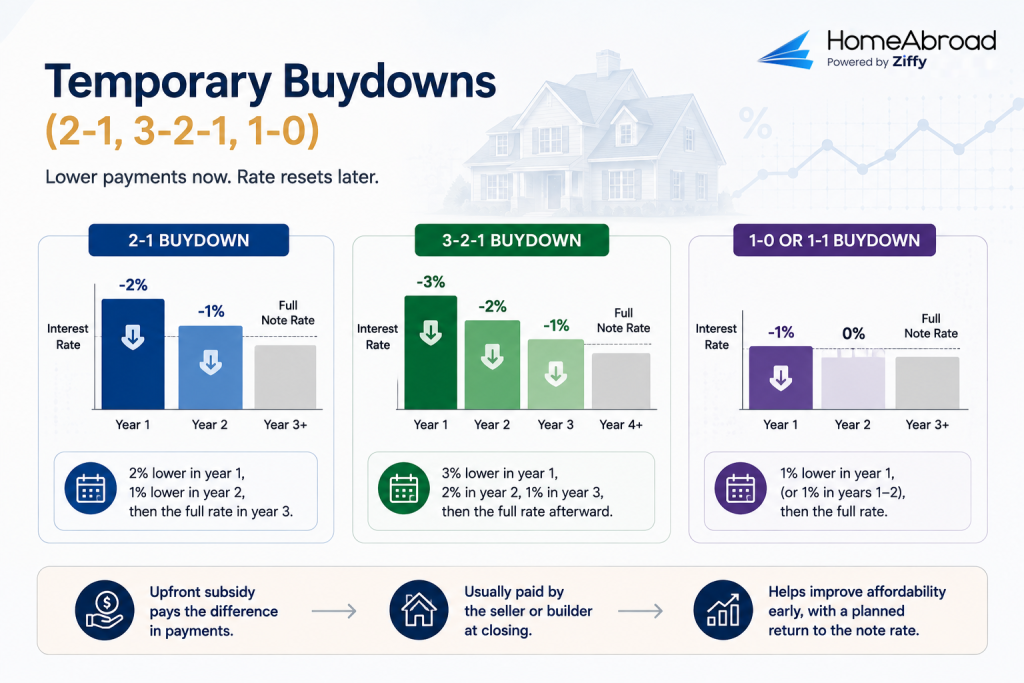
The key thing to understand is the reset. A temporary buydown does not change your actual loan rate. It only softens the payment early on. From the reset year forward, you owe the full note-rate payment, so budget for that number, not the year-one number.
Here is how a 2-1 buydown looks on an illustrative $300,000 loan with a 7.5% note rate. These are example figures for explanation, not a quote.
Year | Rate applied | Approx. monthly P&I |
|---|---|---|
Year 1 | 5.5% | $1,703 |
Year 2 | 6.5% | $1,896 |
Year 3 and after | 7.5% | $2,098 |
Permanent vs. Temporary Buydown Comparison
Feature | Permanent buydown | Temporary buydown |
|---|---|---|
How long does the lower rate last | Full loan term | First 1 to 3 years |
Who usually pays | Often the borrower | Often the seller or builder |
Effect on the qualifying rate | Lowers it | Usually no effect (see below) |
Best fit | Long holds, DSCR qualification help | Early cash flow, planned refinance |
Main risk | Paying for a rate you may refinance away | Payment shock at the reset |
How Buydowns Affect DSCR Loan Qualification for Investors
This is where buydowns become an investor tool rather than just a payment tweak. A DSCR loan qualifies on the property’s rental income, not your personal income. The ratio is straightforward:
DSCR = qualifying monthly rent ÷ monthly PITIA
Lower the rate, lower the PITIA, and the ratio goes up. A stronger DSCR can push a deal above a lender’s minimum or into better pricing.
Permanent buydowns and DSCR
A permanent buydown lowers the note rate itself, so it lowers the PITIA that underwriting uses. For a property sitting just under the DSCR line, buying down the rate can be the lever that lifts the ratio over it.
Here is an illustrative example. The rent is fixed and the only thing that changes is the rate.
Before buydown | After permanent buydown | |
|---|---|---|
Qualifying rent | $3,000 | $3,000 |
Monthly PITIA | $3,150 | $2,970 |
DSCR | 0.95 | 1.01 |
In this example, a lower rate moves the DSCR from below 1.0 to above it. Whether that changes your approval depends on the program and the rest of the file, but the direction is real: a permanent buydown improves the ratio underwriting sees.
If your property still lands below 1.0 even after a buydown, that is not the end of the road. HomeAbroad also offers a No-Ratio DSCR loan that evaluates equity, reserves, and property strength for deals with a DSCR under 1.0.

Steven Glick
Director of Mortgage Sales · HomeAbroad
A permanent buydown can improve DSCR because it lowers the qualifying payment. A temporary buydown may reduce your payment initially, but it generally doesn’t change the note rate used for underwriting. We always recommend evaluating the upfront cost against your expected holding period.
Do temporary buydowns help DSCR qualification?
Usually not. As a general rule across DSCR lending, the loan is qualified at the note rate, not the temporarily reduced rate. That means a temporary buydown can improve your early cash flow without improving the DSCR that underwriting calculates.
Program specifics vary, so confirm how a temporary buydown affects your qualifying DSCR with a HomeAbroad loan officer before you count on it. If your goal is to qualify a thin deal, a permanent buydown is normally the tool that moves the ratio.
Cash flow and qualification are two different goals
It helps to separate what you are trying to do:
- Qualify a thin deal. A permanent buydown lowers the qualifying PITIA and can raise the DSCR.
- Ease early cash flow on a deal that already qualifies. A temporary buydown, or an interest-only option, can lower the payment in the early years while you stabilize the property.
Match the tool to the goal, and the decision gets a lot clearer.
What a Buydown Costs and When It Pays Off
A buydown trades an upfront cost for monthly savings, so the real question is how long you have to keep the loan for those savings to add up to more than you paid. That is the breakeven point.
The breakeven calculation
You can work it out in four steps:
- Find the upfront buydown cost.
- Find the monthly payment savings at the lower rate.
- Divide the cost by the monthly savings to get the number of months to break even.
- Compare that to how long you realistically expect to keep the loan.
Here is an illustrative example on a $300,000 loan:
- Upfront cost: 2 points, or $6,000
- Monthly savings from the lower rate: about $180
- Breakeven: $6,000 ÷ $180 ≈ 33 months, or about 2.8 years
If you plan to hold the loan for ten years, the buydown pays for itself and then keeps saving you money. If you expect to refinance in two years, you would sell or refinance before reaching breakeven, and the cost would be largely wasted.
When a permanent buydown makes sense
- You plan a long hold with no near-term refinance
- The deal needs the DSCR lift to qualify or to price better
- The point cost pays back within your expected hold period
When a temporary buydown makes sense
- A seller or builder credit is paying for it
- Early cash flow matters while you lease up or stabilize the property
- You genuinely expect to refinance before the reset
The common advice to “keep the property and refinance the rate later” only works if rates actually fall and you can qualify to refinance. Treat that as a possibility, not a plan you can bank on.
A note on taxes for investors
The tax treatment of points on an investment property differs from a primary residence. Points paid on a rental property are generally not deducted all at once in the year you pay them. Instead they are usually spread out over the life of the loan.
This is general information, not tax advice. Rules depend on your situation, so talk to a tax professional and review IRS Publication 527 (Residential Rental Property) before you assume a deduction.
Buydowns for Foreign National and Expat Investors
If you are investing from outside the US, a buydown works the same way it does for any investor, and it can matter even more. Foreign national and US-newcomer investors usually finance rentals with DSCR loans because these programs qualify on the property’s income rather than US credit history or US tax returns. See how that compares in our guide on DSCR loans versus conventional mortgages for foreign nationals.
Why the rate carries more weight when you qualify on rent
When personal income is not part of the qualification, PITIA becomes the main lever on both approval and pricing. A rate reduction that lowers PITIA can therefore do more work for a cross-border investor than for a conventionally qualified buyer.
How HomeAbroad structures investor financing
HomeAbroad specializes in foreign national mortgage programs and has closed DSCR loans for investors from more than 40 countries. We qualify the loan on the property’s rental income, support ownership through a US LLC, and price buydown options where they fit your file and your hold plan. You can see this approach in action in a recent foreign national DSCR case study.
Find the Right Buydown Strategy With HomeAbroad
A mortgage rate buydown can improve cash flow, strengthen DSCR, or both, depending on the option you choose. The right approach depends on your investment goals, expected holding period, and current loan pricing.
At HomeAbroad, we help foreign national investors compare permanent and temporary buydown options, estimate their impact on monthly payments and DSCR, and determine whether the upfront cost makes financial sense for the property.
Speak with a HomeAbroad loan specialist to explore your mortgage rate buydown options and see how they could affect your investment financing.
Frequently Asked Questions
Is a mortgage rate buydown worth it for investors?
It depends on your hold period. If you keep the loan long enough to pass the breakeven point, a permanent buydown saves money over time. If you plan to sell or refinance before breakeven, the upfront cost may not pay off. Run the math on your specific numbers first.
What is the difference between a temporary and permanent buydown?
A permanent buydown lowers your rate for the full loan term, usually through discount points. A temporary buydown lowers your rate only for the first one to three years, after which it resets to the full note rate. Permanent lowers your true rate; temporary just softens the early payments.
Can you buy down the rate on a DSCR loan?
Yes. Buydown options are available on DSCR loans, and HomeAbroad can price both permanent and temporary buydowns on its investor programs. The right choice depends on your goals, your hold period, and current pricing on your specific property.
Do buydown points help you qualify for a DSCR loan?
A permanent buydown can. Because it lowers the note rate, it lowers the PITIA used to calculate DSCR, which can raise your ratio. A temporary buydown usually does not help qualification, since DSCR loans are generally underwritten at the note rate. Confirm the specifics with your loan officer.
How much does it cost to buy down a mortgage rate?
Cost is tied to your loan amount and current pricing. One discount point equals 1% of the loan amount, and the rate reduction per point varies by lender and market. Because pricing changes with rates, ask HomeAbroad for a current quote rather than relying on a rule of thumb.